
Comparing Four Lichen Species
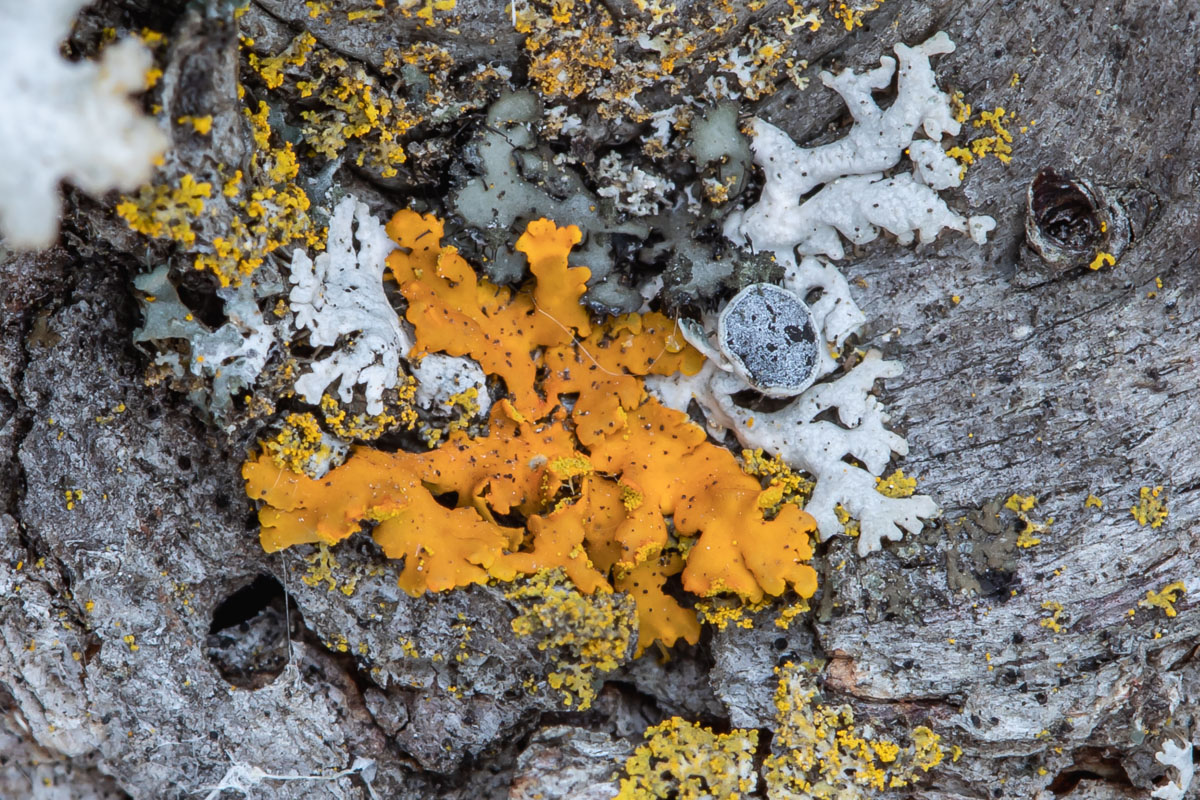 Four Lichens
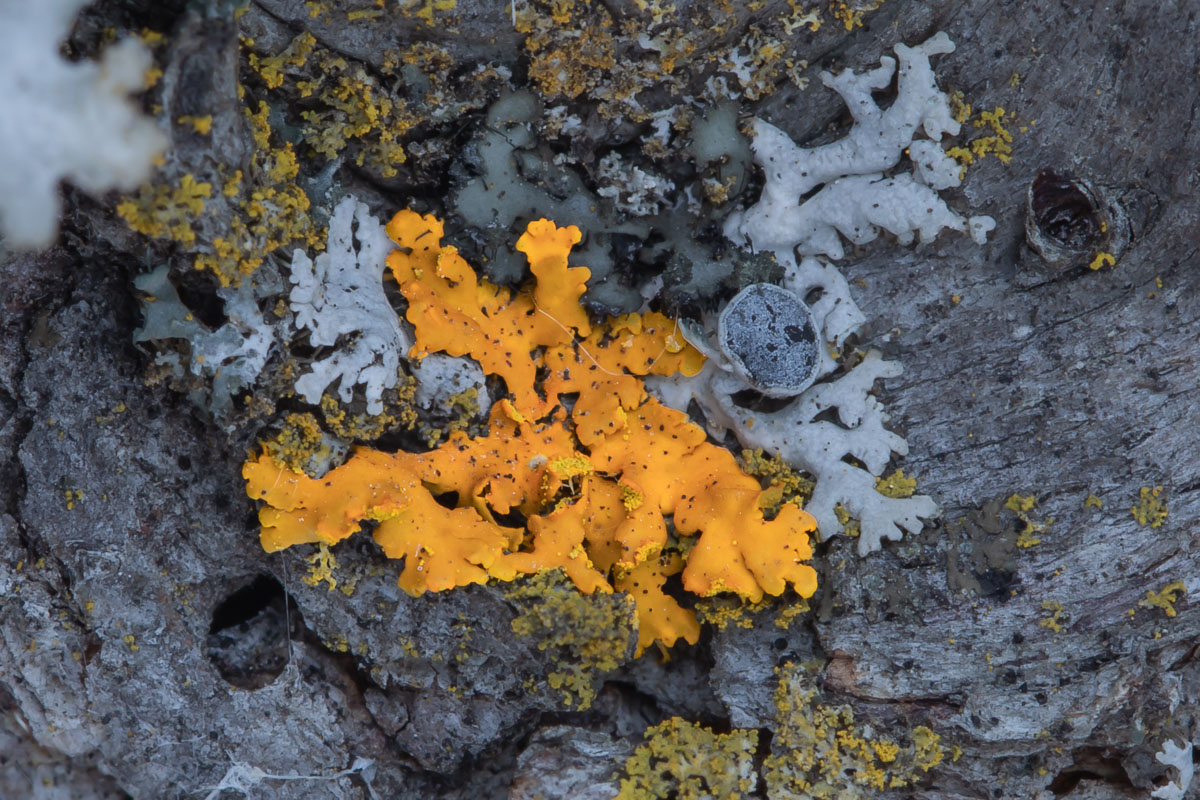 E21A8057-1 Bare-bottomed-Sunburst (Xanthomendoza fulva)
- Thallus: dark red-orange to medium orange;
- Lobes: rounded or finely divided, 0.2-0.6 mm wide, flat to somewhat convex, ascending to erect (especially in the northwest) or mostly horizontal (especially in the southeast), with mealy soredia on the edge of the lower surface, not forming hoods;
- Lower surface: white, with few rhizines or holdfasts.
- Apothecia: rarely seen;
- pycnidia: common, resembling dark orange pimples;
- Conidia: baciliform, 3-4.5 um long.
HABITAT: Mostly on bark, sometimes on wood, and rarely on rock.
COMMENTS:
- Among the sorediate species of Xanthoria, X. fulva, X. ulophyllodes, and X. oregana are most similar to X. fallax.
- Xanthoria fulva has narrower, more ascending lobes and lacks rhizines, and the grandular soredia are mainly on the lower surface.
-Xanthoria fulva and X. oregana have soredia on the lower surface of the lobes, and the pycnidia are more prominent.
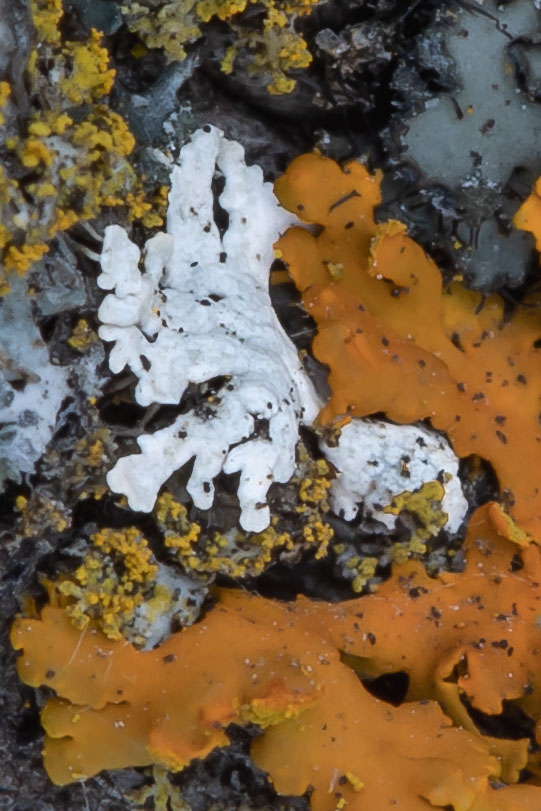 E21A8057B-1 Powdery Shield (Physcia millegrana)
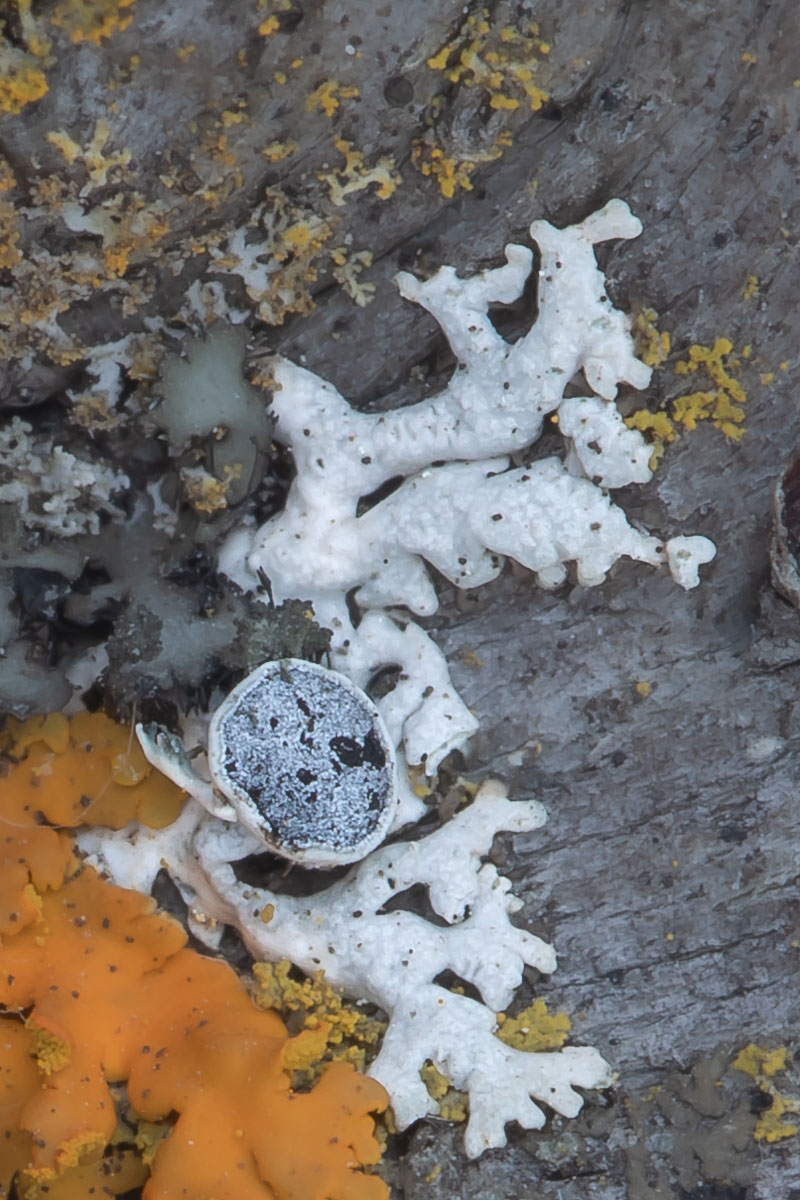 E21A8057A-1 Powdery Shield with Apothecia (Physcia millegrana)
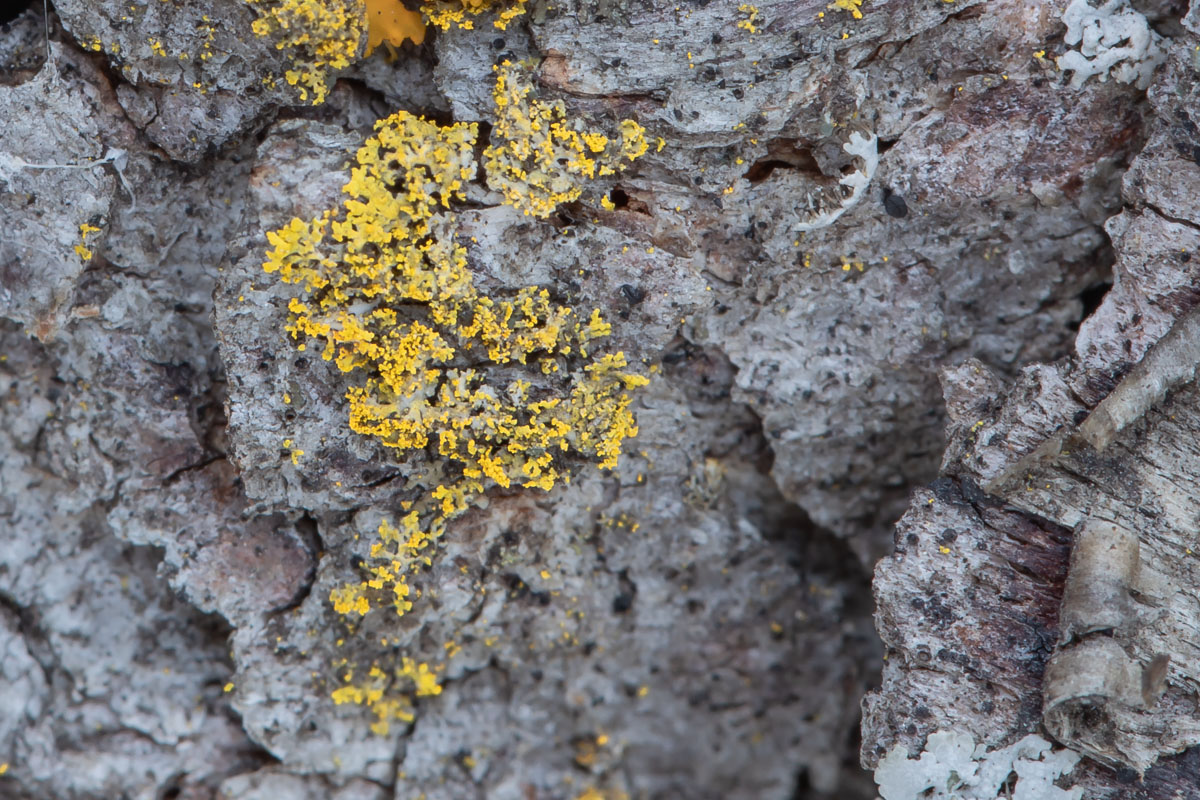 E21A8057C-1 Candleflame (Candelaria concolor)
- Thallus: small foliose, up to 1 cm wide or coalescing to form extensive colonies, tightly adnate to adnate, lobate
- Lobes: dorsiventral to subterete, loosely imbricate, narrow, 0.1-0.5 (-1.2) mm wide
- Upper Surface: lemon yellow to mustard yellow, paling to yellow green in shade, smooth to somewhat coarse,
- Soredia: sorediate, granular, blastidious, marginal to submarginal or at lobe tips
- Upper Cortex: c. 10-30 µm thick
- Medulla: white, very thin lower cortex: c. 20 µm thick
- Lower Surface: white to pinkish, somewhat shiny;
- Rhizines: simple, white
- Apothecia: rare, laminal or appearing terminal, sessile, up to c. 1 mm diam.;
- Margin: smooth but often sorediate or lobulate;
- Disc: darker yellow than the thallus;
- Epithecium: c. 5-10 µm thick;
- Hymenium: c. 60-90 µm tall; paraphyses: simple, cylindrical to submoniliform with up to 5 µm wide tips;
- Hypothecium: c. 50 µm thick asci: clavate, >30-spored ascospores: uni- or biguttulate, colorless, 7-10 x 4-6 µm
- Pycnidia: common, appearing as raised warts on the thallus surface, concolorous with upper surface or darker
- Conidia: ellipsoid to narrowly ellipsoid, 2-3 x 1,5 µm
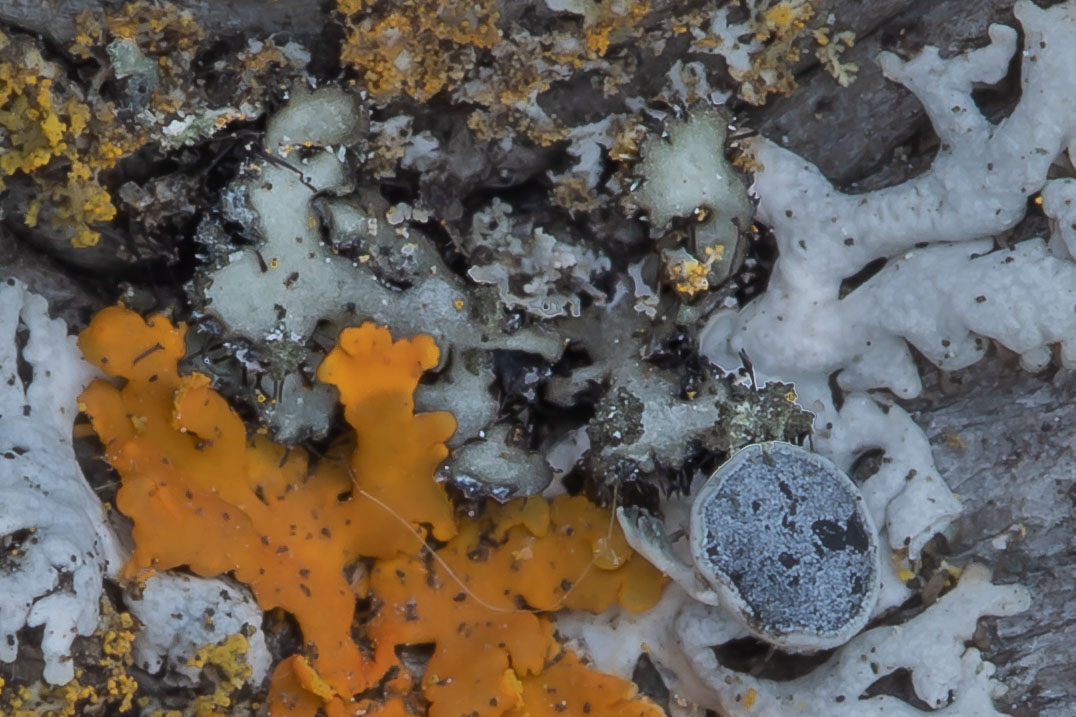 E21A8057D-1 Mealy Shadow (Phaeophyscia orbicularis)
- Thallus: foliose, up to 4 cm in diam.
- Lobes: irregular to more often orbicular, elongate and discrete to somewhat irregularly rounded and partly imbricate, 0.5-1(-1.5) mm
- Upper Surface: broad, usually +flat, prostrate pale gray to dark gray or pale brown, epruinose and without distinctive epinecral layer
- Soredia: sorediate, powdery to finely granular, only rarely granular and pseudocorticate, in primarily laminal or submarginal soralia which are round to irregular
- Upper Cortex: paraplectenchymatous
- Medulla: white
- Lower Cortex: paraplectenchymatous
- Lower Surface: black, sometimes paler at the lobe ends, dull or rather shiny
- Rhizines: simple
- Apothecia: black, infrequent, up to 1.5 mm in diam., sessile
- Margin: entire or grossly crenate, usually with a corona of rhizines
- Ascospores: narrowly ellipsoid, 19-25(-28) x 7.5-11 µm, Physcia-type
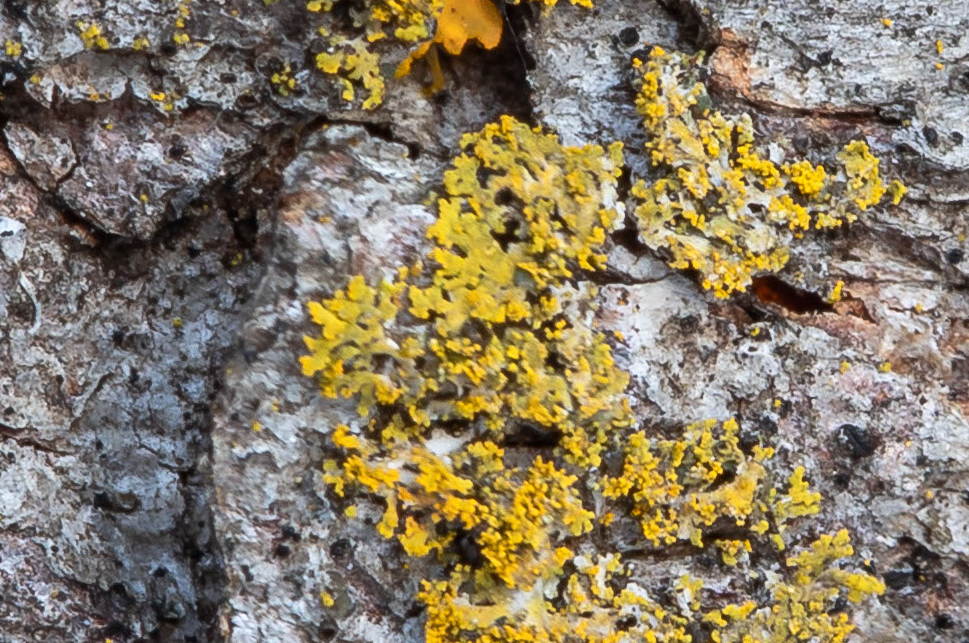 E21A8274-8280 Stack Full Focus
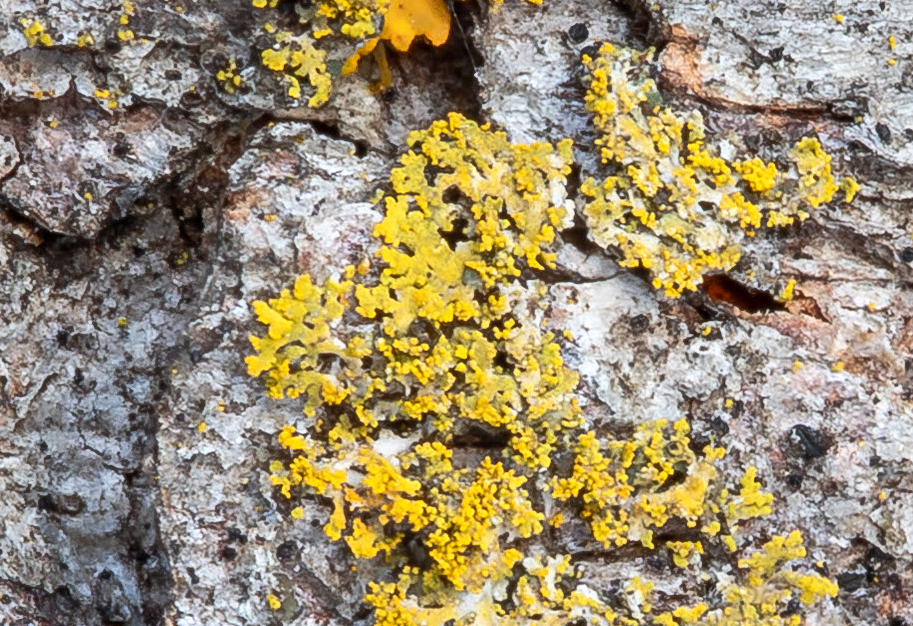 E21A8281-8289 Stack 0.3M - 0.5M Focus