Macros
At close range, the familiar dissolves into pattern and structure. Macro photography reveals the overlooked — droplets, spores, textures, and the quiet geometry of living surfaces — where scale shifts perception, and small details become landscapes of their own. Whether examining spring buds, insects, lichens, or droplets after a rain, these close views bring forward details that often go unnoticed by the naked eye.
Water & Surfaces
Rain Held Close reveals the quiet geometry of water gathering on a fallen oak leaf in the moments after a storm. At this scale, raindrops become glassy hemispheres, each holding a miniature reflection of the surrounding grasses and autumn colors. The leaf’s surface, textured and weathered, turns into a landscape of its own—where droplets cling, merge, and create fleeting patterns that shift with the slightest breeze.
Rain Held Close
A quiet world distilled into droplets.
Camera: Canon EOS 5D Mk IV
Lens: EF100mm f/2.8L Macro IS USM
Settings: ISO 200 • Aperture f/8 • Shutter 1/125 s
E21A0028 • Size: 1558 x 1039
Water changes the way we see the natural world. After a rain or on a cool morning, familiar leaves, flowers, and branches become landscapes of reflection, texture, and light. At macro scale, every droplet acts as a tiny lens, revealing details that exist for only a brief moment before the sun and wind return the scene to normal.
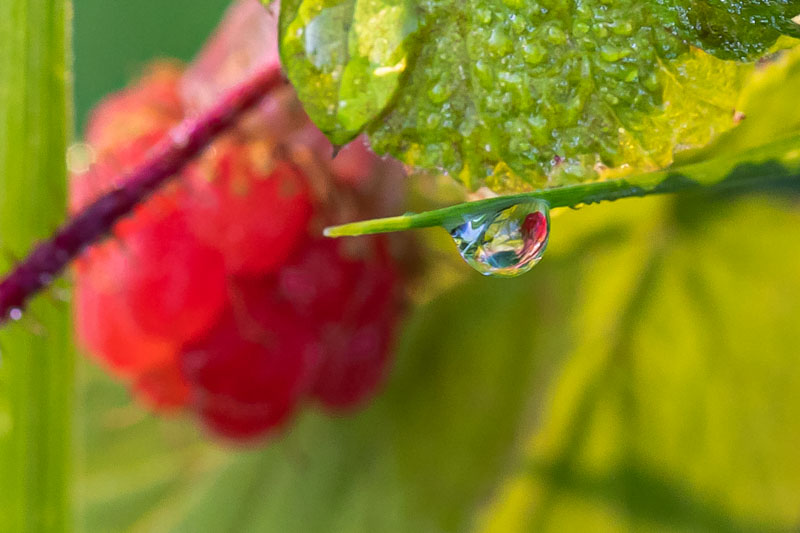
A single drop of morning dew hangs from a blade of grass beneath a raspberry leaf, acting as a tiny natural lens. Within its curved surface, the raspberry above appears inverted and compressed into a miniature world of brilliant reds and greens. The surrounding leaf still glistens with dew, while the softly blurred fruit beyond the droplet reveals the source of the reflection. Lasting only until the morning sun warms the plants, the scene is a reminder that some of nature's most remarkable details are measured in millimeters.
A Raspberry in the Dew
A single drop of morning dew holds a tiny reflection of the fruit above.
Camera: Canon EOS 5D Mark IV
Lens: EF100mm f/2.8L Macro IS USM
Settings: ISO 400 • Aperture f/8.0 • Shutter 1/40 s
E22A6236 • Size: 1400 × 933
Dewline on Raspberry Leaf
A ridge of morning light held in droplets.
Camera: Canon EOS 5D Mark IV
Lens: EF100mm f/2.8L Macro IS USM
Settings: ISO 200 • Aperture f/2.8 • Shutter 1/400 s
D79A5273 • Size: 1156 x 771
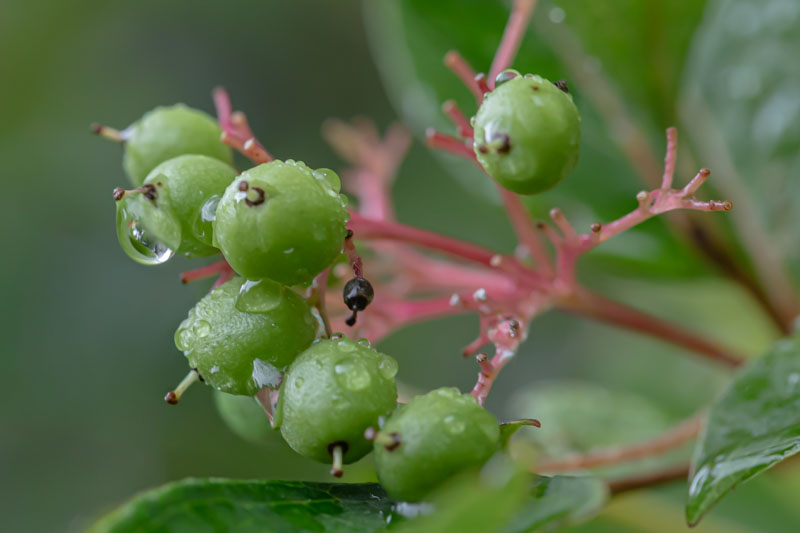
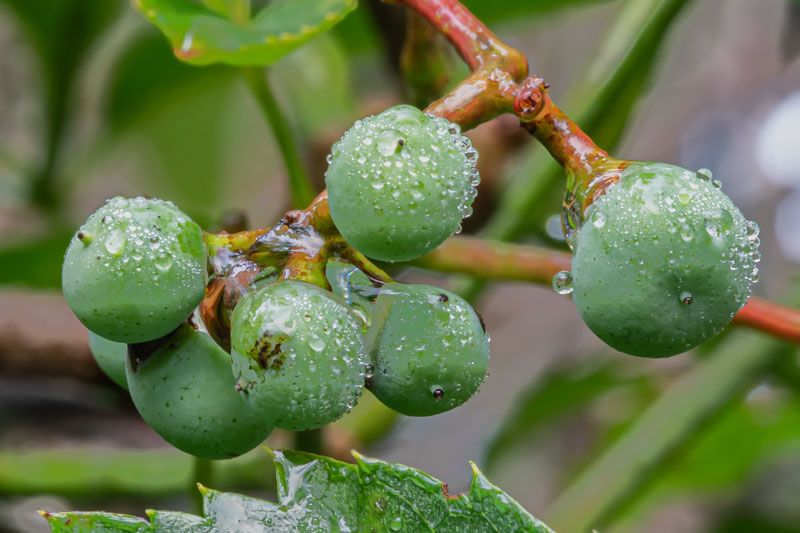
Tiny beads of dew trace the raised veins of a raspberry leaf, each droplet clinging to the fine hairs that run along its surface. At this scale, the leaf becomes a landscape of soft ridges and valleys—textures normally invisible, now glowing with refracted light. The shallow depth of field hints at how fleeting this moment is, and how a future focus stack could reveal even more of the leaf’s hidden geometry.
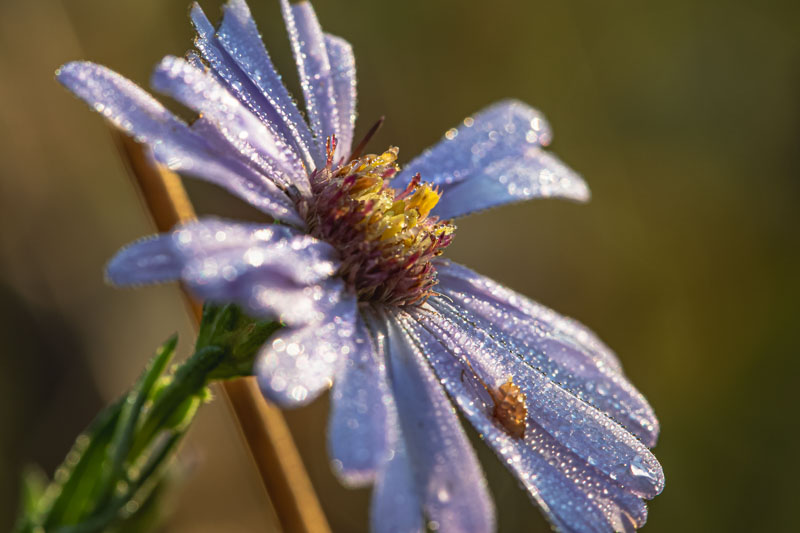
Morning Jewels
Dew catches the first light along the petals of a Smooth Blue Aster.
Camera: Canon EOS 5D Mark IV
Lens: EF100mm f/2.8L Macro IS USM
Settings: ISO 200 • Aperture f/9.0 • Shutter 1/60 s
D79A5419 • Size: 5500 x 3667
A cool autumn morning leaves the petals of a Smooth Blue Aster edged with countless droplets of dew. Backlit by the rising sun, each bead becomes a tiny point of light, tracing the flower's shape and revealing textures that disappear as the day warms. For a brief time, the familiar blossom is transformed into a constellation of sparkling detail.
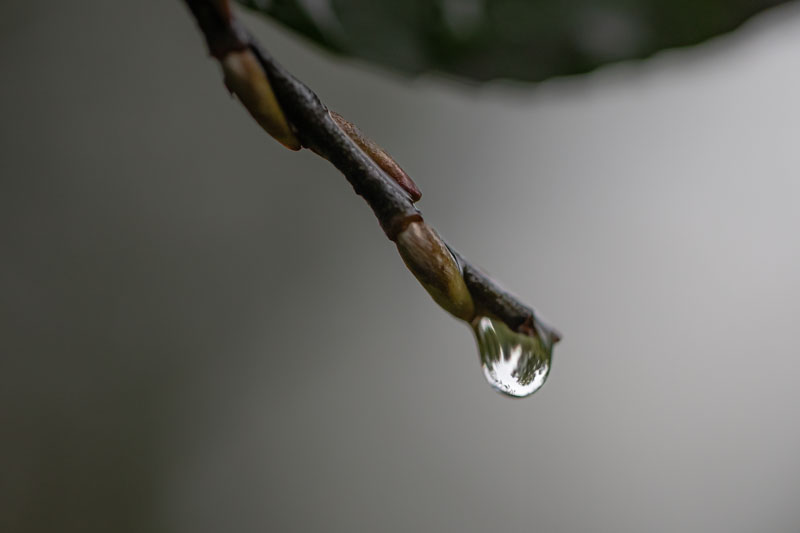
A World in a Drop
After the rain, a single droplet holds an upside-down reflection.
Camera: Canon EOS 5D Mark IV
Lens: EF100mm f/2.8L Macro IS USM
Settings: ISO 200 • Aperture f/5.6 • Shutter 1/40 s
E21A1003 • Size: 2413 x 1609
Suspended beneath a slender twig, a raindrop becomes a tiny natural lens, inverting the surrounding landscape within its curved surface. Reduced to a silhouette against the sky, the branch gives way to the delicate geometry of the water itself. Lasting only moments before gravity or the next breeze releases it, the droplet captures an entire world in miniature.
Spring Buds & New Growth
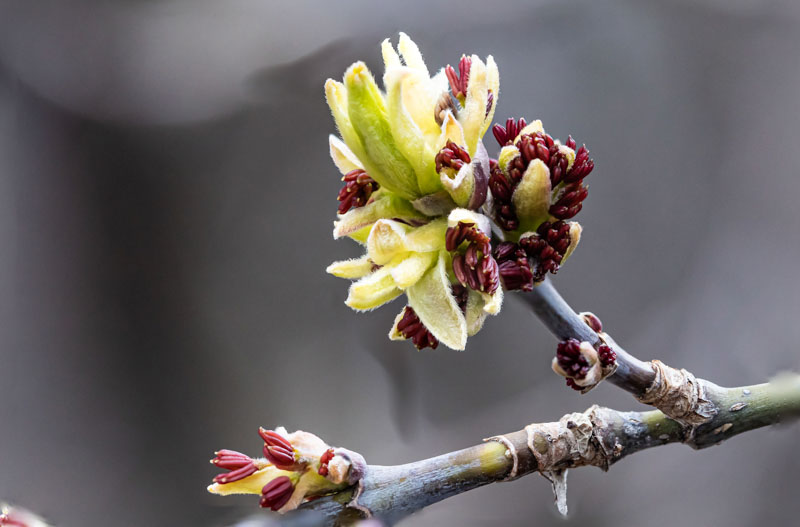
Tight clusters of developing catkins and velvety new leaves mark the brief moment before the flowers lengthen and release pollen into the warming air.
Spring's First Tassels
New leaves and emerging male catkins mark the beginning of another growing season.
Camera: Canon EOS 5D Mk IV
Lens: EF100mm f/2.8L Macro IS USM
Settings: ISO 100 • Aperture f/13 • Shutter 4 s
E22A0537-551 • Size: 5187 x 3414
Common Apple
Malus domestica buds in early spring.
Camera: Canon EOS 5D Mk IV
Lens: EF100mm f/2.8L Macro IS USM
Settings: ISO 200 • Aperture f/13 • Shutter 0.3 s
E22A1140-48 • Size: 6160 x 4107
A tight cluster of apple buds emerges from the center of a leaf rosette, each one wrapped in green sepals and edged with pink. The buds are still closed, but the color is already gathering at their tips, marking the brief pause between spring growth and full bloom.
The First to Unfold
White petals emerge from a cluster of rose-colored buds.
Camera: Canon EOS 5D Mark IV
Lens: EF100mm f/2.8L Macro IS USM
Settings: ISO 800 • Aperture f/13.0 • Shutter 1/80 s
E22A1285 • Size: 5842 x 3895
A single crab apple blossom has opened ahead of the surrounding buds, its white petals catching the sunlight while the rest of the cluster remains tightly wrapped in rose-pink. The leaves are fresh and bright, framing the flower against a soft spring background and showing the brief transition from bud to bloom.
Not Yet Open
Crab apple blossoms waiting in their green cups.
Camera: Canon EOS 5D Mk IV
Lens: EF100mm f/2.8L Macro IS USM
Settings: ISO 200 • Aperture f/13 • Shutter 0.3 s
E22A1136 • Size: 6160 x 4107
A cluster of crab apple buds rises above the new leaves, still wrapped in green sepals and edged with pink. The blossoms have not yet opened, but the color is already gathering at their tips, marking the brief pause between spring growth and full bloom.
Insects Up Close
Face of a Dasher
Pachydiplax longipennis
Camera: Canon EOS 5D Mark IV
Lens: EF100mm f/2.8L Macro IS USM
Settings: ISO 800 • Aperture f/10.0 • Shutter 1/320 s
E22A5724-1 • Size: 2100 x 1400
A tight portrait of a male Blue Dasher reveals the red-and-blue compound eyes, pale face, gripping legs, and fine wing venation often missed in a wider perch view.
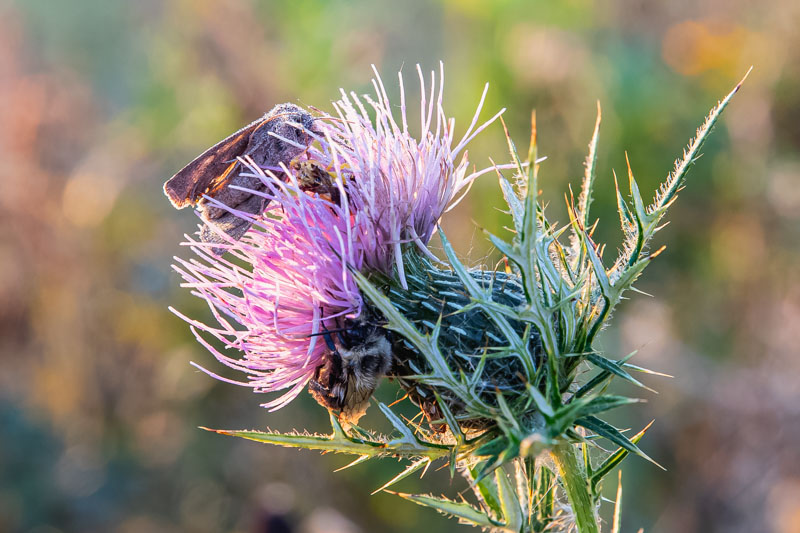
Morning Survivors
A frosted moth and a bumblebee share a thistle in the first light of a cold autumn morning.
Camera: Canon EOS 5D Mark IV
Lens: EF24-70mm f/2.8L II USM
Settings: ISO 200 • Aperture f/8.0 • Shutter 1/40 s
D79A5841 • Size: 2600 x 1733
The first rays of sunlight reach a native thistle where two pollinators have spent the night. Frost still clings to the resting moth, outlining its wings with a delicate crystalline edge, while the bumblebee below appears sheltered within the flower's bristled head. Bumblebees can warm their flight muscles by vibrating them before takeoff, allowing them to forage on mornings too cold for many other insects. For a brief moment, the flower becomes a refuge where two very different strategies for surviving a chilly dawn are revealed side by side.
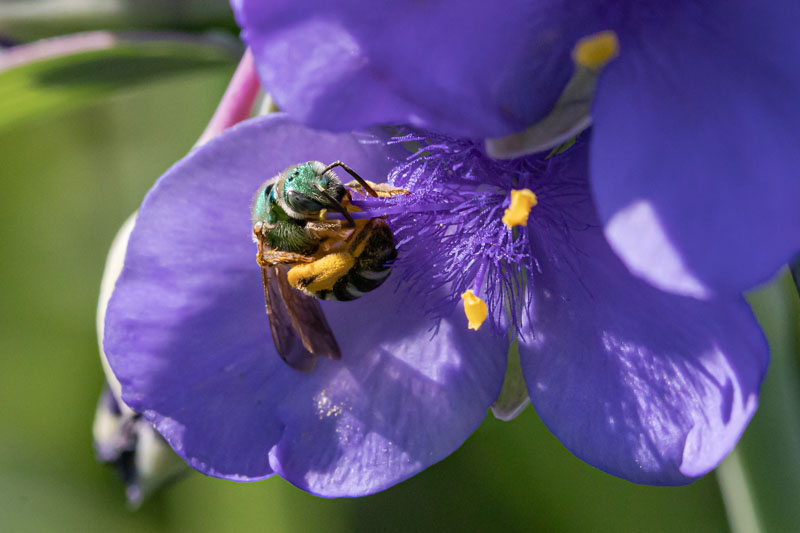
Loaded for the Journey
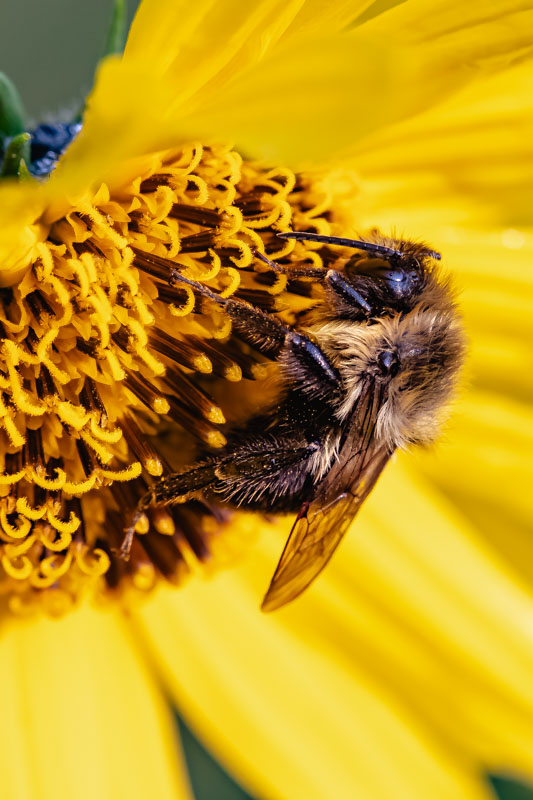
Bright yellow pollen clings to the pollen-collecting hairs of a female Bicolored Striped Sweat Bee (Augochlorella striata).
Camera: Canon EOS 5D Mark IV
Lens: EF100mm f/2.8L Macro IS USM
Settings: ISO 2000 • Aperture f/10.0 • Shutter 1/500 s
D79A0849 • Size: 3000 x 2000
A female Bicolored Striped Sweat Bee gathers nectar while carrying bright yellow pollen on the dense hairs of her hind legs. The close view highlights both the bee's metallic green body and one of the essential tasks of a native pollinator.
Lichens as Miniature Landscapes
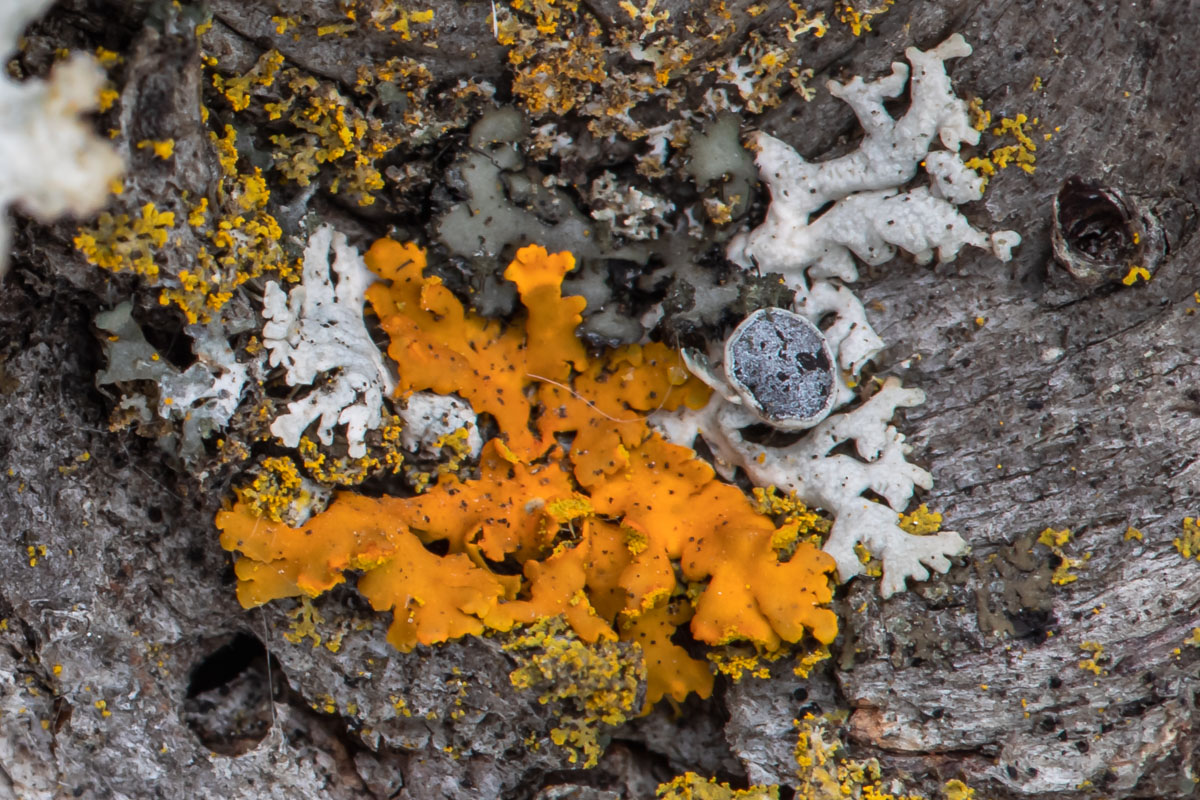
Candleflame in the Company of a Shadow, its warm yellow lobes erupt from a shadow of Common Greenshield. The Candleflame contrasts with the pale grays of Powdery Shield and the muted green-gray tones of Mealy Shadow. Each species occupies a different microtexture of the elm bark: Candleflame filling cracks with its fine soredia, Powdery Shield forming crisp-edged tiny rosettes, and Mealy Shadow spreading more loosely across the surface. Together they reveal the complexity of lichen communities at sub-millimeter scales.
Candleflame in the Company of a Shadow
A small lichen community revealed at bark-level scale.
Camera: Canon EOS 5D Mk IV
Lens: EF100mm f/2.8L Macro IS USM
Settings: ISO 200 • Aperture f/13 • Shutter 5 s
E21A8057 • Size: 2208 x 1472
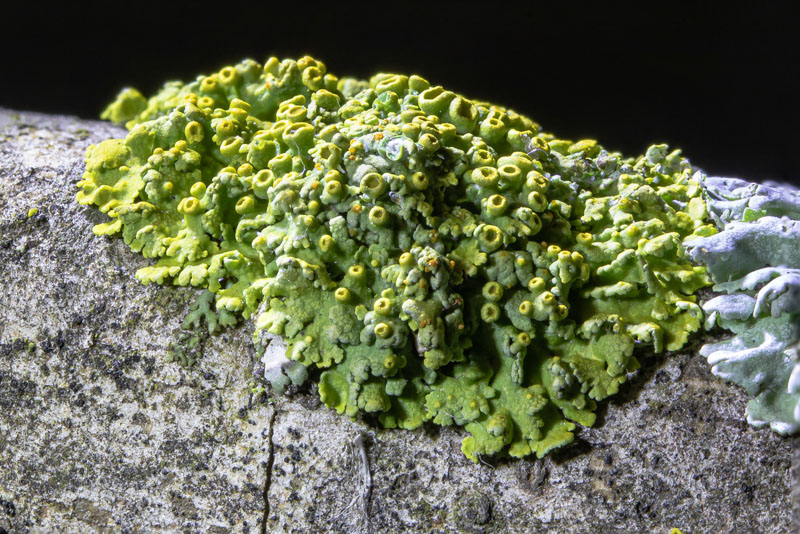
A Cushion of Sunbursts
A close view of a sunburst lichen showing crowded fruiting disks and a lobed thallus.
Camera: Canon EOS 5D Mark IV
Lens: EF100mm f/2.8L Macro IS USM
Settings: ISO 250 • Aperture f/13.0 • Shutter 1/8 s
D79A0913-918 Focus Stack • Size: 2900 x 1933
At first glance, this small patch of lichen reads as a bright yellow-green cushion on bark, but the scale tells the better story. The entire thallus is only about 0.70" [18 mm] wide, while a typical apothecium measures roughly 0.020" [0.5 mm] across. In close view, those tiny fruiting disks crowd the lobed surface like miniature suns, giving the colony its sunburst character and pointing toward Pin-cushion Sunburst Lichen.
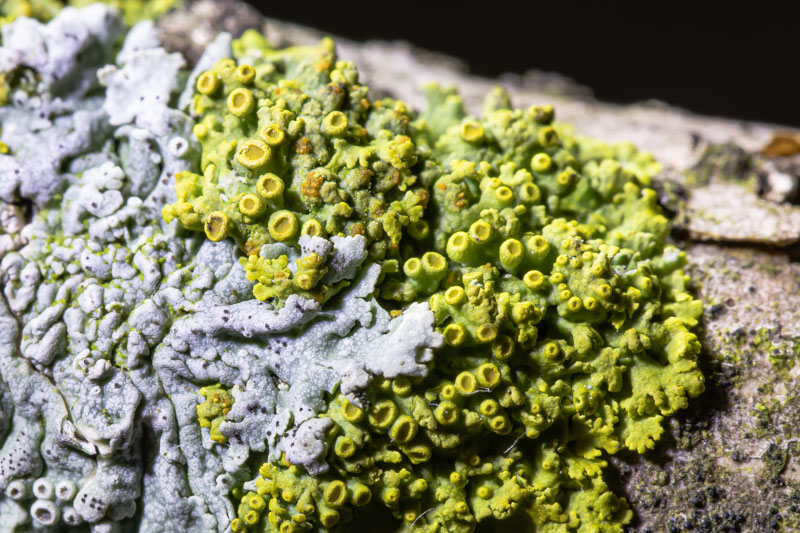
Fringed Candleflame Lichen
Small yellow cups rise from a ragged, leafy thallus on bark.
Camera: Canon EOS 5D Mark IV
Lens: EF100mm f/2.8L Macro IS USM
Settings: ISO 250 • Aperture f/13.0 • Shutter 1/8 s
D79A0902 • Size: 3900 x 2600
Fringed Candleflame Lichen (Candelaria fibrosa) forms a bright yellow-green patch with lobed, slightly ragged margins and numerous small cup-like apothecia. In this close view, the candleflame lichen grows across bark beside a pale gray foliose lichen, making the color and texture contrast especially clear.