Pear-shaped Puffball
Lycoperdon pyriforme
Pear-shaped puffball is a small woodland fungus that often appears on decaying wood, moss-covered logs, stumps, or bark where organic material has collected. These round to pear-shaped fruiting bodies begin pale and gradually age through tan and brown tones. The surface is covered with tiny warts or spines that can wear away, leaving a dotted pattern.
For identification details and comparison with similar puffballs, see Lycoperdon pyriforme in the Field Notes section.
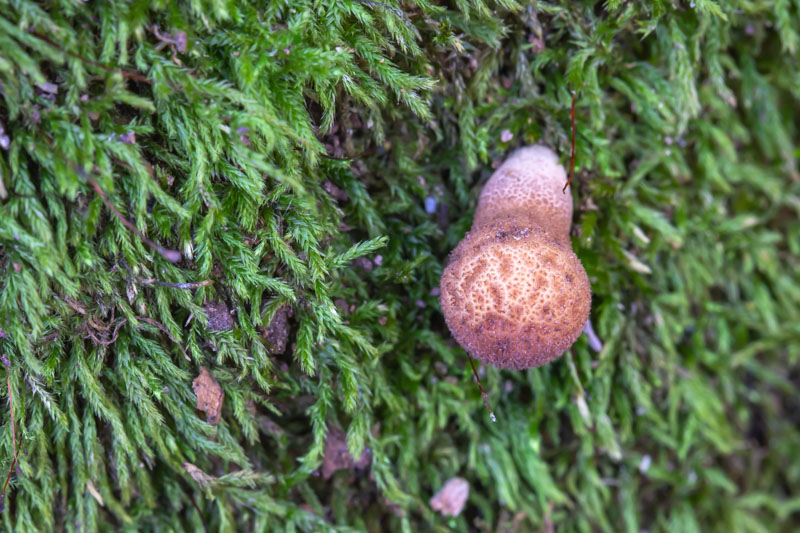
Pear-shaped Puffball on Mossy Bark
A close view of a pear-shaped puffball emerging from a thick green moss layer on wood.
Camera: Canon EOS 5D Mark IV
E21A6643 • Size: 800×533
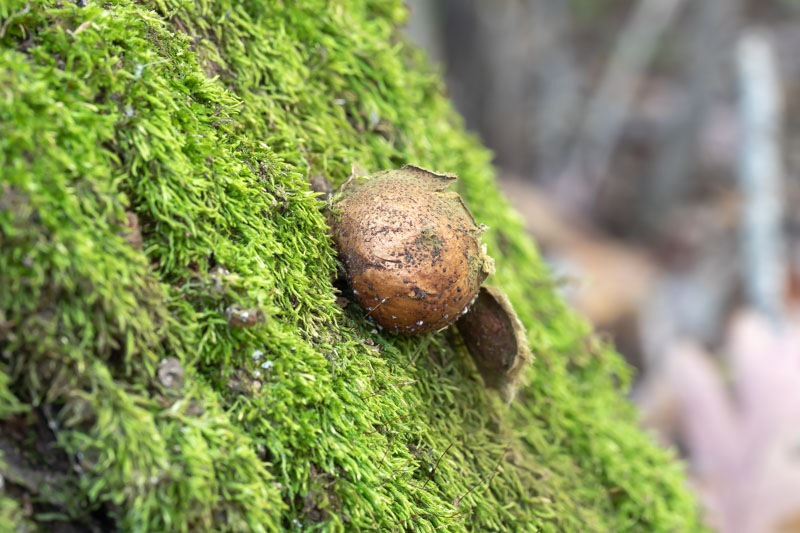
Mature Puffball
A browner, more mature fruiting body shows the worn, dotted surface typical of older pear-shaped puffballs.
Camera: Canon EOS 5D Mark IV
E21A6627 • Size: 800×533
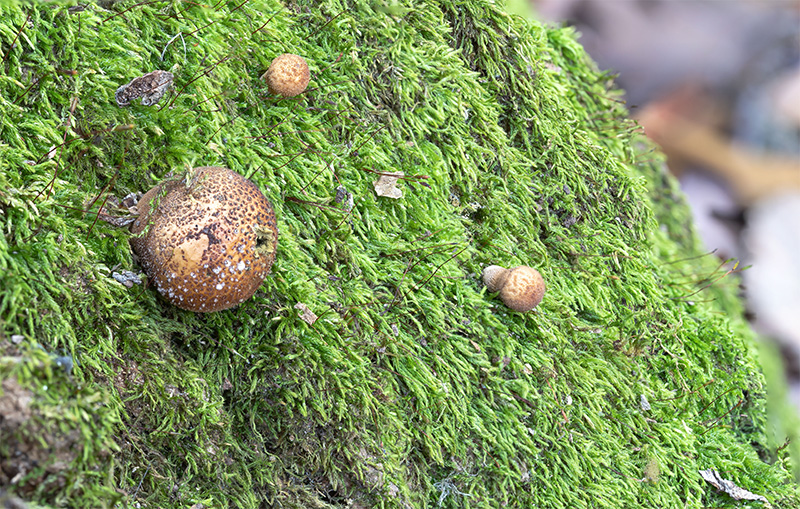
Puffball Cluster on Moss
Several puffballs at different stages of maturity are scattered across the mossy surface.
E21A6629-41 • Size: 800×509
When young, the interior of a pear-shaped puffball is white and firm. As it matures, the interior spore mass turns olive-brown and powdery, and spores are released through a small pore at the top when the fruiting body is disturbed. Its role is saprobic: it breaks down decomposing plant material and returns nutrients to the woodland ecosystem.
Appearance
Shape: rounded to pear-shaped, often about 1-3 cm across.
Color: white when young, aging to tan or brown.
Surface: small warts or spines that may wear away with age.
Interior: white and firm when young, olive-brown and powdery at maturity.
Habitat
Substrate: decaying wood, stumps, logs, and moss-covered bark where dead organic matter is present.
Environment: moist, shaded woodland settings.
Season: late summer through autumn, sometimes persisting into early winter.