
Flavoparmelia caperata
Flavoparmelia caperata
Family: Parmeliaceae
Common Greenshield (Flavoparmelia caperata) is a pale yellow-green foliose lichen forming rounded rosettes on hardwood bark. It is one of the most frequently encountered members of Flavoparmelia in Minnesota and serves as a useful reference species for recognizing the genus as a whole.
Diagnostic Overview
Flavoparmelia caperata is characterized by:
- Thallus: pale yellow-green to green-gray (especially in shade)
- Growth form: foliose, loosely adnate, forming discrete rosettes or merging patches
- Lobes: broad, rounded, typically 5–13 mm wide; smooth to gently rugose
- Surface: laminally sorediate; soredia granular to wart-like, often diffuse
- Isidia: absent
- Underside: black centrally, grading to brown and naked toward margins
- Rhizines: simple, black, denser toward the center
- Apothecia: rare but documented; laminal, sessile, brown-disc with pale thalline margin
Field Recognition Notes
In the field, F. caperata is often recognized by its soft, matte yellow-green surface, broad lobes, and laminal sorediation rather than marginal structures. Colonies frequently appear as isolated rosettes scattered across mature hardwood trunks rather than as continuous sheets.
Color perception varies with lighting conditions. Specimens photographed in low light or twilight may appear cooler (blue-shifted). Reliable color assessment benefits from comparison across multiple lighting conditions.
Chemistry
- Medulla: K+ bright yellow (caperatic acid)
While chemical testing confirms identification, F. caperata is usually identifiable visually when mature.
Apothecia (Uncommon but Significant)
Although primarily sorediate, Flavoparmelia caperata occasionally produces laminal apothecia. These are:
- Sessile
- Brown-disc
- Surrounded by a pale thalline margin
- Embedded directly in the upper cortex
The presence of apothecia is uncommon and provides valuable documentation of sexual reproduction in this species.
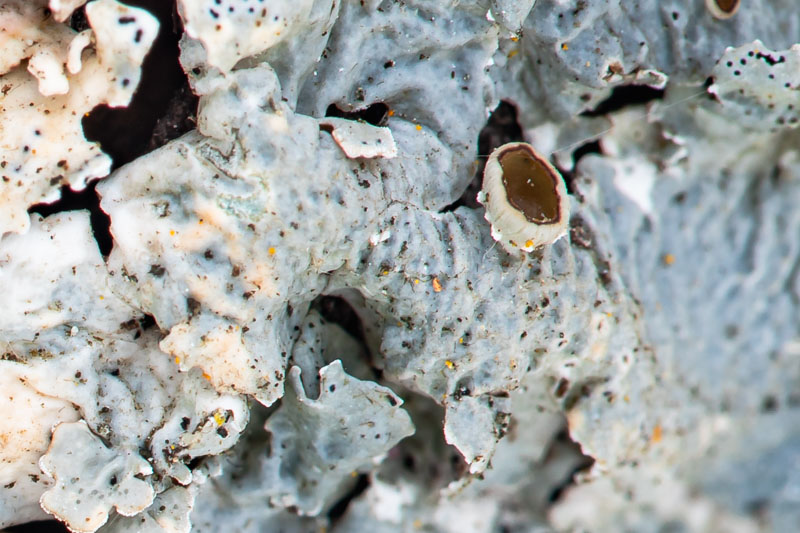
Apothecium with Pale Thalline Margin
Rare laminal apothecia with brown discs and pale thalline margins.
Comparison With Similar Taxa
Flavoparmelia caperata may be confused with the following foliose lichens:
-
Punctelia bolliana / P. rudecta
Blue-gray thallus with white pseudocyphellae; apothecia more common. -
Physcia spp.
Smaller rosettes, narrower lobes, different sorediation patterns; underside pale. -
Flavoparmelia baltimorensis
Saxicolous (rock-dwelling); chemically and ecologically distinct.
These comparisons are most reliable when thallus underside and sorediation patterns are examined.
Habitat and Ecology
- Substrate: hardwood bark (oak, maple, elm common)
- Light: partial shade to filtered sun
- Moisture: consistent humidity preferred
- Indicator value: often more abundant and better developed in areas of good air quality
Colonies may persist for decades, expanding slowly across bark surfaces.
Notes on Genus Context
This species represents a typical expression of Flavoparmelia in Minnesota and aligns closely with genus-level traits described in regional field guides, including Tanner Barnharst’s Minnesota Lichen Guide (2025). The genus is characterized by yellow-green foliose thalli lacking pseudocyphellae and bearing laminal soredia.
References
-
Consortium of Lichen Herbaria — Flavoparmelia caperata
https://lichenportal.org/portal/taxa/index.php?taxon=54388 -
iNaturalist — Flavoparmelia caperata
https://www.inaturalist.org/taxa/129848-Flavoparmelia-caperata -
Missouri Department of Conservation — Common Greenshield Lichen
https://mdc.mo.gov/discover-nature/field-guide/common-greenshield-lichen -
Minnesota Seasons — Common Greenshield Lichen
http://www.minnesotaseasons.com/Fungi/Common_Greenshield_Lichen.html