
Polycauliona polycarpa
Family: Teloschistaceae
Pin-cushion Sunburst (Polycauliona polycarpa) is a small, bright orange foliose lichen commonly found on nutrient-enriched bark and twigs. It is especially distinctive for its dense clusters of orange, disc-shaped reproductive structures, which often dominate the thallus. This species frequently appears in mixed lichen communities and is a reliable indicator of nitrogen-rich conditions.
For representative images and visual context, see the page: Pin-cushion Sunburst in the Gallery section.
Description
Polycauliona polycarpa is recognized by:
- Growth form: small foliose, often appearing tufted or subfruticose
- Thallus: bright orange to yellow-orange, thin and somewhat irregular
- Lobes: narrow, short, and often indistinct beneath dense apothecia
- Surface features: typically lacking soredia or isidia; surface often obscured by fruiting bodies
- Underside: pale to whitish; lacking a dark lower cortex
- Attachment: loosely attached to bark, often on fine twigs
The overall growth is compact and clustered, with the thallus frequently subordinate to the abundant reproductive structures. It commonly colonizes small branches where nutrient enrichment is present.
Substrate and Habitat
Typical substrates and settings include:
- Bark of deciduous trees, especially on small branches and twigs
- Frequently observed on trees influenced by bird activity or roadside environments
Notes may include:
- Prefers open, well-lit conditions
- Tolerant of drying and exposure
- Commonly found in mixed lichen communities, often alongside Physcia and Candelaria
Identification
Key features for field diagnosis:
- Color: vivid orange to tangerine
- Form: small, tufted clusters rather than broad rosettes
- Surface: dominated by numerous orange apothecia
- Underside: pale, lacking dark pigmentation
- Reproductive structures: abundant, crowded apothecia (diagnostic)
- Chemistry: typically K+ purple (anthraquinones), though field testing is rarely necessary
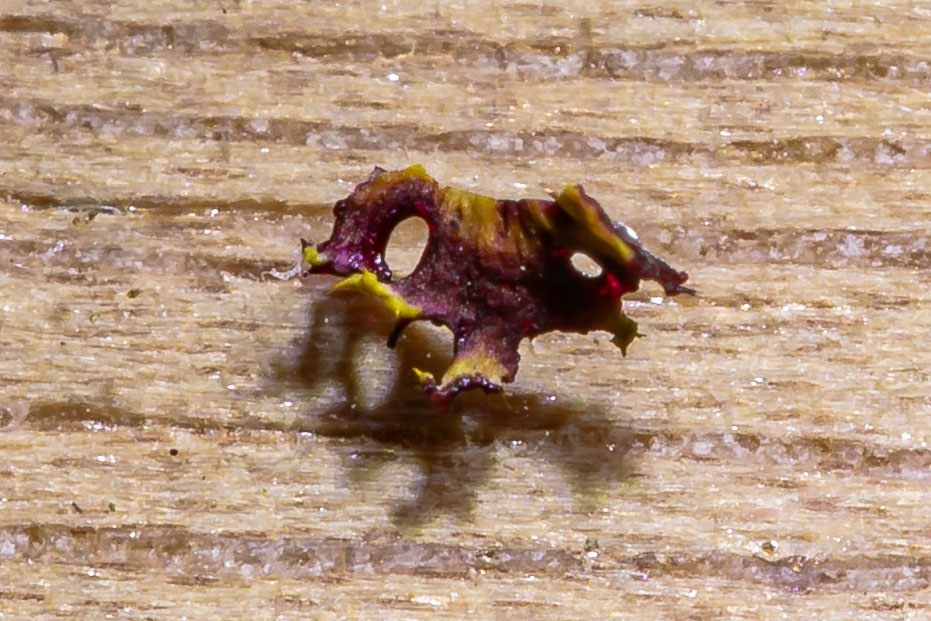
K Test Reaction on Pin-cushion Sunburst
A tiny fragment reveals a deep purple reaction, confirming the presence of anthraquinone pigments.
A minute fragment of Polycauliona polycarpa rests on a wooden surface, its orange cortex transformed by a potassium hydroxide test. The vivid shift to deep purple marks a strong K+ reaction, characteristic of anthraquinone-containing lichens in the Teloschistaceae. Even at this small scale, the thin, lobed structure of the thallus is visible, with translucent edges and irregular openings hinting at its delicate, foliose form. This chemical response provides a useful supporting feature in confirming identification when morphology alone is ambiguous.
Key distinctions:
- Differs from Xanthoria parietina (now Polycauliona parietina) by its smaller size, narrower lobes, and much denser apothecia
- Lacks the broad, leafy rosette form typical of larger sunburst lichens
- Distinguished from Candelaria concolor by its foliose structure and apothecia (rather than granular surface)
Ecology and Notes
Polycauliona polycarpa is a nitrophilous species, thriving in environments enriched by nitrogen from bird droppings, dust, or human activity. It is commonly used as an informal indicator of elevated nutrient conditions on bark substrates.
In Minnesota, it appears to be locally common but easily overlooked due to its small size. It often co-occurs with other nutrient-tolerant lichens, forming recognizable assemblages on exposed twigs.
Observations in this collection have reached Research Grade, supporting consistent identification across multiple sightings.
References
-
Consortium of Lichen Herbaria
https://lichenportal.org -
Regional field guide
(Add preferred Upper Midwest or North American lichen guide) -
iNaturalist taxon page
https://www.inaturalist.org/taxa/Polycauliona-polycarpa —