
Red-winged Blackbird
Agelaius phoeniceus
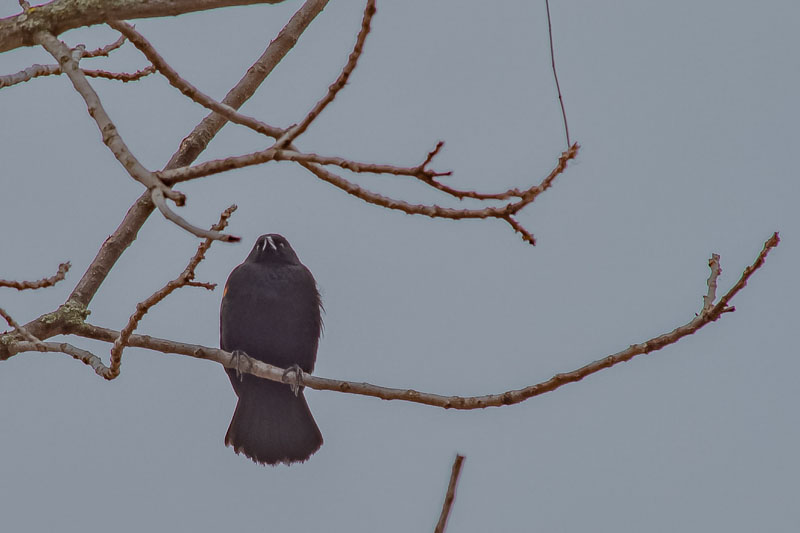
Red-winged Blackbird perched on a bare branch
A sentinel of the marsh, flashing red and gold against gray skies.
Perched upright with bold presence, the male’s glossy black plumage contrasts the fiery epaulets that define the species.
Size: 2110 x 1407
Camera: Canon EOS 5D Mk IV
Lens: EF70-300mm f/4-5.6 IS USM
Settings: ISO 200 • Aperture f/9.0 • Shutter 1/80 s
Overview
Among the most recognizable North American songbirds, the Red-winged Blackbird thrives in wetlands, meadows, and roadside reeds. Males guard territories from high perches, flashing their red-and-yellow shoulder patches to rival males and to attract females. Females, streaked brown and more subdued, weave deep within cattails and grasses to build their nests.
Identification
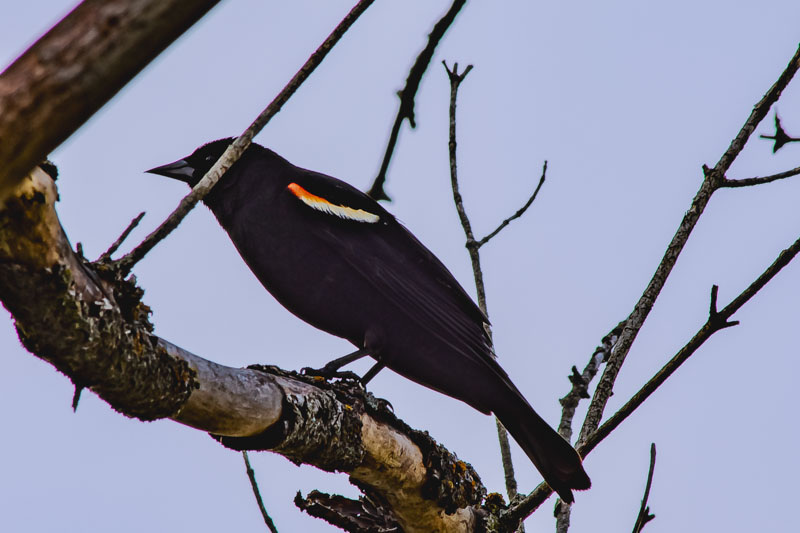
Camera: Canon EOS 5D Mk IV
Lens: EF70-300mm f/4-5.6 IS USM
Settings: ISO 200 • Aperture f/13.0 • Shutter 1/80 s
- Male: Glossy black overall with bright red shoulder patches edged in yellow.
- Female: Brown, heavily streaked, resembling a large sparrow.
- Bill: Long, sharply pointed, and black.
- Song: A bold “conk-la-ree!” — loud and unmistakable across open wetlands.
- Behavior: Territorial; males often sing from perches and chase intruders aggressively.
Female Red-winged Blackbird
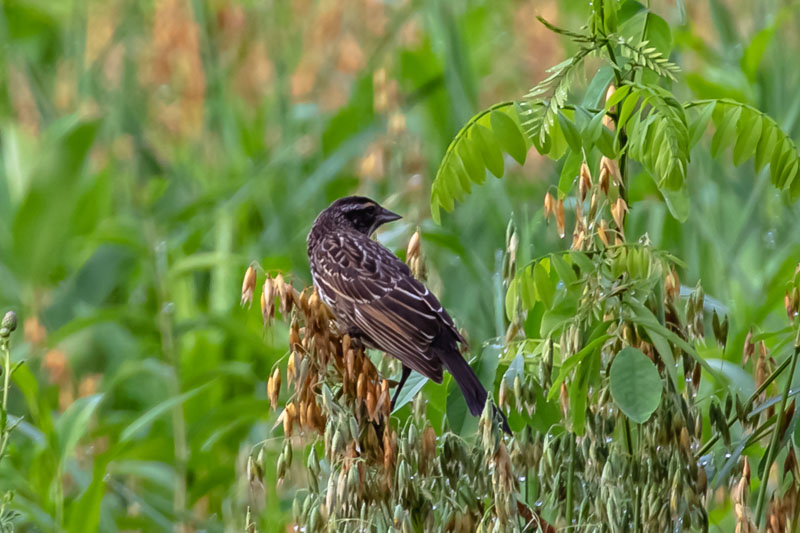
Female Red-winged Blackbird among seed heads
Streaked brown and russet, she blends seamlessly into the marshland reeds.
Perched lightly on ripened grasses, the female’s intricate patterning provides perfect camouflage among the seed heads.
Camera: Canon EOS 5D Mk IV
Lens: EF70-200mm f/2.8L IS II USM 2x
Settings: ISO 250 • Aperture f/8.0 • Shutter 1/160 s
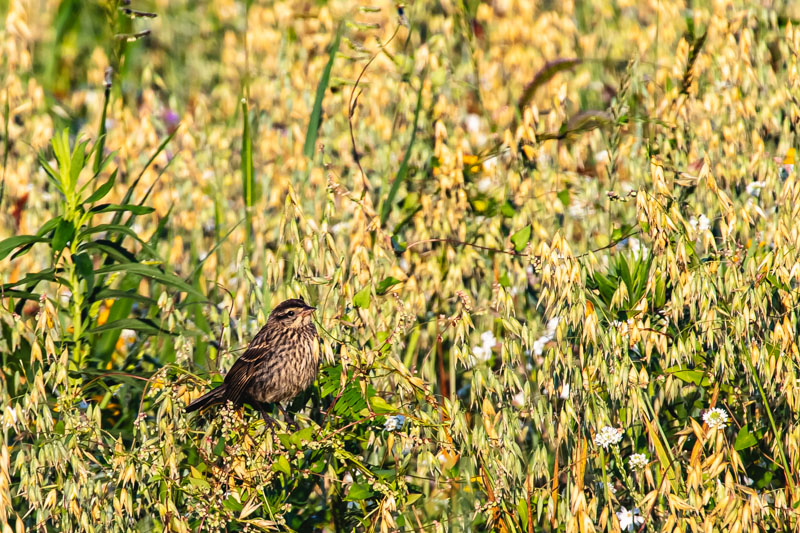
Female Red-winged Blackbird — Marsh Sentinel
Amid the shimmer of late-summer fields, her sharp gaze surveys the colony.
Though less vivid than the male, her song and vigilance are vital to the nest’s defense and the rhythm of the wetland chorus.
Camera: Canon EOS 5D Mk IV
Lens: EF70-200mm f/2.8L IS II USM 2x
Settings: ISO 160 • Aperture f/13.0 • Shutter 1/250 s
Female Overview
Female Red-winged Blackbirds are often mistaken for large sparrows due to their streaked brown plumage, but they share the same strong, pointed bill and confident stance as the males. Their coloration provides essential concealment when nesting among cattails and grasses. Females are highly vocal, answering the males’ trills with a series of rapid chattering calls that reinforce pair bonds and warn of predators.
Key Traits
- Brown and buff streaking overall, with a pale eyebrow stripe.
- Slightly smaller than the male, averaging 7–8.5" [18–22 cm].
- Builds a deep, cup-shaped nest woven from wet vegetation.
- Feeds on insects, seeds, and larvae gleaned from reeds and stalks.
Photographer’s Note
These females reveal the subtler side of the species — elegance hidden in camouflage. In the soft light of the meadow, their patterns echo the textures of the landscape, reminding us that beauty isn’t always found in bold color, but in the art of blending in.
Habitat
Prefers marshes, wet meadows, and grassy fields, often nesting near standing water. Outside breeding season, large flocks gather in fields and grain areas, sometimes mixing with grackles and cowbirds.
Diet
Feeds primarily on insects, seeds, and grains. In summer, consumes beetles, caterpillars, and other invertebrates; in winter, shifts to foraging for seeds and crop grains.
Photographer’s Perspective
Captured on a muted day, the bird’s black sheen reflects subtle blue and violet tones, while the crimson shoulder patch gleams even under low light. The composition emphasizes its posture — alert, balanced, and defiant — the classic stance of the Red-winged Blackbird.