
Dryobates pubescens
Small and deliberate, the downey Woodpecker moves through trees and feeders with quiet precision. Its black-and-white pattern breaks into fragments of light and shadow, while its compact size and short bill distinguish it from similar species. In winter especially, it becomes a familiar presence—appearing at suet feeders and working methodically along bark in search of insects.
For identification details and comparison with similar species, see
the Dryobates pubescens in the Field Notes section.
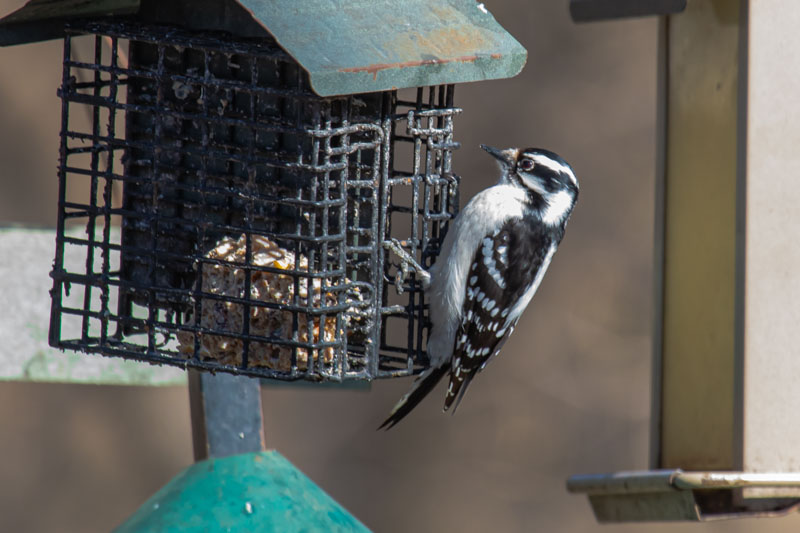
Downey Woodpecker — At the Feeder
A steady grip and quiet focus at the edge of winter.
Clinging to the wire frame, the downey Woodpecker braces itself with tail and feet, probing the suet with quick, efficient movements.
Camera: Canon EOS 5D Mk IV
Lens: EF100-400mm f/4-5.6L IS USM
Settings: ISO 800 • Aperture f/8.0 • Shutter 1/320 s
E22A0415 • Size: 2149x1433
Overview
The downey Woodpecker is the smallest woodpecker in North America, yet one of the most widespread and adaptable. Found in woodlands, parks, and backyard feeders, it balances delicacy with persistence—moving in short, purposeful hops along branches and trunks.
Its black-and-white plumage provides strong visual contrast, while the male’s small red patch at the back of the head adds a subtle accent. At feeders, it often appears comfortable and unhurried, returning repeatedly to reliable food sources.
At the Feeder
Perched vertically on the suet cage, the woodpecker demonstrates the classic support system of its family: stiff tail feathers pressed against the surface, feet gripping firmly, and body aligned for stability. Each movement is economical—short probes and pauses rather than continuous motion.
The surrounding structure of the feeder echoes the grid of branches in its natural habitat, a familiar geometry adapted to a human setting.
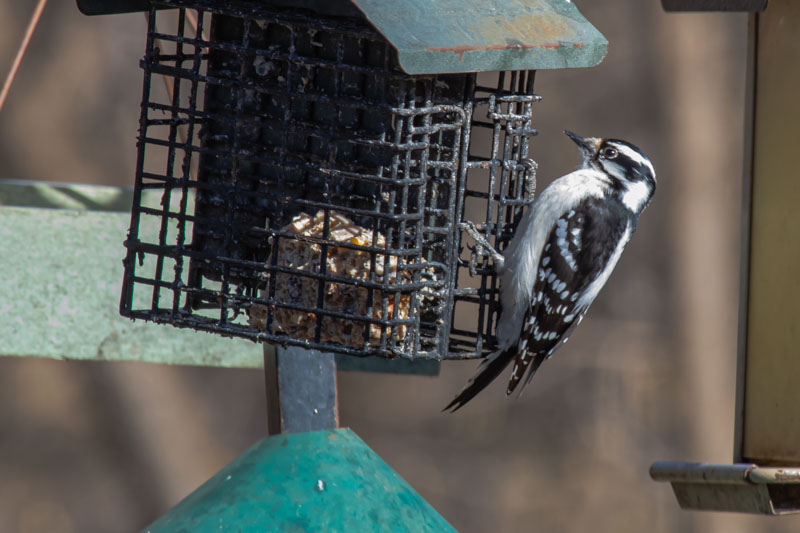
Close Approach
A slight lean inward, attention fixed on the suet within.
Camera: Canon EOS 5D Mk IV
Lens: EF100-400mm f/4-5.6L IS USM
Settings: ISO 800 • Aperture f/8.0 • Shutter 1/320 s
E22A0411 • Size: 2149x1433
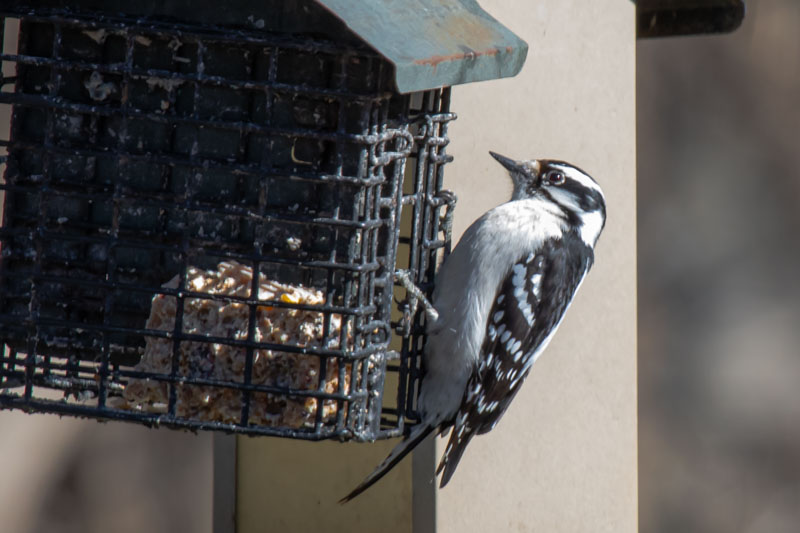
Poised and Still
A brief pause—head lifted, listening before the next movement.
Camera: Canon EOS 5D Mk IV
Lens: EF100-400mm f/4-5.6L IS USM
Settings: ISO 800 • Aperture f/8.0 • Shutter 1/320 s
E22A0408 • Size: 2149x1433
Pattern and Form
The downey’s markings resolve into clear field marks at close range: white spotting along the wings, a clean white underside, and bold facial striping. Its bill, notably short relative to head size, helps distinguish it from the similar Hairy Woodpecker.
Even in stillness, the bird holds a poised, alert posture—head slightly raised, eye fixed forward, ready to shift position at the slightest disturbance.
Photographer’s Perspective
This sequence isolates the woodpecker against a soft, neutral background, allowing its structure and pattern to stand forward. The feeder provides context without overwhelming the subject, framing the interaction between bird and environment.
Across the sequence, small changes in posture—leaning in, pausing, rebalancing—reveal the rhythm of feeding behavior, where efficiency and awareness remain in constant balance.