
Nitrogen Bark Community
Nitrogen-Enriched Bark Community
When tree bark becomes enriched with reactive nitrogen — from bird perching, agricultural drift, roadside exposure, or urban air — the lichen community shifts. Bright orange and yellow species thrive, while more sensitive lichens disappear.
This assemblage shows a classic nitrogen bark community, where nitrophile and nitrogen-tolerant species coexist on oak bark.
Visual Notes
- Bright orange foliose Xanthomendoza fallax
- Yellow granular crusts (Candelariella spp.)
- Gray foliose Physcia species
- Gray crustose lichens with dark apothecia (likely Lecanora)
- Dense mixed-species mosaic pattern
Gallery
classic nitrogen-enriched oak bark assemblage
mixed nitrogen-tolerant bark community
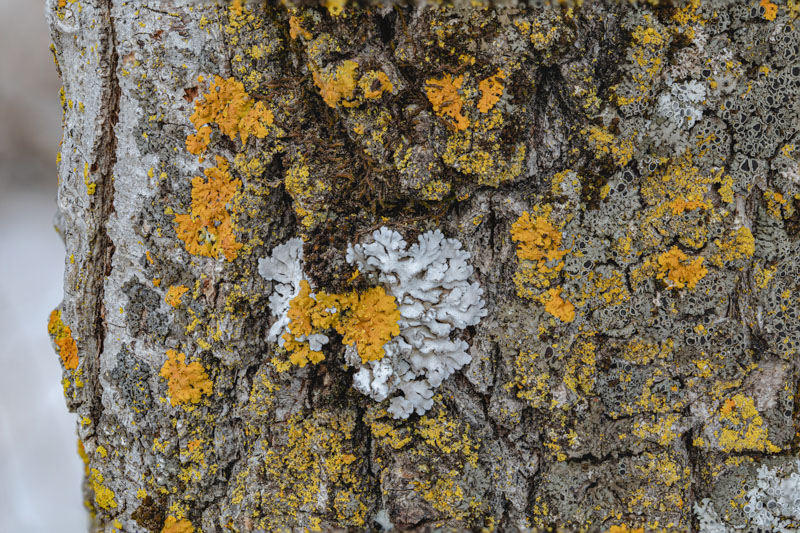
Nitrogen-Enriched Oak Bark
A mixed community of orange, yellow, and gray lichens colonizing oak bark enriched with nitrogen.
Camera: Canon EOS 5D Mk IV
Lens: EF100mm f/2.8L Macro IS USM
Settings: ISO 200 • Aperture f/13 • Shutter 0.4 s
E21A8928-8941 • Size: 5558 x 3706
A wider view reveals the mosaic structure typical of nitrogen-enriched bark. Bright orange sunburst rosettes contrast sharply against pale gray foliose lichens and darker crustose species. The clustering of nitrophile taxa suggests localized nutrient enrichment on the bark surface.
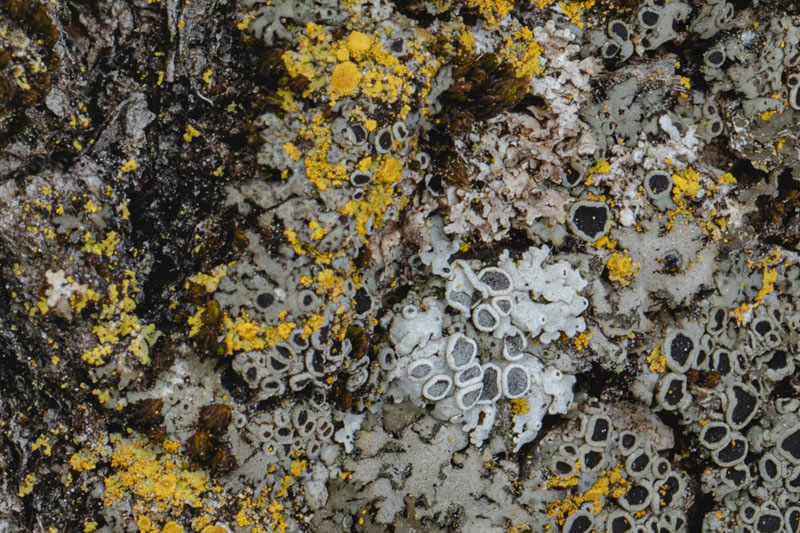
Crustose and Foliose Mosaic
Gray crustose lichens with dark apothecia interwoven among yellow granular colonies.
Camera: Canon EOS 5D Mk IV
Lens: EF100mm f/2.8L Macro IS USM Settings: ISO 200 • Aperture f/13 • Shutter 0.4 s
E21A8928-8941A • Size: 1347 x 898
This close view highlights the fine-scale diversity within the community. Gray crustose lichens bearing dark apothecia — likely Lecanora — occupy the bark surface between patches of yellow Candelariella. These species tolerate elevated nitrogen and often expand where more sensitive lichens decline.
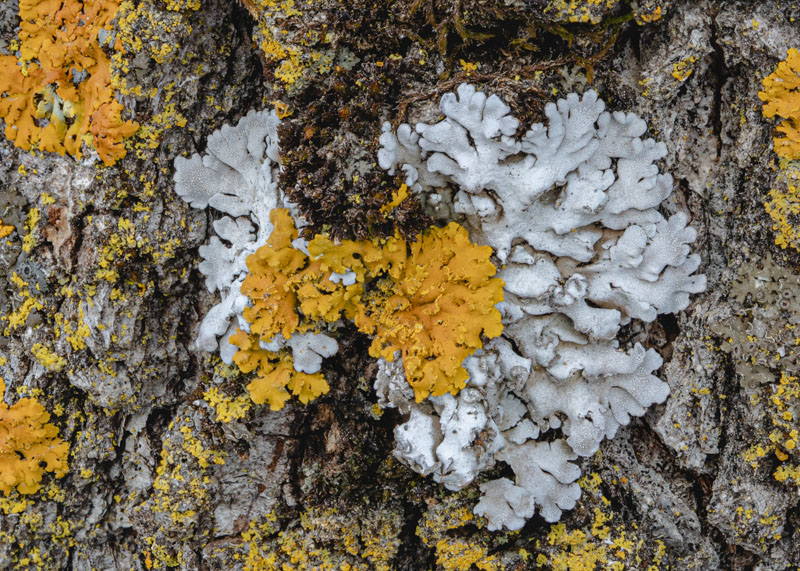
Physcia and Sunburst Interaction
Gray foliose *Physcia* species partially overlapped by vivid Hooded Sunburst.
Camera: Canon EOS 5D Mk IV
Lens: EF100mm f/2.8L Macro IS USM
Settings: ISO 200 • Aperture f/13 • Shutter 0.4 s
E21A8928-8941B • Size: 2396 x 1710
The pale gray foliose lichen, likely a Physcia species, shows broad lobes and a smooth upper cortex. Unlike the orange sunburst, it does not require nitrogen enrichment but tolerates it well. The overlap between species illustrates how enrichment alters competitive balance without eliminating all diversity.
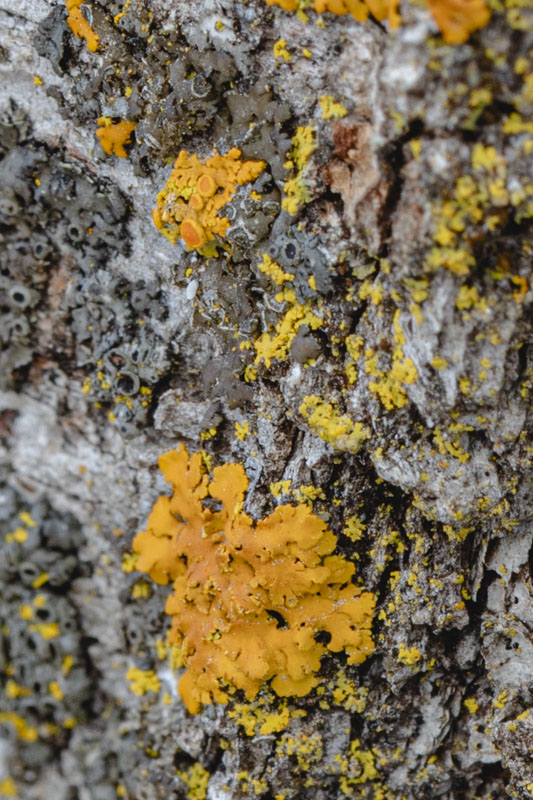
Sunburst with Granular Associates
Bright orange *Xanthomendoza fallax* surrounded by fine yellow crusts.
Camera: Canon EOS 5D Mk IV
Lens: EF100mm f/2.8L Macro IS USM
Settings: ISO 200 • Aperture f/13 • Shutter 0.4 s
E21A8932A • Size: 815 x 1223
Hooded Sunburst acts as a visual indicator of nitrogen enrichment. Its compact orange rosettes expand readily on nutrient-enriched bark, often accompanied by granular yellow crusts such as Candelariella. Together they form a recognizable ecological signal visible even from a distance.
Ecological Context
Nitrogen enrichment alters bark chemistry, favoring species that can metabolize or tolerate elevated nitrate and ammonium levels. These nitrophile lichens respond rapidly to changing atmospheric inputs, making them valuable indicators of air quality and nutrient deposition.
Rather than representing damage, this community reflects a chemical shift in the environment — one that reshapes biodiversity at a miniature scale.
Related Pages
- Hooded Sunburst (Xanthomendoza fallax)
- Candleflame (Candelaria concolor)
- Field Notes: Xanthomendoza fallax