
Rough Speckled Shield
Punctelia rudecta
This gallery documents Rough Speckled Shield growing on mature bark, showing the species’ broad, rounded lobes and lightly textured surface. Smaller gray foliose lichens and scattered yellow sunburst species are present in the surrounding bark community.
For identification notes and comparison with similar shield lichens, see the Field Notes page: Punctelia rudecta.
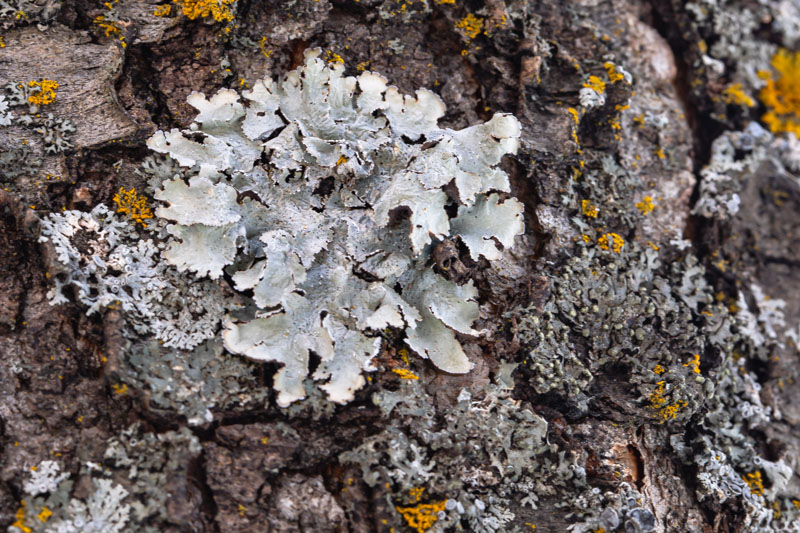 Shield Detail in Winter Light
Close view of overlapping lobes and surface texture, with subtle speckling visible across the thallus.
Camera: Canon EOS 5D Mk IV
Lens: EF100mm f/2.8L Macro IS USM
Settings: ISO 200 • Aperture f/13 • Shutter 3.0 s
E21A8224 • Size: 4296x2864
Broad, overlapping lobes form a loose rosette against deeply furrowed bark. Subtle shifts from cool gray to pale blue emerge across the matte surface, with softened edges and gentle shadows giving the thallus a sculpted, layered appearance. Smaller gray lichens and flecks of yellow occupy the surrounding bark, adding contrast without competing for attention.
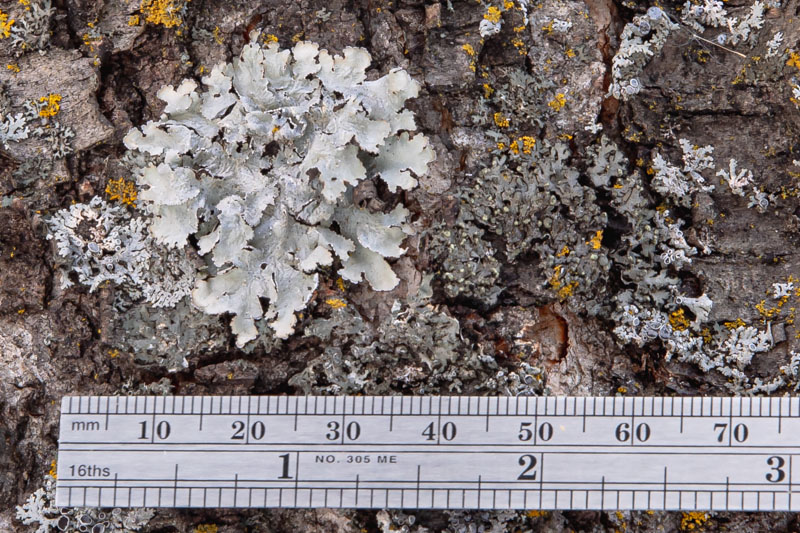 Rosette Scale and Proportion
Broad gray lobes among many smaller lichen colonies.
Camera: Canon EOS 5D Mk IV
Lens: EF24-70mm f/2.8L II USM
Settings: ISO 200 • Aperture f/13 • Shutter 0.6 s
E21A8223 • Size: 1646x1097
A broad rosette, roughly three centimeters across, spreads over the bark of an oak tree. Pale gray lobes form a loose, bushy pattern. Nearby, smaller lichens cluster in bark crevices—some so compact that their entire thallus is comparable in size to a single lobe of the larger rosette—highlighting the contrast in scale within this bark-lichen community.
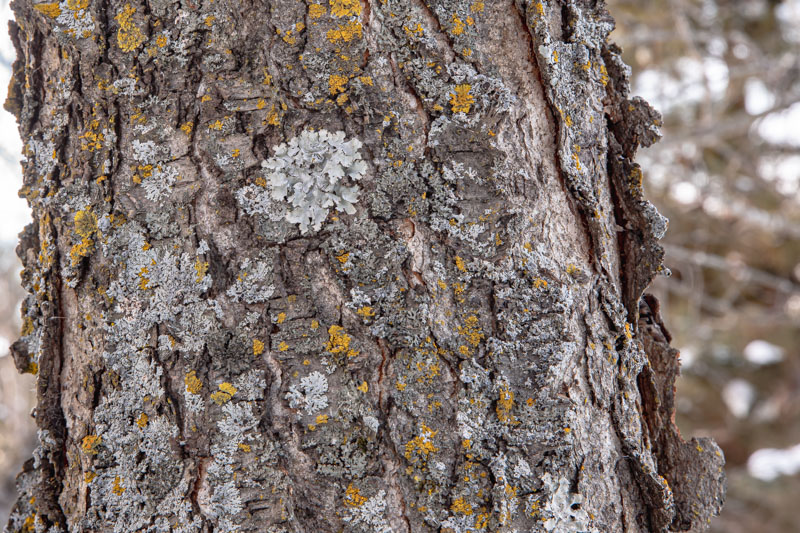 Context on Oak Trunk
The lichen in situ on a mature tree trunk, surrounded by a diverse bark-lichen community.
Camera: Canon EOS 5D Mk IV
Lens: EF24-70mm f/2.8L II USM
Settings: ISO 200 • Aperture f/13 • Shutter 0.6 s
E21A8222 • Size: 6720x4480
A section of mature oak bark supports a dense assemblage of foliose and sunburst lichens. Broad gray rosettes dominate the surface, while smaller gray and yellow colonies occupy fissures and edges of peeling bark. The composition emphasizes how larger shield lichens anchor the community, with finer forms filling the surrounding texture of the trunk.