
Physcia stellaris
Star Rosette (Physcia stellaris) forms pale gray to bluish-gray rosettes with narrow, radiating lobes that create a distinct star-like outline. The foliose rosettes marked by distinctive white-rimmed apothecia. These pale, elevated rims sharply contrast with the darker disc at the center, making P. stellaris one of the most easily recognized bark-dwelling Physcia species. Its lobes are small, rounded, and slightly pruinose, giving the thallus a soft, frosted appearance.
For identification details and comparison with other similar species, see the Physcia stellaris in the Field Notes section.
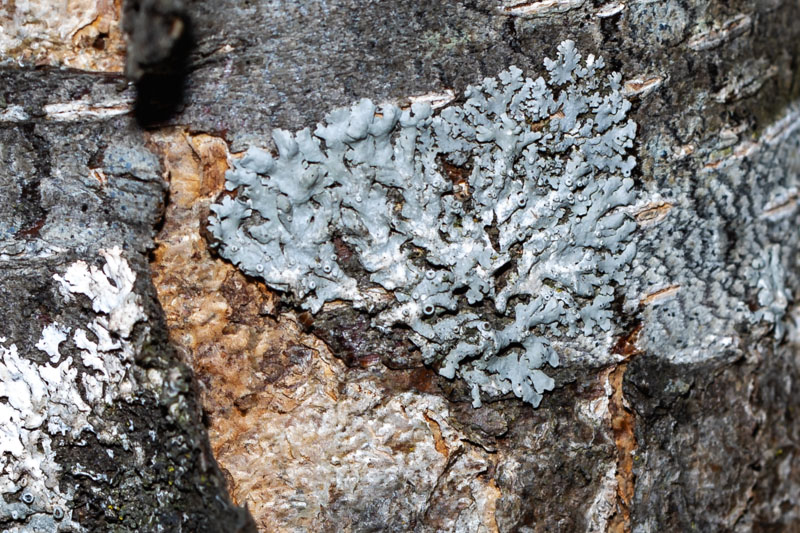 Star Rosette on Bark
Radiating lobes forming a crisp, star-shaped rosette on bark.
Camera: Canon EOS 5D Mk IV
Lens: EF100mm f/2.8L Macro IS USM
ISO 100 • Aperture f/8.0 • Shutter 1/200 s
E21A9140 • 1500×1000
In this image, the evenly spaced lobes and subtle surface pruina are visible with scattered apothecia developing toward the center. The species commonly grows on nutrient-enriched bark and is frequently encountered in urban and suburban settings.
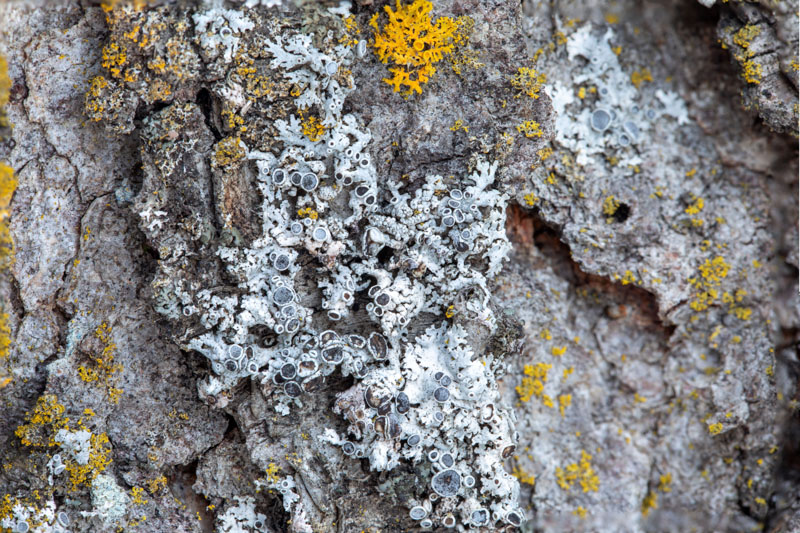 Star Rosette with Candleflame Contrast
Pale gray rosettes encircle a bright patch of Candleflame in the bark’s natural hollow.
Camera: Canon EOS 5D Mk IV
Lens: EF100mm f/2.8L Macro IS USM
Settings: ISO 200 • Aperture f/9.0 • Shutter 1/2 s
E21A8059–8071 • Size: 6720×4480
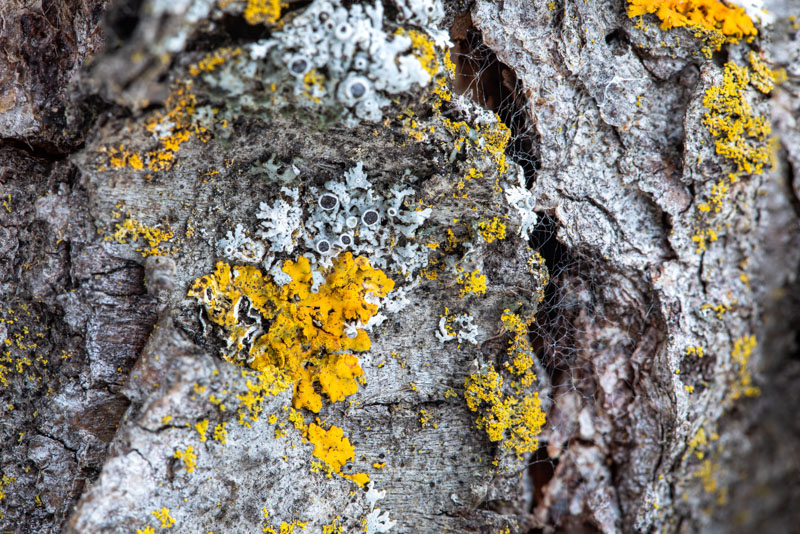 Star Rosette with Candleflame and Powdery Companions
Crisp gray Star Rosettes rising over Candleflame, framed by pale blue clusters of Powdery Shield.
Camera: Canon EOS 5D Mk IV
Lens: EF100mm f/2.8L Macro IS USM
Settings: ISO 200 • Aperture f/9.0 • Shutter 1/2 s
E21A8072-8081 • Size: 6720x4480