
Kneiff’s Hook-Moss
Drepanocladus aduncus
Kneiff’s Hook-Moss (Drepanocladus aduncus) is a distinctive pleurocarpous moss named for its hooked, strongly curved leaves—a feature that makes it one of the easiest wetland mosses to recognize. Its long, sweeping stems form loose, reclining mats in damp forest microhabitats, often mixing with lichens and other mosses along moist bark or decaying wood.
In Minnesota it is common in seepage zones, stream margins, fen edges, and shaded, moisture-holding bark—anywhere water persists long enough to support bryophyte growth.
Photos
The colony in Streambank Tangle showcases the classic sweeping, secund leaves of Knieff’s Hook-moss, mixed with Mealy Shadow lichens in a cool, shaded microhabitat. Several sporophytes are visible in the upper right and lower left. The leaves curve secund (all to one side), giving each stem a gentle, flowing shape reminiscent of underwater vegetation.
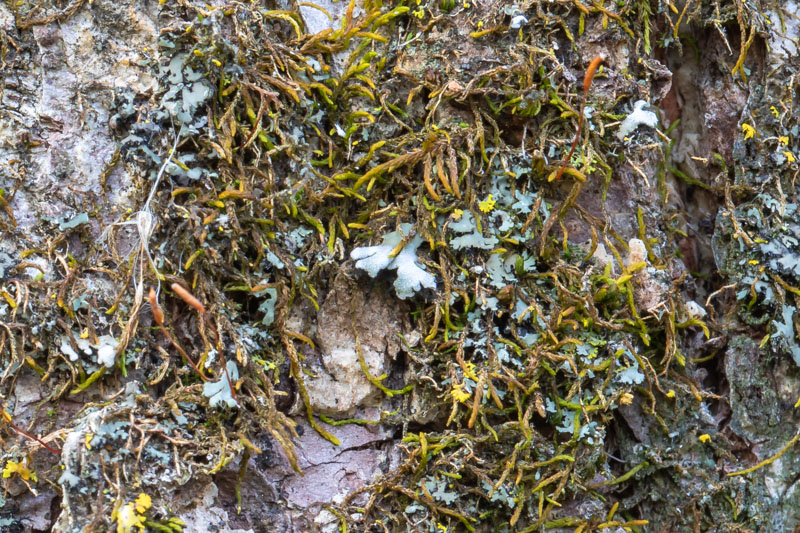
Streambank Tangle
_Threadlike stems drape down damp bark, following the moisture gradient of a nearby flowing stream.
Camera: Canon EOS 5D Mk IV
Lens: EF100mm f/2.8L Macro IS USM
Settings: ISO 200 • Aperture f/16.0 • Shutter 1/4 s
E21A6571 • Size: 2459x1639
Barkside Cascade presents a clear view of the moss’s drooping architecture, shaped by constant access to moisture from the nearby creek bed.
The scene Moss & Lichen Interlace highlights a mixed epiphytic habitat enriched by constant moisture, allowing both moss and lichen species to flourish side by side.
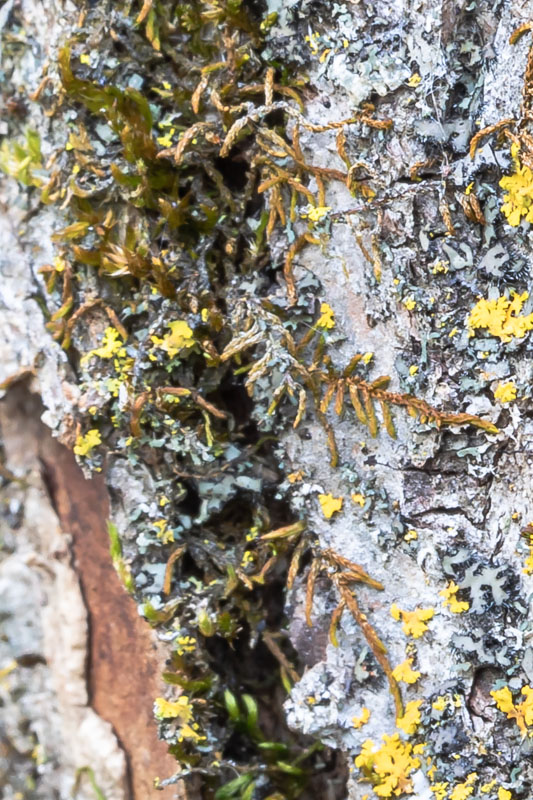
Barkside Cascade
Long, curved shoots of Hook-Moss spill over a ridge of elm bark, interwoven with Common Sunburst and Mealy Shadow lichens.
Camera: Canon EOS 5D Mk IV
Lens: EF100mm f/2.8L Macro IS USM
Settings: ISO 200 • Aperture f/16.0 • Shutter 0.6 s
E21A6570 • Size: 837x1255
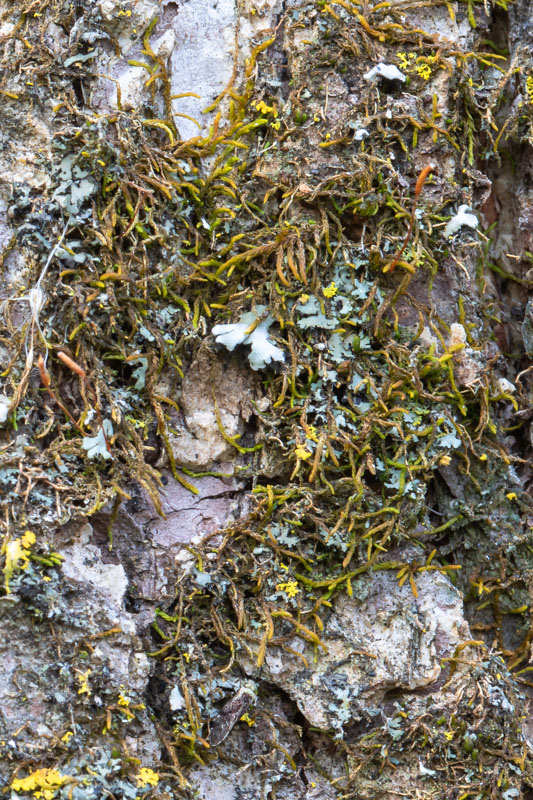
Moss & Lichen Interlace
A tight community of Hook-Moss filaments threading through pale foliose lichens and scattered Common Sunburst lichen patches.
Camera: Canon EOS 5D Mk IV
Lens: EF100mm f/2.8L Macro IS USM
Settings: ISO 200 • Aperture f/16.0 • Shutter 0.6 s
E21A6572 • Size: 1911x2866
Identification
- Growth form: Pleurocarpous; long, reclining stems forming loose mats.
- Leaves: Narrow, curved secund (hooked to one side), giving stems a flowing shape.
- Color: Yellow-green to olive; often glossier in wet conditions.
- Texture: Smooth, flexible, not tufted.
- Substrate: Wet bark, decaying logs, peat, fen soils, marsh margins, seepage zones.
- Common associates: Common Sunburst lichen, Physcia, Flavoparmelia, and moisture-tolerant epiphytic mosses.
This species is frequently confused with Scorpidium or Hypnum, but the strong leaf curvature and draping growth help distinguish it.
Habitat
Drepanocladus aduncus prefers environments where water is present or persists, including:
- Streambanks
- Springs and seeps
- Fens and calcareous wetlands
- Damp forest bases
- Moist, shaded bark on elm, ash, and maple
- Decaying wood with long-lasting humidity
These photos were taken near flowing water, a classic habitat where the moss’s long, flexible stems capture and hold moisture efficiently.
Collection
E21A6570 Barkside Cascade
E21A6572 Moss & Lichen Interlace
E21A6571 Streambank Tangle
References
-
Minnesota DNR – Bryophytes of Calcareous Fens Field Guide
https://files.dnr.state.mn.us/eco/mcbs/moss_booklets/mn_bryo_calcfen_fieldguide.pdf -
Drepanocladus aduncus – iNaturalist Taxon Page
https://www.inaturalist.org/taxa/154182-Drepanocladus-aduncus/browse_photos -
Bryophyte Flora of North America – Volume 1 (Mosses)
https://www.museums.ualberta.ca/bfna