
Physcia Aipolia
Physcia aipolia
Family: Physciaceae
Hoary Rosette Lichen (Physcia aipolia) is a common and easily recognized foliose lichen of bark and wood, notable for its pale gray thallus marked with distinct white maculae and abundant dark apothecia. It forms compact rosettes that often occur alongside other Physcia species, requiring attention to surface texture and reproductive structures for confident identification.
This page documents Research Grade observations on iNaturalist using photos E21A8059–8071. Visual presentation and artistic interpretation are handled separately in the Gallery section, Hoary Rosette page.
Description
The thallus is foliose, forming rounded to irregular rosettes typically 5–10 cm across. Lobes are narrow (1–3 mm), flat to slightly convex, and closely appressed to the substrate.
The upper surface is pale gray to bluish gray with conspicuous white maculae, giving the thallus a frosted or hoary appearance. The surface is smooth to weakly wrinkled and lacks soredia or isidia.
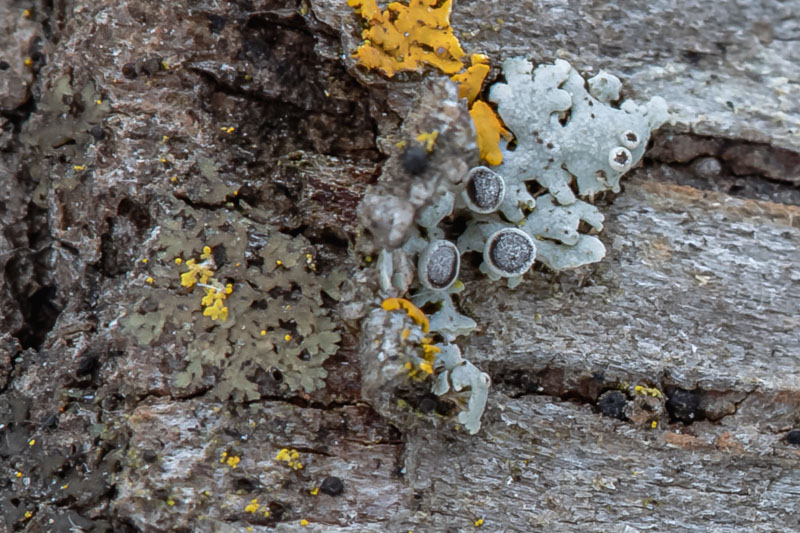
Apothecia are frequent and conspicuous—round, dark brown to black discs with a persistent pale margin—often crowding the central portions of mature thalli.
The lower surface is pale to dark brown with simple, unbranched rhizines.
Substrate and Habitat
Observed growing on hardwood bark, often on trunks and larger branches in open or lightly shaded conditions. Physcia aipolia is tolerant of moderate disturbance and is commonly encountered in urban, suburban, and woodland-edge environments.
Identification Notes
Key features supporting Physcia aipolia include:
- Pale gray thallus with distinct white maculation
- Absence of soredia and isidia
- Numerous dark apothecia with pale margins
- Narrow, appressed lobes forming compact rosettes
It can be confused with other Physcia species, particularly Powdered Rosette (Physcia millegrana), which differs by having soredia and typically fewer apothecia.
Apothecia Detail — Hoary Rosette
A close-up view of Hoary Rosette Lichen (Physcia aipolia) showing the characteristic dark apothecia with pale rims. These black-centered fruiting bodies are a key diagnostic feature, separating P. aipolia from similar Physcia species that are sorediate or produce fewer apothecia. Winter moisture enhances contrast between the discs, thallus, and bark, making this one of the most reliable field characters for confirmation.
Similar Species
- Powdered Rosette (Physcia millegrana) — sorediate, often lacking abundant apothecia
- Star Rosette (Physcia stellaris) — broader lobes, weaker maculation
- Physcia adscendens — helmet-shaped lobe tips with marginal soralia
Field Notes
These observations were made during winter conditions, where elevated humidity enhanced contrast between the pale maculae and darker apothecia. The strong rosette form and heavy apothecial production made this specimen particularly diagnostic.
References
- iNaturalist — Research Grade observation set (E21A8059–8071)
- Minnesota Lichen Guide
- Consortium of North American Lichen Herbaria