
Hoary Rosette Lichen
Physcia aipolia
Hoary Rosette Lichen is a pale gray foliose lichen distinguished by its frosted appearance, produced by white maculation across the upper surface. Compact rosettes cling closely to bark, often studded with dark apothecia that provide strong contrast in winter and early spring conditions.
This Gallery page focuses on visual form, surface texture, and growth habit. For diagnostic features and identification notes, see the Field Notes page: Physcia aipolia
Gallery
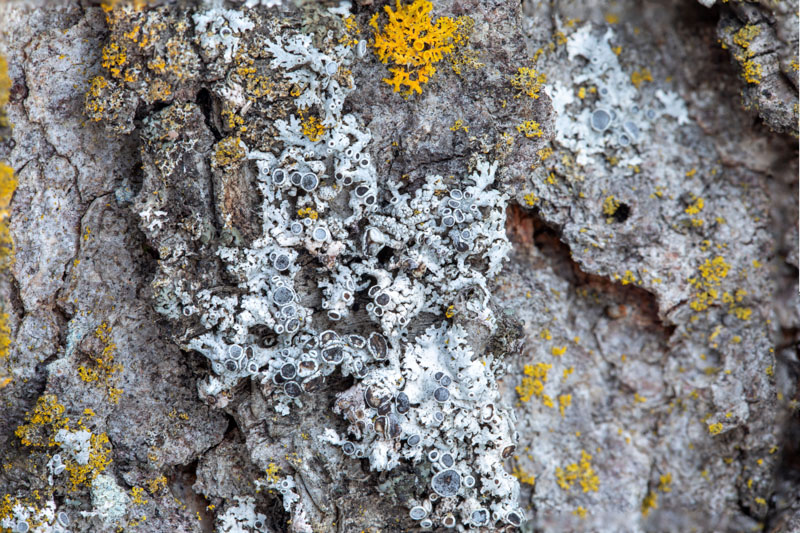 Hoary Rosette Community
Mature Physcia aipolia among mixed bark lichens
Camera: Canon EOS 5D Mk IV
Lens: EF100mm f/2.8L Macro IS USM
Settings: ISO 200 • Aperture f/13 • Shutter 3.2 s
E21A8059-8071 • Size: 6720x4480
Visual Notes
- Pale gray thallus with conspicuous white maculae
- Narrow, appressed lobes forming dense rosettes
- Abundant dark apothecia with pale margins
- Strong contrast under high humidity or snowmelt conditions
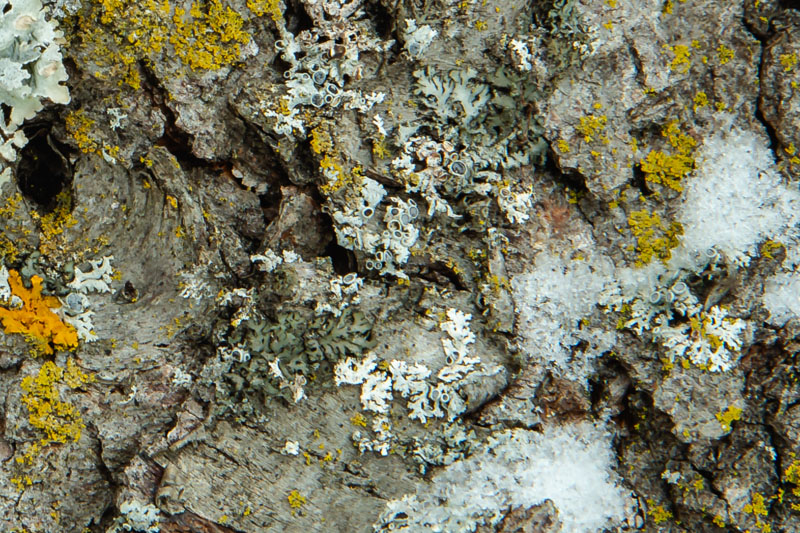 Hoary Rosette in Community
Physcia aipolia within a mixed winter bark assemblage
Camera: Canon EOS 5D Mk IV
Lens: EF100mm f/2.8L Macro IS USM
Settings: ISO 200 • Aperture f/13 • Shutter 3.2 s
E21A8043 • Size: 6720x4480
Hoary Rosette Lichen (Physcia aipolia) appears here as part of a mixed bark community, growing alongside other gray and yellow lichens on fissured hardwood bark. In such shared spaces, subtle differences in surface texture, maculation, and apothecia become more apparent, especially under winter conditions. Elevated moisture and low-angle light enhance contrast between neighboring species, making community-level views particularly useful for understanding how Physcia species coexist and distinguish themselves in the field.
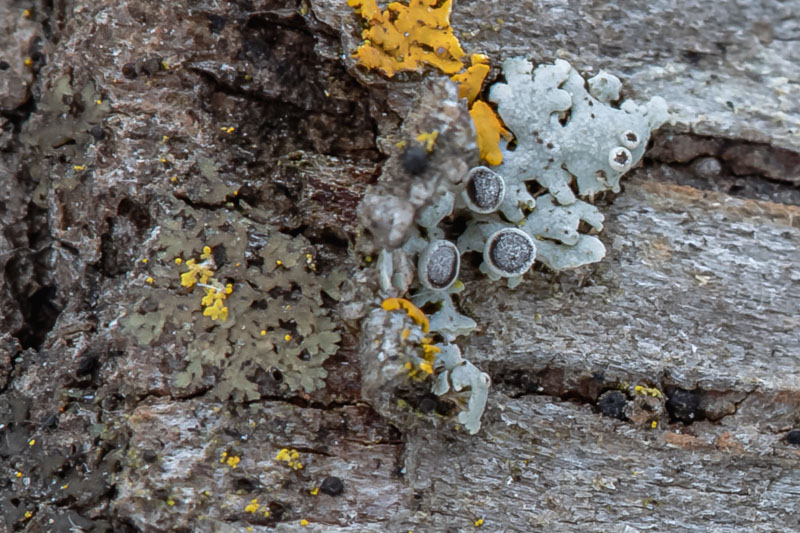 Hoary Rosette — Apothecia in Context
Diagnostic fruiting bodies of Physcia aipolia
Camera: Canon EOS 5D Mk IV
Lens: EF100mm f/2.8L Macro IS USM
Settings: ISO 200 • Aperture f/13 • Shutter 2.5 s
E21A8187 • Size: 1508x1005
A close view of Hoary Rosette Lichen (Physcia aipolia) reveals the dark, rounded apothecia with pale rims that distinguish this species from other Physcia lichens. Set against fissured bark and neighboring lichens, the apothecia stand out clearly, especially under winter conditions that enhance contrast. Paired with wider community views, this image links fine detail with overall growth habit.
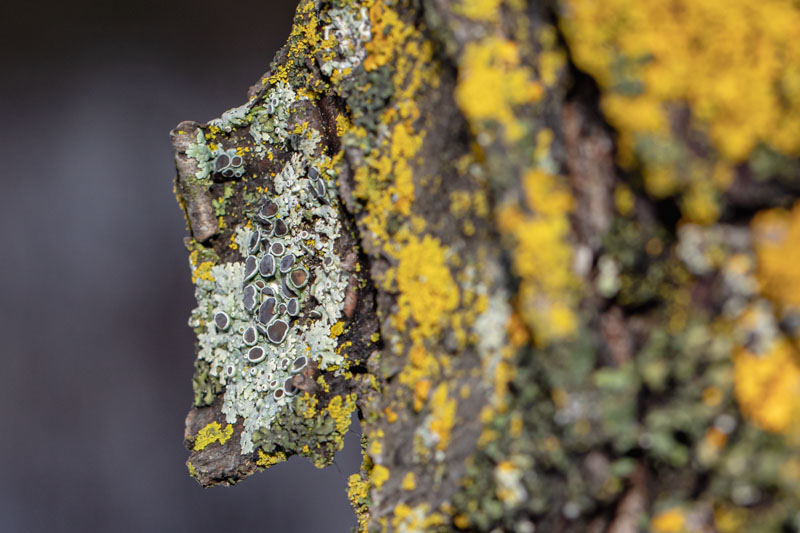 Hoary Rosette at the Margin
Physcia aipolia within a layered bark community
Camera: Canon EOS 5D Mk IV
Lens: EF100mm f/2.8L Macro IS USM
Settings: ISO 200 • Aperture f/8 • Shutter 1/60 s • Flash
E21A8604 • Size: 2745x1830
A narrow strip of bark supports a small colony of Hoary Rosette Lichen (Physcia aipolia), surrounded by bright yellow crustose lichens and darker bark textures. Seen along an exposed edge, the pale rosettes and dark apothecia stand out against neighboring species, illustrating how Physcia aipolia often occupies transitional spaces within mixed bark communities. The shallow depth of field emphasizes both isolation and connection—an ending view that reflects coexistence rather than dominance.
Related Pages
-
Field Notes:
Hoary Rosette Lichen (Physcia aipolia) -
Similar Galleries: