Yellow-rumped Warbler — Photographic Sequence
Setophaga coronata
The Yellow-rumped Warbler photographs collected here follow a short autumn encounter as the birds moved through a juniper and nearby branches. The upper crown still held abundant berries, while the lower branches were largely bare. The warblers concentrated their feeding higher in the tree, then returned to more open perches below. For identification, habitat, and natural-history details, see the Setophaga coronata species page.
The photographs work best as a sequence rather than as isolated portraits. They move from an open perch to active feeding, then to preening and quieter pauses where the bird’s eye ring, breast streaking, wing pattern, yellow flank, and yellow rump become easier to study.
Open Sky
E22B0979 begins the sequence on a bare diagonal branch against open blue sky. The bird is relatively small in the frame, but the clean background and simple perch give the photograph a strong graphic quality.
The yellow flank patch is visible even at this distance, while the streaked breast and pale eye ring remain readable. The open perch also introduces the contrast that became apparent during the encounter: the lower branches were sparse, while the upper portions of the juniper still carried dense clusters of berries.
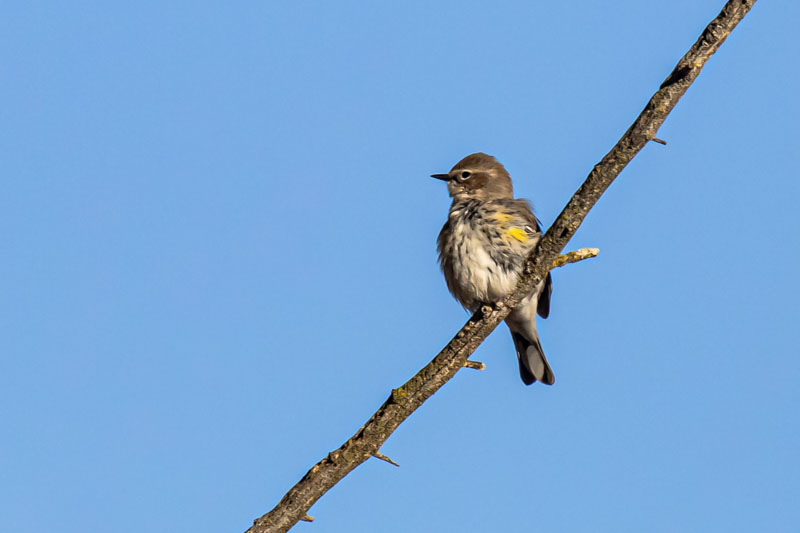
Open Sky
A quiet perch gives the warbler room against an uninterrupted blue background.
Camera: Canon EOS 5D Mark IV
Lens: EF100-400mm f/4.5-5.6L IS USM
Settings: ISO 3200 • Aperture f/9.0 • Shutter 1/5000 s
E22B0979 • Size: 2000 x 1333
Feeding in the Juniper
Higher in the tree, the setting changed completely. Dense sprays of juniper foliage still carried ample berries, and the Yellow-rumped Warblers moved through those upper branches to feed.
E22B1003 gives the clearest view of the behavior. The bird is framed by fruiting branches with its bill open, making the feeding activity immediately apparent. E22B1005 places the bird deeper in the foliage and shows how enclosed the upper feeding area could become.
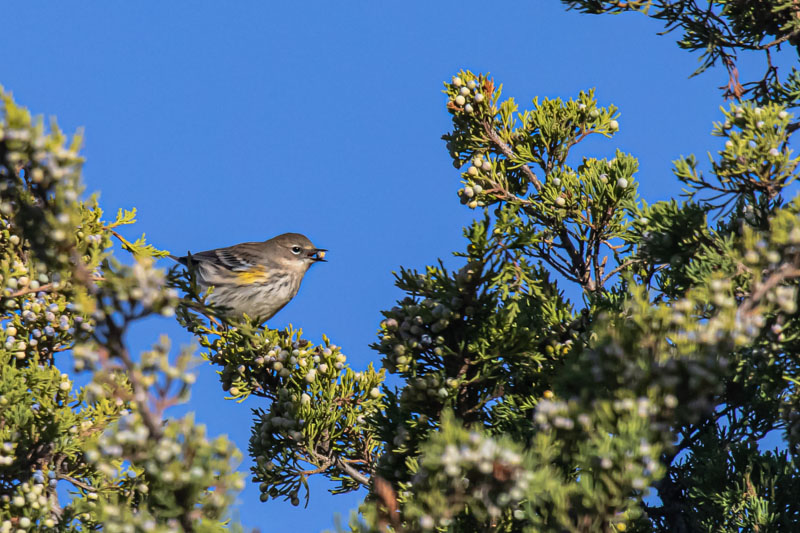
Among the Juniper Berries
The upper branches still hold an ample food supply.
Camera: Canon EOS 5D Mark IV
Lens: EF100-400mm f/4.5-5.6L IS USM
Settings: ISO 3200 • Aperture f/10.0 • Shutter 1/4000 s
E22B1003 • Size: 2400 x 1600
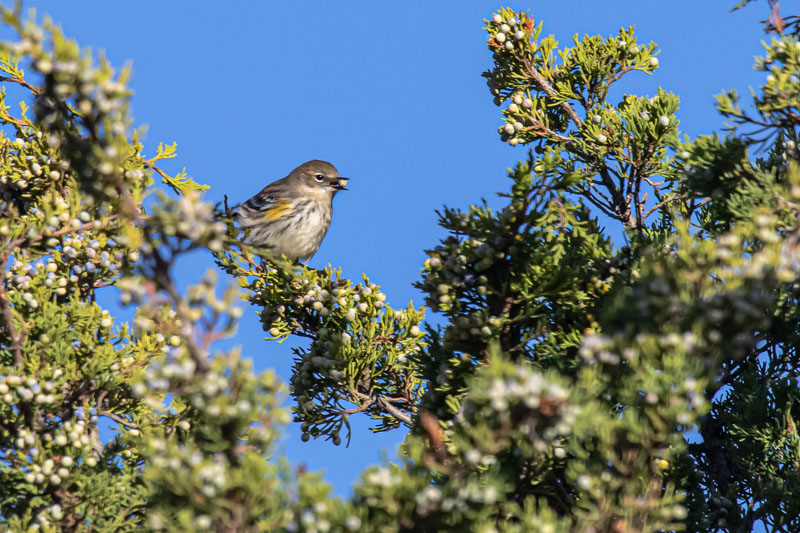
Deeper in the Juniper
Dense foliage surrounds the bird where the berries remain plentiful.
Camera: Canon EOS 5D Mark IV
Lens: EF100-400mm f/4.5-5.6L IS USM
Settings: ISO 3200 • Aperture f/10.0 • Shutter 1/2000 s
E22B1005 • Size: 2400 x 1600
The contrast between the sparse lower limbs and the berry-rich crown became one of the clearest observations from the encounter. The birds were not simply passing through the juniper; they were concentrating their activity where the remaining fruit was most abundant.
Preening on the Lower Branches
After feeding higher in the tree, the sequence returns to the open lower branches. The uncluttered setting reveals more of the plumage, especially the bright yellow rump that gives the species its common name.
E22B1012 catches the bird with its head buried into the back feathers. E22B1013 follows with the eye visible during the preening movement and the yellow rump exposed prominently. In E22B1014, the bird settles upright again, leaving the rump and patterned folded wing clearly visible against the sky.
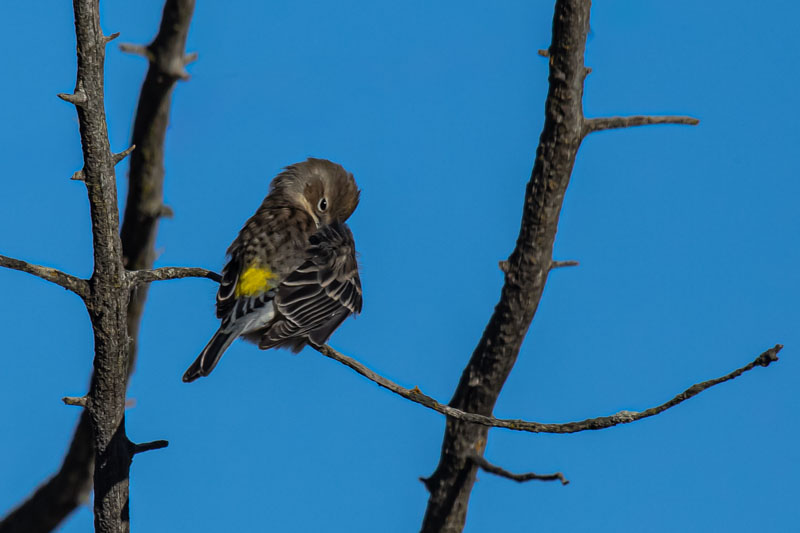
Preening Begins
The head disappears into the back feathers as the bird pauses to groom.
Camera: Canon EOS 5D Mark IV
Lens: EF100-400mm f/4.5-5.6L IS USM
Settings: ISO 3200 • Aperture f/10.0 • Shutter 1/4000 s
E22B1012 • Size: 2400 x 1600
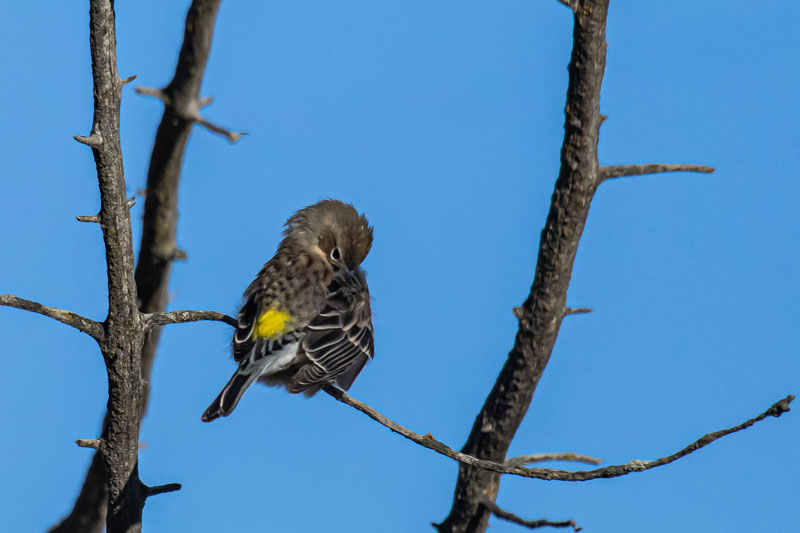
Yellow Revealed
Preening parts the feathers and exposes the bright yellow rump.
Camera: Canon EOS 5D Mark IV
Lens: EF100-400mm f/4.5-5.6L IS USM
Settings: ISO 3200 • Aperture f/10.0 • Shutter 1/8000 s
E22B1013 • Size: 2400 x 1600
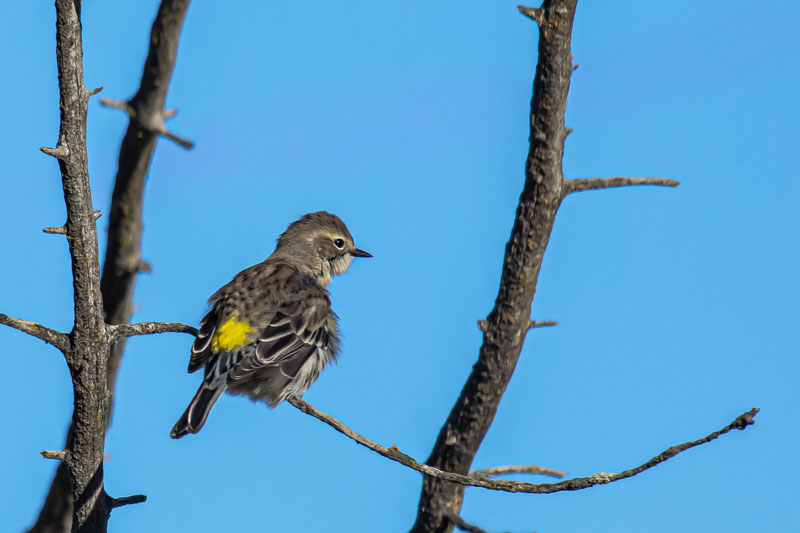
Rump in the Sun
An open lower perch gives a clear view of the feature behind the name.
Camera: Canon EOS 5D Mark IV
Lens: EF100-400mm f/4.5-5.6L IS USM
Settings: ISO 3200 • Aperture f/10.0 • Shutter 1/2000 s
E22B1014 • Size: 2400 x 1600
The three frames are strongest together because the behavior reveals a field mark that is less obvious in the side portraits. The yellow rump is not merely documented; it becomes part of the action.
Among the Branches
The next three photographs move back into a more layered woodland setting. A diagonal branch crosses in front of the bird while darker trunks, patches of blue sky, and soft foliage create depth around the perch.
Here the value is continuity. The perch and lighting remain nearly constant while the bird changes its attention from the branches below, to a side profile, and finally outward toward the camera.
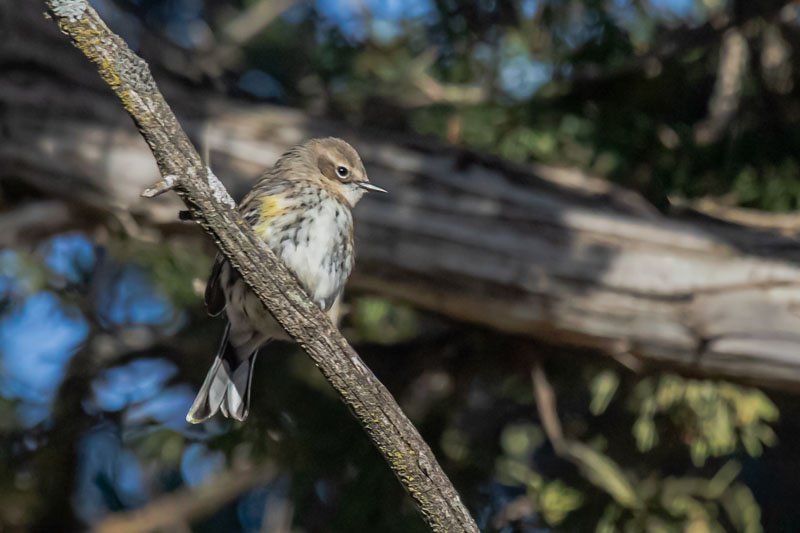
Looking Below
A downward glance draws attention into the branches beneath the perch.
Camera: Canon EOS 5D Mark IV
Lens: EF100-400mm f/4.5-5.6L IS USM
Settings: ISO 3200 • Aperture f/8.0 • Shutter 1/6400 s
E22B1018 • Size: 2400 x 1600
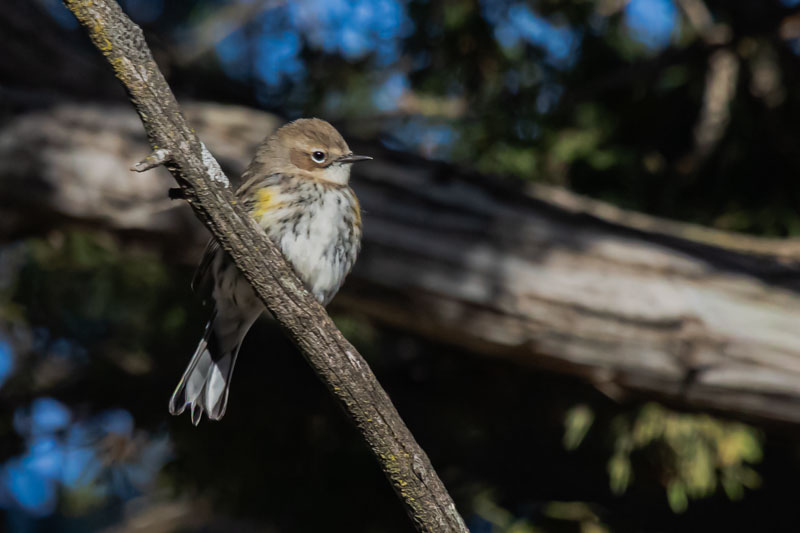
Side Glance
A brief profile brings the eye ring, fine bill, and breast streaking into view.
Camera: Canon EOS 5D Mark IV
Lens: EF100-400mm f/4.5-5.6L IS USM
Settings: ISO 3200 • Aperture f/8.0 • Shutter 1/6400 s
E22B1021 • Size: 2400 x 1600
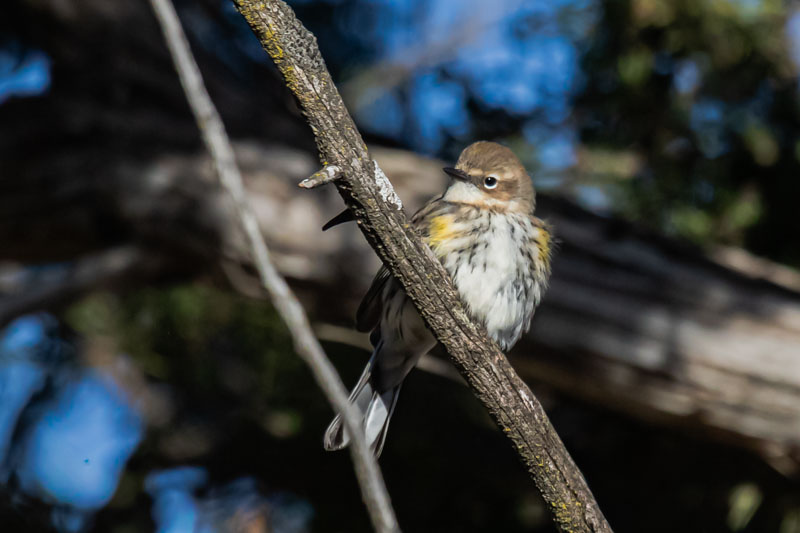
Through the Branches
An open eye and outward look give the final woodland frame a more direct presence.
Camera: Canon EOS 5D Mark IV
Lens: EF100-400mm f/4.5-5.6L IS USM
Settings: ISO 3200 • Aperture f/8.0 • Shutter 1/6400 s
E22B1024 • Size: 2400 x 1600
The sequence reads naturally as:
downward glance → side profile → outward look
The surrounding branches are more prominent than in the open-sky portraits, but they preserve the sense of a small warbler moving through the interior of the tree.
On the Lichen Branch
E22B1030 closes the encounter with the cleanest portrait in the group. The Yellow-rumped Warbler sits fully visible on a lichen-covered branch, separated from the background by a broad field of soft brown and muted vertical grasses.
The eye, streaked breast, folded wing, and yellow flank patch all remain easy to read. Compared with the busier feeding and woodland photographs, the simple background gives the bird more visual weight while the textured branch still preserves a sense of place.
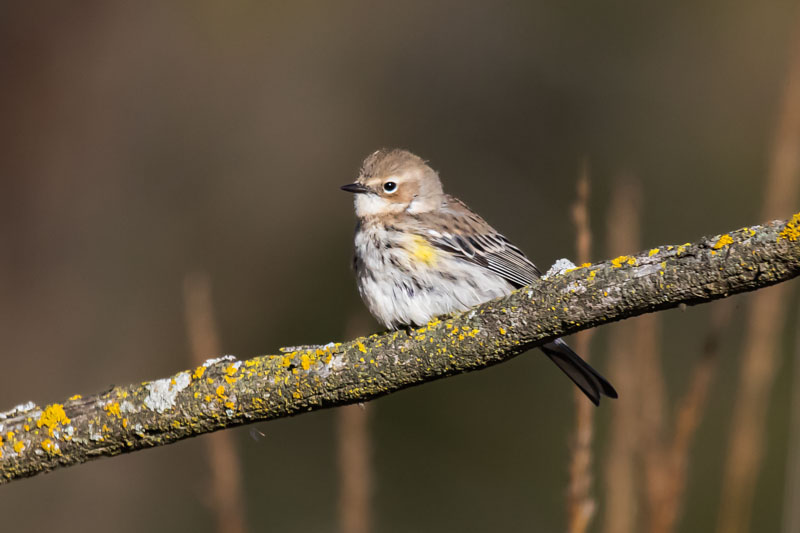
Yellow on the Flank
A clean autumn portrait with the bird’s yellow side patch catching the light.
Camera: Canon EOS 5D Mark IV
Lens: EF100-400mm f/4.5-5.6L IS USM
Settings: ISO 3200 • Aperture f/8.0 • Shutter 1/6400 s
E22B1030 • Size: 2400 x 1600
Photographer’s Perspective
What began as a small set of perched portraits developed into a more complete account of the encounter.
The open lower branches and berry-rich upper crown established the setting. E22B1003 and E22B1005 added feeding behavior, while E22B1012–1014 showed the birds returning to the lower limbs to preen. That sequence also produced the clearest views of the yellow rump. E22B1018–1024 recorded quieter changes in attention among the branches, and E22B1030 provided the strongest close portrait.
The photographs now form a progression:
open perch → feeding → preening → changing attention → clean portrait
Several of the individual frames stand on their own. E22B1030 is the strongest close portrait, E22B0979 the cleanest minimalist composition, and E22B1014 one of the clearest identification views. The Field Notes page benefits from keeping the less polished frames as well, because the sequence shows how the bird moved through the tree and how behavior revealed details that a single portrait could not.
Return of the EOS 7D
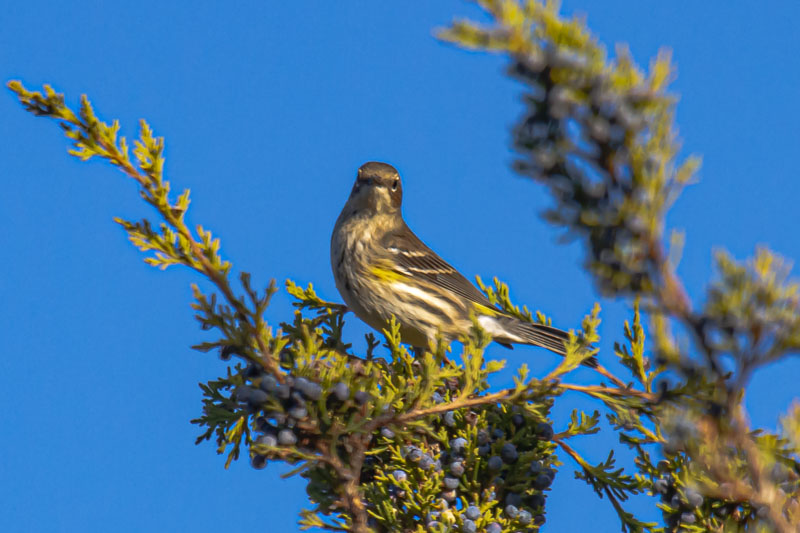
Camera: Canon EOS 7D
Lens: EF100-400mm f/4.5-5.6L IS USM
ISO: 1000 • Aperture: f/8.0 • Shutter 1/640 s
D19D0030 • Size: 2000 x 1333
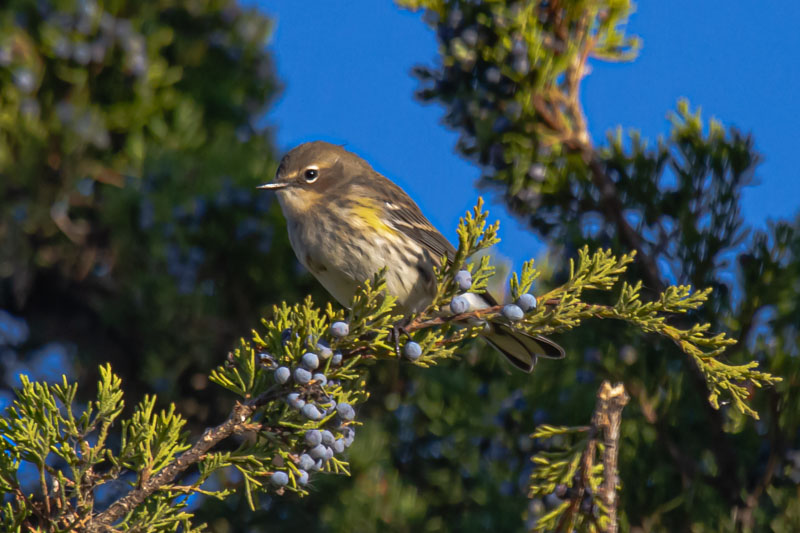
Camera: Canon EOS 7D
Lens: EF100-400mm f/4.5-5.6L IS USM
ISO: 1000 • Aperture: f/8.0 • Shutter 1/640 s
D19D0051 • Size: 2000 x 1333
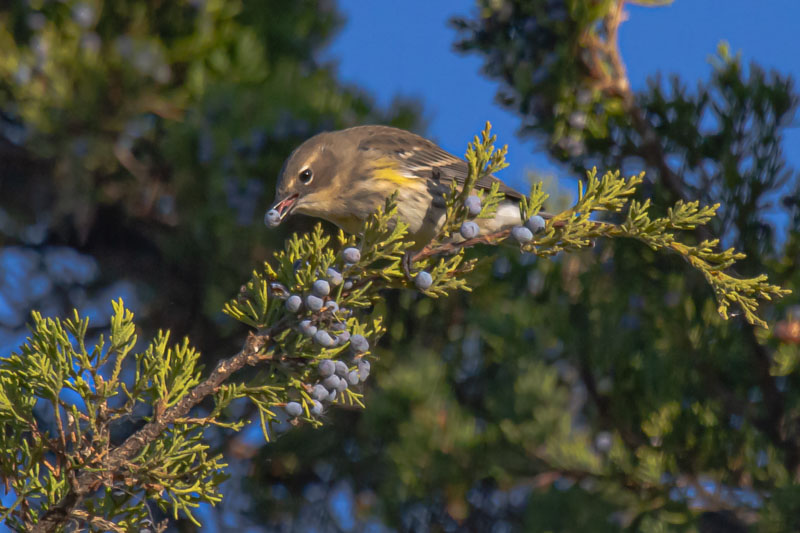
Camera: Canon EOS 7D
Lens: EF100-400mm f/4.5-5.6L IS USM
ISO: 1000 • Aperture: f/8.0 • Shutter 1/640 s
D19D0052 • Size: 2000 x 1333
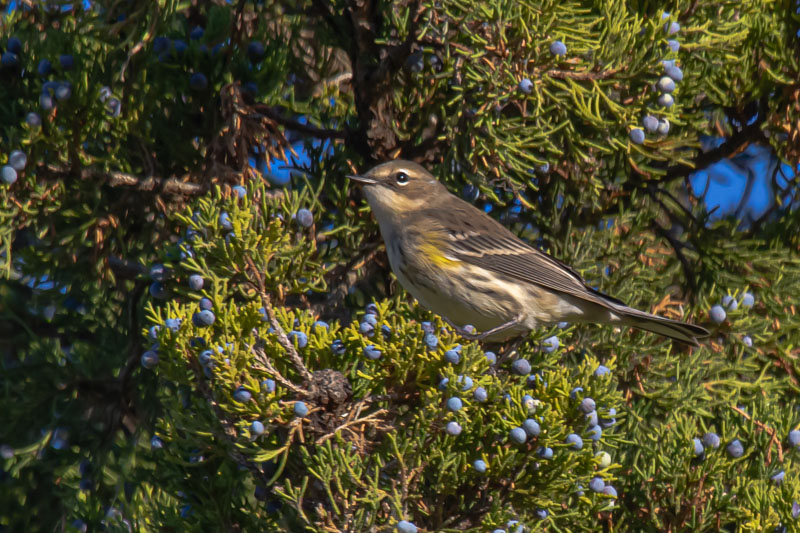
Camera: Canon EOS 7D
Lens: EF100-400mm f/4.5-5.6L IS USM
ISO: 1000 • Aperture: f/8.0 • Shutter 1/640 s
D19D0042 • Size: 2000 x 1333
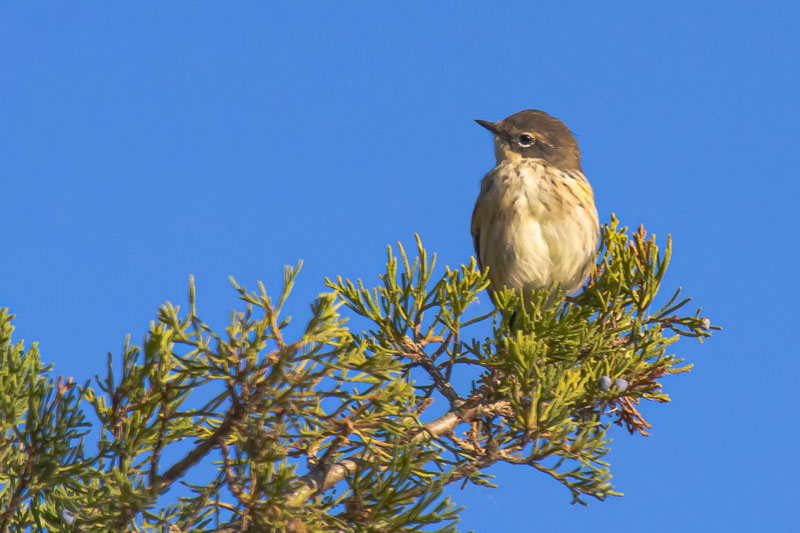
Camera: Canon EOS 7D
Lens: EF100-400mm f/4.5-5.6L IS USM
ISO: 1000 • Aperture: f/8.0 • Shutter 1/640 s
D19D0055 • Size: 2000 x 1333
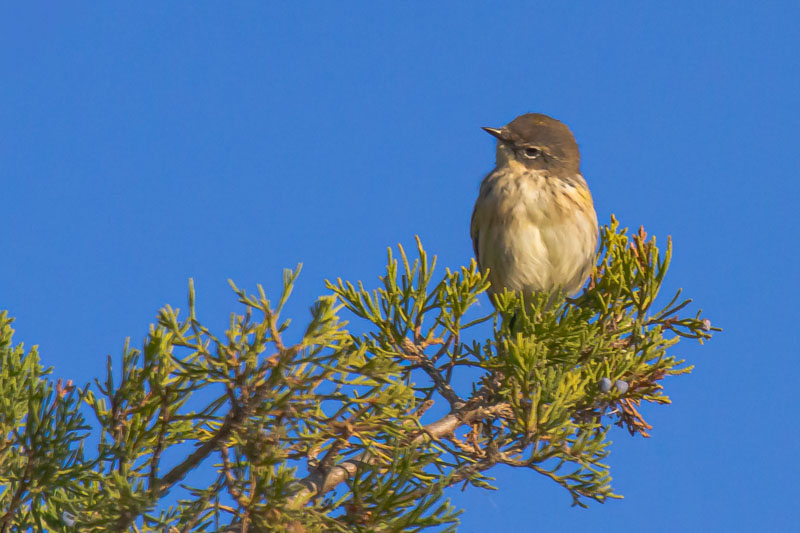
Camera: Canon EOS 7D
Lens: EF100-400mm f/4.5-5.6L IS USM
ISO: 1000 • Aperture: f/8.0 • Shutter 1/640 s
D19D0056 • Size: 2000 x 1333
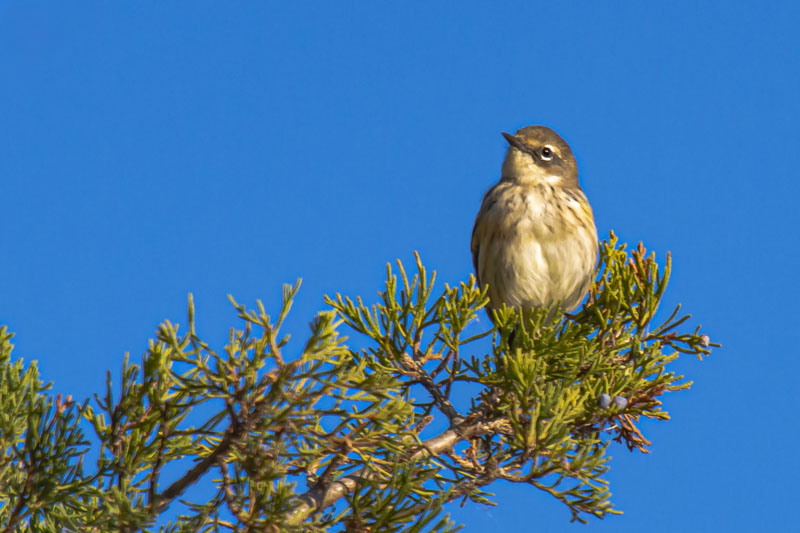
Camera: Canon EOS 7D
Lens: EF100-400mm f/4.5-5.6L IS USM
ISO: 1000 • Aperture: f/8.0 • Shutter 1/640 s
D19D0057 • Size: 2000 x 1333