Great Blue Heron — Photography Sequence
Ardea herodias
The Great Blue Heron photographs in the Gallery highlight the bird’s form and feather detail. This sequence follows small changes in posture and light while the heron remained on a rounded boulder in the pond. For identification, habitat, and natural-history details, see the Ardea herodias species page in Field Notes.
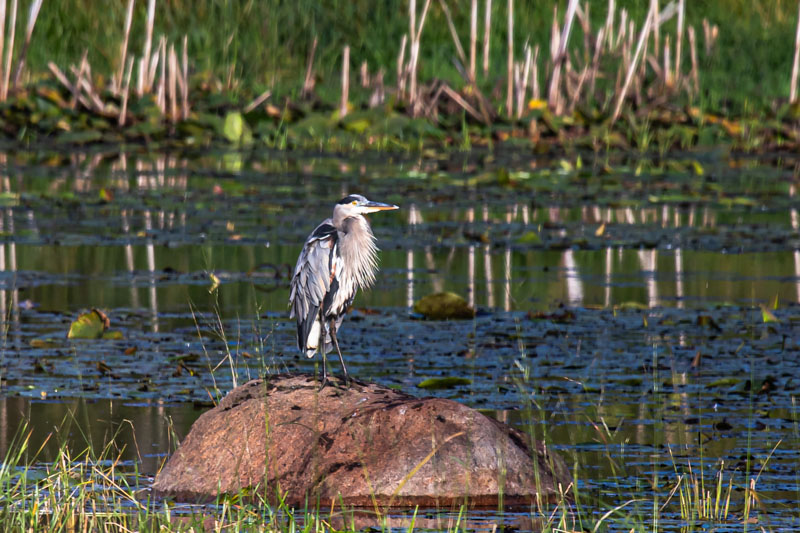 An Island of Its Own
A rounded boulder gives a lone Great Blue Heron a place above the water.
Camera: Canon EOS 5D Mark IV
Lens: EF100-400mm f/4.5-5.6L IS USM
ISO: 200 • Aperture: f/8 • Shutter: 1/250 sec
E22B0514 • Size: 2400 x 1600
Photographic Sequence
The rock provides a consistent setting across these four photographs. Reeds, floating leaves, and reflections surround the heron, while changes in its head position alter the outline of the bill and the arrangement of the long feathers. Clouds obscured the sun during the encounter, changing both the illumination and the appearance of the gray plumage.
A Turn and a Pause
A backward glance draws attention to the spreading breast feathers in E22B0525. In E22B0531, the heron faces more toward the camera, with sunlight illuminating the breast and layered wing feathers.
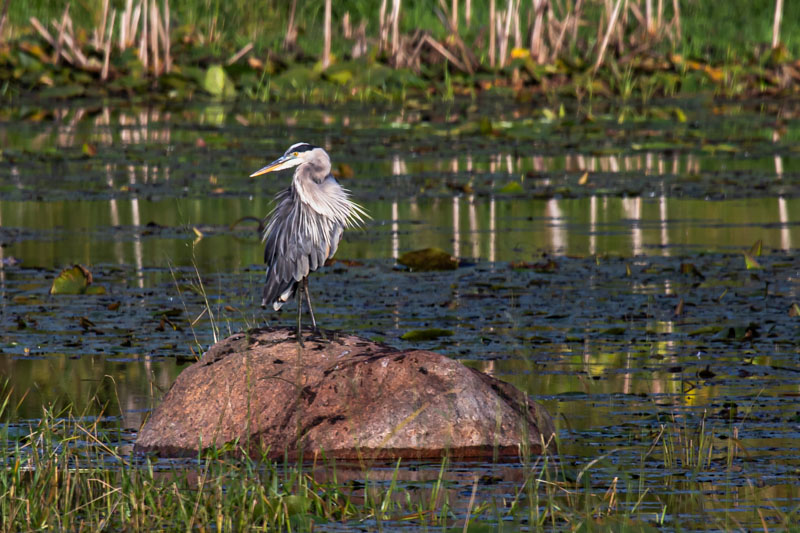 A Quiet Turn
Long breast feathers spread over folded wings as a Great Blue Heron looks back.
Camera: Canon EOS 5D Mark IV
Lens: EF100-400mm f/4.5-5.6L IS USM
ISO: 200 • Aperture: f/8 • Shutter: 1/250 sec
E22B0525 • Size: 2400 x 1600
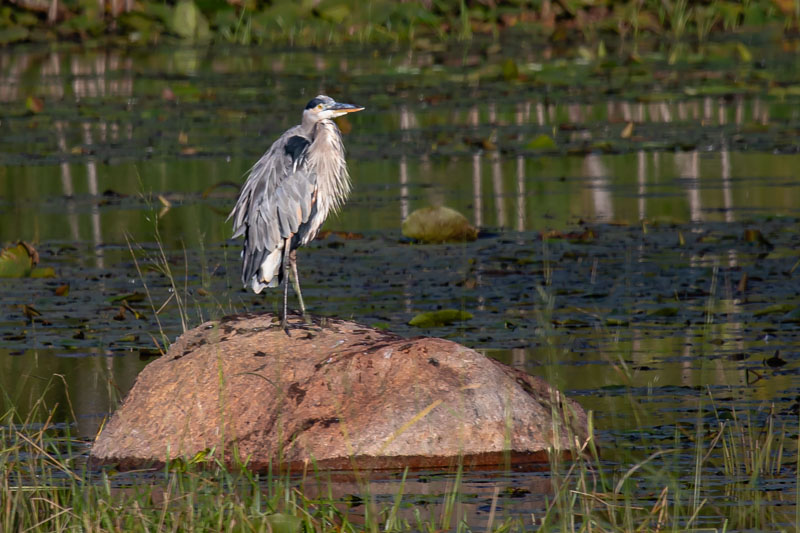 A Place to Pause
Sunlight catches the heron’s long breast feathers as it surveys the pond from a rocky perch.
Camera: Canon EOS 5D Mark IV
Lens: EF100-400mm f/4.5-5.6L IS USM
ISO: 200 • Aperture: f/8 • Shutter: 1/250 sec
E22B0531 • Size: 2000 x 1333
These frames record small changes in posture rather than a feeding sequence. The surrounding water remains part of the composition, placing the feather detail within the wider wetland setting.
Feathers in the Light
In E22B0550, the heron’s head forms a clear profile above the layered feathers of its back and folded wings. Compared with the brighter E22B0531, the finished photograph has cooler gray tones and more subdued highlights.
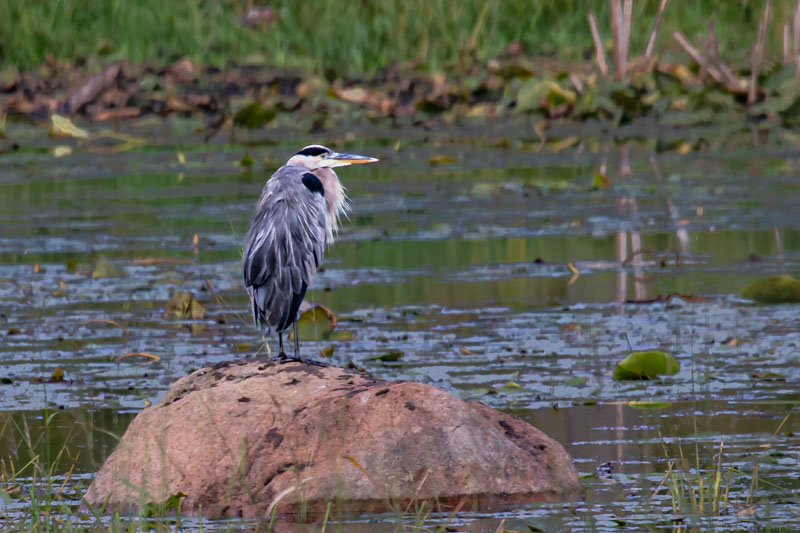 Feathers in the Light
Long silver-gray plumes catch the sunlight, standing out against the darker water.
Camera: Canon EOS 5D Mark IV
Lens: EF100-400mm f/4.5-5.6L IS USM
ISO: 400 • Aperture: f/8 • Shutter: 1/250 sec
E22B0550 • Size: 2000 x 1333
White Balance
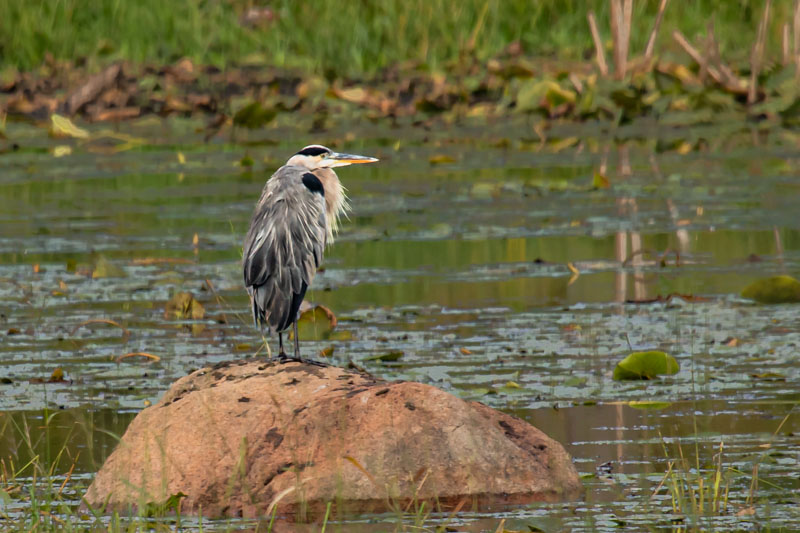
Clouds obscured the sun during this encounter. ISO was increased from 200 to 400 to compensate for the reduced light while retaining f/8 and 1/250 second. That change addressed the lower illumination; white balance addresses the color of the light.
The earlier rendering of E22B0550 above has a cooler, slightly blue-violet appearance in the plumage. E22B0550-2 below uses the Cloudy white-balance setting. The feathers appear more neutral gray, the rock looks warmer, and the greens in the pond are more pronounced. These are two renderings of the same photograph, allowing the color treatment to be compared without a change in the bird’s pose.
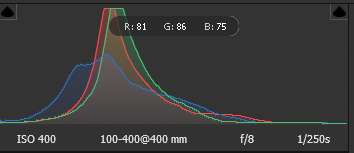
_Histogram E22B0550, showing the Automatic (Daylight) white-balance.
Camera: Canon EOS 5D Mark IV
Lens: EF100-400mm f/4.5-5.6L IS USM
ISO: 400 • Aperture: f/8 • Shutter: 1/250 sec
E22B0550 • Size: 2000 x 1333
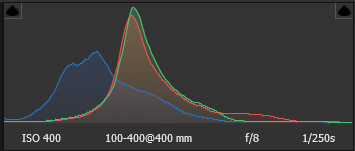
Histogram E22B0550-2, the Cloudy white-balance version.
Camera: Canon EOS 5D Mark IV
Lens: EF100-400mm f/4.5-5.6L IS USM
ISO: 400 • Aperture: f/8 • Shutter: 1/250 sec
E22B0550-2 • Size: 2000 x 1333
The histograms show the white-balance. The Cloudy setting is confirmed from the edit, although the white-balance control itself is not visible in this clip. The earlier version’s white-balance setting has not been recorded here.
The warmer rendering fits more comfortably alongside the sunlit E22B0531 while preserving the feather separation and clear profile of E22B0550. The comparison illustrates why exposure and white balance should be considered separately: raising ISO compensates for reduced light, while adjusting white balance changes how the colors are rendered.
Feathers in the Light — Cloudy White Balance
The Cloudy setting warms the scene, reducing the cool cast in the heron’s silver-gray feathers.
Photographic Notes
All four photographs were made with a Canon EOS 5D Mark IV and an EF100-400mm f/4.5-5.6L IS USM lens. Keeping the rock and surrounding pond in the frame preserves the setting while allowing the poses and feather patterns to be compared.
E22B0550 offers the clearest side profile and a strong view of the layered plumage. E22B0531 emphasizes the illuminated breast feathers, E22B0525 adds the backward glance, and E22B0514 introduces the broader setting. Together, they show how a stationary subject can yield distinct photographs through small changes in posture and passing cloud cover.