Virginia Ctenucha — Photographic Sequence
Ctenucha virginica
The Virginia Ctenucha photographs collected here follow a single rain-damp encounter in tall grass. The moth repeatedly changed position, spreading and lifting its wings, turning toward the camera, and finally clinging upright to a stem. For identification, habitat, and natural-history details, see the Ctenucha virginica species page.
Taken together, the photographs show how strongly posture changes the moth’s appearance. Its broad, nearly black wings can dominate the silhouette, then part to reveal an orange collar and metallic-blue thorax and abdomen. As the moth turns, the long, comb-like antennae become as visually prominent as its color.
Wings in the Wet Grass
E21A1656 establishes both the moth and its setting. The Virginia Ctenucha spreads its broad wings across the rain-damp vegetation, their pale outer margins separating the dark silhouette from the surrounding green. The orange collar and metallic-blue thorax appear below the wing bases, offering the first glimpse of the brighter color concealed by a closed resting posture.
The side view also records the moth’s unusually long antennae and the way it moves through closely spaced stems and leaves. Rather than isolating the insect, the photograph preserves the meadow as part of the encounter.
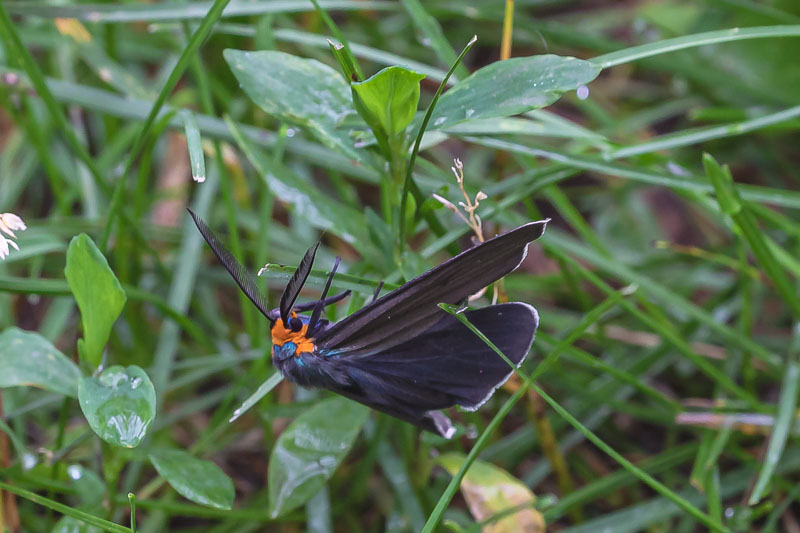
Wings Across the Grass
Broad, pale-edged wings sweep through the wet vegetation as orange and cobalt markings emerge beneath them.
Camera: Canon EOS 5D Mark IV
Lens: EF100mm f/2.8L Macro IS USM
Settings: ISO 200 • Aperture f/9.0 • Shutter 1/30 s
E21A1656 • Size: 1800 x 1200
Color Beneath the Wings
E21A1660 turns the moth toward the camera. The raised wings form a dark frame around the face, while the orange collar and blue shoulder patches become the visual center. Wet leaves and crossing stems still surround the insect, but the frontal posture gives the encounter a more animated character.
Less than a minute later, E21A1661 moves closer and becomes the defining portrait of the sequence. The tighter composition resolves the fine branches of the antennae, the texture of the orange scales, and the metallic-blue thorax. The clean foreground allows those structures to read clearly while enough vegetation remains to preserve the natural setting.
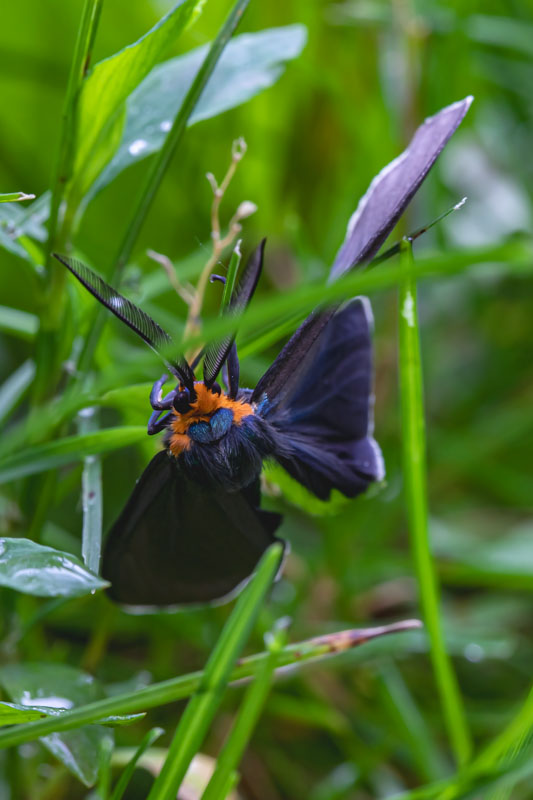
A Flash Beneath the Wings
A frontal wing lift briefly reveals the vivid blue and orange hidden within the moth’s darker resting silhouette.
Camera: Canon EOS 5D Mark IV
Lens: EF100mm f/2.8L Macro IS USM
Settings: ISO 200 • Aperture f/13.0 • Shutter 1/4 s
E21A1660 • Size: 5300 x 3533
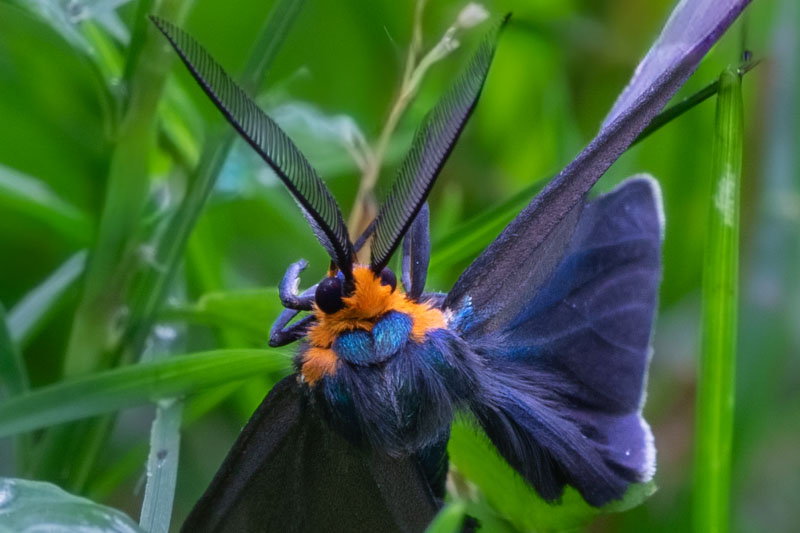
Feathered Antennae
Comb-like antennae rise above an orange collar and metallic-blue thorax as the dark wings open behind them.
Camera: Canon EOS 5D Mark IV
Lens: EF100mm f/2.8L Macro IS USM
Settings: ISO 200 • Aperture f/13.0 • Shutter 1/4 s
E21A1661 • Size: 1300 x 867
Upright in the Grass
E21A1664 closes the sequence with a distinct change in orientation. The moth clings vertically to a narrow stem, exposing more of the metallic-blue abdomen beneath the raised wings. One antenna follows the stem upward while the other reaches into open space, giving the moth and vegetation a shared vertical rhythm.
The closer crop makes this posture easy to read and reduces the competing grass around the subject. It preserves useful underside and abdomen detail while giving the antennae and upright stance room to define the frame.
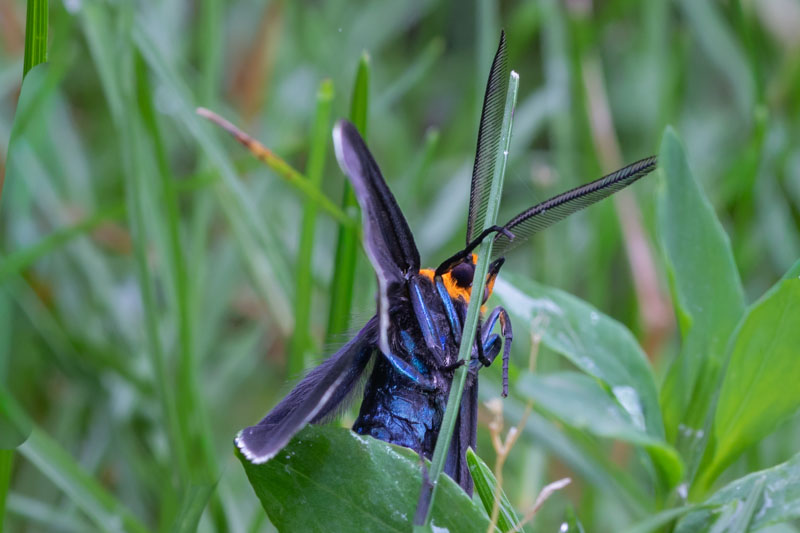
Upright in the Grass
Clinging to a slender stem, the moth exposes a metallic-blue abdomen beneath raised wings and reaching antennae.
Camera: Canon EOS 5D Mark IV
Lens: EF100mm f/2.8L Macro IS USM
Settings: ISO 200 • Aperture f/10.0 • Shutter 1/4 s
E21A1664 • Size: 2000 x 1333
Field Characters Across the Sequence
The four views record complementary identification characters:
- E21A1656 shows the broad, dark forewings with pale margins, the orange head and collar, and the metallic-blue thorax.
- E21A1660 provides a frontal view of the orange collar and blue shoulder patches between the raised wings.
- E21A1661 gives the clearest view of the long, comb-like antennae and the texture of the head and thorax.
- E21A1664 exposes more of the metallic-blue abdomen and records the upright clinging posture.
The surroundings add useful habitat context. Wet, closely spaced grass blades repeatedly cross the moth’s outline, consistent with an insect encountered low in moist meadow vegetation. The photographs are less diagrammatic than a clean specimen view, but they preserve the conditions in which the moth was found.
For comparison with the similar Yellow-collared Scape Moth, the most useful details in this set are the Virginia Ctenucha’s relatively broad wings, metallic-blue thorax, and collar that broadens toward the shoulders. The hindwings are not fully exposed, so the sequence does not show every diagnostic character.
Perspective
The sequence progresses through posture rather than a change of setting. E21A1656 begins with a broad side view among wet leaves. E21A1660 turns the orange-and-blue markings toward the camera. E21A1661 moves into an intimate portrait dominated by the antennae, and E21A1664 finishes with the moth clinging upright to a stem.
wings spread across the grass → frontal wing lift → feathered antennae portrait → upright stem-clinging posture
The four photographs show a moth whose appearance changes continuously with movement. Broad dark wings, saturated body color, and finely branched antennae take turns defining the subject, while the wet meadow remains visible around every pose.