Monarch Photographic Sequence
Danaus plexippus
The Monarch photographs in this sequence show the species in several useful contexts: an adult nectaring among tall yellow prairie flowers, a butterfly approaching purple thistle in flight, close views on yellow flowers, and a striped caterpillar on milkweed. Together, the images connect the adult butterfly to its meadow habitat and to the larval stage that depends on milkweed.
For identification details and natural history notes, see the species page: Danaus plexippus. For the finished image presentation, see the Gallery page: Monarch.
Photographic Sequence
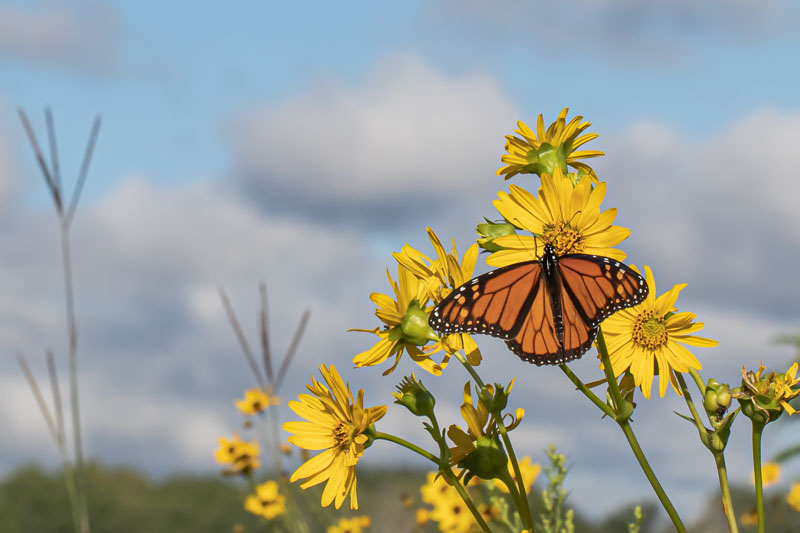
Monarch Among Prairie Flowers
The tighter crop gives the Monarch a stronger role in the frame while keeping the blue sky, clouds, and tall yellow flowers as habitat context.
E21A3459
The adjusted crop of E21A3459 is the strongest overall adult Monarch image in the set. The butterfly is large enough to read clearly, but the scene still feels open and environmental. The yellow flowers, blue sky, and soft clouds give the image a prairie-summer setting rather than a simple close-up.
The original wider version had a broader meadow feel, but the butterfly was smaller and had to compete more with the surrounding flowers. This revised version keeps the better parts of the wide image while making the Monarch the clear subject.
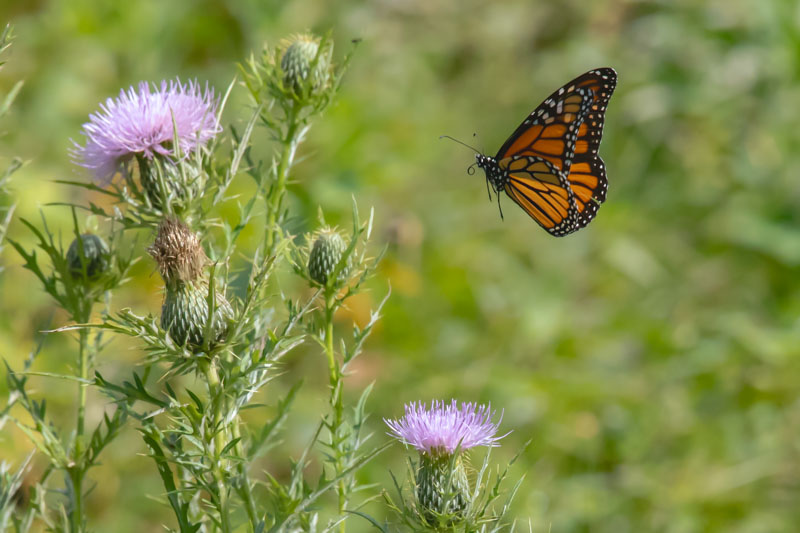
Monarch Approaching Thistle
A flight view with purple thistle flowers, giving the sequence a different flower type, wing angle, and behavior.
E21A5083
E21A5083 adds a different kind of Monarch image. Instead of a perched or nectaring pose, the butterfly is suspended in flight near purple thistle flowers. The open green background helps separate the butterfly, while the thistle stems anchor the left side of the frame.
This image is not as strong as a close identification view, but it is important to the sequence because it adds movement and behavior. It also broadens the floral context beyond the yellow composite flowers shown in the other adult images.
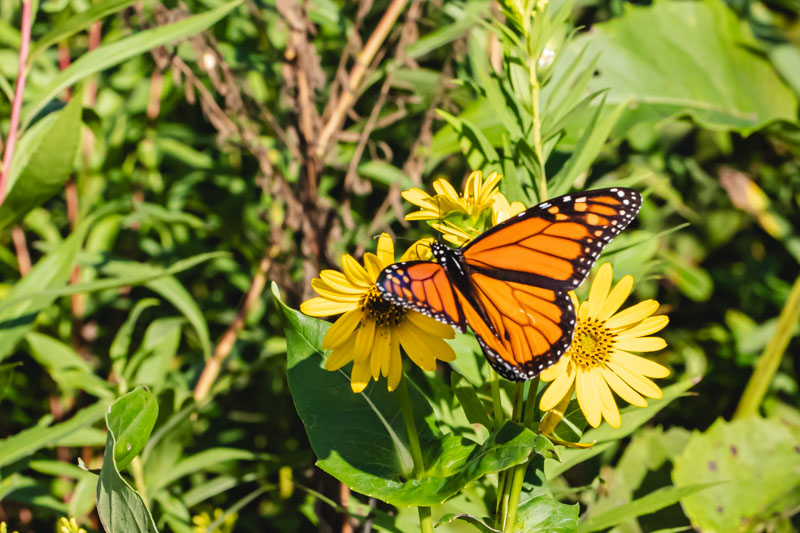
Monarch on Yellow Flowers
A closer dorsal view showing the orange wings, black veins, and white-spotted margins.
E21A3466
E21A3466 is the clearest adult identification image in the group. The Monarch fills more of the frame than in the habitat views, and the dorsal wing pattern is easy to see. The black venation, orange wing panels, and white-spotted dark margins are all visible.
The background is busier than in the later crop of E21A3459, but this image remains useful because the butterfly itself is large, sharp, and readable. It provides a good bridge between the more artistic habitat images and the field-identification view.
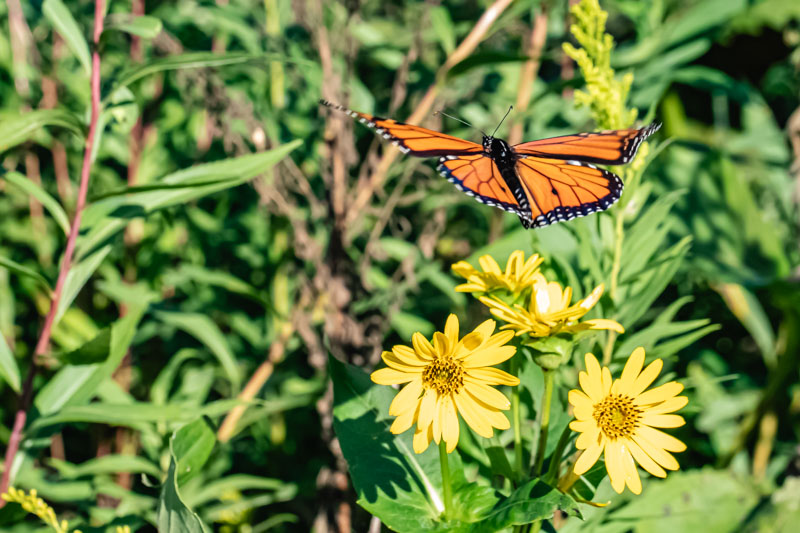
Monarch in Flight
The butterfly lifts above the yellow flowers, adding a second action frame to the adult sequence.
E21A3471
E21A3471 is another flight image, but it differs from the thistle frame. Here the Monarch is above the yellow flowers, with the wings open and the body angled slightly across the frame. The butterfly is smaller and the background is active, but the pose gives the page a sense of motion.
This image works best as a supporting frame. It adds energy to the set without replacing the stronger lead image or the closer identification view.
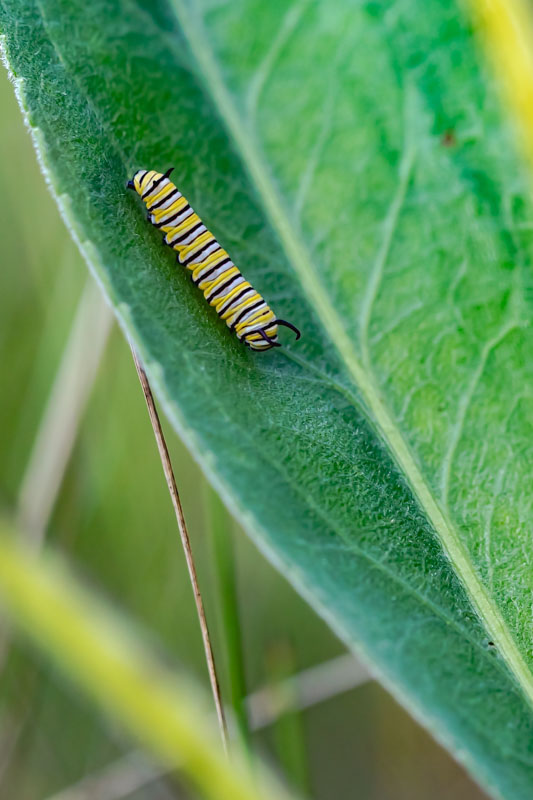
Monarch Caterpillar on Milkweed
The smooth, banded larva on milkweed connects the adult butterfly to its host plant and life cycle.
D79A0327
D79A0327 belongs in the Monarch sequence because it shows the larval stage on milkweed. Unlike the hairy tussock moth caterpillars reviewed separately, this larva has the smooth black, yellow, and white banding expected for Monarch. The milkweed leaf also helps place the image in the correct biological context.
This photo is not part of the adult nectar sequence, but it gives the page a stronger natural-history connection. It also leaves room to expand the page later if additional images are added for egg, chrysalis, or other larval stages.
Notes on the Set
The adult Monarch images work best as a small sequence rather than a large collection of similar frames. The adjusted E21A3459 provides the strongest gallery lead, E21A5083 adds flight and thistle context, E21A3466 gives the clearest adult identification view, and E21A3471 adds a second movement frame.
The caterpillar image should remain separate in tone from the adult images, but it is valuable enough to include because it connects the species page to milkweed and the Monarch life cycle. If more life-cycle images are added later, this page could grow into a fuller sequence: egg, caterpillar, chrysalis, adult, nectaring, and migration-season adults.
The dew-covered hairy caterpillars should not be included here. Those are better treated separately as White-marked Tussock Moth or another tussock moth page, depending on final identification.