Common Pixie-cup Lichen — Photographic Sequence
Cladonia pyxidata
The Common Pixie-cup photographs collected here show connected parts of the same colony.
For identification evidence, alternatives, habitat, and natural-history references, see the Cladonia pyxidata species page.
A Closer View
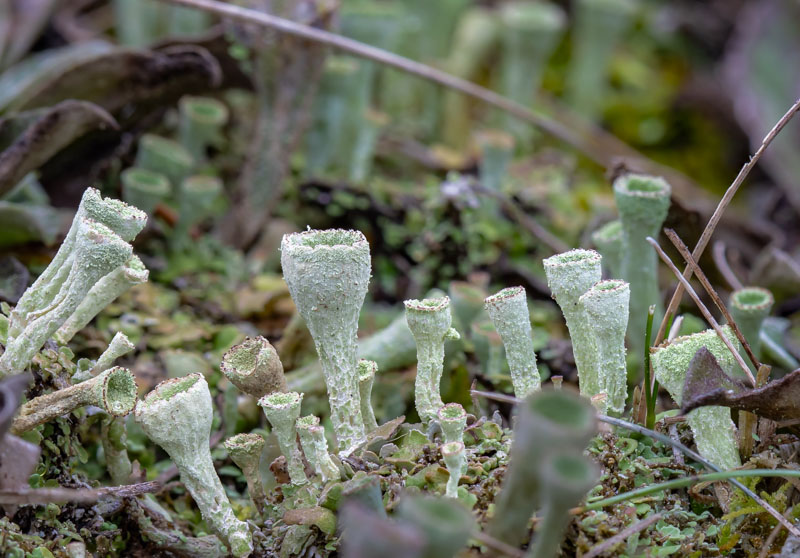
A Small Gathering
Common Pixie-cups bring intricate form to an easily overlooked patch of ground.
Camera: Canon EOS 5D Mark IV
Lens: EF100mm f/2.8L Macro IS USM
Settings: ISO 200 • Aperture f/13 • Shutter 0.4 s
E22B1802-12 • Size: 2868 x 2000
Smaller cups and leaning stalks give the group an irregular rhythm. Pale gray-green surfaces separate the principal subjects from the softer greens and browns behind them.
The close view makes the rough stalk surfaces and uneven cup rims especially apparent. Small scale-like structures, mosses, and fragments of plant litter remain visible around the bases. Softer foreground cups and the receding vegetation give the scene depth without removing the principal group from its surroundings.
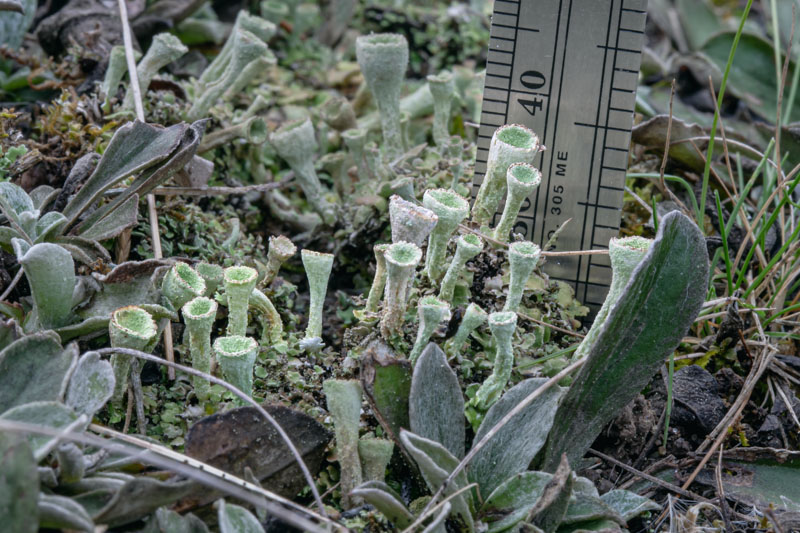
Cups on a Scale
A scale drawn close behind a pair of pixie-cup lichens.
Camera: Canon EOS 5D Mark IV
Lens: EF100mm f/2.8L Macro IS USM
Settings: ISO 200 • Aperture f/32 • Shutter 2 s
E22B1827 • Size: 4900 x 3267
The Wider Colony
E22B1813-26 gives more space to the plants surrounding the lichens. Broad leaves frame the foreground cups, while fine stems and scattered litter connect the clusters across the ground. The cups share attention with their immediate habitat, making this photograph a useful companion to the closer portrait.
The connection between the images is spatial: the area featured in E22B1802-12 lies in the background of E22B1813-26. A group that serves as the main subject in the close-up becomes part of the setting in the wider photograph. Reading the two together helps place the detailed portrait within the colony.
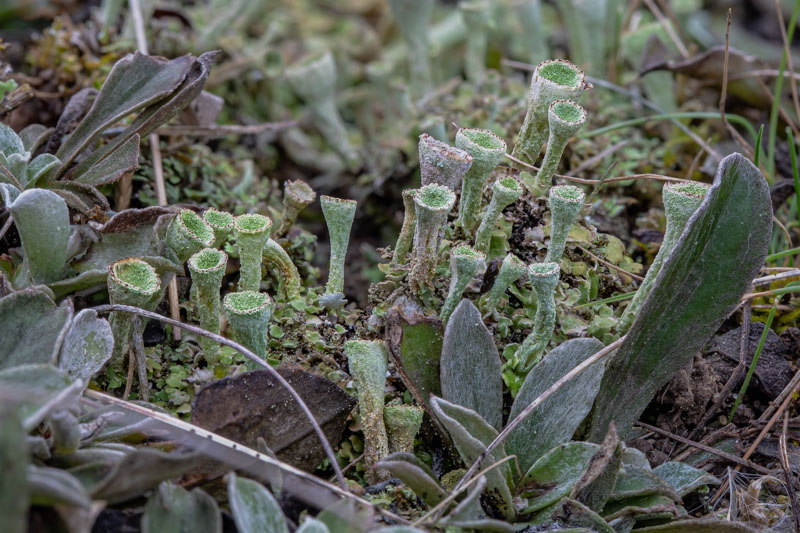
At Cup Height
Seen from their own level, open cups and slender stalks in a miniature landscape.
Camera: Canon EOS 5D Mark IV
Lens: EF100mm f/2.8L Macro IS USM
Settings: ISO 200 • Aperture f/13 • Shutter 1/2 s
E22B1813-26 • Size: 4400 x 2934
Exposure and Stacking
Both photographs are described as stacked images and share the supplied camera, lens, and exposure settings: Canon EOS 5D Mark IV, EF100mm f/2.8L Macro IS USM, ISO 200, f/13, and 1/2 second. Their different visual emphasis comes from the framing and the placement of subjects within the scene. The supplied metadata does not specify the number of source frames, stacking software, lighting method, or camera support.
The revised close-up is listed at 2868 x 2000 pixels, and the wider view at 4400 x 2934 pixels. These are the supplied image dimensions, rather than the dimensions of the smaller previews used during the earlier review.
Field Characters Across the Sequence
- E22B1802-12 records the open cups, uneven rims, and rough, granular to scaly surfaces of the upright stalks.
- E22B1813-26 records the arrangement of the cups among low vegetation and the relationship between foreground clusters and the close-up area behind them.
These photographs support comparison of visible form and texture, but do not by themselves confirm the species. The previously discussed microscope view of a cup interior contributes separate identification evidence; it is not one of the two images presented here. The species page explains why Cladonia pyxidata is favored while retaining alternative identifications.
Perspective
The close-up makes the cups the principal subject; the wider view shows where that subject belongs. Their strongest connection is the shift in attention from a background group in one photograph to the detailed portrait in the other.
close-up of the cups → wider colony among low vegetation → recognition of the close-up area in the background