Symphyotrichum laeve
Smooth Blue Aster carries blue-violet ray flowers around disks that begin yellow and deepen toward reddish purple with age. For identification, habitat, and natural-history details, see the Symphyotrichum laeve species page.
The photographs bring together two encounters. “Morning Jewels” isolates a large, dew-covered flower, while the newer sequence follows a more open branching plant with smaller flower heads, developing buds, and flowers at several stages. The difference in apparent flower size initially raised the possibility of Sky-blue Aster (Symphyotrichum oolentangiense). D79A5416 has been identified on iNaturalist as Smooth Blue Aster; the newer E22A9505-16 observation was posted more cautiously as American asters (Symphyotrichum) and remains provisional here pending further identification.
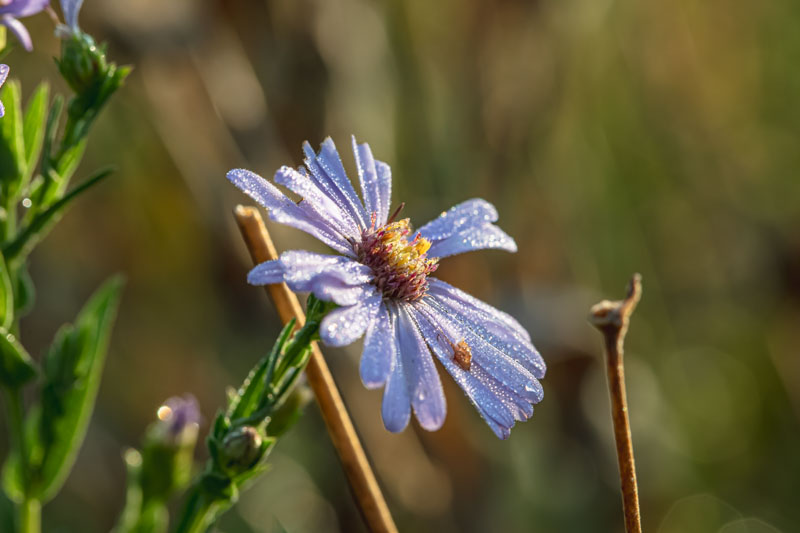 Top View of Flower
An irregular circle of blue-violet rays surrounds a disk changing from yellow toward reddish purple.
D79A5416 Size: 5500 x 3667
The isolated flower shows the broad rays and changing disk color clearly. Its close macro composition makes the head appear much larger than the flowers seen together in the later habitat sequence.
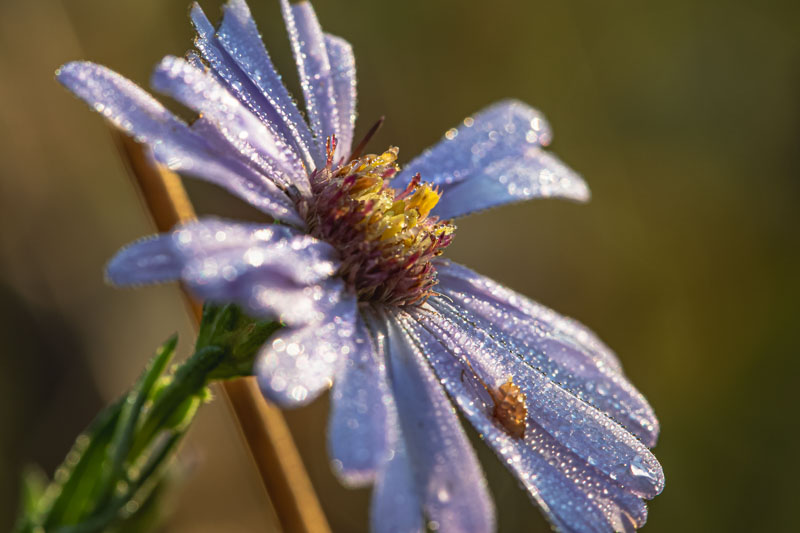 Morning Jewels
Beads of dew gather along the blue-violet rays, turning the flower into a small study of light and color.
Camera: Canon EOS 5D Mark IV
Lens: EF100mm f/2.8L Macro IS USM
Settings: ISO 1600 • Aperture f/8.0 • Shutter 1/125 s
D79A5419 • Size: 5500 x 3667
The droplets follow the folds and edges of the rays, while the warm disk anchors the cooler colors of the flower. This photograph emphasizes the individual flower as a miniature landscape rather than the overall form of the plant.
The newer sequence widens the view. Flowers, opening buds, and closed buds occupy the same branching cluster, showing how the bloom progresses across the plant rather than all at once.
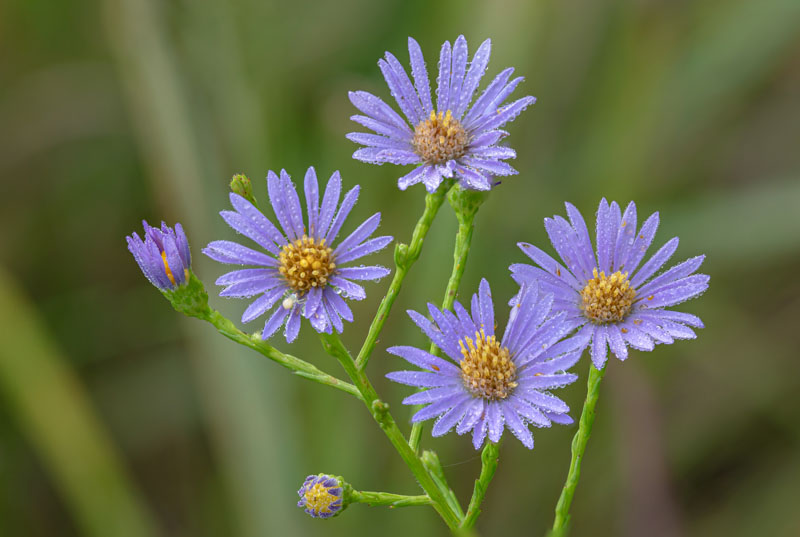
Five Notes in Sequence
Morning dew highlights different stages of bloom, from tightly closed buds to aging disks.
Camera: Canon EOS 5D Mark IV
Lens: EF100mm f/2.8L Macro IS USM
Settings: ISO 1600 • Aperture f/8.0 • Shutter 1/125 s
E22A9505-16 • Size: 5000 x 3333
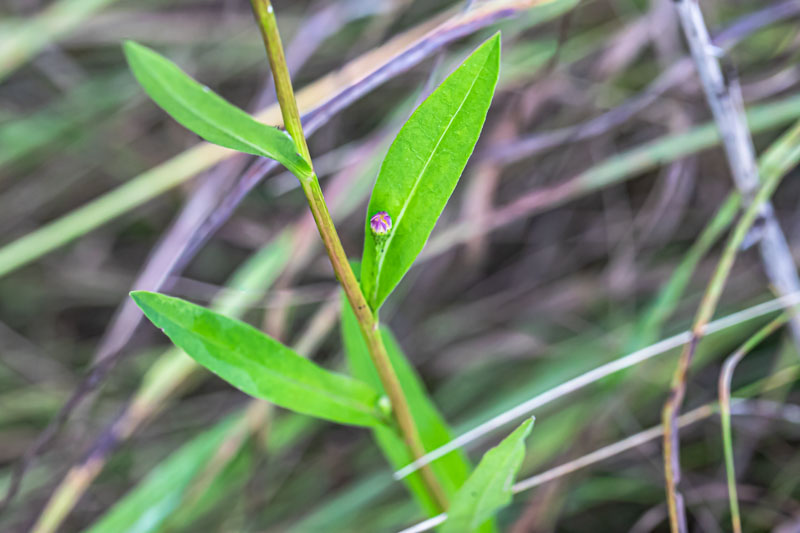 Leaf and Stem Evidence
The relationship between leaf base and stem provides more diagnostic information than flower size or color alone.
Camera: Canon EOS 5D Mark IV
Lens: EF100mm f/2.8L Macro IS USM
Settings: ISO 1600 • Aperture f/8.0 • Shutter 1/125 s
E22A9530 • Size: 5700 x 3800
Smooth Blue Aster typically has smooth, somewhat waxy leaves whose bases clasp the stem, often with small ear-like lobes. Sky-blue Aster generally has rough-textured leaves that narrow into winged stalks and do not clasp the stem. E22A9530 was made specifically to document that distinction; it should be considered together with the wider habit photographs and the eventual iNaturalist identification.
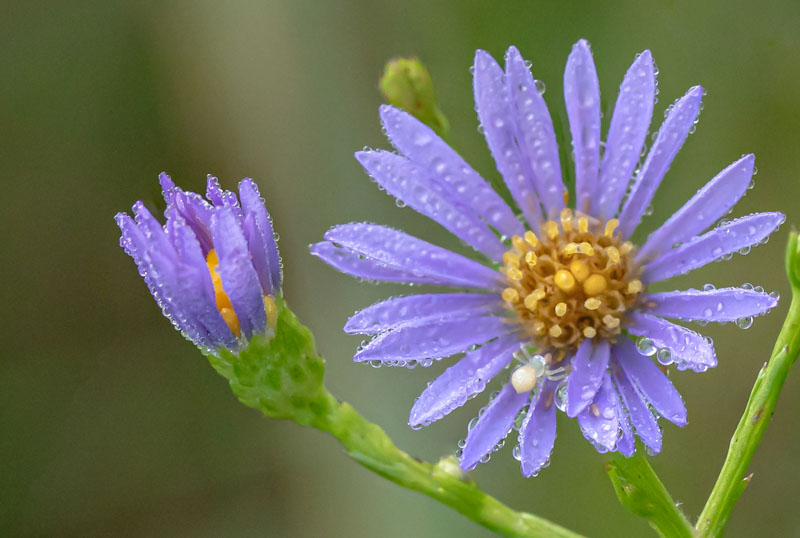 Aster Constellation
Open flowers and developing buds are distributed across a loose framework of slender stems.
Camera: Canon EOS 5D Mark IV
Lens: EF100mm f/2.8L Macro IS USM
Settings: ISO 1600 • Aperture f/8.0 • Shutter 1/125 s
E22A9492-9503A • Size: 2059 x 1373
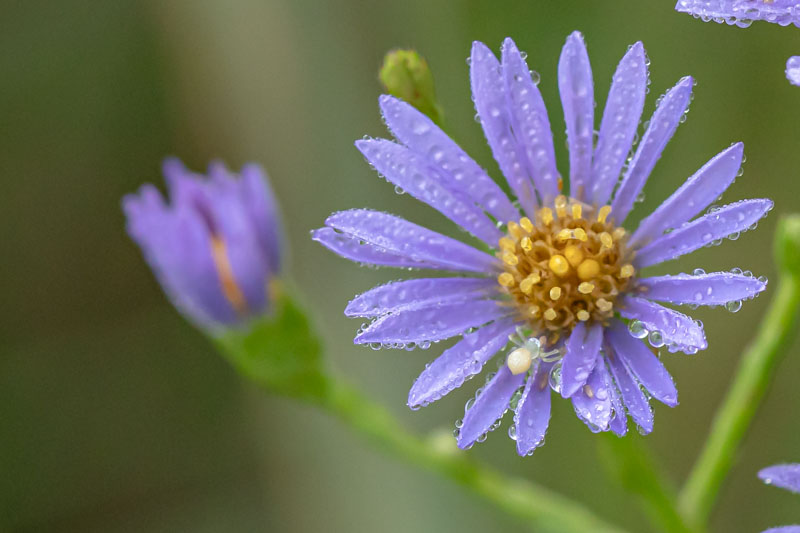
Concealed as Dew
A crab spider, nearly indistinguishable from the droplets, waits against the colorful face of the aster.
Camera: Canon EOS 5D Mark IV
Lens: EF100mm f/2.8L Macro IS USM
Settings: ISO 1600 • Aperture f/8.0 • Shutter 1/125 s
E22A9503 • Size: 2059 x 1373
Identification Notes
Working identification: Smooth Blue Aster (Symphyotrichum laeve)
Family: Asteraceae
Flowers: Blue-violet rays surrounding yellow disks that may become reddish with age
Leaves: Smooth to the touch, usually toothless or nearly so, with upper leaves clasping the stem
Bloom season: Late summer into autumn
Habitat: Prairies, open woods, woodland edges, and other sunny to partly shaded sites
Similar species: Sky-blue Aster (Symphyotrichum oolentangiense), distinguished especially by rough leaves with nonclasping bases
The newer observation remains provisional until its diagnostic features and community identification agree. If it is ultimately identified as Sky-blue Aster, the E22A9492–E22A9530 sequence should move to a separate page under Symphyotrichum oolentangiense.
Dew reveals the architecture of one flower; the wider sequence reveals the structure of the plant and the questions behind its name.
References
- Minnesota Wildflowers — Smooth Blue Aster, Symphyotrichum laeve
- Minnesota Wildflowers — Sky-blue Aster, Symphyotrichum oolentangiense
- USDA NRCS Plant Guide — Smooth Blue Aster
- iNaturalist observations and personal field notes, Minnesota
Related Pages: Smooth Blue Aster — Gallery · Symphyotrichum laeve — Species Notes