American Robin
Turdus migratorius
The American Robin is a familiar Minnesota thrush, often seen standing upright on exposed perches or moving across lawns and woodland edges in search of food. Its warm orange breast, dark head, broken white eye ring, and yellow bill make it one of the most recognizable birds in the spring landscape.
For identification details and comparison with similar species, see the Turdus migratorius in the Field Notes section.
On the weathered post, the robin is fully visible and separated cleanly from the soft background. The upright pose, complete profile, and open setting make this the clearer formal portrait of the two photographs.
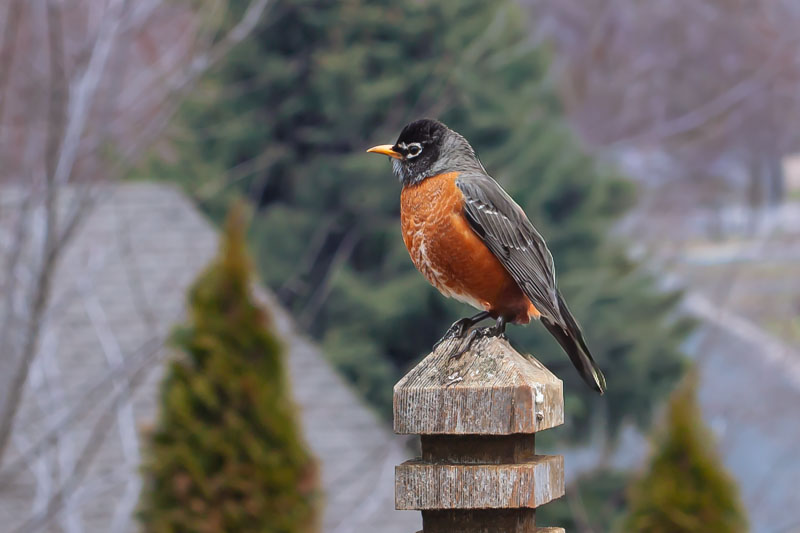
Perched in Spring
A moment of stillness above the early spring landscape.
Camera: Canon EOS 50D
Lens: EF100mm f/2.8 Macro USM
Settings: ISO 100 • Aperture f/8.0 • Shutter 1/60 s
D50A1905 • Size: 2000 x 1333
The second photograph moves closer into the robin's surroundings. Branches and new leaves partially screen the body, but the sharply defined eye, yellow bill, layered wing feathers, and bright orange breast remain easy to read. Rather than an open portrait, the frame shows the bird as it appears within a dense spring thicket.
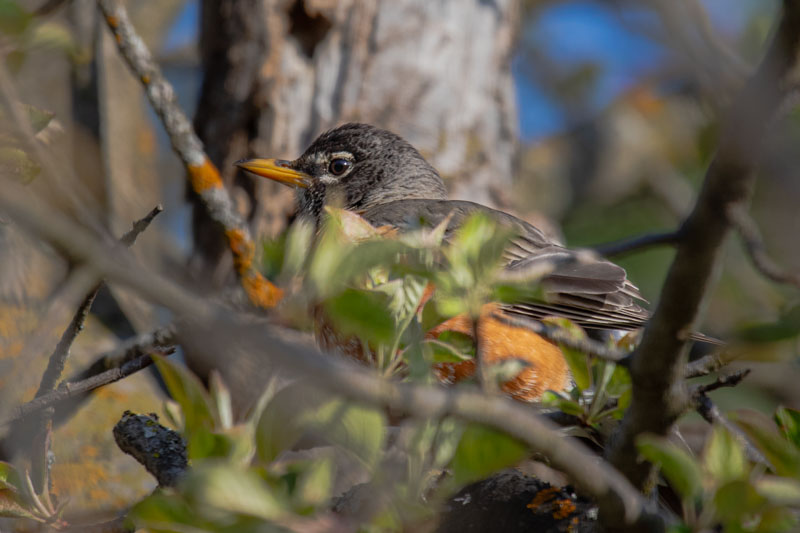
Robin Among the Branches
Bright eye and orange breast emerging through the new leaves.
Camera: Canon EOS 5D Mark IV
Lens: EF100-400mm f/4.5-5.6L IS USM
Settings: ISO 500 • Aperture f/5.6 • Shutter 1/640 s
E22A2253 • Size: 3000 x 2000
Overview
Together, the photographs show two familiar ways an American Robin enters the landscape. D50A1905 presents the bird as an open, recognizable spring portrait, while E22A2253 places it within the branches and leaves where a robin may pause between movements. One emphasizes shape and color; the other emphasizes habitat and concealment.
Photographer's Perspective
The weathered-post photograph remains the stronger opening image because the robin is unobstructed and the background falls away cleanly. The newer photograph adds a different kind of value: a closer eye-level view with more feather detail and a stronger sense of the bird being discovered within the spring growth.