Blue Jay
Cyanocitta cristata
Blue Jays are unmistakable in color, but these photographs reveal more than the familiar blue, white, and black pattern. The strongest moments come through behavior: a poised launch from the leaves, broad wingbeats across open sky, and a return to the pine tops where another jay waits nearby. Together, the images present the bird as watchful, direct, and socially aware.
For identification details and comparison with similar species, see the Cyanocitta cristata in the Field Notes section.
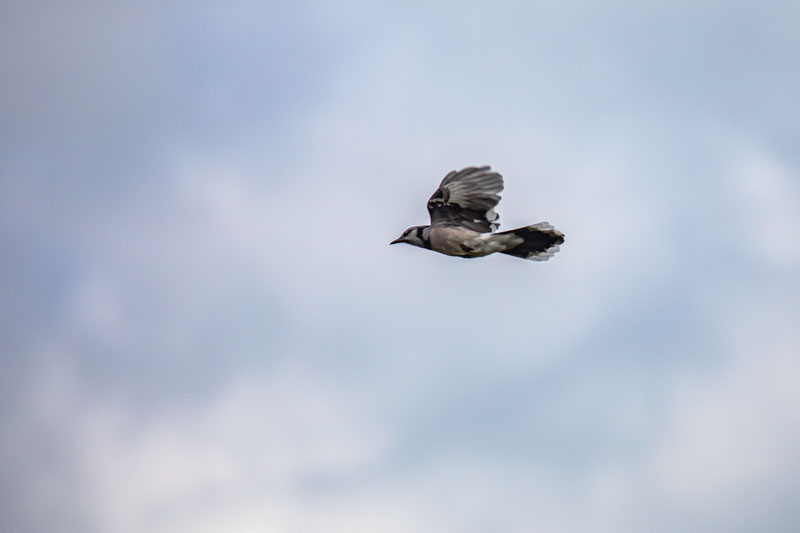
Blue Across the Open Sky
The barred wings and tail remain vivid even in motion.
A Blue Jay crosses the bright sky with its body level and wings opened through the stroke, revealing the pattern that is often partly hidden when the bird is perched.
Camera: Canon EOS 5D Mark IV
Lens: EF100-400mm f/4.5-5.6L IS II USM
Settings: ISO 320 • Aperture f/6.3 • Shutter 1/600 s
E21A4792 • Size: 4506 x 3004
Overview
This page follows a behavioral arc rather than a contrast between male and female plumage. After opening with the strongest flight portrait, it returns to the instant before takeoff, follows the bird through several phases of flight, and closes with a landing sequence and a quiet return to an exposed pine-top perch.
The open sky simplifies the setting and makes small changes in wing position easy to read. In the pine-top frames, branches and needles restore the bird to its woodland edge habitat and introduce the presence of a second jay.
Launch from the Leaves
Before the flight begins, the Blue Jay holds an alert posture at the top of the foliage. The perch still supports the bird, but the open space ahead gives the frame a sense of movement about to begin.
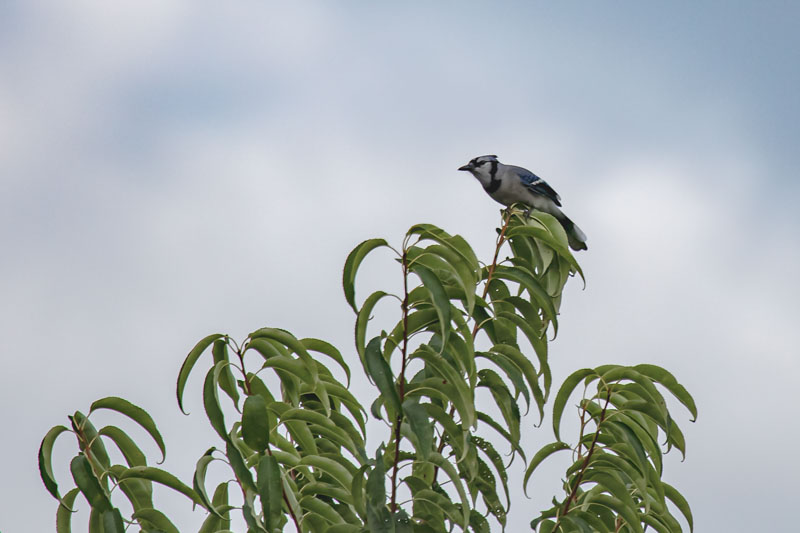
At the Point of Launch
Still on the perch, poised above open air.
Camera: Canon EOS 5D Mark IV
Lens: EF100-400mm f/4.5-5.6L IS II USM
Settings: ISO 800 • Aperture f/6.3 • Shutter 1/600 s
E21A4776 • Size: 2861 x 1907
In the next frame, the bird has cleared the perch. Leaves remain close beneath it, preserving the connection between the launch point and the open air beyond.
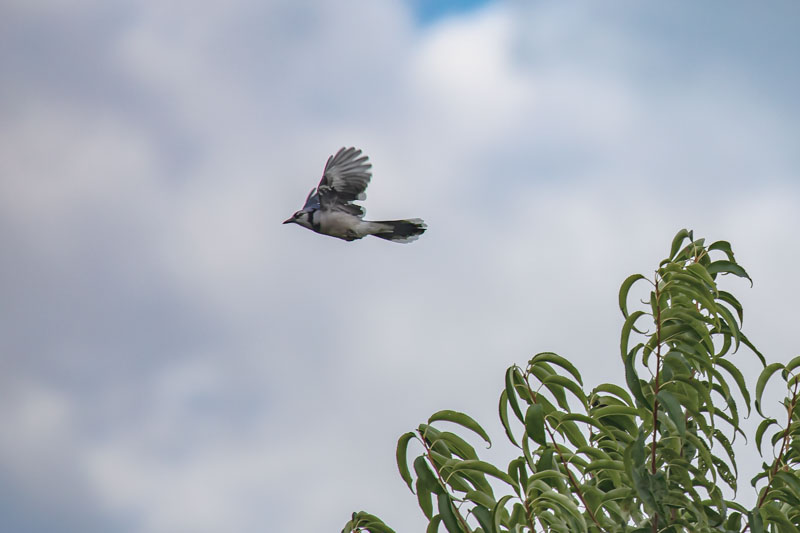
Clearing the Leaves
The first strong wingbeat carries the bird beyond the perch.
Camera: Canon EOS 5D Mark IV
Lens: EF100-400mm f/4.5-5.6L IS II USM
Settings: ISO 800 • Aperture f/6.3 • Shutter 1/600 s
E21A4777 • Size: 2451 x 1634
Open-Sky Flight
Once clear of the foliage, the Blue Jay becomes a study in structure. The broad, rounded wings change shape through the wingbeat while the long tail helps hold the bird on a steady line. Blue barring flashes across the wings and tail, then contracts as the body streamlines between strokes.
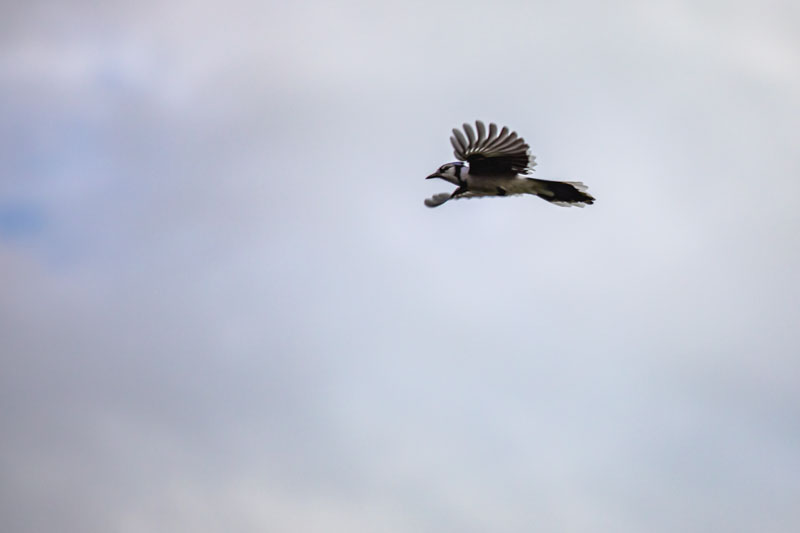
Wings Open to the Sky
A broad stroke reveals the full shape of the wings.
Camera: Canon EOS 5D Mark IV
Lens: EF100-400mm f/4.5-5.6L IS II USM
Settings: ISO 320 • Aperture f/6.3 • Shutter 1/600 s
E21A4790 • Size: 4506 x 3004
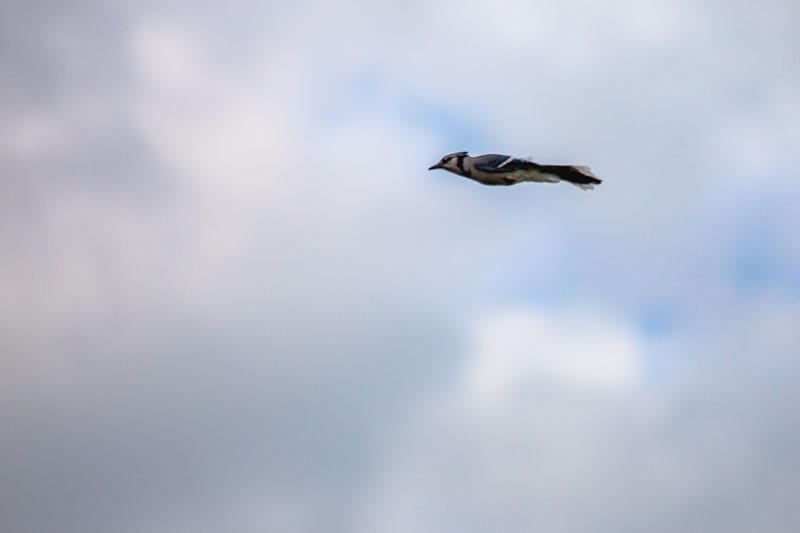
Direct Flight
Wings drawn closer as the body carries forward.
Camera: Canon EOS 5D Mark IV
Lens: EF100-400mm f/4.5-5.6L IS II USM
Settings: ISO 320 • Aperture f/6.3 • Shutter 1/600 s
E21A4791 • Size: 4506 x 3004
These are not merely two similar flight photographs. They show different phases of the same motion: one emphasizing lift and wing area, the other speed and forward direction. Seen together, they give the page the kind of structural detail that a perched portrait cannot provide.
Landing in the Pines
A separate sequence begins with two Blue Jays occupying neighboring pine tops. Their spacing creates a quiet visual relationship before one bird lifts its wings and settles beside the other.
A separate sequence begins as one Blue Jay approaches another bird already occupying a nearby pine top. The raised wings and spread tail hold the arriving bird briefly against the open sky before it settles onto the neighboring perch.
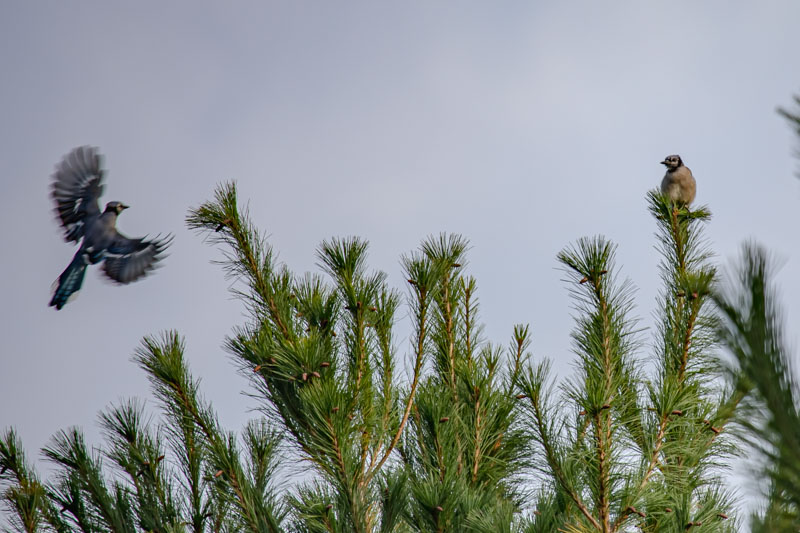
Landing Nearby
Wings raised as the second bird watches the approach.
Camera: Canon EOS 5D Mark IV
Lens: EF100-400mm f/4.5-5.6L IS II USM
Settings: ISO 100 • Aperture f/5.6 • Shutter 1/320 s
E21A4699 • Size: 3587 x 2391
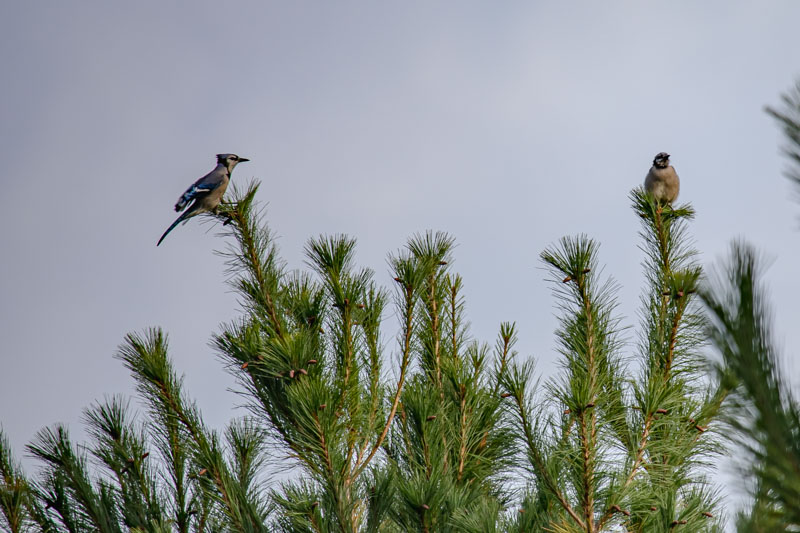
Joined at the Pine Tops
The arriving bird settles onto the neighboring perch.
Camera: Canon EOS 5D Mark IV
Lens: EF100-400mm f/4.5-5.6L IS II USM
Settings: ISO 100 • Aperture f/5.6 • Shutter 1/320 s
E21A4700 • Size: 3587 x 2391
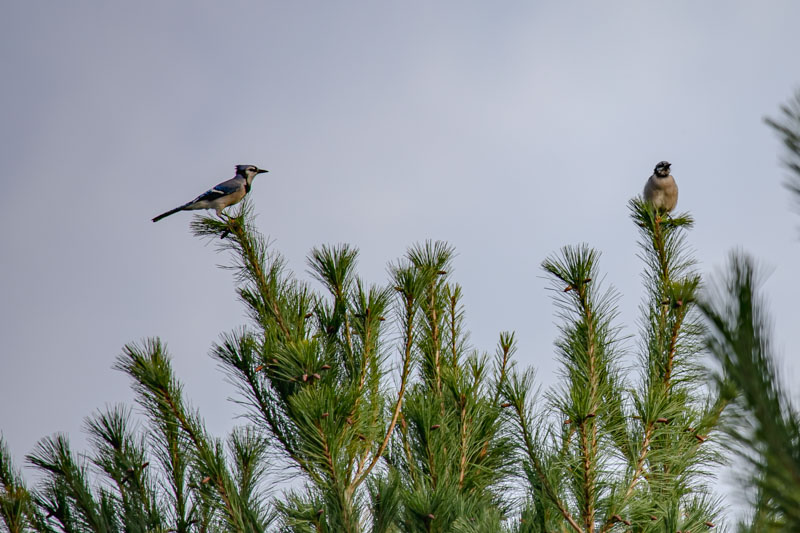
Settled Again
The brief arrival gives way to stillness.
Camera: Canon EOS 5D Mark IV
Lens: EF100-400mm f/4.5-5.6L IS II USM
Settings: ISO 100 • Aperture f/5.6 • Shutter 1/320 s
E21A4701 • Size: 3587 x 2391
The second bird appears softer and less crisply marked, making a juvenile Blue Jay a reasonable possibility, though the photographs do not establish age with certainty. The interaction itself appears brief and social rather than overtly aggressive: an approach, a landing, and then two birds remaining close among the pine tips.
Pine-Top Watch
After the movement of the flight and landing sequences, the final portrait returns to stillness. The open perch and pale sky isolate the bird’s crest, face pattern, and upright posture without competing detail.
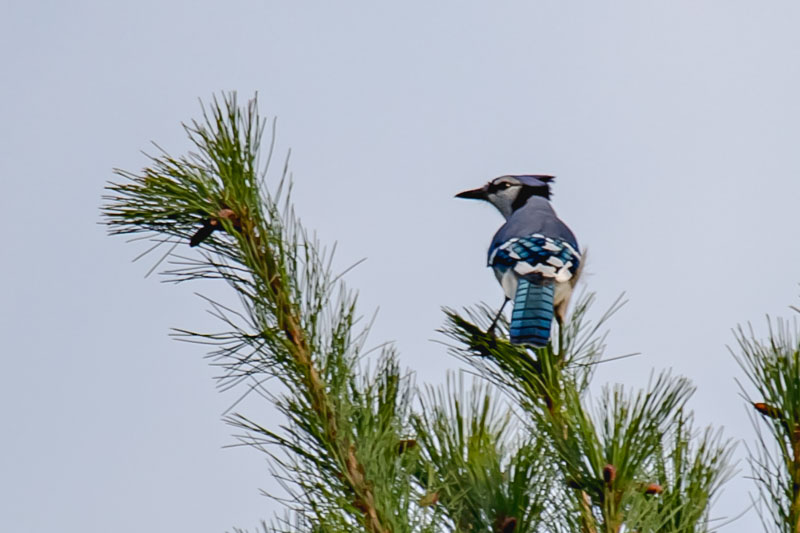
Pine-Top Watch
Alert and upright at the edge of open sky.
Camera: Canon EOS 5D Mark IV
Lens: EF100-400mm f/4.5-5.6L IS II USM
Settings: ISO 100 • Aperture f/5.6 • Shutter 1/320 s
E21A4708 • Size: 1194 x 796
Photographer’s Perspective
The Blue Jay does not offer the same male-and-female contrast that shapes the Northern Cardinal or Red-winged Blackbird pages. Its distinction emerges through movement instead. The launch frame creates anticipation, the open-sky sequence reveals wing structure, and the landing frames add a social dimension that a single portrait would miss.
Seen as a sequence, the bird changes from a compact figure on a perch to a broad pattern of wings and tail, then returns to the pine tops with the same alert presence. That movement between stillness and flight gives the Blue Jay page its own visual identity.