Haemorhous mexicanus
House Finches gather easily around feeders and perches, their social nature often bringing multiple birds into close proximity. Males show varying degrees of red across the head and chest, while females remain softly streaked in brown—subtle, but equally expressive in posture and movement.
For identification details and comparison with similar species, see
the Haemorhous mexicanus in the Field Notes section.
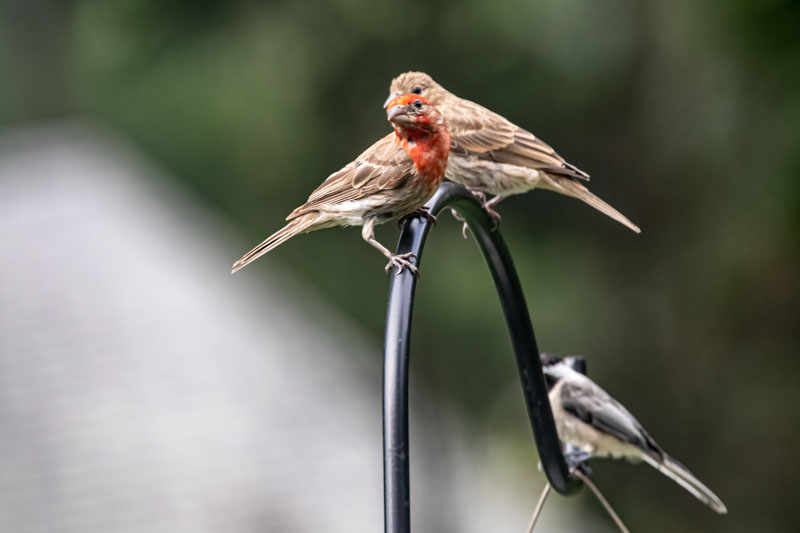
House Finch Pair — Garden Perch
A brief pause above the feeder, where space is limited and attention is shared.
Two House Finches balance on the curved metal hook, the male’s red plumage contrasting with the softer tones of the female behind him. Below, another bird waits its turn, adding tension to the moment.
Camera: Canon EOS 5D Mk IV
Lens: EF100-400mm f/4-5.6L IS USM
Settings: —
E21A2648
Overview
The House Finch is a familiar presence in residential areas, often appearing in small groups that shift and rearrange themselves around feeders and perches. Interactions are subtle—small adjustments in position, brief displacements, and quiet negotiation over space.
Color variation among males adds another layer of interest, with some showing deep red while others appear more orange or subdued.
Shared Space
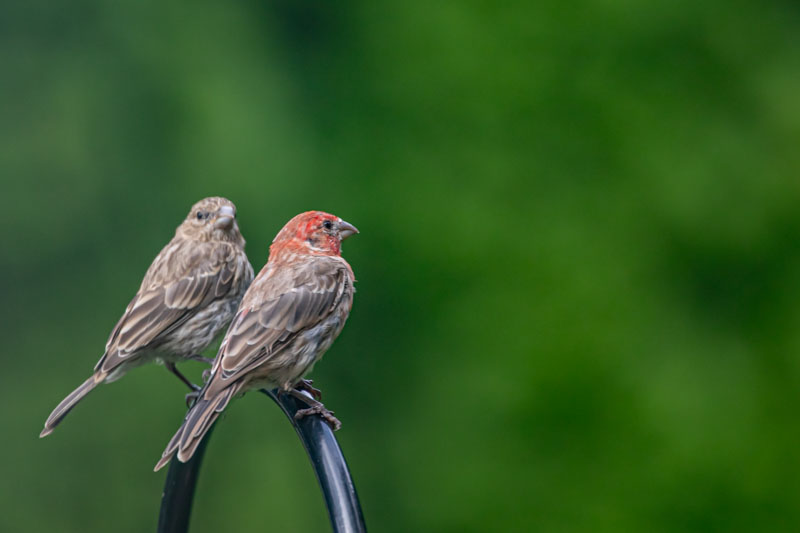
Side by Side
Balanced on the same perch, the pair settles into a moment of stillness.
Camera: Canon EOS 5D Mk IV
Lens: EF100-400mm f/4-5.6L IS USM
Settings: —
E21A2644
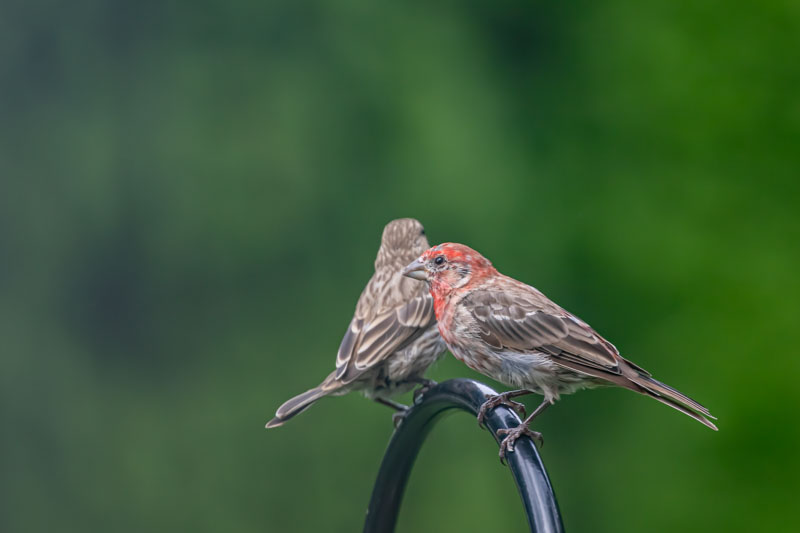
Turning Away
A slight shift creates distance without leaving the perch.
Camera: Canon EOS 5D Mk IV
Lens: EF100-400mm f/4-5.6L IS USM
Settings: —
E21A2645
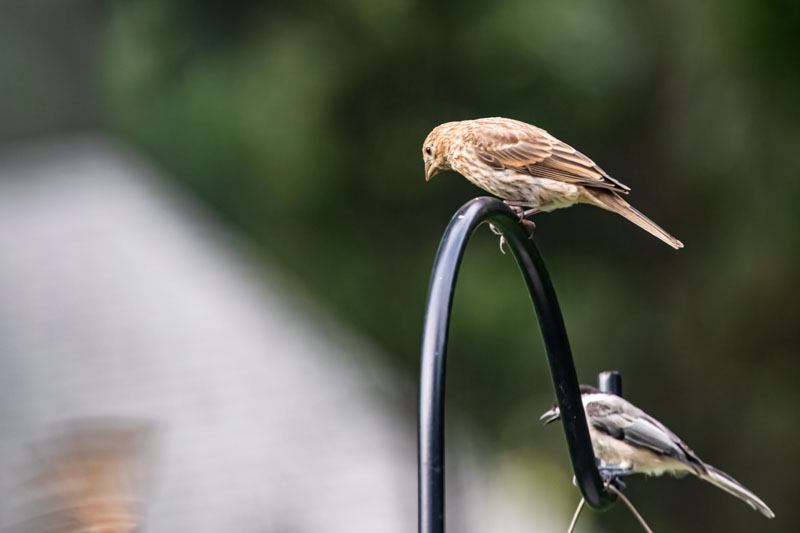
Waiting Below
Patience on a lower rung, watching for an opening.
Camera: Canon EOS 5D Mk IV
Lens: EF100-400mm f/4-5.6L IS USM
Settings: —
E21A2646
Photographer’s Perspective
What makes this sequence compelling is the interaction between the birds rather than any single individual. The curved perch creates a natural stage, compressing space and forcing proximity, while the shallow depth of field isolates the moment against a soft green background.
The presence of a third bird just below the frame adds quiet tension—an unspoken cue that the arrangement is temporary, and about to change.