Haliaeetus leucocephalus
Bald Eagles carry a presence that feels deliberate and watchful, whether perched deep in a pine or resting near human structures. The white head and tail contrast sharply against the dark body, giving the bird a clean, sculpted profile that stands out even at a distance. In Minnesota, they are most often seen near water, but their adaptability brings them into a range of landscapes.
For identification details and comparison with similar species, see
the Haliaeetus leucocephalus in the Field Notes section.
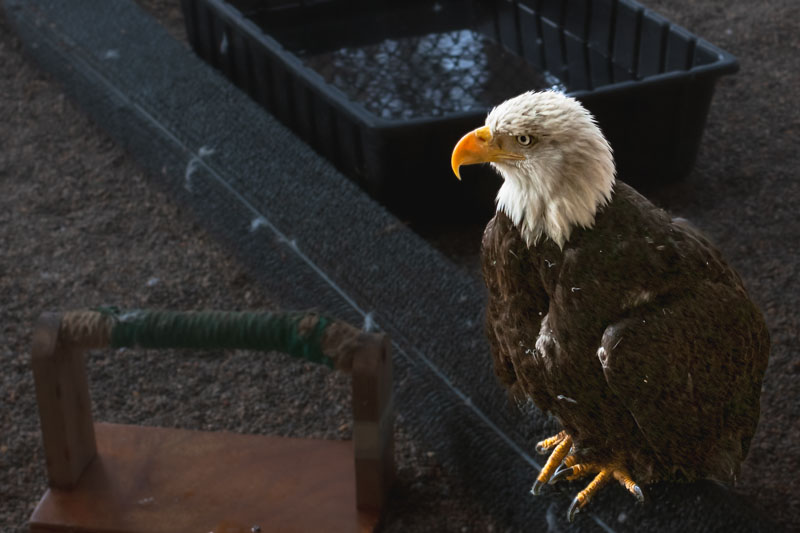
Perched Bald Eagle
A steady gaze in a managed setting.
Camera: Canon EOS 50D
Lens: 50mm f/1.4 USM
Settings: ISO 500 • Aperture f/5.6 • Shutter 1/30 s
IMG_0004 • Size:3105x2070
Overview
The Bald Eagle is one of the most recognizable birds in North America, defined as much by its silhouette as its coloration. Often found near lakes and rivers, it spends long periods perched, scanning for fish or carrion. Even at rest, the bird conveys strength through its structure—broad shoulders, heavy bill, and upright stance.
Flight Study
The flight of a Bald Eagle is powerful and deliberate, with slow wingbeats that create a steady rhythm. When banking or soaring, the broad wings reveal the layered arrangement of feathers that provide lift and control. The head remains level, scanning the environment below, while the tail fans out to assist with maneuvering. The layered sequence captures the grace and strength of the eagle in motion, a fitting emblem for Maine’s wild rivers.
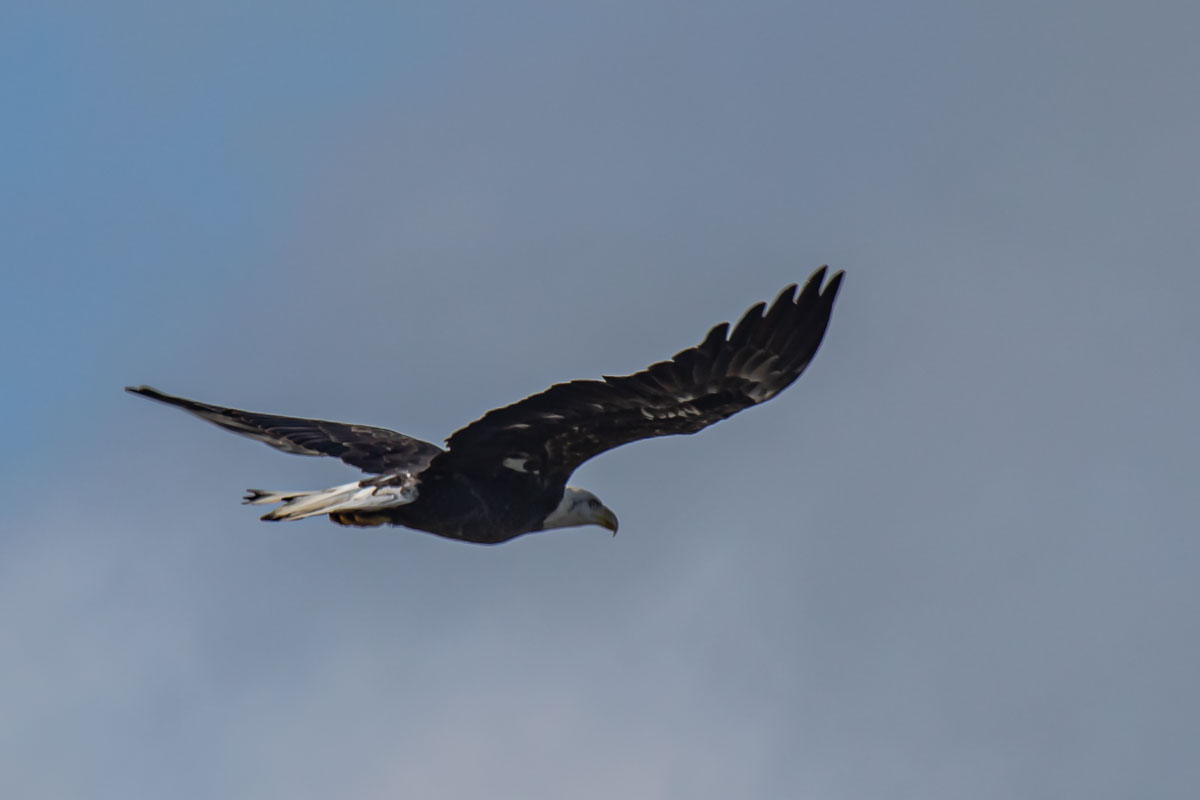
On Broad Wings
Horizontal body and a white tail against a subdued sky.
Camera: Canon EOS 5D Mark IV
Lens: EF100-400mm f/4.5-5.6L IS USM
ISO: 400 • Aperture: f/13.0 • Shutter: 1/500 s
E22B0586 • Size: 2100 x 1400
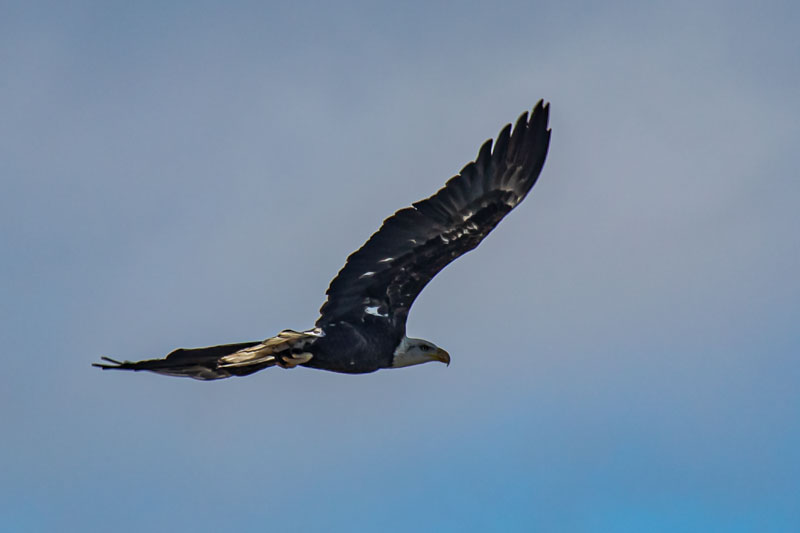
Wing Lift
Broad primaries rise above a level flight path.
Camera: Canon EOS 5D Mark IV
Lens: EF100-400mm f/4.5-5.6L IS USM
ISO: 400 • Aperture: f/13.0 • Shutter: 1/500 s
E22B0587 • Size: 2100 x 1400
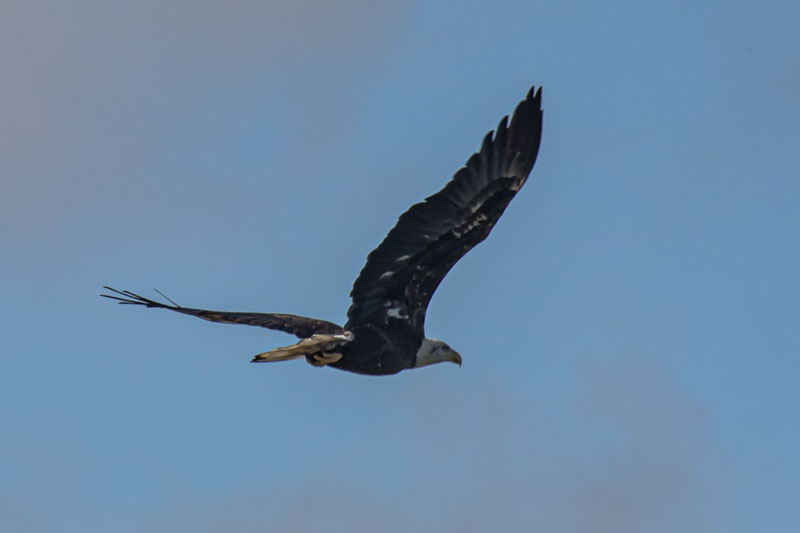
Full Extension
Separated primaries define the outer edge of the raised wing.
Camera: Canon EOS 5D Mark IV
Lens: EF100-400mm f/4.5-5.6L IS USM
ISO: 400 • Aperture: f/13.0 • Shutter: 1/500 s
E22B0588 • Size: 2100 x 1400
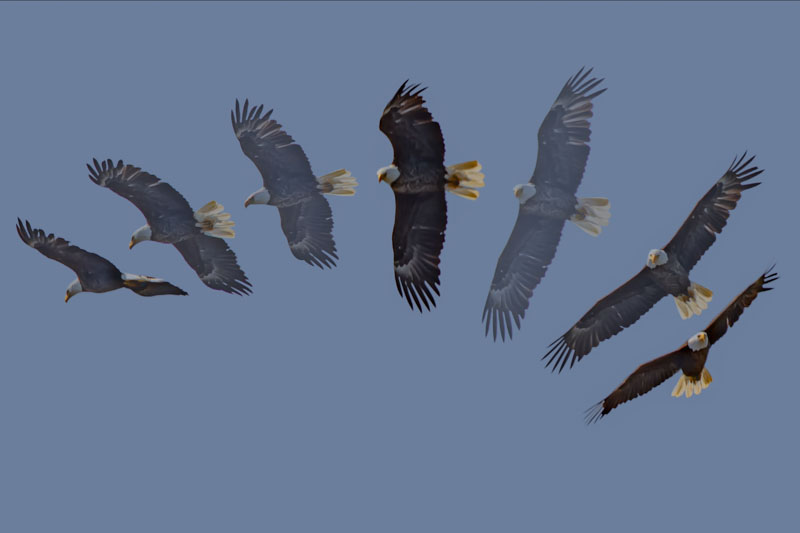
Bald Eagle over Kennebec River
Composite of a bald eagle banking over the river.
Camera: Canon EOS 5D Mk IV
Lens: EF70–300 mm f/4-5.6 IS USM
Settings: ISO 200 • Aperture f/9 • Shutter 1/640 s
D79A3617-3623 • Size: 2306x3623
In the Pines
These images show the eagle in a more typical natural setting, perched among pine branches where its darker body blends into shadow while the white head remains a focal point.
The layered feathers across the back and wings show clearly in this view, with subtle patterning that is often overlooked compared to the bold head and tail.
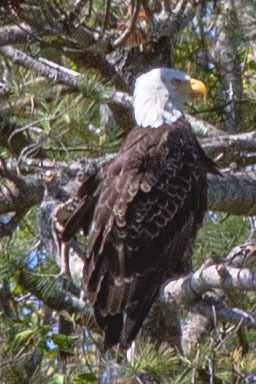
Bald Eagle in Pine
A quiet presence among branches.
Camera: Canon EOS 5D Mark IV
Lens: EF70-300mm f/4-5.6L IS USM
Settings: ISO 200 • Aperture f/9.0 • Shutter 1/640 s
D79A3611 • Size: 256x384
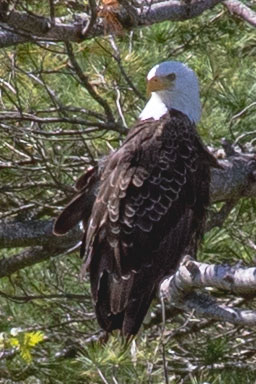
Bald Eagle Rear View
Feather structure and posture.
Camera: Canon EOS 5D Mark IV
Lens: EF70-300mm f/4-5.6L IS USM
Settings: ISO 200 • Aperture f/9.0 • Shutter 1/640 s
D79A3612 • Size: 256x384
Seen from behind, the eagle’s layered wing feathers create a scaled pattern, emphasizing both insulation and aerodynamic form.
Photographer’s Perspective
These images highlight the contrast between environments—managed space versus natural woodland—and how the Bald Eagle maintains the same composed posture in both. The most striking element remains the head: always alert, always scanning, anchoring the entire presence of the bird.