Broad-winged Hawk
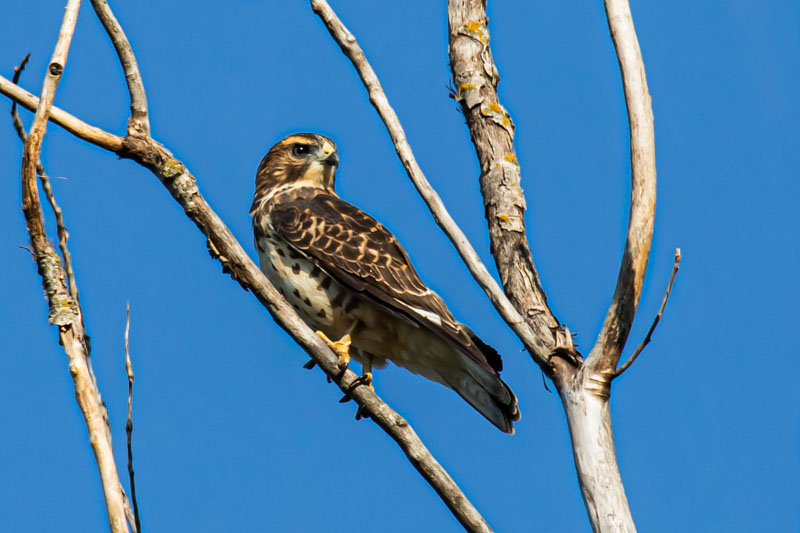
Buteo platypterus
The Broad-winged Hawk is a compact woodland raptor, often recognized by its sturdy buteo shape, barred underparts, and relatively short tail. Seen high in bare branches, it can appear quiet and watchful one moment, then suddenly become animated as it calls or shifts position above the open edge.
For identification details and comparison with similar species, see the Buteo platypterus in the Field Notes section.
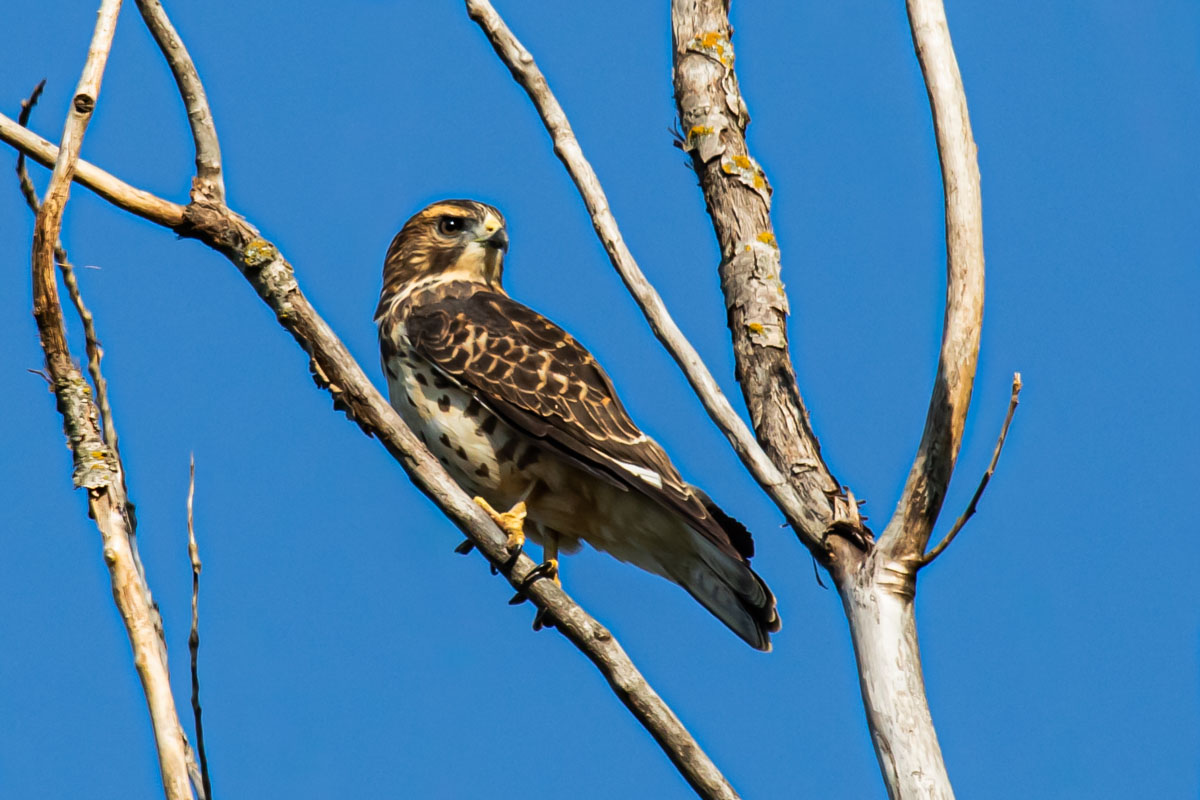
High Perch Portrait
A clear view of a compact woodland hawk in strong morning light.
The clean side profile shows the hooked bill, yellow cere, streaked face, marked underparts, and folded wing pattern.
The surrounding bare branches keep the image grounded in the tree without overwhelming the bird.
Camera: Canon EOS 5D Mark IV
Lens: EF100-400mm f/4.5-5.6L IS USM
Settings: ISO 800 • Aperture f/8 • Shutter 1/1600 s
E22A8004 • Size: 1820 x 1213
Overview
This sequence presents a stronger and closer Broad-winged Hawk encounter than the earlier distant flight record. Instead of relying on a small bird against a pale sky, these photographs show the hawk perched in good light, with facial detail, feather pattern, posture, and behavior all visible.
The bare branches frame the bird naturally. A fully cleaned background would make the portrait simpler, but keeping the branch structure preserves the feeling of a real woodland-edge perch.
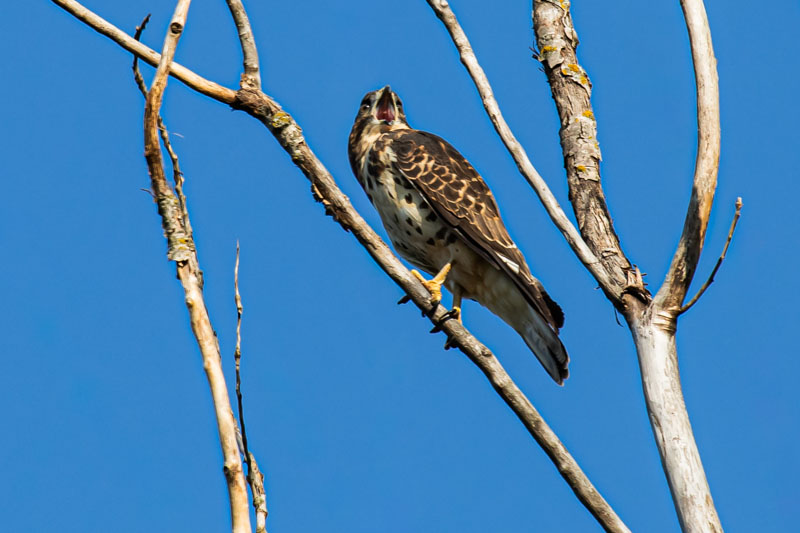
Calling Through the Branches
Calling Through the Branches
Both eyes visible as the hawk opens into a call.
Camera: Canon EOS 5D Mark IV
Lens: EF100-400mm f/4.5-5.6L IS USM
Settings: ISO 500 • Aperture f/8 • Shutter 1/1000 s
E22A8022 • Size: 2000 x 1333
This is the strongest behavioral frame in the set. The open bill gives the image energy, while the visible eyes keep the face engaged with the viewer. The surrounding branches are busy, but they read as habitat rather than clutter.
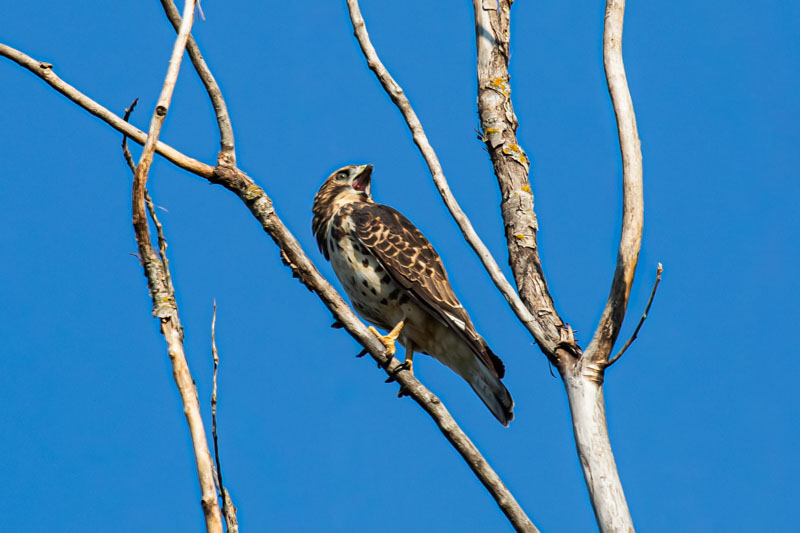
Skyward Call
A sharper calling frame with a cleaner branch pattern.
Camera: Canon EOS 5D Mark IV
Lens: EF100-400mm f/4.5-5.6L IS USM
Settings: ISO 500 • Aperture f/8 • Shutter 1/1000 s
E22A8020 • Size: 2253 x 1502
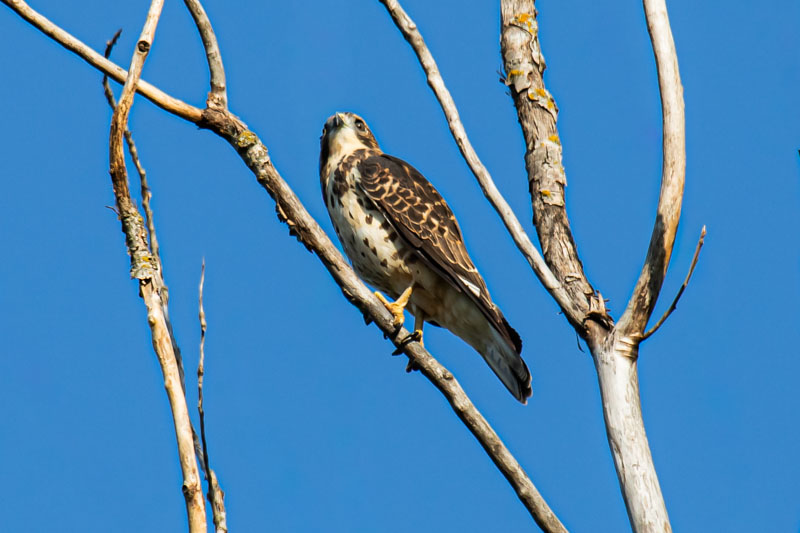
Upward Watch
The same high perch, quiet again between calls.
Camera: Canon EOS 5D Mark IV
Lens: EF100-400mm f/4.5-5.6L IS USM
Settings: ISO 500 • Aperture f/8 • Shutter 1/1000 s
E22A8024 • Size: 2000 x 1333
The calling images work well as a pair: one with the strongest facial presence, the other with a cleaner arrangement of branches and a sharp upward posture.
Identification Notes
In these closer views, the bird shows the compact buteo structure expected of a Broad-winged Hawk: a sturdy body, relatively short tail, rounded head, and folded wings that do not create the long, angular impression of an Osprey. The underparts are marked, the bill is short and hooked, and the yellow cere is visible in the portrait view.
The perched posture also helps separate this bird from an Osprey. An Osprey would usually appear longer-winged, paler below, and more angular overall, with a stronger dark eye stripe and a different pattern through the head and body.
Photographer’s Perspective
The newer photographs turn this from a documentary raptor record into a stronger gallery page. The first image gives a clean identification portrait, while the calling frames add behavior and presence. Leaving some of the surrounding branches in place keeps the sequence natural, especially for a woodland hawk using a bare tree as a high lookout.
Together, the images show both stillness and voice: the hawk first as a perched observer, then as an active presence calling from the branches.