Tringa solitaria
Solitary Sandpipers pass through Minnesota as quiet migrants of freshwater edges, flooded grass, marsh margins, ponds, and roadside wetlands. This bird kept to shallow water and partially submerged logs, showing the bold white eye-ring, dark spotted upperparts, clean white belly, and greenish legs that help distinguish the species in the field.
For identification details and comparison with similar species, see the Tringa solitaria in the Field Notes section.
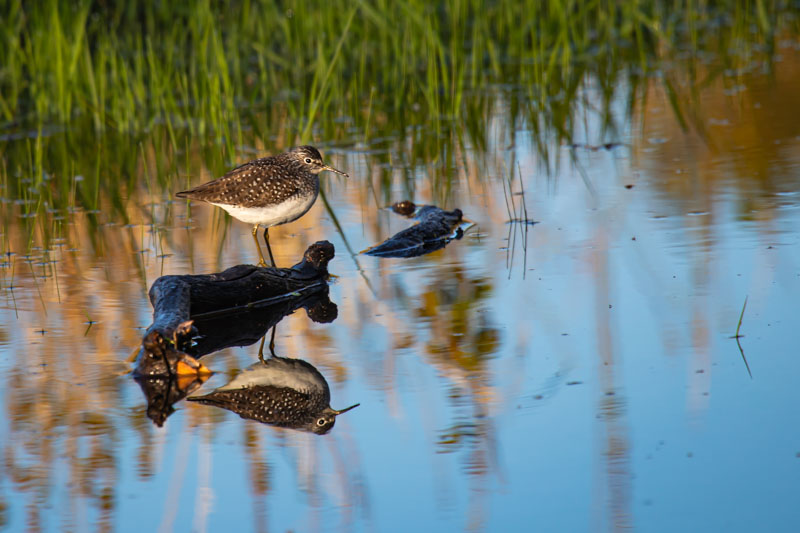
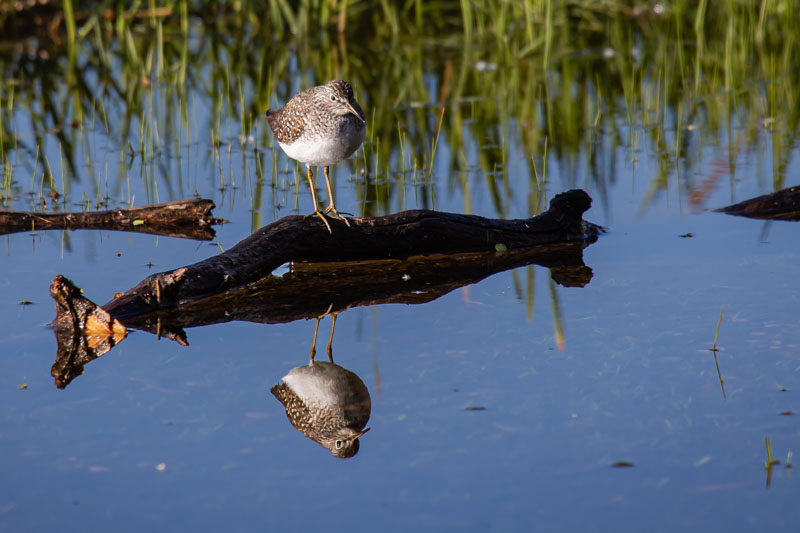
Reflected Wetland Perch
A small shorebird pauses above its own reflection.
A Solitary Sandpiper stands on a partially submerged log in shallow wetland water, its spotted upperparts and pale belly mirrored below. The still surface turns the field marks into part of the composition.
Camera: Canon EOS 5D Mk IV
Lens: EF100-400mm f/4.5-5.6L IS II USM
Settings: ISO 250 • Aperture f/7.1 • Shutter 1/200 s
E22A1353 • Size: 4329x2933
Overview
Solitary Sandpipers are often found alone or in very small numbers, especially around shallow freshwater rather than open sandy shorelines. In this sequence, the bird worked the flooded edge slowly, moving between exposed wood, emergent grass, and open reflective water. The white eye-ring, fine pale spotting across the back, and greenish legs remained visible across the changing angles.
Through Shallow Water
The bird moved through quiet water with a deliberate, alert posture. Rather than joining a flock on an open mudflat, it stayed close to flooded grass and scattered debris, using the wetland edge as both feeding ground and cover.
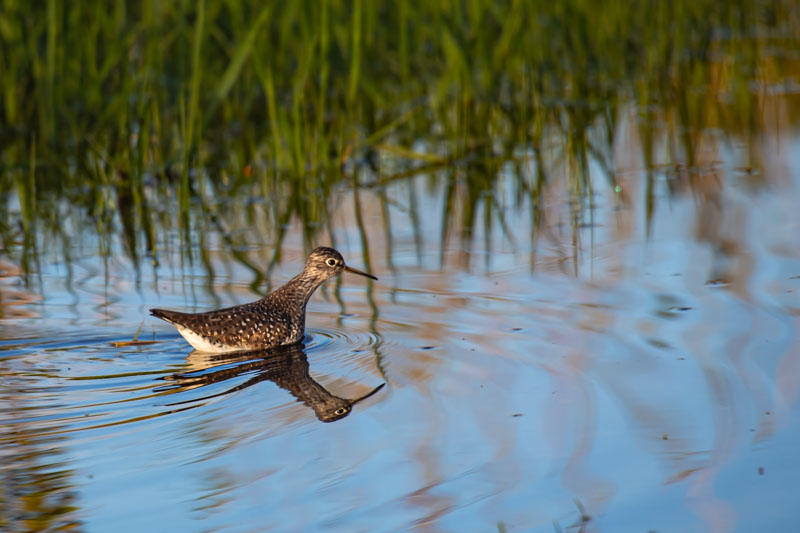
Through Shallow Water
A white eye-ring carries through the reflected marsh light.
Camera: Canon EOS 5D Mk IV
Lens: EF100-400mm f/4.5-5.6L IS II USM
Settings: ISO 250 • Aperture f/7.1 • Shutter 1/200 s
E22A1357 • Size: 4329x2933
The profile view shows the compact body, slim straight bill, and strong contrast between the dark spotted upperparts and the clean white belly. Even in reflected light, the face pattern remains clear.
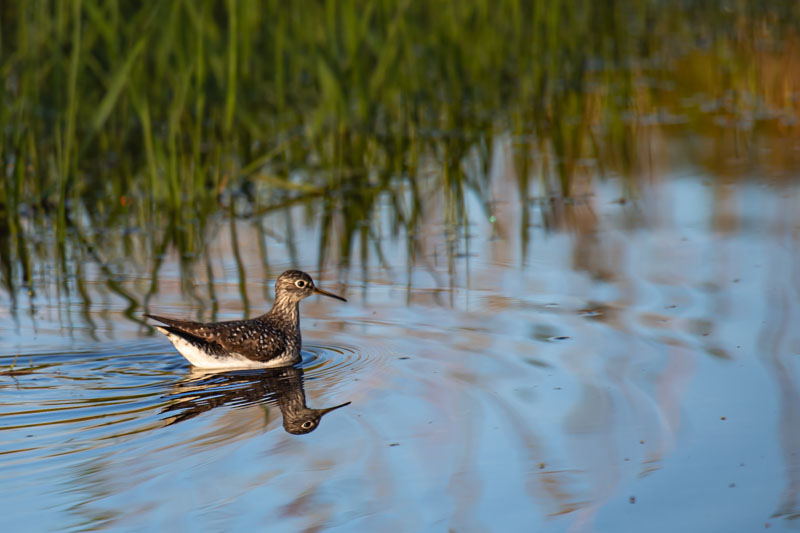
Profile in Blue Water
The bird moves through open reflection, low and alert.
Camera: Canon EOS 5D Mk IV
Lens: EF100-400mm f/4.5-5.6L IS II USM
Settings: ISO 250 • Aperture f/7.1 • Shutter 1/200 s
E22A1358 • Size: 4329x2933
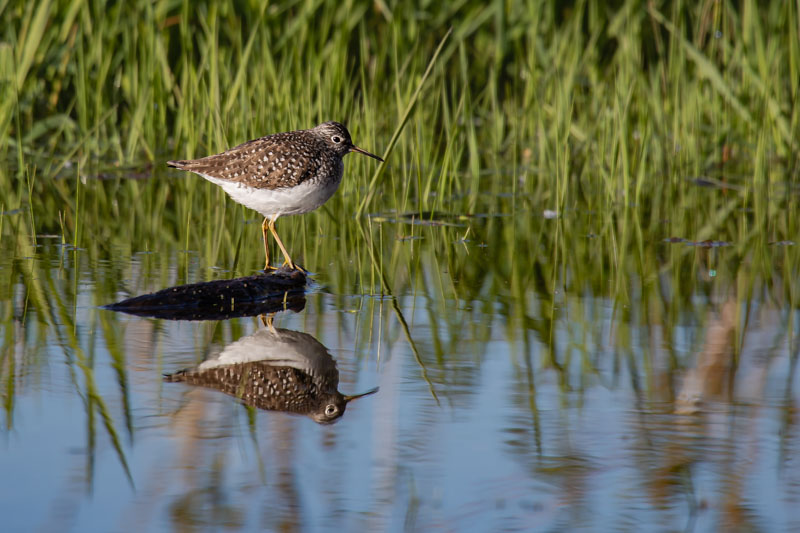
Reflected Profile
Dark spotted upperparts stand out against flooded grass.
Camera: Canon EOS 5D Mk IV
Lens: EF100-400mm f/4.5-5.6L IS II USM
Settings: ISO 200 • Aperture f/8.0 • Shutter 1/250 s
E22A1409 • Size: 4016x2677
Together, these images show the bird in its working habitat: shallow water, emergent vegetation, and soft morning reflection. The setting gives scale to the bird’s small shorebird form while still preserving the key identification marks.
On the Flooded Log
When the sandpiper stepped onto exposed wood, its posture changed from moving profile to upright pause. The frontal view emphasizes the pale underparts, darker breast mottling, and fine spotting across the head and shoulders.
Head-on Pause
The bird turns toward the camera from a low wetland perch.
Camera: Canon EOS 5D Mk IV
Lens: EF100-400mm f/4.5-5.6L IS II USM
Settings: ISO 200 • Aperture f/8.0 • Shutter 1/250 s
E22A1398 • Size: 4016x2677
From this angle, the bird appears compact and rounded, but the long greenish legs and slim bill still point to a shorebird rather than a small songbird at the water’s edge.
Photographer’s Perspective
The reflections made this encounter especially useful for both composition and identification. In some frames, the water doubled the bird’s form; in others, the wetland grass and submerged wood gave context to how the bird was moving through the habitat. The strongest field mark across the set is the bold white eye-ring, supported by the dark spotted upperparts, pale belly, slim bill, and solitary freshwater setting.