R. Fraley

Turkey Vulture

Cathartes aura

Turkey Vultures are often seen overhead, rocking on raised wings as they circle in open sky. Perched at closer range, the bird shows a different kind of presence: a red, featherless head, pale hooked bill, dark brown-black plumage, and a hunched posture well suited to scavenging life.

For identification details and comparison with similar species, see
the Cathartes aura in the Field Notes section.


Interrupted Breakfast
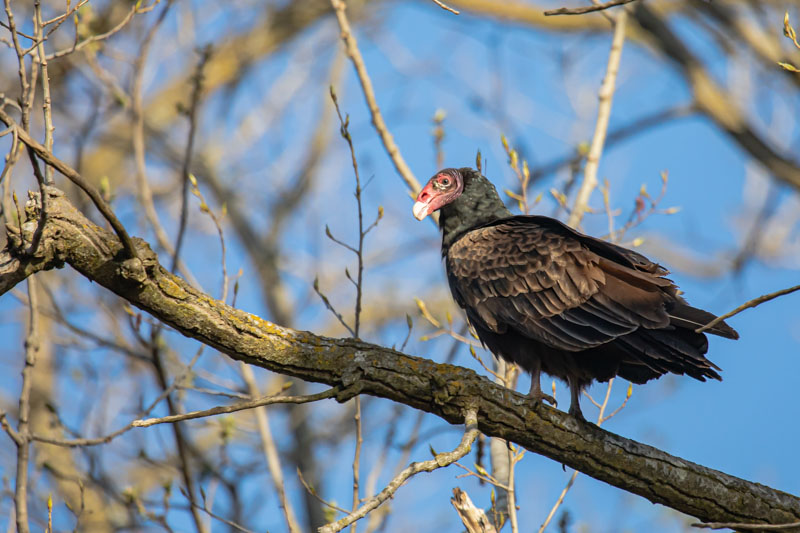
A Turkey Vulture pauses after being disturbed from feeding nearby.
Perched on a broad branch among early spring buds, the Turkey Vulture turns its red head toward the interruption. The close view shows the pale bill, bare facial skin, and dark layered plumage that are easy to miss when the species is only seen circling overhead.
Camera: Canon EOS 5D Mk IV
Lens: EF100-400mm f/4.5-5.6L IS USM
Settings: ISO 1600 • Aperture f/5.6 • Shutter 1/4000 s
E22A1088 • Size: 5165x3443


Overview

Turkey Vultures are familiar as soaring birds, often recognized by their long wings, shallow V-shaped profile, and steady circling flight. These photographs show a quieter moment: the bird settled into the branches, alert after feeding, with the morning light bringing out detail in the dark brown feathers and wrinkled red skin of the head.

The setting adds a seasonal note. Bare limbs, fresh buds, and clear blue sky frame the bird before the canopy has filled in, giving an unusually open view of a species more often photographed at a distance.


Perched in the Spring Branches

The perch reveals the bird’s structure in a way flight photos usually do not. The body looks heavy and compact on the branch, while the long folded wings and layered feathers still suggest the broad-winged shape seen overhead.

Watching from the Branch
Alert posture among leafing branches.
Camera: Canon EOS 5D Mk IV
Lens: EF100-400mm f/4.5-5.6L IS USM
Settings: ISO 1600 • Aperture f/5.6 • Shutter 1/4000 s
E22A1082 • Size: 5165x3443

Seen from farther back, the Turkey Vulture blends into the tangle of trunks and branches more than its size might suggest. The red head remains the clearest field mark, standing out against the darker body and pale spring background.

Red Head in Morning Light
The bare red head and pale bill stand out against dark plumage.
Camera: Canon EOS 5D Mk IV
Lens: EF100-400mm f/4.5-5.6L IS USM
Settings: ISO 1600 • Aperture f/5.6 • Shutter 1/4000 s
E22A1086 • Size: 5165x3443

Layered Wing Feathers
Dark brown feather edges catch the light across the folded wing.
Camera: Canon EOS 5D Mk IV
Lens: EF100-400mm f/4.5-5.6L IS USM
Settings: ISO 1600 • Aperture f/5.6 • Shutter 1/4000 s
E22A1087 • Size: 5165x3443

Together, the closer frames show how much detail is hidden in what can appear, at a distance, to be a plain dark bird. The scalloped wing feathers, wrinkled head, and pale bill all become visible once the bird is seen at rest.


Plumage Detail

At close range, the Turkey Vulture’s plumage is not simply black. The folded wings show dark brown tones, lighter feather edges, and layered texture across the back and sides. These details give the perched bird a rugged, almost armored appearance.

The featherless head is equally important. It is one of the most useful identification marks in the field and also reflects the bird’s scavenging habits, keeping the head easier to clean while feeding.


Photographer’s Perspective

This was not the classic Turkey Vulture photograph: no circling silhouette, no broad wings held in a shallow V, and no in-flight view against open sky. Instead, the encounter gave a closer look at the bird after feeding nearby, perched in spring branches and alert to the disturbance.

That makes the sequence useful in a different way. It documents a Turkey Vulture at rest, showing posture, feather texture, head detail, and habitat context that are often lost in distant flight photographs.