Tamiasciurus hudsonicus
American Red squirrels often reveal themselves first by sound: a sharp scolding call from the canopy, the quick scratch of claws on bark, or the sudden flare of a tail along a limb. Even when they pause, they seldom look settled. Their small size, pale underparts, and lifted tail give them a distinct silhouette, while their posture always suggests the next movement is already being considered.
For identification details and comparison with similar species, see the Tamiasciurus hudsonicus in the Field Notes section.
A red squirrel pauses on an open branch and looks directly toward the camera. Against the clean sky, the round eye, pale belly, and bristled tail stand out clearly, giving the animal a brief moment of stillness that feels more like a pause than true rest.
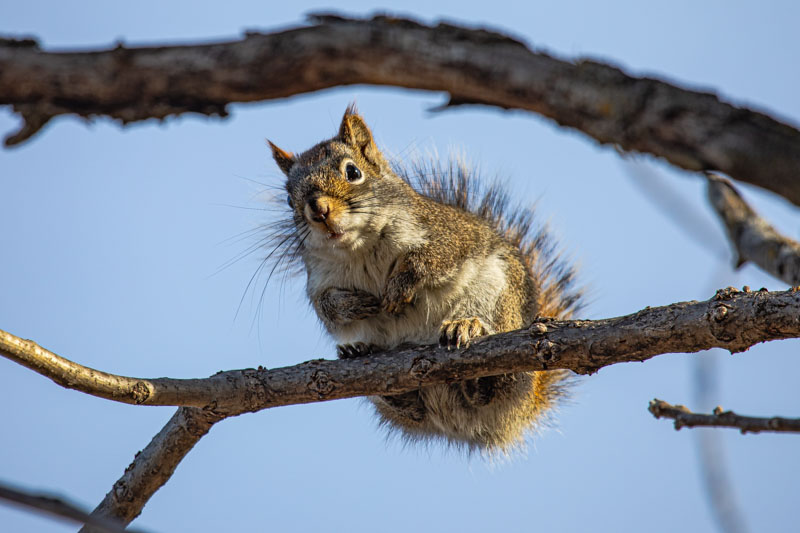
Watchful on an exposed limb
Head tilted, forepaws tucked, tail lit from behind.
Camera: Canon EOS 5D Mark IV
Lens: EF100-400mm f/4.5-5.6L IS USM
Settings: ISO 200 • Aperture f/7.1 • Shutter 1/400 s
E22A0954 • Size: 5207x3471
Overview
Red squirrels are among the most animated mammals in the woods. They move in short bursts, stop abruptly, then seem to weigh the next leap before vanishing around the trunk. Much of their character comes through in these pauses: the lifted forepaws, the tension in the back, the flared whiskers, and the tail held like a counterbalance above the branch.
Watchful in the canopy
These images emphasize posture more than motion. On bare limbs, with little cover from bark or needles, the squirrel’s body language becomes easy to read: curiosity, vigilance, and the constant readiness to retreat behind the trunk. Perched on a weathered branch, the squirrel leans forward with its paws held close to the chest, as though deciding whether to continue outward or slip back toward the trunk. The light catches the belly fur and the fringe of the tail, while the open background isolates the animal from the surrounding tree.
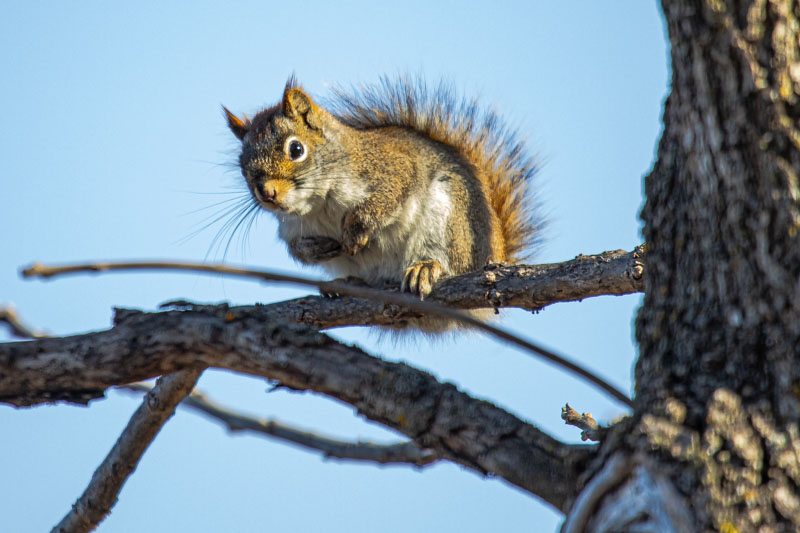
At the branch edge
A brief pause before the next movement.
Camera: Canon EOS 5D Mark IV
Lens: EF100-400mm f/4.5-5.6L IS USM
Settings: ISO 640 • Aperture f/5.6 • Shutter 1/640 s
E22A0926 • Size: 3459x2306
A red squirrel rarely looks relaxed in the way larger squirrels sometimes do. Even when stationary, it appears compressed and spring-loaded, balanced over the branch with the hind feet set for instant movement.
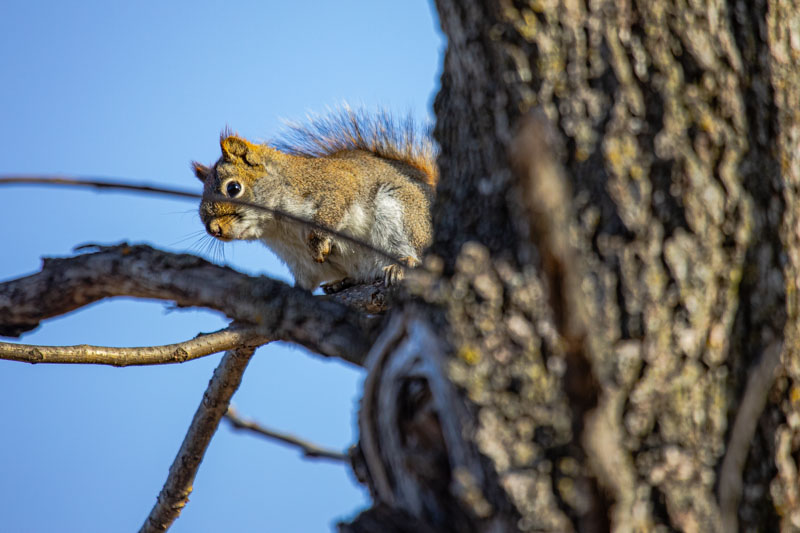
Half hidden by the trunk
Using bark and angle as cover.
Camera: Canon EOS 5D Mark IV
Lens: EF100-400mm f/4.5-5.6L IS USM
Settings: ISO 640 • Aperture f/5.6 • Shutter 1/800 s
E22A0919 • Size: 5207x3471
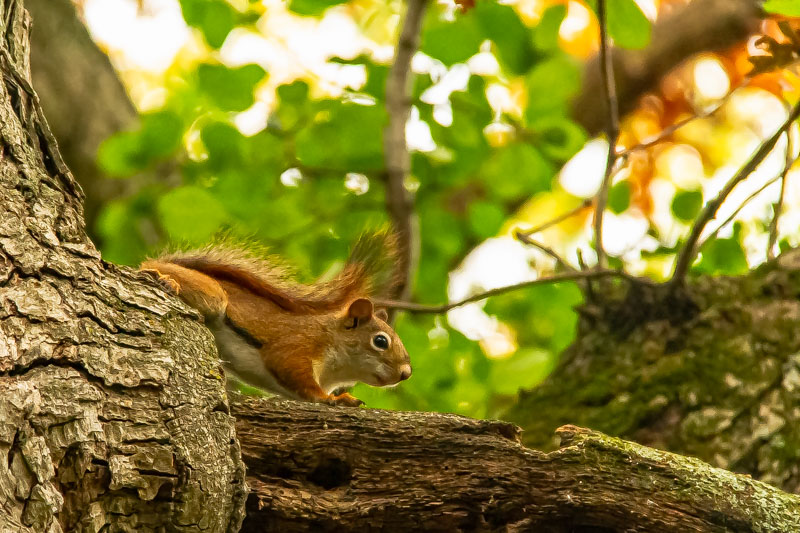
Along the woodland edge
Low against the bark beneath autumn leaves.
Camera: Canon EOS 7D
Lens: EFS 18-200mm f/3.5-5.6 IS
Settings: ISO 3200 • Aperture f/5.6 • Shutter 1/60 s
IMG_7404 • Size: 3409x2273
Taken together, the sequence shows how little exposure a red squirrel really gives. One moment it is fully outlined against the sky; the next it tucks itself behind the trunk or settles so closely to the bark that it nearly becomes part of the tree.
Mushroom carrier
Food-gathering behavior is one of the most memorable parts of watching red squirrels. Fungi, cones, seeds, and buds all become part of their routine, and a squirrel carrying a large mushroom can look almost comically overburdened for a few seconds before it disappears into the branches. A red squirrel moves along a limb with a mushroom clenched in its mouth, the load almost as visually prominent as the animal itself. The scene captures the species at its most industrious, turning a fleeting foraging moment into something both practical and unexpectedly expressive.
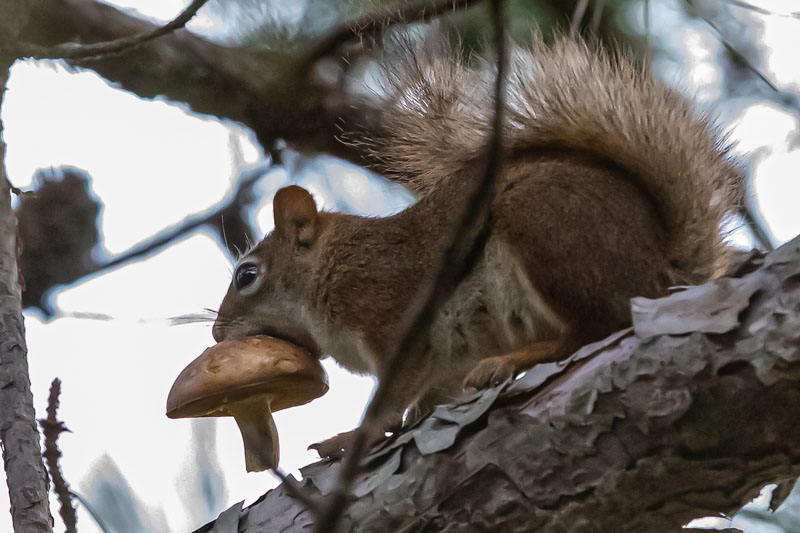
Carrying a mushroom
A late-season harvest in the pines.
Camera: Canon EOS 5D Mark IV
Lens: EF70-200mm f/2.8L IS II USM
Settings: ISO 20000 • Aperture f/6.3 • Shutter 1/1250 s
E21A6162-2 • Size: 2267x1511
Moments like this help define the red squirrel more clearly than any static description. It is not simply a small squirrel of northern woods, but a species shaped by urgency: quick to gather, quick to vanish, and always working within the layered structure of the trees.
Photographer’s Perspective
These photographs work best as a progression from posture to behavior. The branch studies show the squirrel’s alert balance and compressed energy, while the mushroom image reveals the practical side of that restlessness. What stands out across the set is how expressive the species becomes in brief pauses—through forepaws, whiskers, tail position, and the constant sense that stillness will last only a second.