Eastern Gray Squirrel
Sciurus carolinensis
Gray Squirrels are often seen as quick movements at the edge of vision—crossing trunks, freezing against bark, or vanishing into a canopy that seemed empty a moment before. In close views, though, their expression changes. The broad dark eye, the fine whiskers, and especially the long forepaws give them a watchful, deliberate presence that is easy to miss in a passing glimpse.
For identification details and comparison with similar species, see the Sciurus carolinensis in the Field Notes section.
A close portrait that emphasizes the squirrel’s expression and the reach of the forepaw as it braces itself against white birch. The tighter composition gives more weight to gesture and attention than to the full outline of the animal.
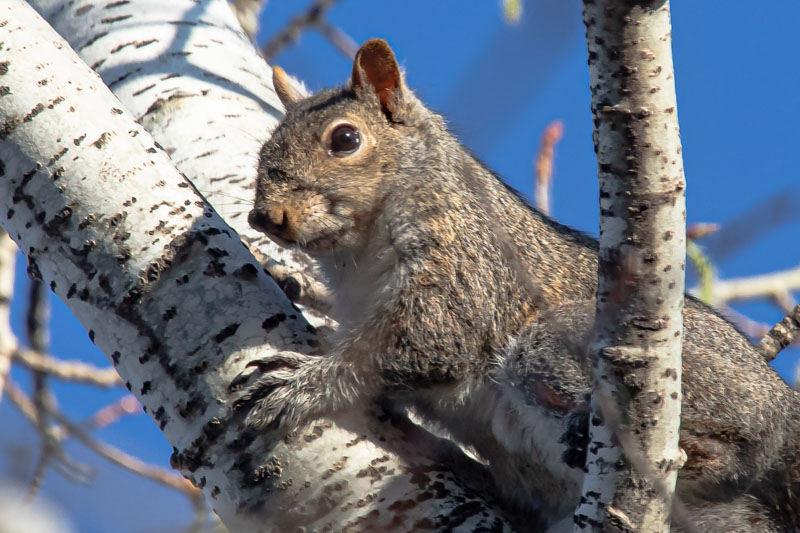
Blue Sky, Birch, and Fur
Sunlit fur and watchful eyes against a clear spring sky.
Camera: Canon EOS 5D Mark IV
Lens: EF100-400mm f/4.5-5.6L IS US
Settings: ISO 640 • Aperture f/10.0 • Shutter 1/640 s
E22A0616 • Size: 2143 x 1429
Overview
Gray Squirrels move easily between woodland edge, park trees, and neighborhood yards, but they are at their most photogenic when they pause. In still moments, their body language becomes more readable: forepaws gathered close, ears upright, tail partly hidden, and the eye fixed on whatever drew their attention. These images follow that shift from portrait to setting, then to variation—showing both the familiar form of the species and the unusual ways it can appear.
In Birch Light
This wider view places the same squirrel back into its surroundings. The full body adds posture and balance, but the crossing limbs and shallow foreground blur also show how quickly a tree can become visually crowded.
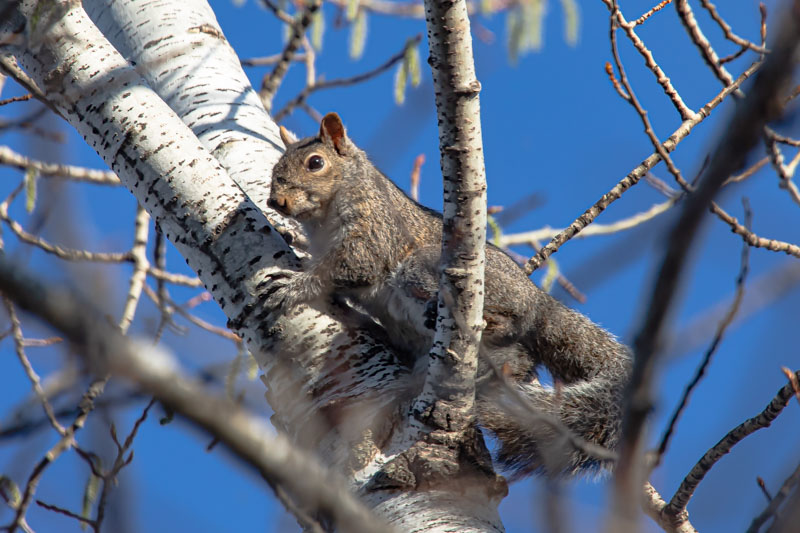
A Pause in the Birch
A fuller view of the same alert moment.
Seen from farther back, the squirrel’s tail, hindquarters, and climbing posture come into view, framed by bright bark and a clear blue sky.
Camera: Canon EOS 5D Mark IV
Lens: EF100-400mm f/4.5-5.6L IS US
Settings: ISO 640 • Aperture f/10.0 • Shutter 1/640 s
E22A0615 • Size: 4254 x 2836
The contrast between this image and the tighter portrait is useful. One shows the whole animal in place; the other isolates the parts that carry the most expression. Together they show how an Eastern Gray Squirrel can be photographed either as a woodland subject or as a character study.
Ghost in the Elm
The first sighting was little more than something white fluttering through the trees behind the house. By the time I focused on the spot, it was gone. Several days later it appeared again, looking at first like a plastic grocery bag caught among the branches. We began calling it “Ghost.” Eventually it paused long enough for me to focus and recognize it as an albino Eastern Gray Squirrel.
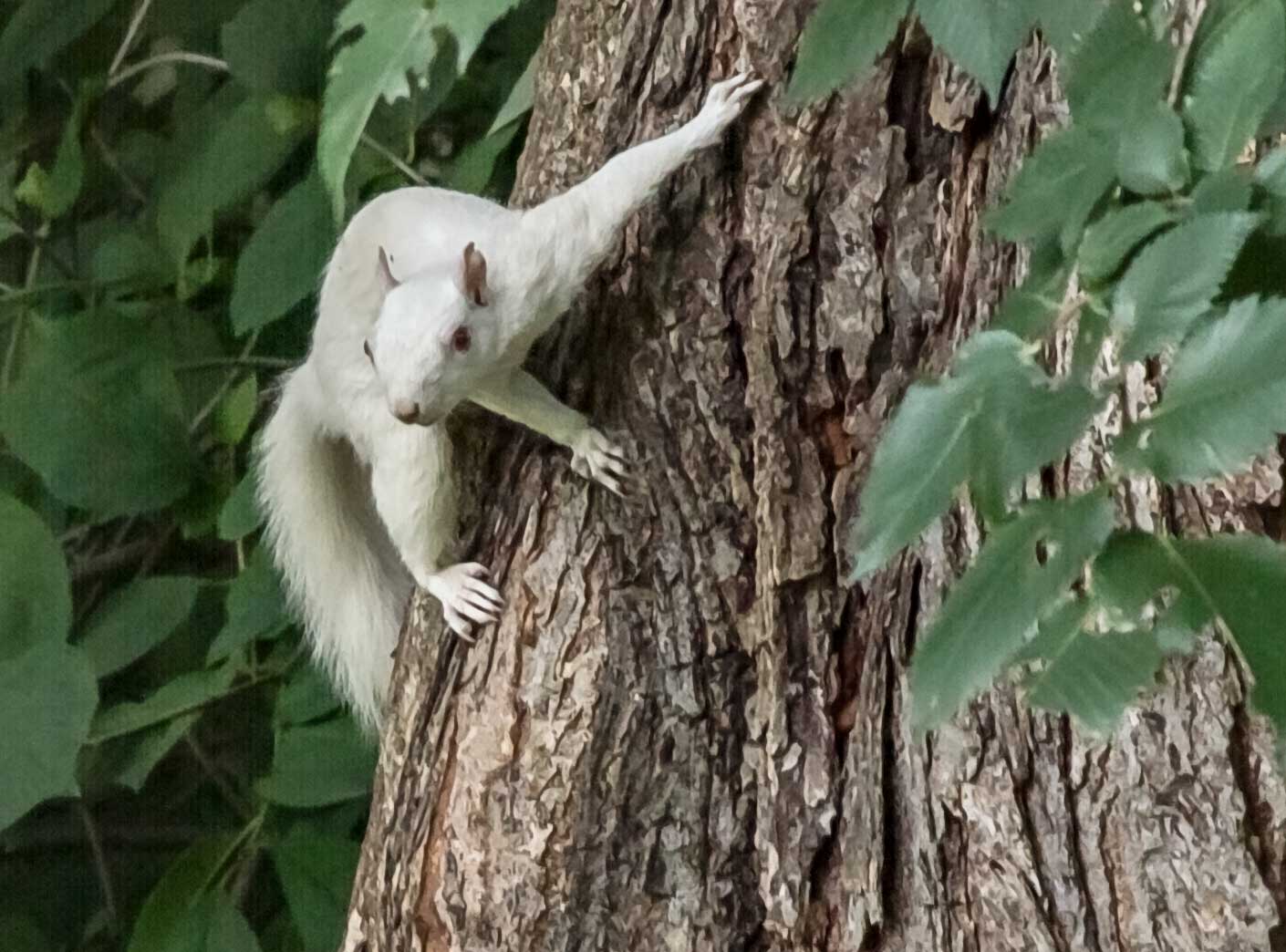
White Descent
A striking pale squirrel against deeply furrowed bark.
Camera: Canon EOS 7D
Lens: EF70-300mm f/4-5.6 IS USM
Settings: ISO 200 • Aperture f/9.0 • Shutter 1/160 s
IMG_3027-3 • Size: 1410 x 1044
Clinging headfirst to the deeply furrowed bark of an American Elm, Ghost shows the familiar structure and climbing posture of an Eastern Gray Squirrel transformed by its white coat. The fine texture in the surrounding leaves is secondary to the striking contrast between the pale animal and the dark bark—a brief encounter that became one of my favorite photographs.
Photographer’s Perspective
Across these images, distance changes what becomes visible. The wider birch view shows posture, balance, and setting; the closer portrait brings attention to the eye and forepaw. White Descent adds something different: the memory of an animal first seen only as a pale flicker in the trees, then finally recognized and photographed. Together, the images move from familiarity to character, and finally to an encounter that felt almost improbable.