Mica Cap Mushroom
Coprinellus micaceus
Mica cap mushrooms often appear in small, crowded clusters around buried wood, old roots, or woody debris. Young fruiting bodies are honey-tan to pale buff, with delicate pleats running down the cap and darker gray tones developing near the margin as the caps mature. The common name comes from tiny mica-like granules that can sparkle on fresh caps, though rain and age may wash them away before a photograph is taken.
These photographs show a compact cluster at several viewing angles, emphasizing the tall pale stems, bell-shaped caps, ribbed margins, and soft woodland setting. For identification details and comparison with similar inky caps, see Coprinellus micaceus in the Field Notes section.
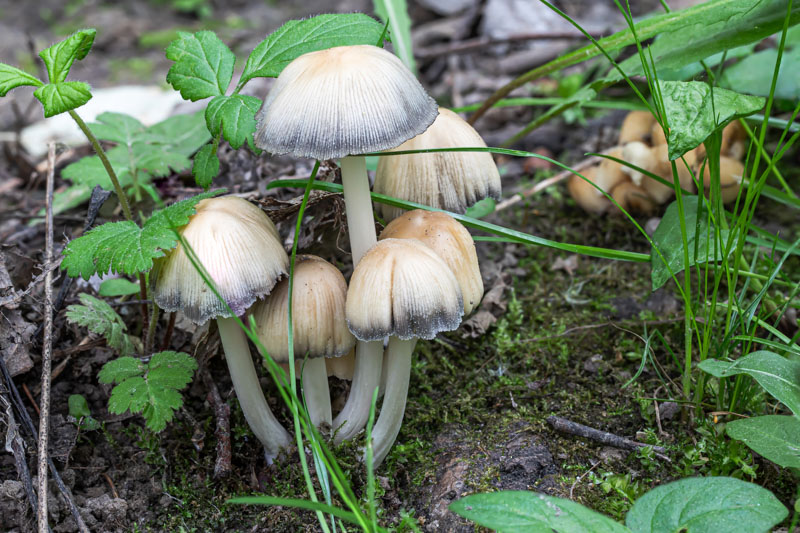
Pleated Bells
A close look at the clustered caps, with pale honey centers fading into gray, ribbed margins.
Camera: Canon EOS 5D Mark IV
Lens: EF100mm f/2.8L Macro IS USM
Settings: ISO 200 * Aperture f/13.0 * Shutter 0.8 s
D79A0676-82 • Size: 5088x3392
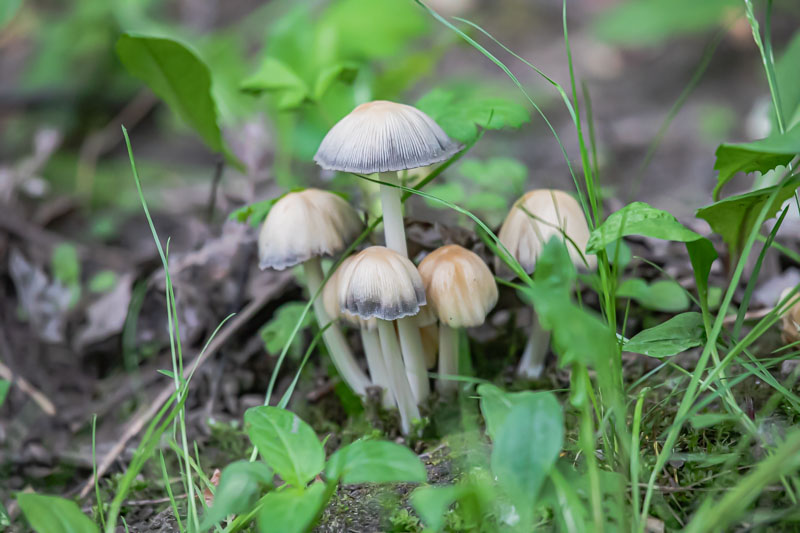
Mica Cap Cluster
A small group rises from mossy soil and leaf litter, their slender stems supporting fragile, pleated caps.
Camera: Canon EOS 5D Mark IV
Lens: EF100-400mm f/4.5-5.6L IS USM
Settings: ISO 6400 * Aperture f/6.3 * Shutter 1/500 s
E22A3732 • Size: 6720x4480
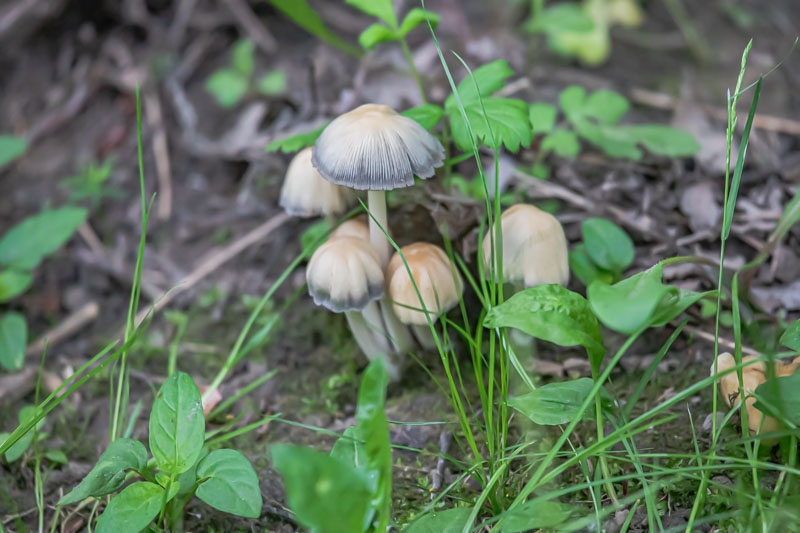
Sheltered in Spring Growth
Grasses and new leaves frame the cluster, giving a sense of scale and habitat on the woodland floor.
Camera: Canon EOS 5D Mark IV
Lens: EF100-400mm f/4.5-5.6L IS USM
Settings: ISO 6400 * Aperture f/6.3 * Shutter 1/500 s
E22A3729 • Size: 6720x4480
The caps in this group are still relatively fresh, with their bell-like shape intact and the pleated edges clearly visible. Several show the darker lower band typical of maturing inky-cap relatives, while the younger caps retain warmer buff and caramel tones. The tight grouping suggests growth from buried woody material rather than open soil.