Sundial Lupine
Lupinus perennis
Sundial lupine brings together two very different kinds of beauty: the precise geometry of palmate leaves and the soft, painterly color of blue-violet flower spikes. The leaves spread like green spokes from a central point, while the upright racemes carry pea-like flowers in shades of lavender, blue, violet, and pale white.
These photographs emphasize the plant as both a botanical subject and a meadow portrait. The closer frames show the star-shaped leaves, hairy stems, unopened buds, and individual flowers; the wider frames place the lupines back among grasses and neighboring spring growth, where the repeated vertical spikes become part of the larger prairie-like scene.
For identification details and comparison with similar lupines, see Lupinus perennis in the Field Notes section.
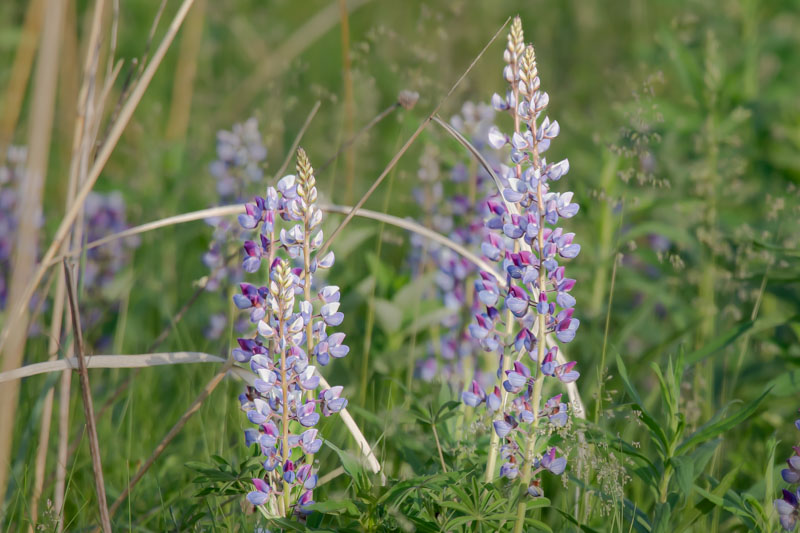
Among the Grasses
A small stand of Sundial Lupine rising through grasses, with blue-violet flower spikes repeated into the soft background.
Camera: Canon EOS 5D Mark IV
Lens: EF100-400mm f/4.5-5.6L IS USM
Settings: ISO 400 * Aperture f/8.0 * Shutter 1/400 s
E22A3676 • Size: 4200x2800
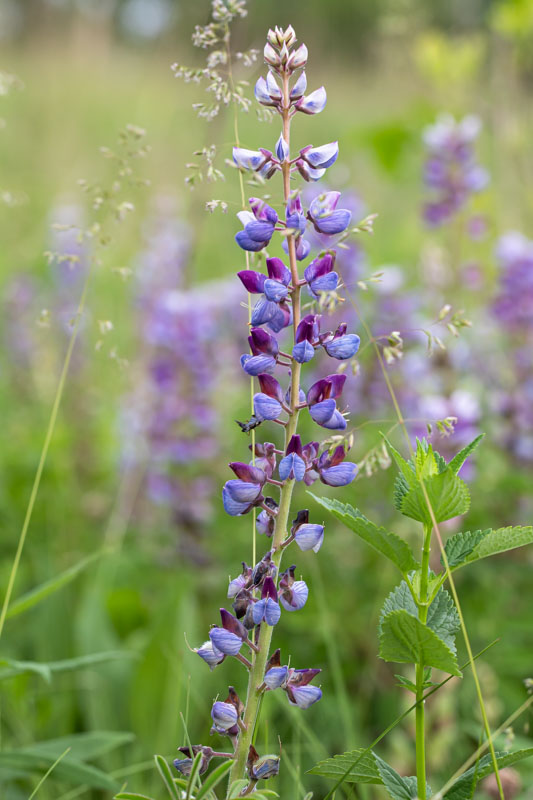
Blue Spire
A vertical portrait of a single flower spike, showing the layered pea-like blossoms opening along the raceme.
Camera: Canon EOS 5D Mark IV
Lens: EF100mm f/2.8L Macro IS USM
Settings: ISO 200 * Aperture f/8.0 * Shutter 1/40 s
D79A0548 • Size: 3524x5286
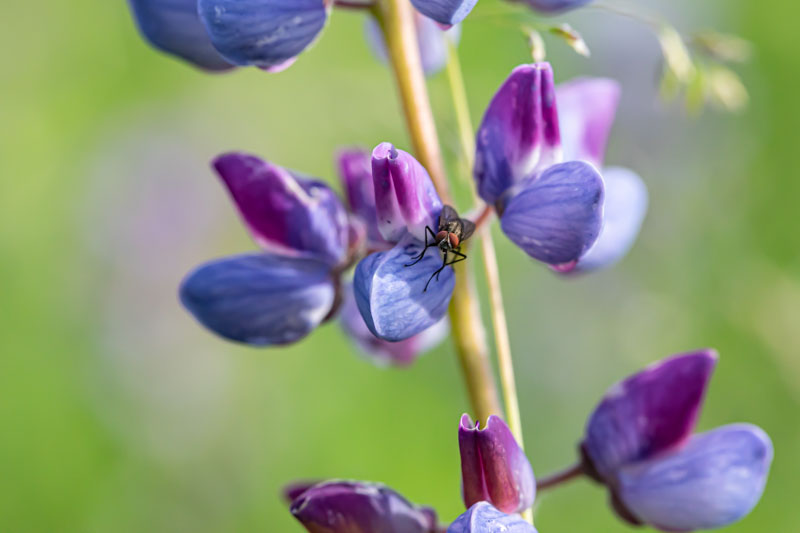
Not the Spider
While checking the lupine blooms for the source of hidden legs, a small fly becomes the morning's subject.
Camera: Canon EOS 5D Mark IV
Lens: EF100mm f/2.8L Macro IS USM
Settings: ISO 800 * Aperture f/8.0 * Shutter 1/320 s
E22A3747 • Size: 4200x2800
The most useful identification photographs are the ones that hold the flower and foliage together. Sundial lupine has palmately compound leaves, with narrow leaflets arranged like a small green wheel. Above them, the flower stalk carries the typical pea-family structure: banner, wings, and keel gathered into a compact blue-violet bloom.
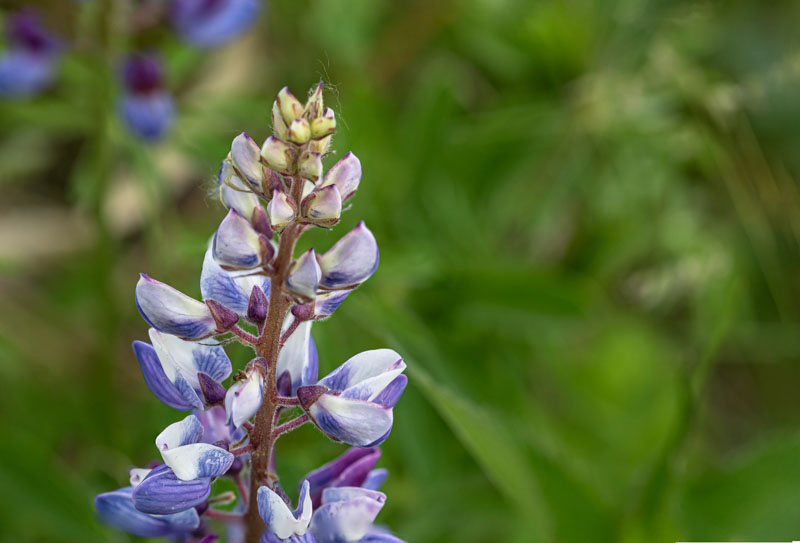
Blue, White, and Violet
A close study of the upper raceme, where unopened buds, pale petals, violet markings, and the hairy flower stalk are all visible.
Focus stack: D79A0560-D79A0575
Camera: Canon EOS 5D Mark IV
Lens: EF100mm f/2.8L Macro IS USM
Settings: ISO 200 * Aperture f/8.0 * Shutter 1/40 s
D79A0560-75 • Size: 4800x3200
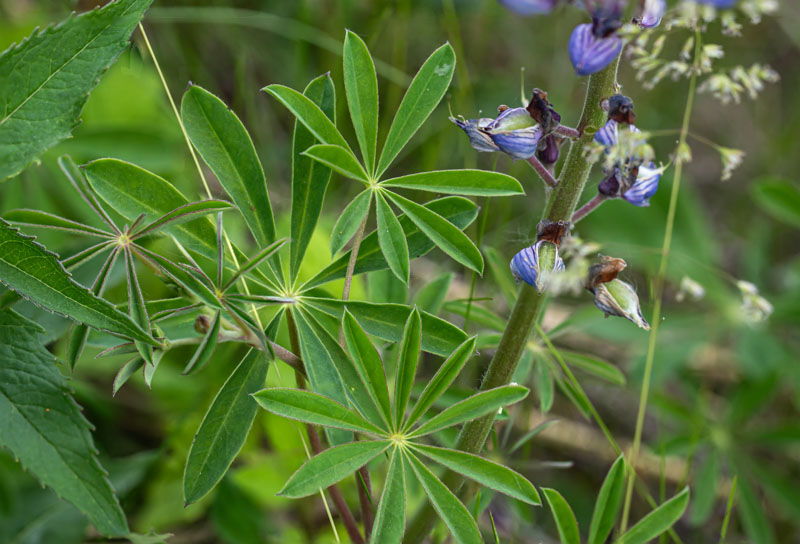
Green Sundials
A natural-history detail showing the spoke-like leaves that give Sundial Lupine one of its most memorable field marks.
Focus stack: D79A0555-D79A0559
Camera: Canon EOS 5D Mark IV
Lens: EF100mm f/2.8L Macro IS USM
Settings: ISO 200 * Aperture f/8.0 * Shutter 1/40 s
D79A0555-59 • Size: 800x544
Beyond its color and form, Sundial Lupine is an ecologically important native wildflower. It is closely associated with open, sunny, sandy habitats and is best known as the larval host plant for the Karner blue butterfly. That connection gives the plant a second story on the page: not just a beautiful spring bloom, but part of a specialized relationship between flower, habitat, and insect life.