Tyrannidae (Tyrant Flycatchers)
Tyrannidae (Tyrant Flycatchers)
Tyrannidae is a family of primarily insect-eating birds of the Americas that includes kingbirds, phoebes, pewees, and many other flycatchers. Members of this family are often recognized by their relatively broad-based bills, upright posture, alert behavior, and characteristic habit of watching from a perch before flying out to capture insects.
They occupy a wide variety of habitats, from open grasslands and wetlands to woodland edges, shrublands, and forest interiors. Many species depend on a combination of suitable perches and open airspace for hunting.
In the field, behavior, posture, voice, and habitat are often as important as plumage for identification.
Orientation
These notes emphasize field recognition, behavior, and comparison across species, rather than a complete taxonomic treatment.
General Characteristics
- Size: Small to medium-sized songbirds, ranging from compact flycatchers to larger, broad-shouldered kingbirds
- Bill: Usually straight, flattened, and relatively broad at the base, adapted for capturing insects
- Plumage: Often gray, brown, olive, black, white, or yellow; some species are more strongly patterned than others
- Voice: Frequently important for identification, particularly among species with similar plumage
- Flight: Often quick and agile, with short aerial pursuits launched from an exposed or partially concealed perch
Habitat and Range
Members of this family may be encountered in:
- Open fields, meadows, and grasslands
- Wetland and marsh edges
- Woodland and forest edges
- Shrublands and brushy openings
- Parks, pastures, roadsides, and other areas with exposed perches
Seasonal patterns may include:
- Breeding habitat: open country, woodland edges, wetlands, shrublands, or forest depending on species
- Migration tendencies: many species present in Minnesota are migratory and occur primarily during the breeding season or migration
- Winter distribution: migratory species may move into Central America, South America, or warmer portions of North America
Birds are often detected first by an exposed silhouette, a repeated call, or a sudden flight from a favored perch.
Field Recognition
Key features for identifying this family:
- Shape: Often upright with a relatively large head, broad shoulders, and alert posture
- Bill: Straight and broad-based rather than conical like the bill of a sparrow or finch
- Plumage: Frequently subdued, making structure and behavior important identification clues
- Movement: Commonly watches from a perch before making a short flight to capture an insect
- Voice: Calls and songs can be highly diagnostic, especially among similar-looking flycatchers
- Behavior: Many species repeatedly return to the same perch or a nearby lookout after an aerial pursuit
The combination of perch selection, hunting behavior, voice, and structural details may be more useful than color alone.
Movement and Flight
- Flight: Often rapid and direct during short pursuits, with abrupt turns while following flying insects
- Perching: Frequently upright on branches, treetops, fence lines, wires, posts, or other lookout points
- Foraging: Many species use a perch-and-sally strategy, flying outward to capture insects before returning to a perch
- Display: Territorial flights, calling from exposed positions, wing movements, and aggressive pursuits may become conspicuous during the breeding season
Movement patterns can be diagnostic. A bird repeatedly leaving an exposed perch, catching an insect in flight, and returning to the same location strongly suggests flycatcher behavior.
Similar Families
This family may be confused with:
- Turdidae: Thrushes and bluebirds may share an upright posture, but generally have narrower bills and are more likely to forage on or near the ground
- Mimidae: Mockingbirds, catbirds, and thrashers may use exposed perches but typically have longer tails, different bill structure, and different foraging behavior
- Cardinalidae: Some buntings and grosbeaks may occupy similar woodland-edge habitats, but have thicker, more conical bills adapted for seeds
- Parulidae: Warblers may also pursue insects among foliage, but are generally smaller, more active within vegetation, and lack the broad-based flycatcher bill
Distinction is often based on bill shape, posture, hunting behavior, and voice rather than any single plumage feature.
Species
Tyrannus tyrannus (Eastern Kingbird)
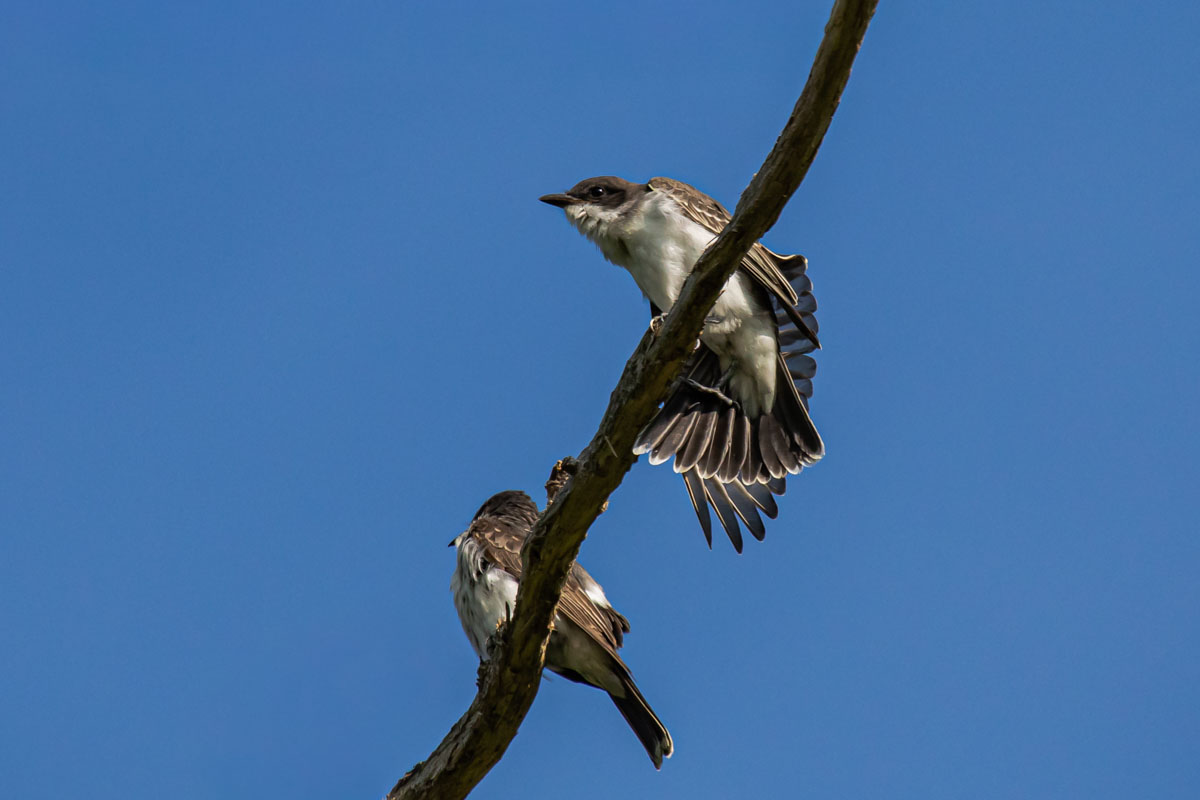
A medium-sized, broad-shouldered flycatcher of open country and woodland edges. Dark upperparts contrast sharply with white underparts, while a broad white terminal band across the dark tail provides one of the species’ strongest identification marks.
Eastern Kingbird — Gallery
Photographs of a pair of Eastern Kingbirds sharing an exposed perch, including a brief sequence showing wing and tail feather movement.
Notes
- Tyrant flycatchers are strongly associated with insect hunting, although diet and foraging methods vary among species.
- A broad-based bill is an important structural characteristic and reflects the family’s emphasis on capturing insects.
- Perch-and-sally behavior is especially conspicuous in kingbirds and many other open-country flycatchers.
- Voice can be essential for distinguishing species whose plumage is otherwise similar.
- Eastern Kingbirds favor conspicuous lookout points and may repeatedly return to the same branch, treetop, fence, or wire after aerial pursuits.
- The white terminal band of the Eastern Kingbird’s tail is particularly useful when the tail is spread or the bird is seen in flight.
- Male and female Eastern Kingbirds are very similar in normal field views and should not generally be assigned a sex from plumage alone.
References
-
Cornell Lab of Ornithology – All About Birds
https://www.allaboutbirds.org -
eBird
https://ebird.org -
Birds of the World / regional atlas as needed
https://birdsoftheworld.org