Eastern Kingbird
Tyrannus tyrannus
The Eastern Kingbird is a sharply patterned flycatcher of open country, woodland edges, wetlands, and scattered trees. Its dark head and upperparts contrast with clean white underparts, while the white terminal band of the tail provides one of its most distinctive field marks.
For identification details and comparison with similar species, see the Tyrannus tyrannus page in the Field Notes section.
This August encounter offered something more than a conventional perched portrait. Two kingbirds shared the same exposed branch, remaining close together while one bird briefly shifted its posture and spread its wing and tail feathers.
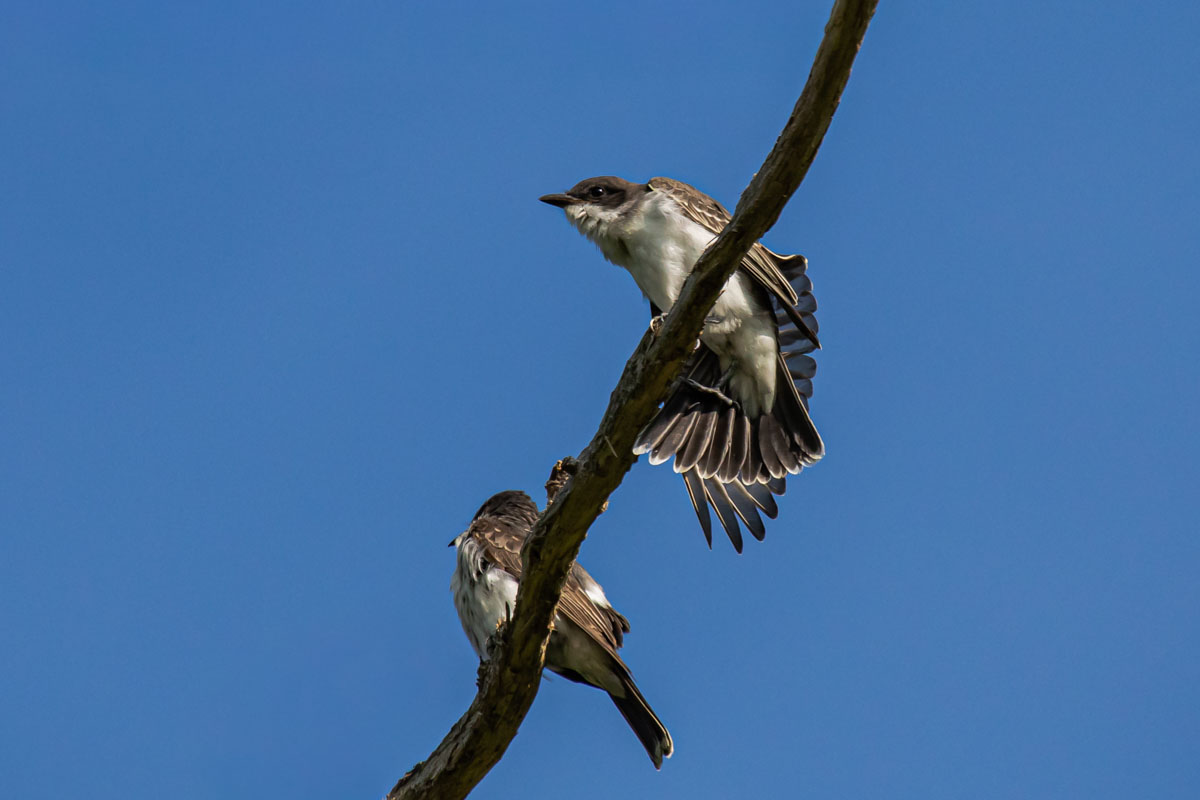
Curve of the Wing
A brief feather spread turns a shared perch into a study of line, balance, and motion.
Camera: Canon EOS 5D Mark IV
Lens: EF100-400mm f/4.5-5.6L IS USM
Settings: ISO 800 • Aperture f/8.0 • Shutter 1/2500 s
E22A8175 • Size: 1200 x 833
Overview
Eastern Kingbirds often choose exposed perches from which they can watch the surrounding airspace and launch after flying insects. Their upright posture, broad shoulders, dark cap, pale underparts, and black tail tipped in white give them a clean and immediately recognizable silhouette.
Here, the presence of two birds transforms the perch into a small interaction. The diagonal branch connects them visually, while the uninterrupted blue sky isolates their forms and makes even subtle changes in posture easy to see.
Feathered Geometry
In the featured frame, the upper kingbird begins to open its right wing while spreading the tail beneath it. The flight feathers do not simply radiate outward. Their tips follow a changing curve, producing a smooth arc from the body through the outer feathers. Pale feather edges make the pattern especially visible against the darker wing.
The feet add another small detail to the moment. The bird appears to carry most of its weight on the left foot while the right foot remains lightly engaged with the branch. Together with the wing and tail spread, the uneven footing suggests a brief transition in posture rather than a static display.
A catchlight in the eye keeps attention on the bird's face before the feather arrangement draws the eye outward. The result is a photograph that begins as a portrait but gradually becomes a study of shape and motion.
A Moment on the Perch
The surrounding frames show how quickly the posture changes. The wing opens, the tail shifts from a compact shape into a fan, and then the bird returns toward a more conventional perch. The second kingbird remains close throughout the sequence, sometimes looking toward its companion and sometimes outward into the surrounding landscape.
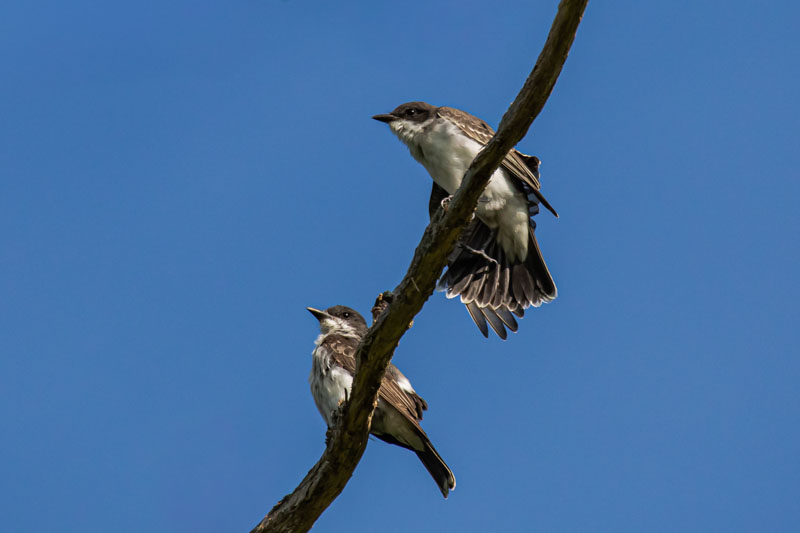
Light in Both Eyes
Both birds catch the morning light as the upper kingbird holds its feathers partly spread.
Camera: Canon EOS 5D Mark IV
Lens: EF100-400mm f/4.5-5.6L IS USM
Settings: ISO 800 • Aperture f/8.0 • Shutter 1/2500 s
E22A8176 • Size: 3000 x 2000
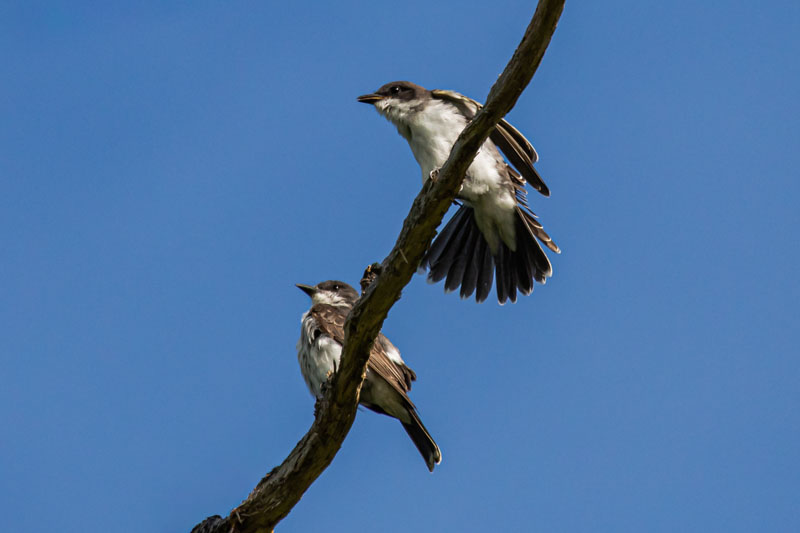
Feathers in Motion
Wing and tail open for an instant above the waiting companion.
Camera: Canon EOS 5D Mark IV
Lens: EF100-400mm f/4.5-5.6L IS USM
Settings: ISO 800 • Aperture f/8.0 • Shutter 1/2500 s
E22A8173 • Size: 3000 x 2000
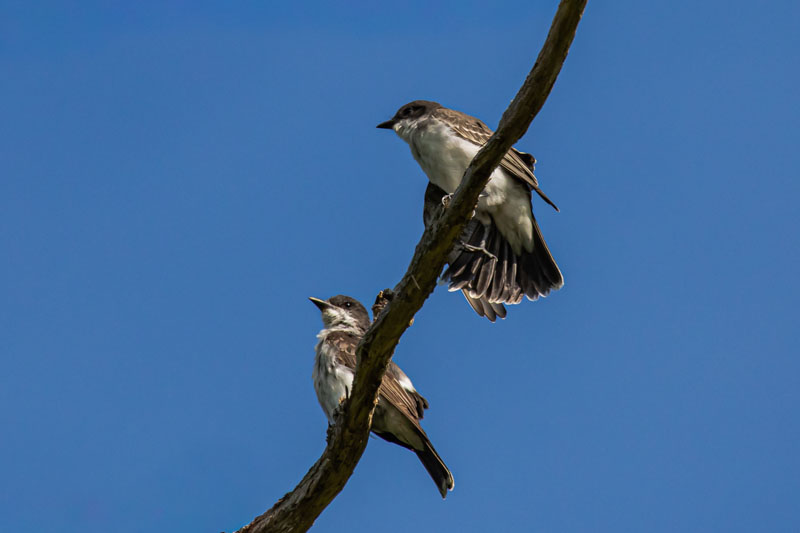
Together on the Branch
The pair settles into a quieter posture beneath the open August sky.
Camera: Canon EOS 5D Mark IV
Lens: EF100-400mm f/4.5-5.6L IS USM
Settings: ISO 800 • Aperture f/8.0 • Shutter 1/2500 s
E22A8177 • Size: 3000 x 2000
Photographer’s Perspective
The attraction of this sequence is not simply having two Eastern Kingbirds together. Small changes from one exposure to the next reveal details that would have been easy to overlook in the field: catchlights in both birds, the shifting grip on the branch, the radial spread of the tail, and especially the curving progression of the right wing feathers.
E22A8175 brings those elements together most successfully. The second bird turns partly away, but the upper kingbird's eye, feather spread, and unusual geometry make the frame more than a record of the encounter. It captures a fraction of a second in which an ordinary perch becomes unexpectedly dynamic.
A second Eastern Kingbird sequence from the same morning documented the birds using an exposed perch while handling a captured dragonfly. See Hunting and Food Exchange for the complete observation.