Eastern Kingbird — Hunting and Food Exchange
Eastern Kingbird — Hunting and Food Exchange
Tyrannus tyrannus
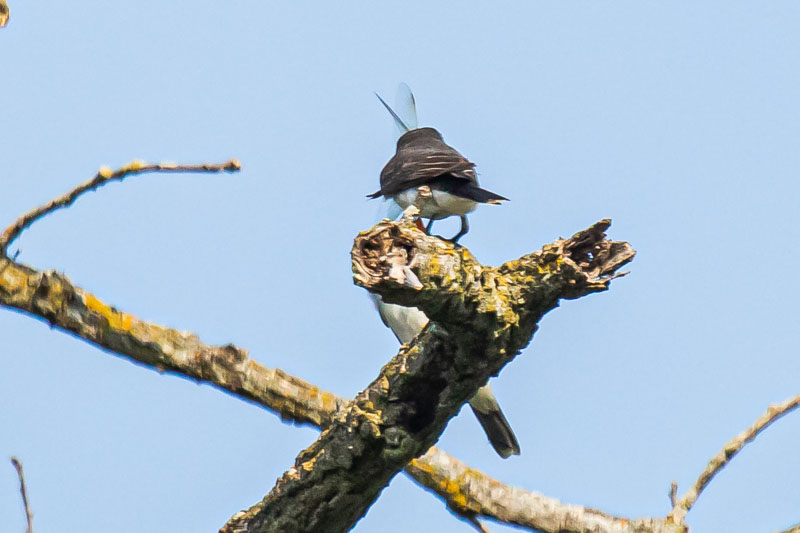
Eastern Kingbirds often use exposed branches as lookout points, watching the surrounding airspace before launching after flying insects. A short photographic sequence from August 8, 2026, recorded that behavior and an unexpected interaction between two birds.
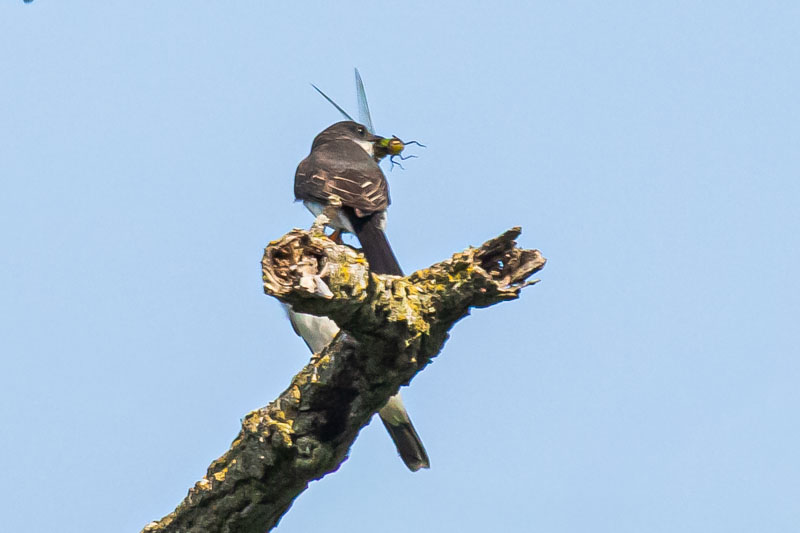
At first, the object carried by one kingbird appeared to be nesting material. Its translucent, smoky appearance was difficult to interpret through the camera. Subsequent photographs revealed something quite different: a captured dragonfly, its wings extending above and behind the bird's head.
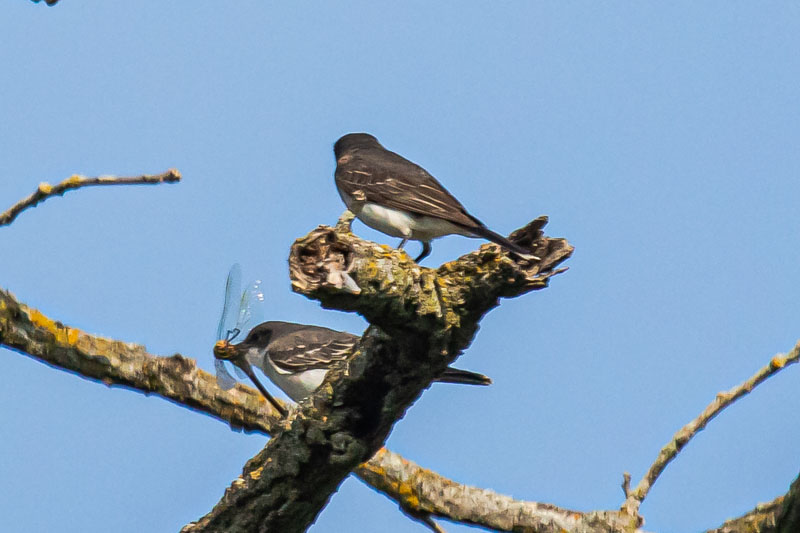
The two kingbirds then handled the insect between them. The exchange was reminiscent of Cedar Waxwings passing a berry, although the photographs do not establish whether these birds were a breeding pair or whether the interaction involved an adult and a recently fledged young bird.
A Dragonfly on the Perch
Dragonfly Revealed
What first looked like nesting material resolves into the translucent wings of captured prey.
E22A8103
This frame provides the clearest interpretation of the object. The dragonfly's body is held crosswise in the bill, while the long translucent wings project above the kingbird's head. Against the bright sky, those wings take on the hazy appearance that initially made the object difficult to identify.
Shared Perch
At the Lookout
Two kingbirds gather at the same exposed hunting perch.
E22A8101
Prey Between Them
The captured insect becomes part of the interaction between the two birds.
E22A8107
Exposed-Perch Hunting
The photographs provide a direct example of the behavior associated with the Eastern Kingbird's preference for exposed perches. From a high branch, the bird has an unobstructed view of passing insects and open space for a rapid aerial pursuit.
Larger prey can be brought back to the perch rather than swallowed immediately in flight. In this sequence, the dragonfly also becomes part of an interaction between the two birds, giving the perch a second function beyond simply serving as a lookout.
What the Photographs Do — and Do Not — Show
The sequence clearly documents a captured dragonfly and two Eastern Kingbirds interacting closely around it. It does not, however, provide enough evidence to determine the sex or age of either bird with confidence.
The exchange could represent interaction between paired adults, or it could involve an adult feeding or transferring prey to a recently fledged young bird. Without clearer age-related plumage details or additional behavioral evidence, the relationship is best left unresolved.
Related Pages
Return to the photographic portfolio: Eastern Kingbird
Identification and field notes: Tyrannus tyrannus