Cedar Waxwing — Perspective
Cedar Waxwing — Perspective
Bombycilla cedrorum
The Cedar Waxwing photographs collected here span several encounters and show the species in very different settings: an open branch against blue sky, a spring canopy with fresh buds, a brief courtship exchange, and a high spruce-top perch.
Taken separately, many of the photographs are simple waxwing portraits. Together, they show how much the character of a Cedar Waxwing image can change when the surrounding branches, buds, or evergreen structure remain part of the story.
For identification, habitat, and natural-history details, see the Bombycilla cedrorum species page.
Open Branch Portraits
The newer open-branch portraits give the Cedar Waxwing page a cleaner gallery lead. E22A8731 works especially well because it balances a clear view of the bird with enough branch structure to keep the scene anchored. The breast texture is stronger than in the nearby frames, and the bird holds its head more forward rather than turning off to the side.
That head angle was part of the challenge in the field. The bird was visible through a set of limbs, but many frames caught the head turned left. The selected image keeps the waxwing in a natural perch setting while still showing the crest, black mask, yellow belly wash, and smooth overall shape.
E22A8727 is the stronger field-mark companion. It shows the red waxy wing tips, yellow tail band, black mask, and clean open-sky profile in one frame. With some of the branch structure retained, it feels less isolated than a fully cleaned version and fits better with the surrounding gallery images.
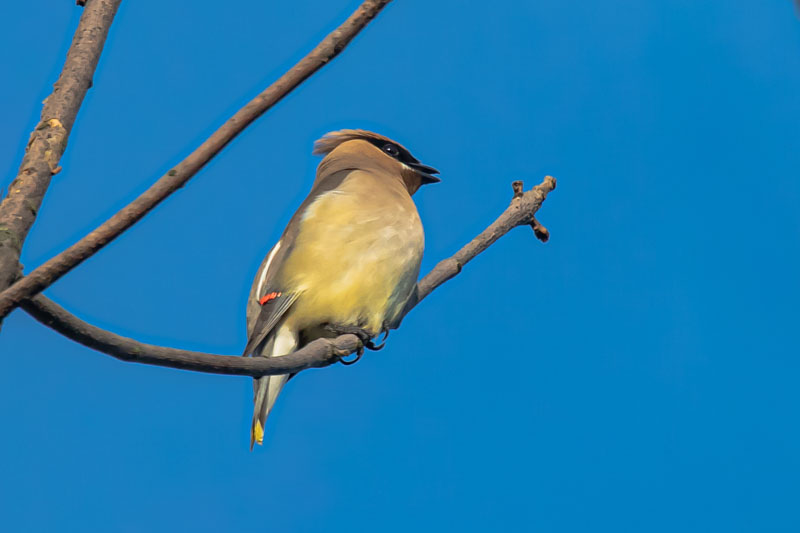
Clear View Through the Branches
Breast texture, open sky, and a forward-held head after working around the surrounding limbs.
Camera: Canon EOS 5D Mark IV
Lens: EF100-400mm f/4.5-5.6L IS USM
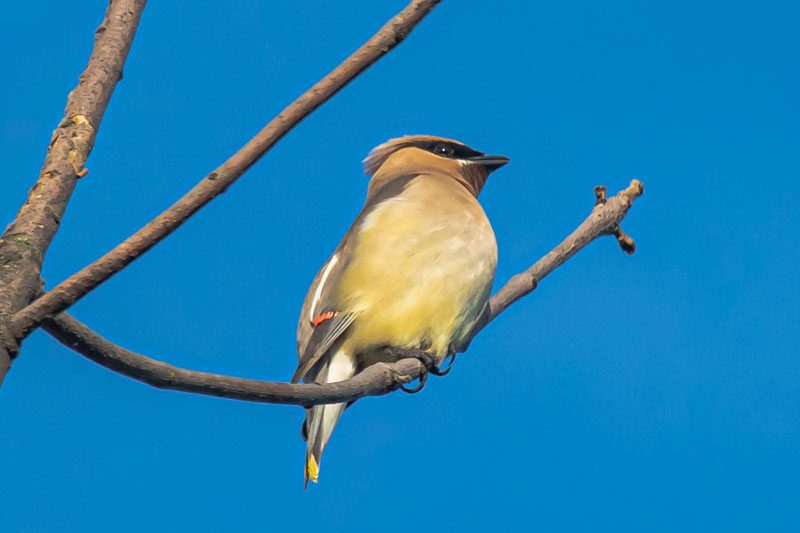
Waxy Wing Tips
Red wing tips, yellow tail band, black mask, and smooth waxwing color in one open-branch portrait.
Camera: Canon EOS 5D Mark IV
Lens: EF100-400mm f/4.5-5.6L IS USM
Spring Bud Exchange
The spring canopy sequence has a different value. It is not as clean as the open-branch portraits, but it carries the stronger behavior story. Two Cedar Waxwings appeared to pass a small green bud or catkin piece back and forth while perched close together in a budding tree.
The repeated green buds around the birds help explain the object being passed. Instead of reading as an isolated berry or unidentified item, it appears tied directly to the tree and the season. That makes the exchange feel more like a small spring moment than a staged portrait.
E22A2676 is the key image because the birds meet bill-to-bill with the green bud between them. The branches are busy and the birds are partly screened, but that natural screening helps preserve the feeling of watching the behavior unfold from a distance.
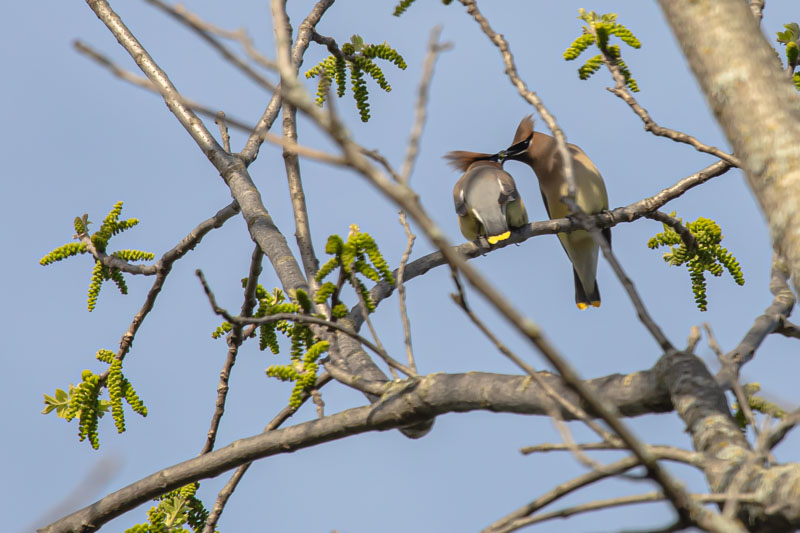
Bud Exchange
The pair meets bill-to-bill with the green bud between them.
Camera: Canon EOS 5D Mark IV
Lens: EF100-400mm f/4.5-5.6L IS USM
Settings: ISO 500 • Aperture f/9.0 • Shutter 1/640 s
E22A2676 • Size: 2552 x 1701
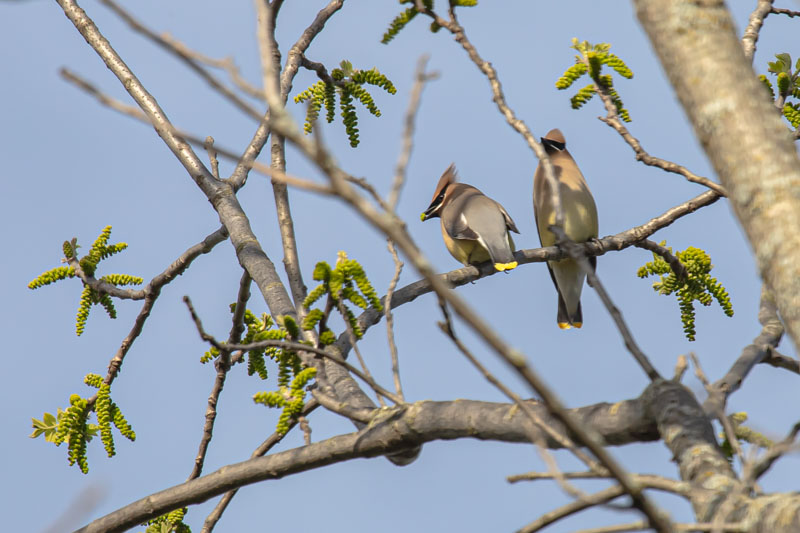
After the Exchange
One bird lowers toward the branch while the other remains upright.
Camera: Canon EOS 5D Mark IV
Lens: EF100-400mm f/4.5-5.6L IS USM
Settings: ISO 500 • Aperture f/9.0 • Shutter 1/640 s
E22A2678 • Size: 2552 x 1701
The exchange is small, but it gives the sequence its story. Instead of a static portrait, the images show social interaction: two birds close together, using a piece of the surrounding spring growth as part of their pair-bonding behavior.
Pair in the Spring Branches
E22A2688 gives the sequence a quiet opening moment, with the pair perched close together before the clearest exchange. One bird faces away, showing the smooth gray back and yellow tail tip, while the other stands upright with the black mask and crest in profile.
The frame is partially screened by branches, which adds to the sense of watching a small behavior unfold from a distance. Even with the obstructions, the waxwing field marks remain strong: a swept-back crest, dark mask, smooth brown head, gray body, and bright yellow tail tips.
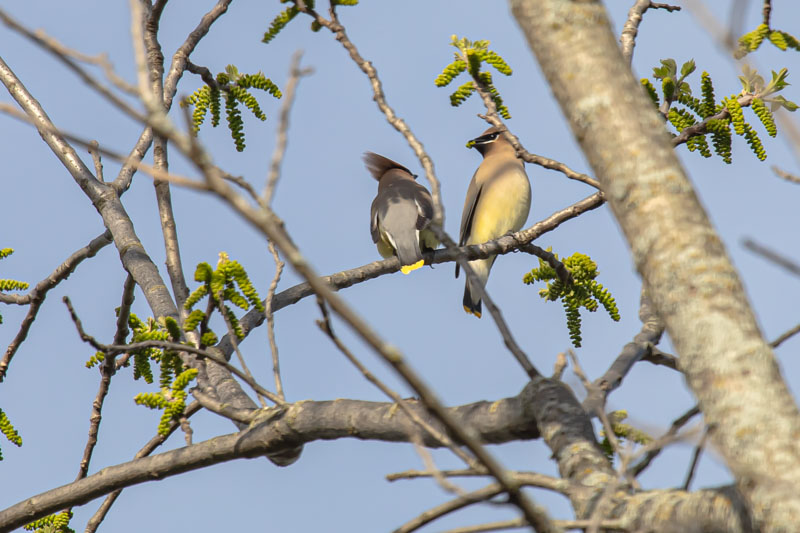
Pair Among Spring Buds
A quiet moment in the canopy before the exchange.
Camera: Canon EOS 5D Mark IV
Lens: EF100-400mm f/4.5-5.6L IS USM
Settings: ISO 500 • Aperture f/9.0 • Shutter 1/640 s
E22A2688 • Size: 2552 x 1701
Single-Bird Context
The single-bird frames help separate the bird from the pair behavior and show the classic Cedar Waxwing shape. The crest gives the head a swept-back profile, while the black mask and pale outline around it sharpen the face.
E22A2670 shows the warm brown head and chest fading into a paler yellow belly and gray lower body. The branch partly hides the lower half, but the long, neat silhouette and yellow tail band still read clearly.
E22A2668 is less portrait-like, but it adds useful context. The rear view makes the tail band the strongest field mark. The bird is turned away, yet the smooth gray body, pointed crest, folded wing shape, and yellow tail tip keep the identification unmistakable.
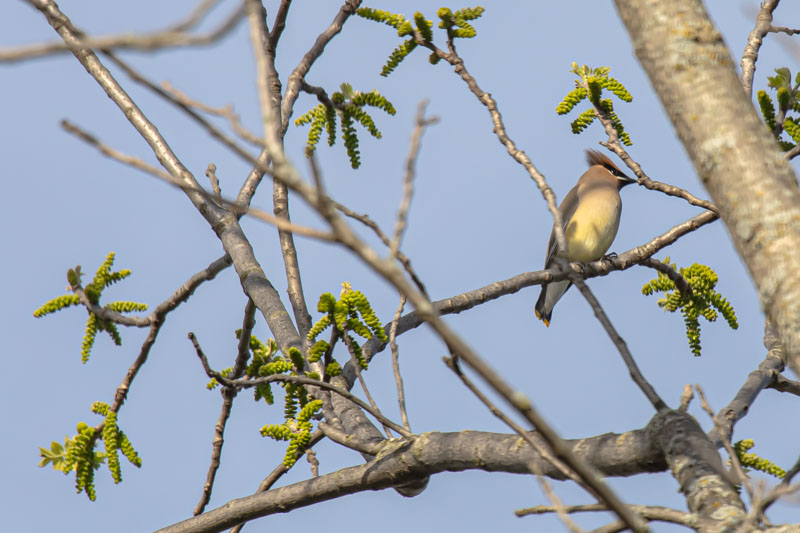
In Spring Buds
Crest raised slightly, mask visible, and yellow tail tip tucked below the branch.
Camera: Canon EOS 5D Mark IV
Lens: EF100-400mm f/4.5-5.6L IS USM
Settings: ISO 500 • Aperture f/9.0 • Shutter 1/640 s
E22A2670 • Size: 2552 x 1701
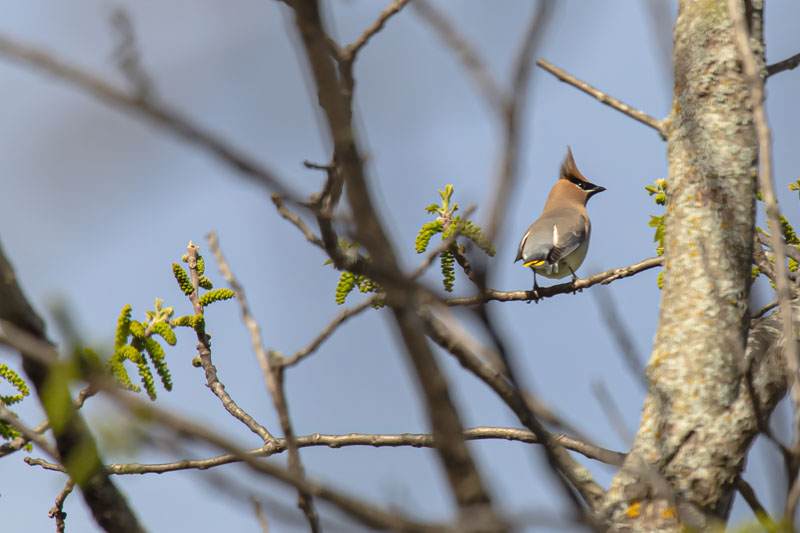
From Behind
The smooth gray back and yellow tail tip stand out against the spring branches.
Camera: Canon EOS 5D Mark IV
Lens: EF100-400mm f/4.5-5.6L IS USM
Settings: ISO 500 • Aperture f/9.0 • Shutter 1/640 s
E22A2668 • Size: 2552 x 1701
High in the Spruce
The spruce-top images add a cleaner blue-sky setting from an earlier encounter. E21A2120 is the quieter portrait, showing the waxwing high in the spruce with the crest, black mask, yellow belly wash, and yellow tail tip visible.
E21A2122 adds personality. The raised crest and open bill turn the same perch into a brief calling moment, giving the page a little more energy after the quieter portraits.
Together, the spruce photos broaden the page beyond the spring bud exchange. They show the same species in a more open lookout posture, with evergreen structure replacing the busy spring canopy.
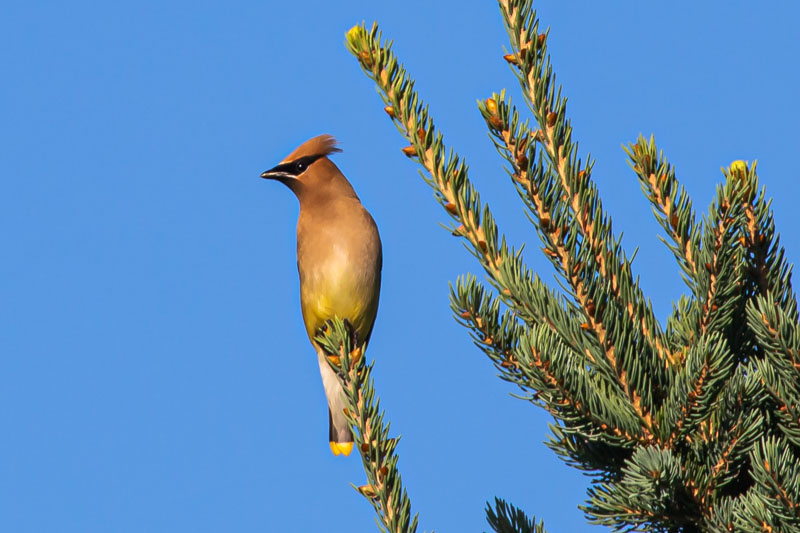
Spruce Top Portrait
A high perch showing the crest, black mask, yellow belly wash, and yellow tail tip.
Camera: Canon EOS 5D Mark IV
Lens: EF70-200mm f/2.8L IS II USM +2x
Settings: ISO 250 • Aperture f/13.0 • Shutter 1/320 s
E21A2120 • Size: 1600 x 1067
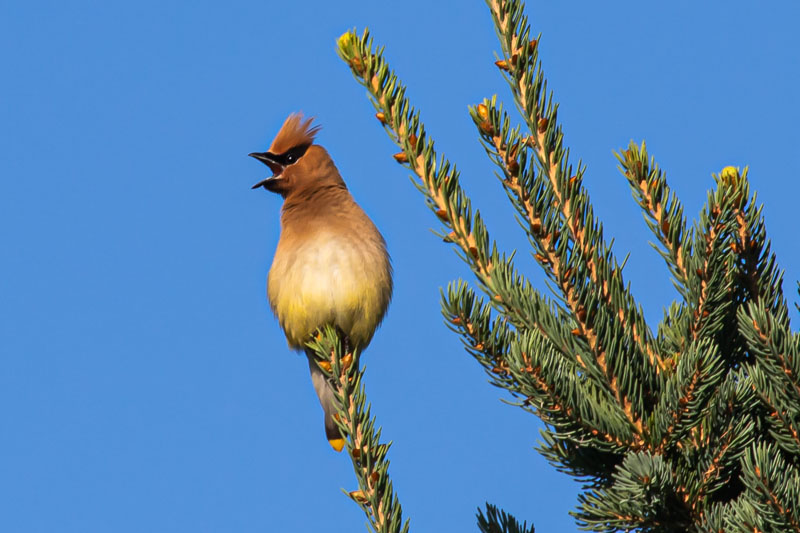
Calling from the Spruce
Crest raised and bill open in a brief moment of voice and energy.
Camera: Canon EOS 5D Mark IV
Lens: EF70-200mm f/2.8L IS II USM +2x
Settings: ISO 200 • Aperture f/13.0 • Shutter 1/320 s
E21A2122 • Size: 1600 x 1067
Photographer’s Perspective
The Cedar Waxwing page changed as the photographs accumulated.
The bud-passing sequence first made the page a behavior story. The branches were busy and the birds were partly screened, but that complexity helped tie the behavior to a real spring tree. Later, the open-branch portraits added a cleaner introduction to the species while preserving enough limb structure to show how the image was found.
E22A8731 now works as the strongest gallery lead because it gives the bird a clear, readable presence without stripping away the surrounding branch context. E22A8727 adds the strongest field-mark companion, especially with the red waxy wing tips and yellow tail band visible. E22A2676 remains the strongest story image because the bill-to-bill exchange gives the page its most distinctive behavior.
The result is less a ranked collection of individual photographs than a progression:
open portrait → field marks → pair behavior → spring habitat → voice and lookout posture
That progression is also why the photographs do not need to appear in order of rating. A gallery can tell a stronger story when each image contributes something different.
Photographic Sequence
The One That Got Away — Almost
A Cedar Waxwing working through the top of a juniper reached for one of its small, berry-like seed cones. What began as an ordinary feeding moment became a four-frame sequence: grasping the berry, losing it, following its fall, and making a quick recovery. The photographs are less about a perfect portrait than about the movement that happened between frames.
E22B1238 is the pivotal image. The tiny berry is visible below the open bill, explaining the bird’s sudden change in posture in the frames that follow. The final photograph opens the scene into flight, with the wings spread and feet hanging beneath the body.
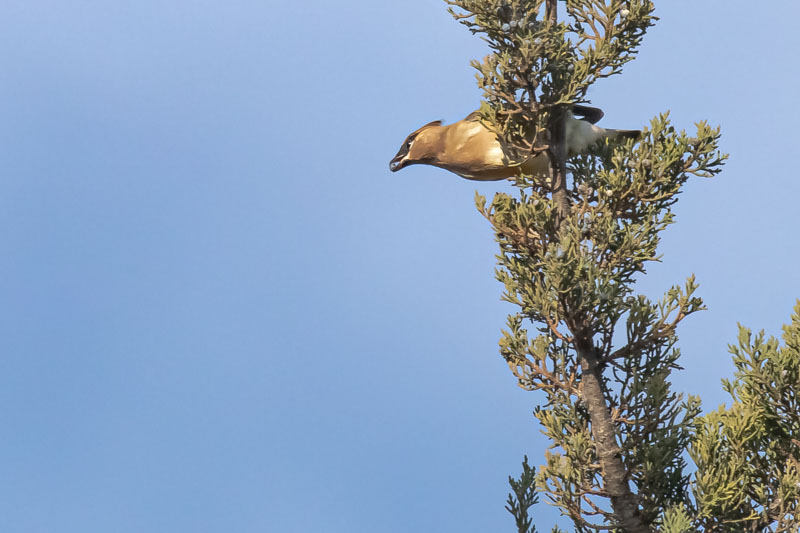
Grasping a Juniper Berry
The waxwing stretches from the juniper while grasping a berry.
Camera: Canon EOS 5D Mark IV
Lens: EF100-400mm f/4.5-5.6L IS USM
Settings: ISO 1600 • Aperture f/10.0 • Shutter 1/2500 s
E22B1235 • Size: 2000 x 1333
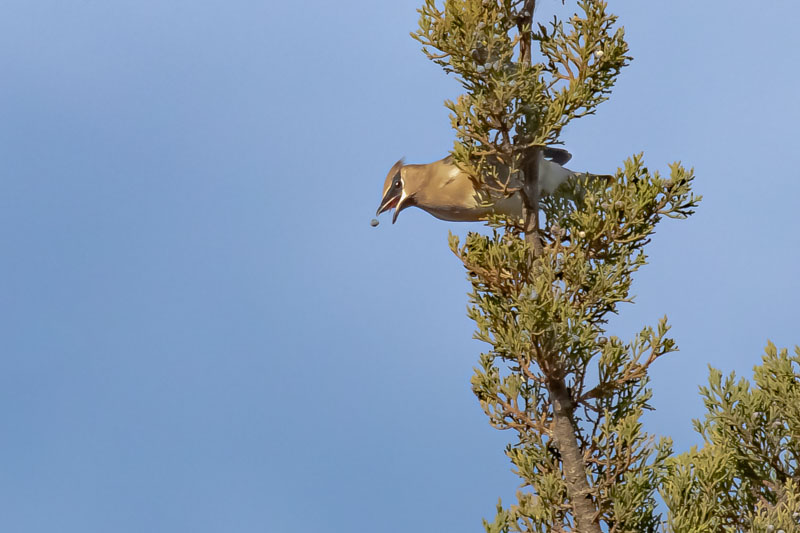
Oops!
The berry slips free, suspended just below the open bill.
Camera: Canon EOS 5D Mark IV
Lens: EF100-400mm f/4.5-5.6L IS USM
Settings: ISO 1600 • Aperture f/10.0 • Shutter 1/2500 s
E22B1238 • Size: 2000 x 1333
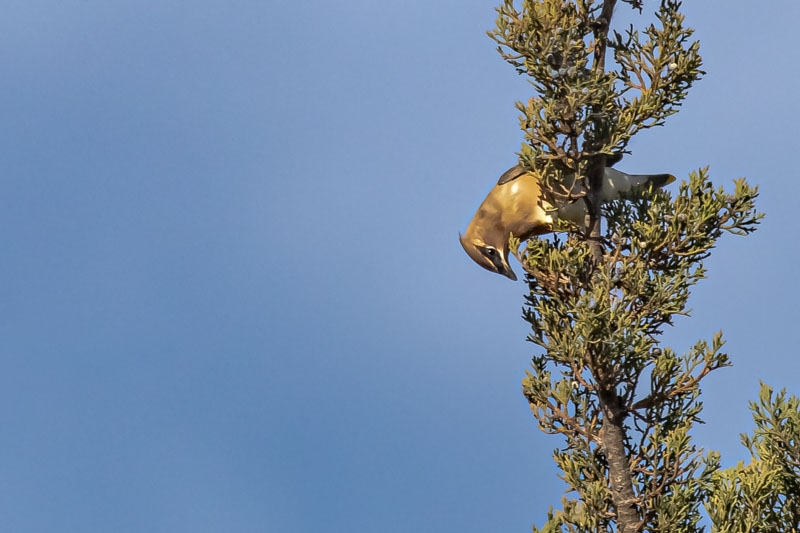
Uh-oh.
Head lowered, the waxwing follows the falling berry.
Camera: Canon EOS 5D Mark IV
Lens: EF100-400mm f/4.5-5.6L IS USM
Settings: ISO 1600 • Aperture f/10.0 • Shutter 1/2500 s
E22B1241 • Size: 2000 x 1333
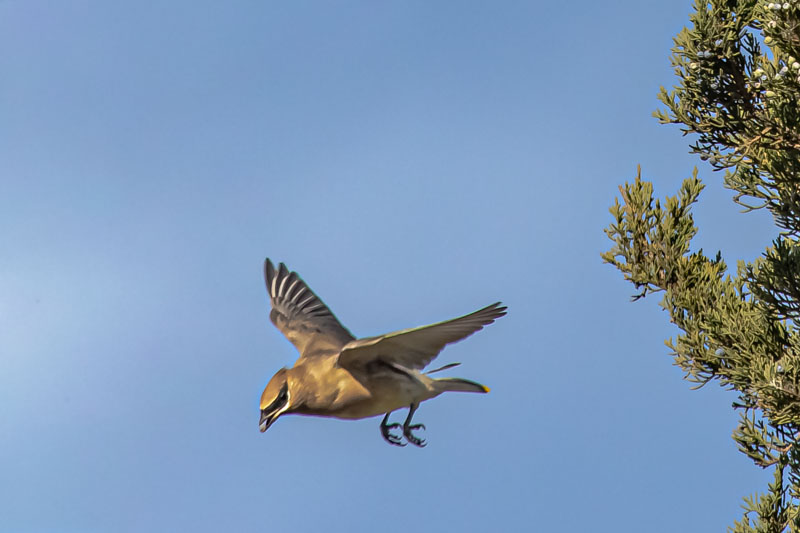
Got it!
Wings spread and feet free of the perch during the quick recovery.
Camera: Canon EOS 5D Mark IV
Lens: EF100-400mm f/4.5-5.6L IS USM
Settings: ISO 1600 • Aperture f/10.0 • Shutter 1/1250 s
E22B1243 • Size: 2000 x 1333
The berry is barely more than a speck, yet it connects the entire sequence. The middle frames make the mishap visible; the last captures the sudden motion that followed. Unlike the spring-bud exchange between two waxwings, this encounter records the agility of a single bird while feeding. It belongs in Perspective, where the sequence matters more than the individual image ratings.