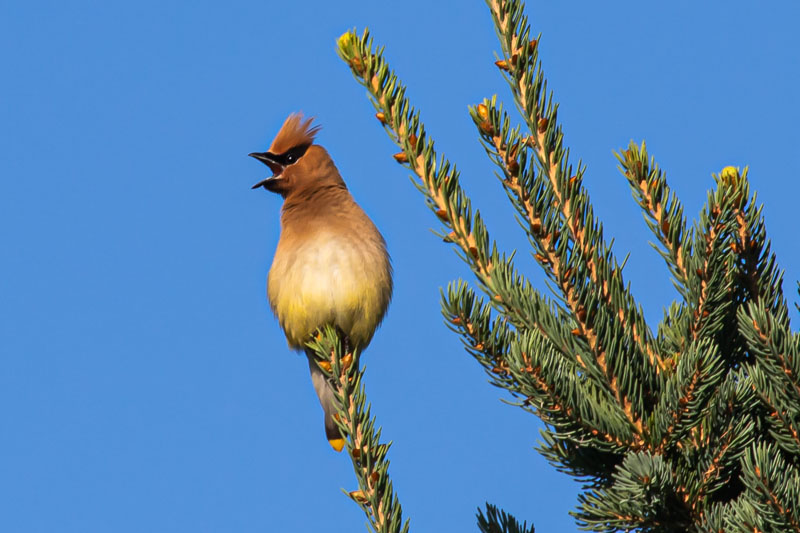
R. Fraley

Cedar Waxwing

Bombycilla cedrorum

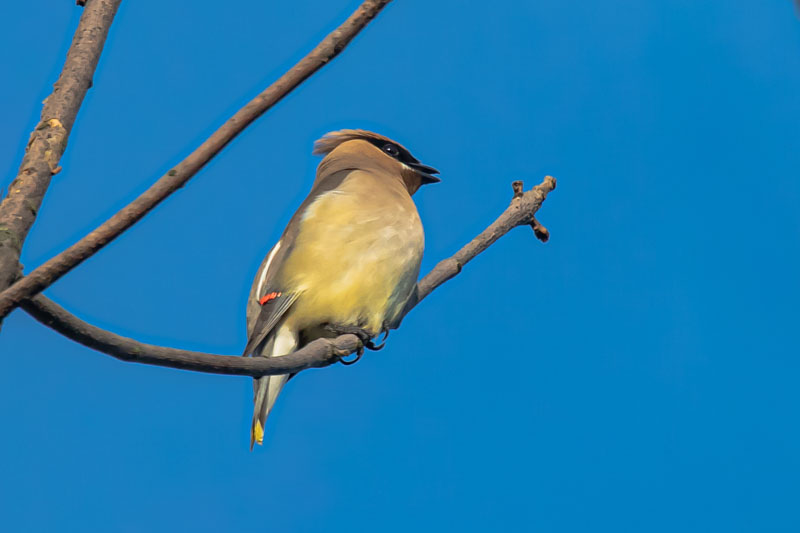
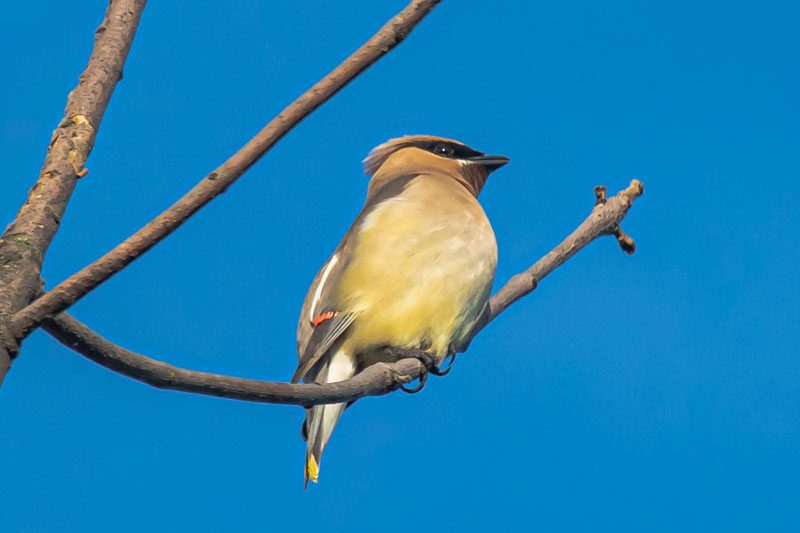
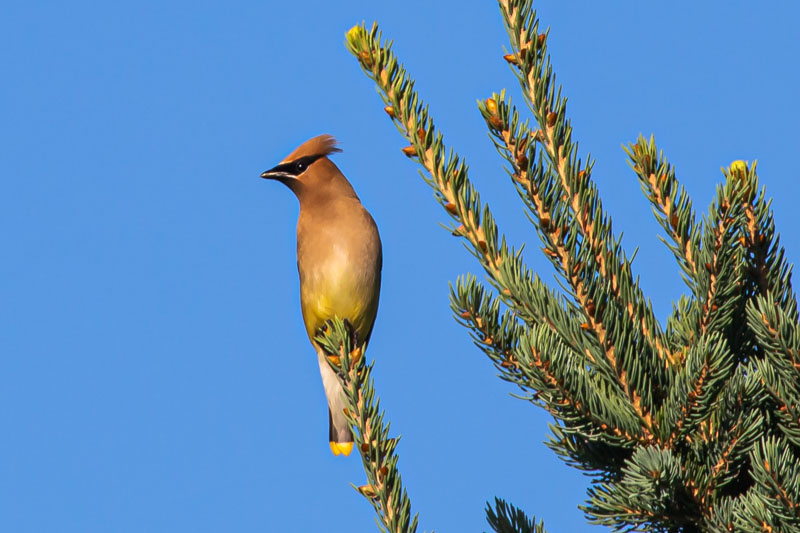
Cedar Waxwings are sleek, social songbirds with a smooth brown crest, black facial mask, soft gray wings, pale yellow belly, and a yellow-tipped tail. In spring, they can be surprisingly quiet in the upper branches, blending into the warm light and fresh buds until the mask, crest, or bright tail band catches the eye.

For identification details and comparison with similar species, see the Bombycilla cedrorum page in the Field Notes section.


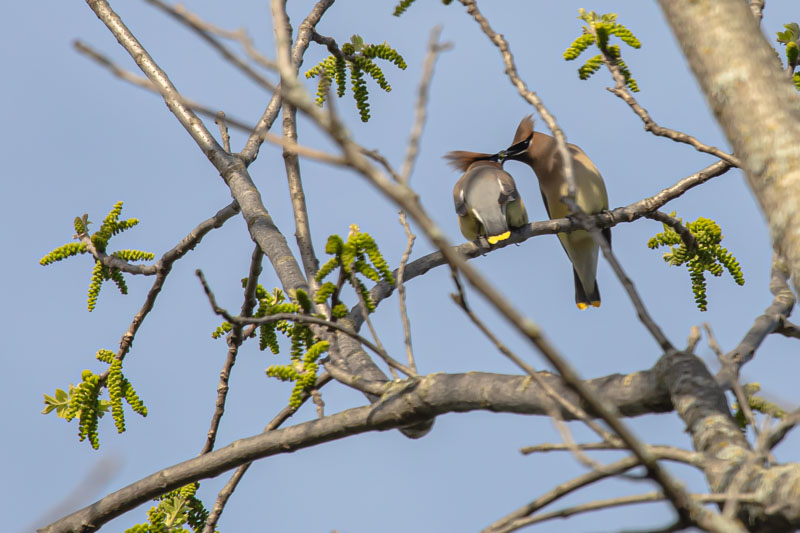
This pair was photographed in a budding spring tree during a brief courtship sequence. The birds appeared to pass a small green bud or catkin piece back and forth, a behavior often associated with pair bonding in waxwings.

Cedar Waxwing Pair Passing a Green Spring Bud

Cedar Waxwing Pair Passing a Green Spring Bud
A small piece of spring growth becomes part of a pair-bonding exchange.
Camera: Canon EOS 5D Mark IV
Lens: EF100-400mm f/4.5-5.6L IS USM + 1.4x
Settings: ISO 500 • Aperture f/9.0 • Shutter 1/640 s
E22A2676 • Size: 2552x1701


Overview

This page follows a short Cedar Waxwing encounter in the spring canopy. The setting is busy with crossing twigs, swelling buds, and soft blue sky, but the birds remain readable through their crests, black masks, silky plumage, and yellow tail tips. The strongest part of the sequence is behavioral rather than purely portrait-like: two birds sharing or passing a fresh green bud while perched close together.

Waxwings are often associated with fruit, especially berries, but this sequence shows how a spring bud can serve the same visual role in a courtship exchange. The object appears to match the new growth on the tree, making the behavior feel closely tied to the season and the perch.


Pair in the Spring Branches

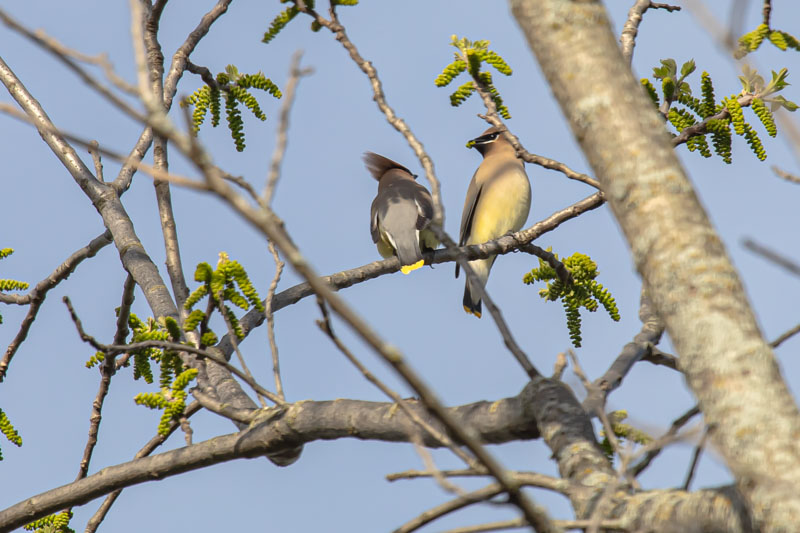
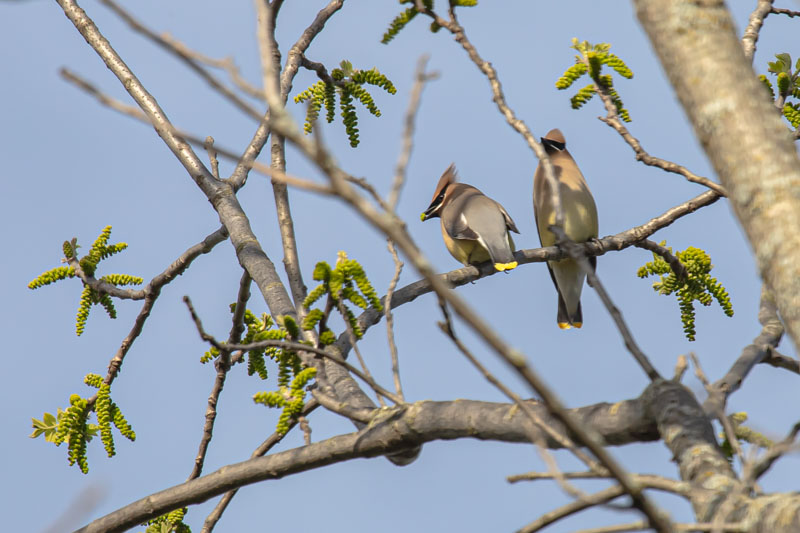
Before the clearest exchange, the two waxwings perch close together among fresh green buds. One bird faces away, showing the soft gray back and yellow tail tip, while the other stands upright with the black mask and crest in profile.

Cedar Waxwing Pair Among Spring Buds

Cedar Waxwing Pair Among Spring Buds
A quiet moment in the canopy before the exchange.
Camera: Canon EOS 5D Mark IV
Lens: EF100-400mm f/4.5-5.6L IS USM + 1.4x
Settings: ISO 500 • Aperture f/9.0 • Shutter 1/640 s
E22A2688 • Size: 2552x1701

The frame is partially screened by branches, which adds to the sense of watching a small behavior unfold from a distance. Even with the obstructions, the waxwing field marks remain strong: a swept-back crest, dark mask, smooth brown head, gray body, and bright yellow tail tips.


Courtship Bud Passing

In the clearest behavioral frames, the pair handles a small green bud or catkin piece. Cedar Waxwings are known for passing small items between mates during courtship. This can involve berries, petals, or other plant material; here, the object appears to be one of the fresh green buds from the tree itself.

Cedar Waxwing Pair Passing a Bud

Bud Exchange
The pair meets bill-to-bill with the green bud between them.
Camera: Canon EOS 5D Mark IV
Lens: EF100-400mm f/4.5-5.6L IS USM + 1.4x
Settings: ISO 500 • Aperture f/9.0 • Shutter 1/640 s
E22A2676 • Size: 2552x1701

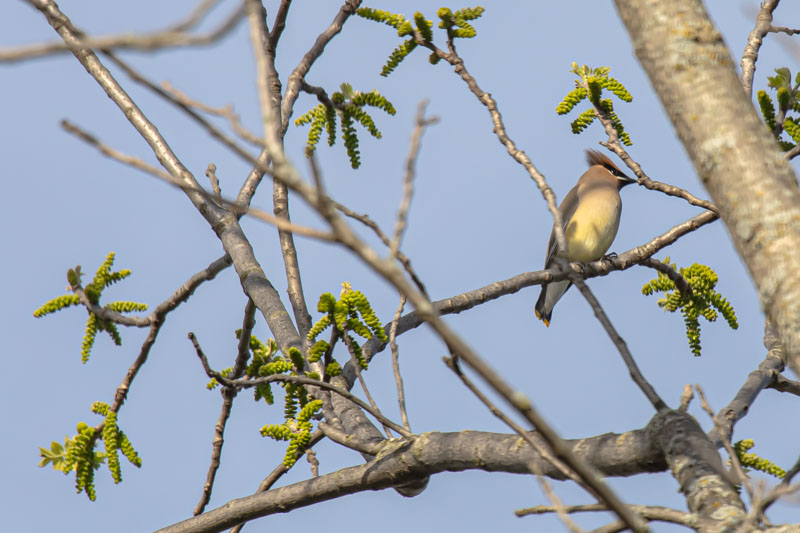
Cedar Waxwing Pair After Bud Exchange

After the Exchange
One bird lowers toward the branch while the other remains upright.
Camera: Canon EOS 5D Mark IV
Lens: EF100-400mm f/4.5-5.6L IS USM + 1.4x
Settings: ISO 500 • Aperture f/9.0 • Shutter 1/640 s
E22A2678 • Size: 2552x1701

The exchange is small, but it gives the sequence its story. Instead of a static portrait, the images show social interaction: two birds close together, using a piece of the surrounding spring growth as part of their pair-bonding behavior.


Single Bird Portraits

The single-bird frames help separate the bird from the pair behavior and show the classic Cedar Waxwing shape. The crest gives the head a swept-back profile, while the black mask and pale outline around it sharpen the face.

Cedar Waxwing in Spring Buds

Cedar Waxwing in Spring Buds
Crest raised slightly, mask visible, and yellow tail tip tucked below the branch.
Camera: Canon EOS 5D Mark IV
Lens: EF100-400mm f/4.5-5.6L IS USM + 1.4x
Settings: ISO 500 • Aperture f/9.0 • Shutter 1/640 s
E22A2670 • Size: 2552x1701

From this angle, the bird's warm brown head and chest fade into a paler yellow belly and gray lower body. The branch partly hides the lower half, but the long, neat silhouette and yellow tail band still read clearly.

Cedar Waxwing from Behind

Cedar Waxwing from Behind
The smooth gray back and yellow tail tip stand out against the spring branches.
Camera: Canon EOS 5D Mark IV
Lens: EF100-400mm f/4.5-5.6L IS USM + 1.4x
Settings: ISO 500 • Aperture f/9.0 • Shutter 1/640 s
E22A2668 • Size: 2552x1701

The rear view makes the tail band the strongest field mark. The bird is turned away, but the clean gray body, pointed crest, folded wing shape, and yellow tail tip keep the identification unmistakable.


Photographer's Perspective

This sequence works best as a behavior page. The branches are busy, and the birds are partly screened at times, but that also keeps the scene natural. The repeated green buds around the birds help explain the object being passed and tie the courtship moment to the spring setting.

The strongest lead image is the bill-to-bill exchange, because it immediately shows why the series is special. From there, the page can step back into the pair perched together, then move into individual portraits that show the waxwing's field marks more clearly.