Barn Swallow — Photographic Sequence
Barn Swallow — Photographic Sequence
Hirundo rustica
The Barn Swallow photographs in this sequence show a juvenile resting on an exposed branch against a clear blue sky. The bird remained on the perch long enough for several changes in posture: quiet profile views, a broad wing extension, and two moments when the wings and body feathers lifted away from the normally streamlined shape.
The yellow gape, warm buff underparts, subdued face color, and relatively short tail streamers are consistent with a juvenile. At rest, the body appears compact and almost neckless. Once the bird begins to stretch and rearrange its feathers, that familiar swallow silhouette changes considerably.
For identification, habitat, and natural-history details, see the Hirundo rustica species page.
Wing Spread
E22A8823 is the strongest photograph in the sequence. The extended wing separates into a broad fan of flight feathers while the bird remains anchored to the branch. Unlike the later wing-lift frames, the head is still visible and the brown eye retains enough light to keep the photograph connected to the bird rather than becoming solely a study of wing structure.
The position also shows how much wing is folded into the compact outline of a perched swallow. With the wing opened, the long primaries become the dominant feature of the image.
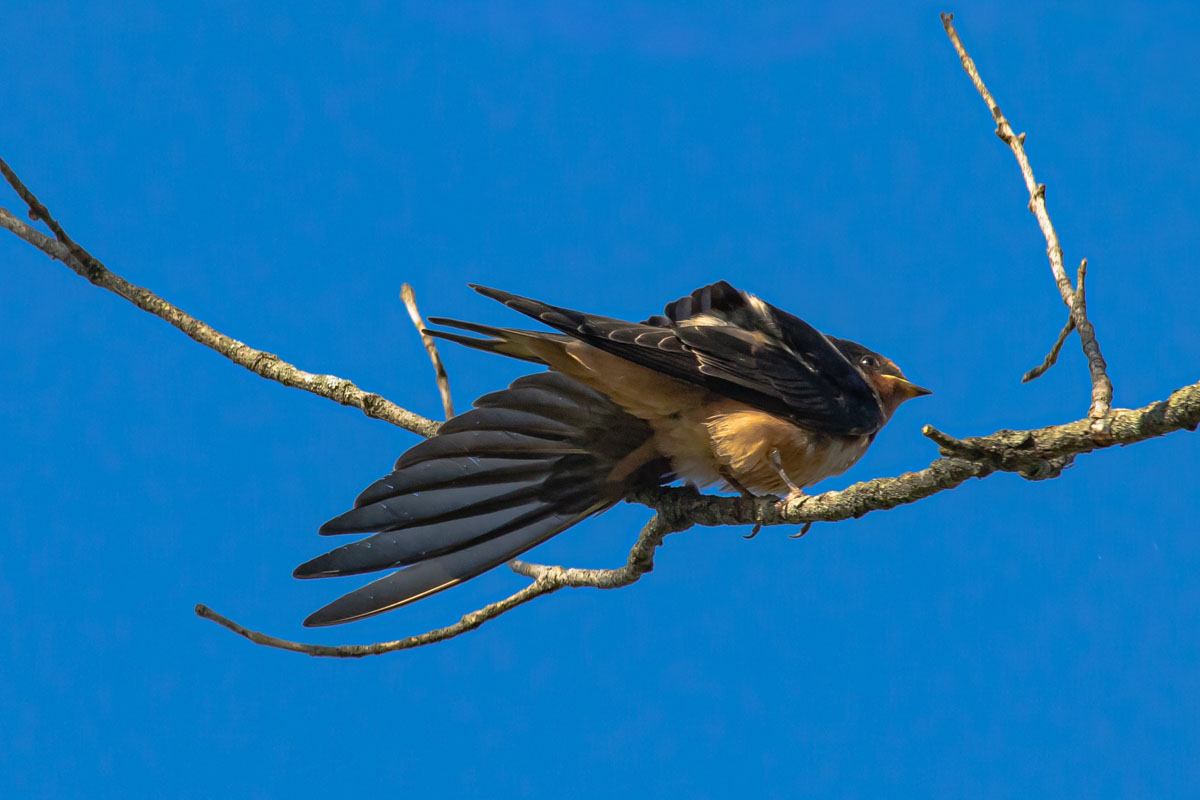 Wing Spread
The extended wing opens into a fan of long flight feathers while the eye remains visible above the perch.
Camera: Canon EOS 5D Mark IV
Lens: EF100-400mm f/4.5-5.6L IS USM
Settings: ISO 1250 • Aperture f/13.0 • Shutter 1/1000 s
E22A8823 • Size: 2600 x 1733
Eye and Feather Detail
The two quieter portraits reveal details that are easily lost when a Barn Swallow is in flight.
E22A8836 gives the clearest overall view of the folded wing. The overlapping coverts and flight feathers form a series of light-edged layers across the back, while the catchlight gives definition to an otherwise dark eye.
E22A8827 places more emphasis on the head. The catchlight is especially distinct, and the upward angle makes the yellow gape prominent. The rounded, slightly puffed body and short tail reinforce the juvenile appearance.
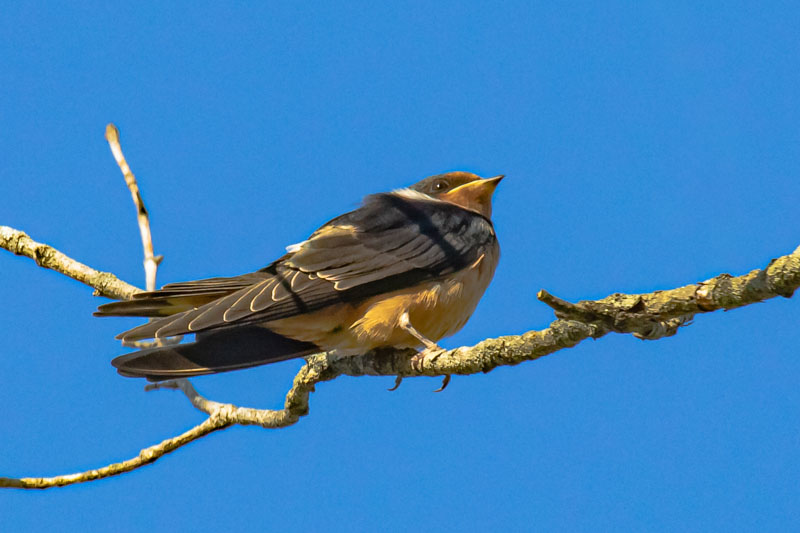 Wing Detail
Layered flight feathers, warm juvenile plumage, and a small catchlight hold together the quiet portrait.
Camera: Canon EOS 5D Mark IV
Lens: EF100-400mm f/4.5-5.6L IS USM
Settings: ISO 1250 • Aperture f/13.0 • Shutter 1/1000 s
E22A8836 • Size: 1800 x 1200
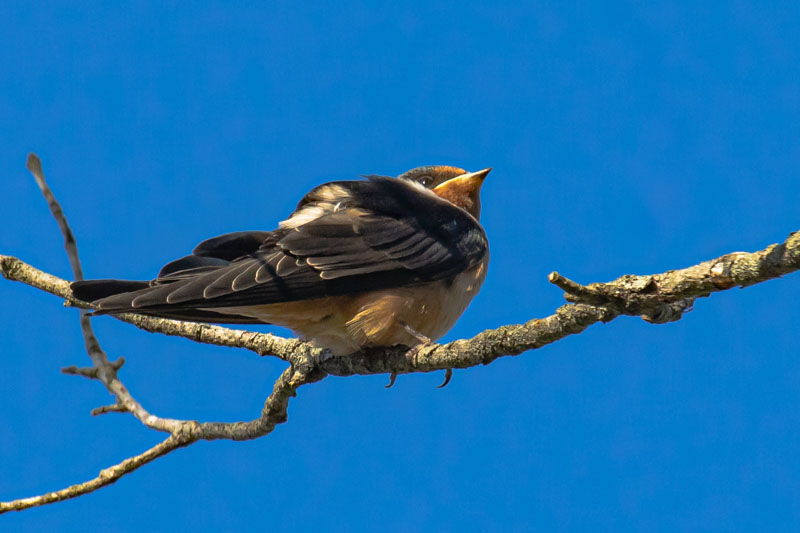 Bright Eye
An upward glance catches the light while the yellow gape remains prominent along the bill.
Camera: Canon EOS 5D Mark IV
Lens: EF100-400mm f/4.5-5.6L IS USM
Settings: ISO 1250 • Aperture f/13.0 • Shutter 1/1000 s
E22A8827 • Size: 1800 x 1200
Edge of Light
The lighting during this encounter was challenging. The juvenile often had its back toward the sun, leaving much of the plumage in shadow. Under those conditions, the upperparts could appear dark brown or nearly black rather than showing the blue tones more readily visible in favorable light.
E22A8810 records the opposite edge of that problem. With the bird backlit, most of the body remains dark while sunlight catches the margins of the shoulder, wing, and tail feathers. The photograph shows how strongly directional light can change the apparent color and definition of juvenile plumage.
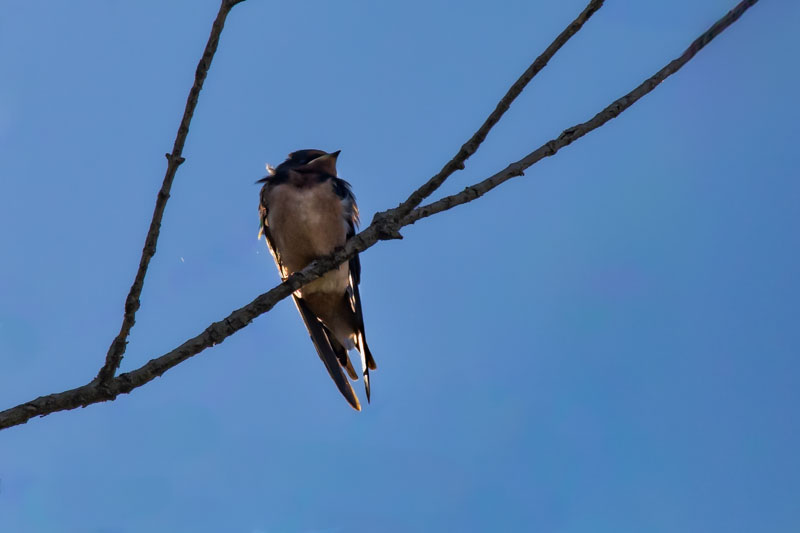 Edge of Light
The plumage in shadow turns dark while sunlight catches the outer feathers.
Camera: Canon EOS 5D Mark IV
Lens: EF100-400mm f/4.5-5.6L IS USM
Settings: ISO 2000 • Aperture f/13.0 • Shutter 1/1600 s
E22A8810 • Size: 3200 x 2133
The Shape Beneath the Feathers
The last two photographs are less conventional portraits, but they reveal something the cleaner perched views conceal.
A resting swallow often appears to have almost no neck. The head, shoulders, breast, and folded wings merge into a compact aerodynamic form. E22A8867 begins to interrupt that outline as the wings lift away from the body. The photograph is dominated by the movement rather than the face, but it shows how much wing is normally compressed into the resting silhouette.
In E22A8866, the change is even more pronounced. The wing is raised, the breast and shoulder feathers are ruffled, and the neck becomes clearly visible. For a moment, the swallow looks much less compact than it does in an ordinary perched posture.
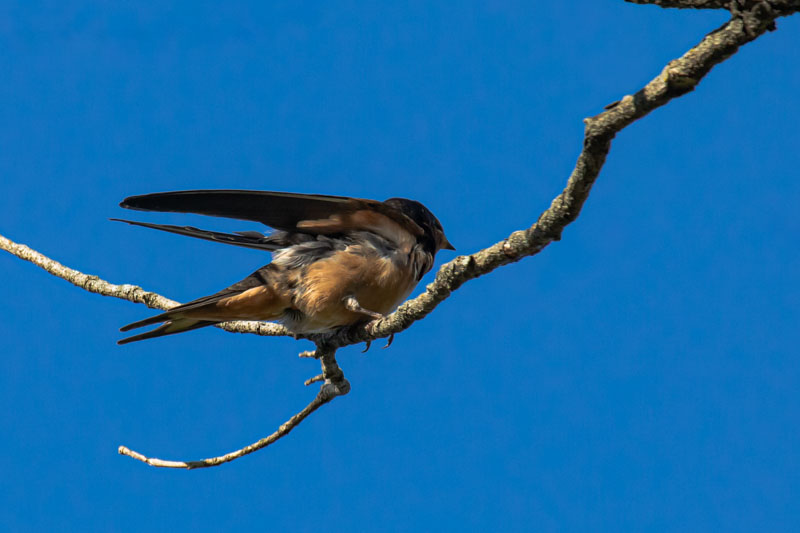 Half-Open Wings
The compact perched shape gives way as the wings begin to open behind the bird.
Camera: Canon EOS 5D Mark IV
Lens: EF100-400mm f/4.5-5.6L IS USM
Settings: ISO 1250 • Aperture f/13.0 • Shutter 1/1000 s
E22A8867 • Size: 2600 x 1733
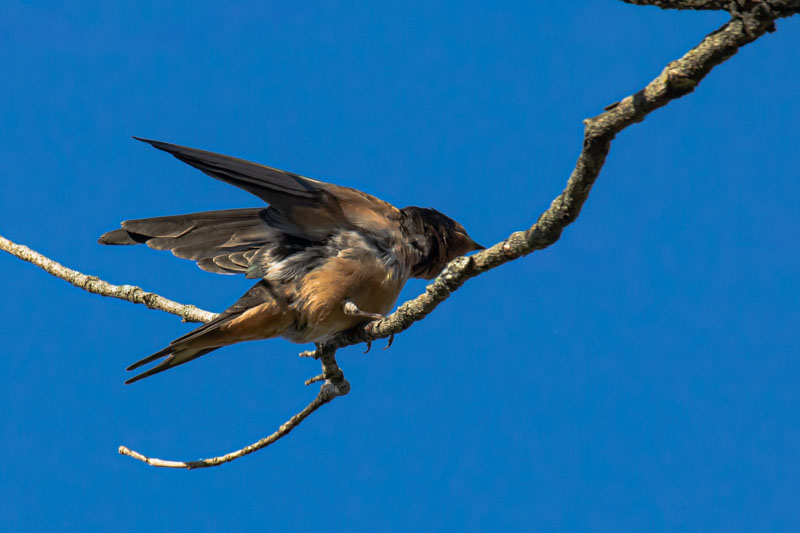 Ruffled Wing Lift
Raised feathers and an extended neck briefly break the smooth, streamlined silhouette.
Camera: Canon EOS 5D Mark IV
Lens: EF100-400mm f/4.5-5.6L IS USM
Settings: ISO 1250 • Aperture f/13.0 • Shutter 1/1000 s
E22A8866 • Size: 2600 x 1733
A Comparison with Tree Swallow
The last two frames recall the Tree Swallow photographs “Half Open Wing” and “Wing Lift”.
In the Tree Swallow image “Half Open Wing,” much of that compact outline remains even while the wing begins to open. “Wing Lift,” however, reveals considerably more neck as the feathers loosen and the bird changes posture.
The Barn Swallow sequence shows much the same transformation. E22A8867 retains more of the compressed resting shape, while E22A8866 reveals the neck and separates the ruffled body feathers into distinct layers. The apparent absence of a swallow’s neck is therefore less a matter of anatomy than of posture and feather contour: when the bird stretches, lifts a wing, or rearranges its plumage, the structure hidden inside the streamlined silhouette becomes visible.
Sequence
Taken together, the six photographs move from the structure of an opened wing through quieter portraits, changing light, and finally the changing shape of the bird itself:
Wing Spread → Wing Detail → Bright Eye → Edge of Light → Half-Open Wings → Ruffled Wing Lift
The sequence is a reminder that a perched swallow is not simply a resting version of a bird built for flight. Even on the branch, small movements reveal how wings, neck, body feathers, and tail are compressed into the exceptionally compact form normally seen between flights.