R. Fraley

Tree Swallow

Tachycineta bicolor

Tree Swallows are usually encountered in motion, sweeping over open water and field edges with quick, buoyant flight. When morning light catches one at rest, the species becomes something else as well: polished, alert, and unexpectedly delicate, with iridescent upperparts set sharply against a bright white underside.

For identification details and comparison with similar species, see the Tachycineta bicolor in the Field Notes section.


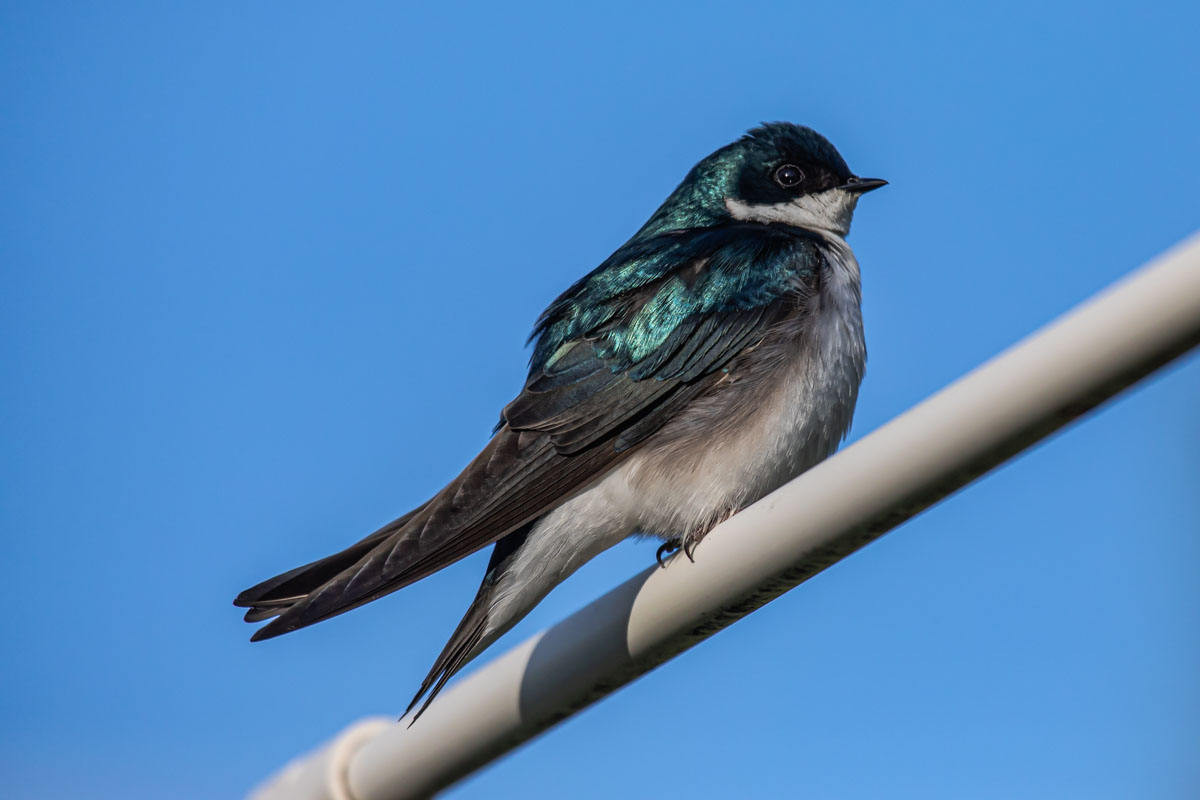
Morning Perch

Morning Perch
A clean pause in early light.
Perched along a white rail beneath a clear blue sky, this Tree Swallow shows the crisp contrast of the species at rest: bright white below, dark above, and a polished blue-green sheen across the head and back. The stillness is brief, but it reveals how elegant the bird is even between flights.
Camera: Canon EOS 5D Mark IV
Lens: EF100-400mm f/4.5-5.6L IS II USM
Settings: ISO 800 • Aperture f/8.0 • Shutter 1/3200 s
E22A1661 • Size: 5417x3611


Overview

Tree Swallows belong as much to the open air as to any perch, but quiet moments like these make their structure and color easier to appreciate. In spring, they often gather around open fields, wetlands, and nesting areas, where they alternate between fast insect-hunting flights and short, watchful pauses on wires, rails, and posts.


In the Morning Light

Fresh morning sun gives the upperparts a metallic quality that can shift from blue to green depending on angle and feather position. At close range, the species appears both sleek and soft: streamlined in outline, but lightly puffed in the cool air.

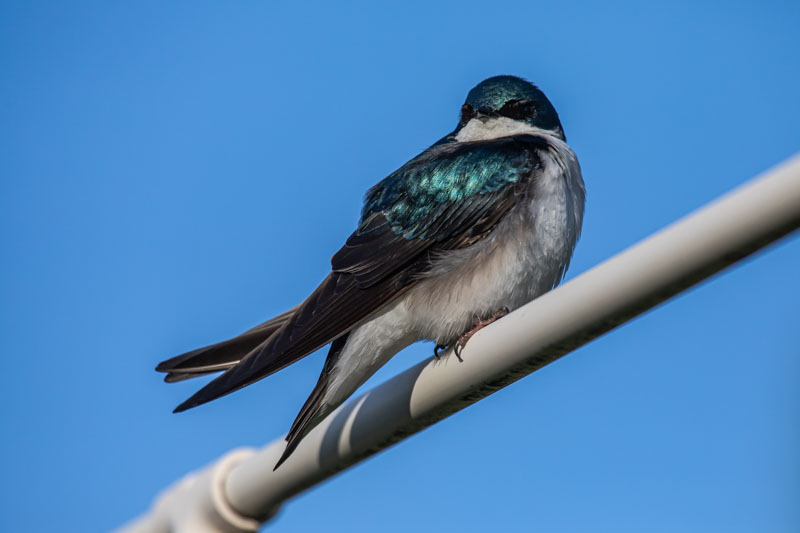
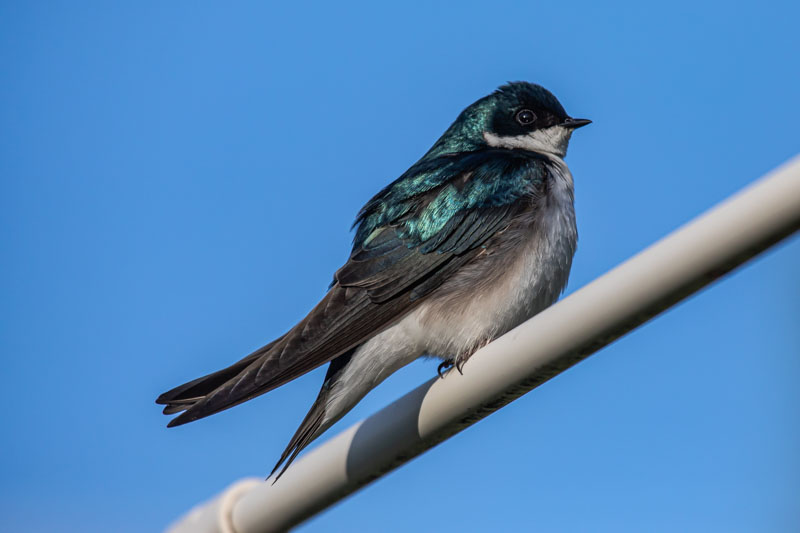
Blue-Green Gloss

Blue-Green Gloss
Metallic color against open sky.
Camera: Canon EOS 5D Mark IV
Lens: EF100-400mm f/4.5-5.6L IS II USM
Settings: ISO 800 • Aperture f/8.0 • Shutter 1/3200 s
E22A1680 • Size: 5739x3826

The clean sky isolates the bird and lets the surface color do the work. In this light, the back and crown take on the smooth, reflective quality that makes Tree Swallows stand out even before they move.

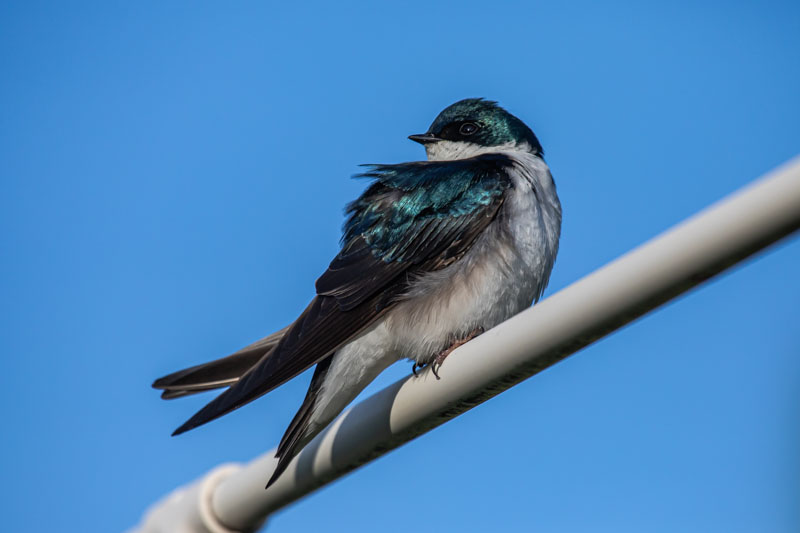
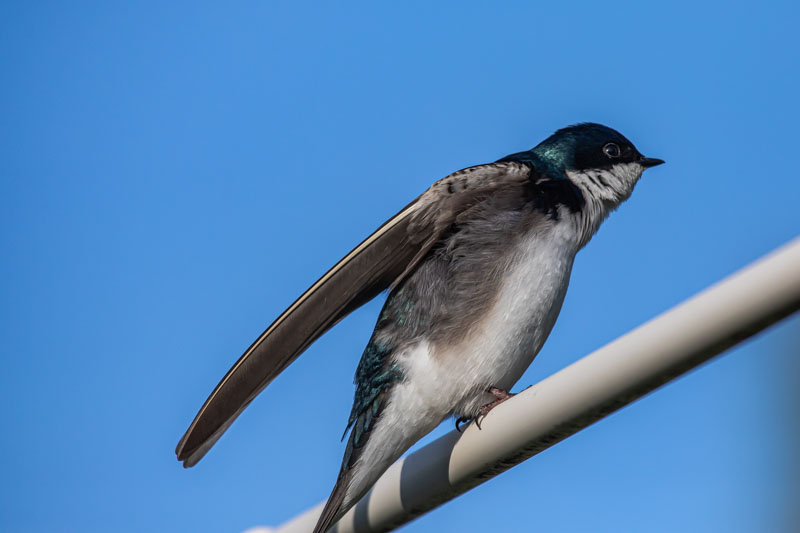
Ruffled Feathers

Ruffled Feathers
A cool start to the day.
Camera: Canon EOS 5D Mark IV
Lens: EF100-400mm f/4.5-5.6L IS II USM
Settings: ISO 800 • Aperture f/8.0 • Shutter 1/3200 s
E22A1664 • Size: 5417x3611

Feathers Lifted

Feathers Lifted
Morning air caught in the plumage.
Camera: Canon EOS 5D Mark IV
Lens: EF100-400mm f/4.5-5.6L IS II USM
Settings: ISO 800 • Aperture f/8.0 • Shutter 1/3200 s
E22A1666 • Size: 5417x3611

Backward Glance

Backward Glance
A turned pose in cool morning light.
Camera: Canon EOS 5D Mark IV
Lens: EF100-400mm f/4.5-5.6L IS II USM
Settings: ISO 800 • Aperture f/8.0 • Shutter 1/3200 s
E22A1679 • Size: 5921x3947

These ruffled frames add a different kind of detail: less aerodynamic, more intimate. The swallow looks momentarily softened by the morning air, showing a fuller shape than the narrow, darting silhouette seen in flight.


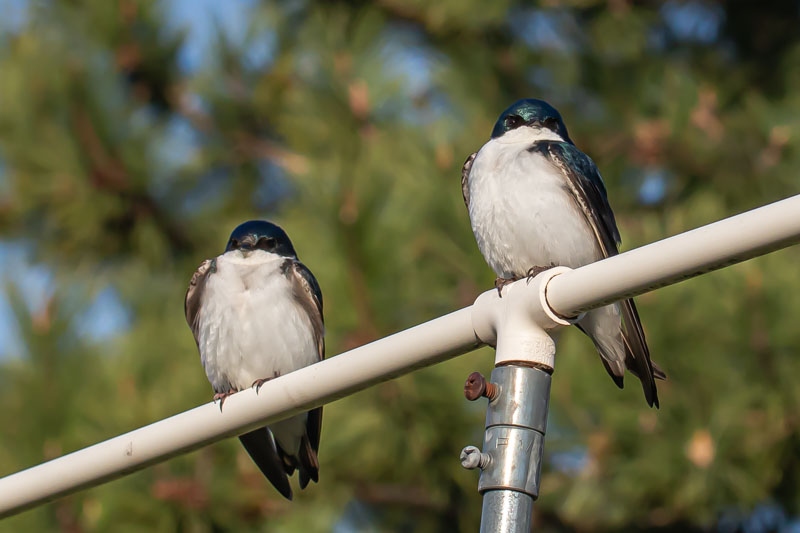
Pair on the Rail

Tree Swallows are often encountered not as isolated individuals, but as paired or loosely social birds around nesting areas and feeding grounds. A shared perch like this gives that side of the species more clearly: alert, balanced, and briefly still before both birds return to the air.

Paired on the Pipe

Paired on the Pipe
Two birds in the morning light.
Camera: Canon EOS 5D Mark IV
Lens: EF100-400mm f/4.5-5.6L IS II USM
Settings: ISO 400 • Aperture f/11.0 • Shutter 1/640 s
E22A1761 • Size: 2043x1362

With both birds in clear focus, the scene feels more complete: not just a portrait of one Tree Swallow, but a shared perch and a shared pause. The pair gives the page a stronger sense of spring presence, where even brief stillness carries an undercurrent of motion and attention.


Lift Before Flight

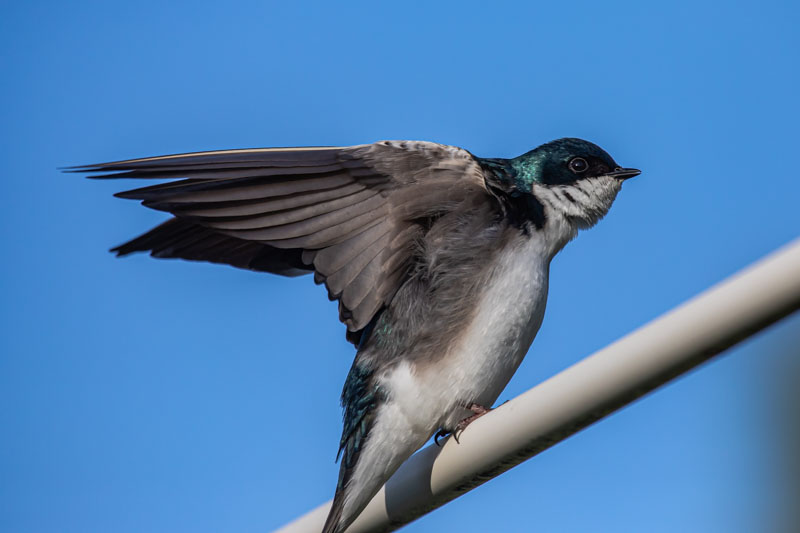
One of the most revealing moments comes just before departure, when the still form begins to open back into motion. The body leans, the wing rises, and the perched bird briefly becomes the flying bird again.

Wing Lift

Wing Lift
Stillness breaking into motion.
Camera: Canon EOS 5D Mark IV
Lens: EF100-400mm f/4.5-5.6L IS II USM
Settings: ISO 800 • Aperture f/8.0 • Shutter 1/3200 s
E22A1657 • Size: 5571x3714

Half Open Wing

Half Open Wing
A poised transition.
Camera: Canon EOS 5D Mark IV
Lens: EF100-400mm f/4.5-5.6L IS II USM
Settings: ISO 800 • Aperture f/8.0 • Shutter 1/3200 s
E22A1658 • Size: 5417x3611

Quiet Return

Quiet Return
Composed again on the rail.
Camera: Canon EOS 5D Mark IV
Lens: EF100-400mm f/4.5-5.6L IS II USM
Settings: ISO 800 • Aperture f/8.0 • Shutter 1/3200 s
E22A1654 • Size: 5417x3611

Together, these frames work as a small progression: rest, motion, and composure regained. They suit Tree Swallows especially well, since the species is defined not just by appearance, but by the tension between stillness and immediate flight.


Nest Box and Pair Behavior

Around the nest box, Tree Swallows seem less like passing aerial birds and more like residents of a particular place. Perches become watch posts, brief gestures take on meaning, and even a small feather adjustment suggests the alert, social energy that gathers around an active nesting site.

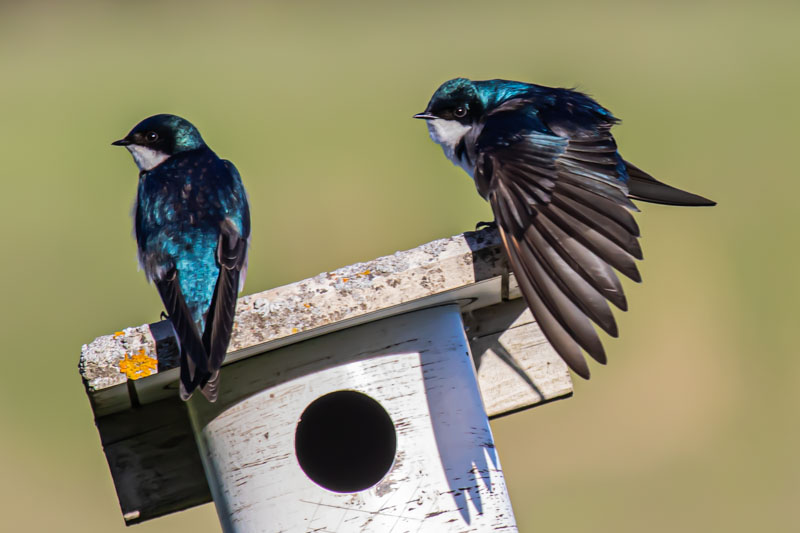
Ruffling at the Nest Box

Ruffling at the Nest Box
A brief adjustment beside the box.
Camera: Canon EOS 5D Mark IV
Lens: EF100-400mm f/4.5-5.6L IS II USM
Settings: ISO 800 • Aperture f/8.0 • Shutter 1/1000 s
E22A1870 • Size: 2285x1523

This moment feels less like departure than readjustment. With one wing lowered and the feathers loosened, the bird appears to be settling itself at the edge of the nest box, a small but expressive gesture within the shared activity of the site.

Vocal Interaction

Vocal Interaction
A brief exchange above the nest box.
Camera: Canon EOS 5D Mark IV
Lens: EF100-400mm f/4.5-5.6L IS II USM
Settings: ISO 800 • Aperture f/8.0 • Shutter 1/1000 s
E22A1860 • Size: 1643x1095

With both birds calling across the roofline, the scene feels more animated than a simple shared perch. The nest box becomes a center of attention, and the open beaks suggest the quick, social exchanges that often accompany pair activity at an active site.

The pair’s behavior around the box is a reminder that Tree Swallows are not just transient visitors to a place, but active participants in a shared environment. The nest box is a focal point for their interactions, and even small moments there can reveal the species’ social nature.


Photographer’s Perspective

The photographs on this page were not made in a single easy approach. The pipe perch stands about twenty feet from the trail, and the Tree Swallows proved wary from the beginning. I moved slowly along the trail edge rather than walking toward them directly, but even so they flushed when I had closed only part of the distance. Each time, I returned to the tripod, reviewed the images, adjusted the camera, and waited for the birds to settle back onto the pipe.

The process repeated several times through the morning. As the light strengthened, the ISO came down in stages, and with each new attempt the distance closed a little more. What began as a cautious long approach gradually became a closer and more intimate study, until some frames were made at much shorter focal lengths than I would have expected at the start. By the time E22A1761 was taken at 100mm, the effort had become part of the photograph itself: patience, retreat, return, and the small reward of being accepted just a little closer.

That slower approach shaped the page as much as the light did. The newer images feel more complete not only because the color is richer and the detail cleaner, but because they show more of what drew me to the birds in the first place: texture, shared perches, and the quick transition from stillness back into flight. That is one of the real pleasures of photography.