Tree Swallow — Photographic Sequence
Tachycineta bicolor
The Tree Swallow photographs collected here follow a morning encounter that moved from distant pipe-perch portraits to close studies of plumage, pair behavior, wing movement, and activity around a nest box. For identification, habitat, and natural-history details, see the Tachycineta bicolor species page.
Taken separately, many of the photographs are quiet portraits. Together, they show how quickly the character of a Tree Swallow changes with angle, light, posture, and distance: blue-green iridescence becomes visible, smooth feathers lift into texture, and a bird that appears settled can open a wing and seem ready for flight in an instant.
In the Morning Light
The first close portraits make color the dominant subject. Fresh morning sun changes the upperparts from nearly dark to metallic blue-green as the bird turns relative to the light.
E22A1661 gives the cleanest introductory pose. The bright white breast, dark cap, and blue-green back are separated clearly against the open sky.
E22A1680 shifts the emphasis toward iridescence. The bird turns slightly toward the camera, bringing more connection to the portrait while the shoulder and back catch the strongest blue-green reflection.
E22A1679 adds a different kind of presence. With the head turned back across the shoulder, the bird shows both the metallic upperparts and the lifted feather edges of the cool morning plumage.
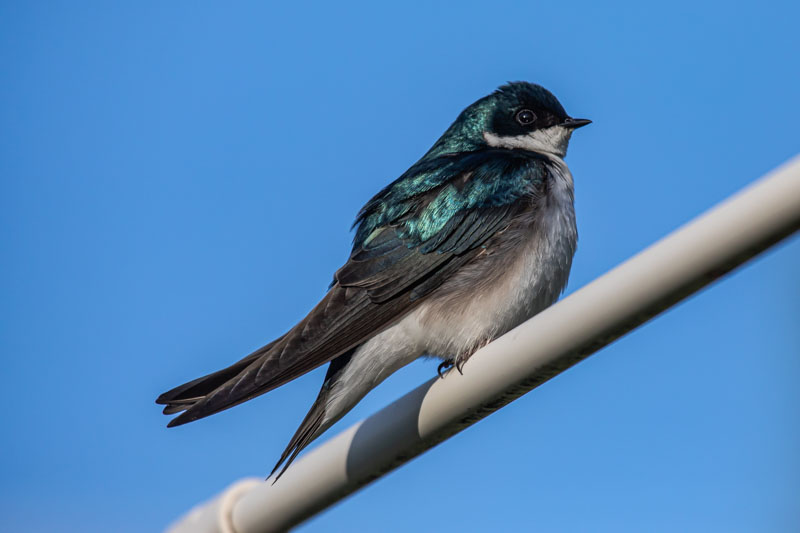
Morning Perch
A clean pause in early light.
Camera: Canon EOS 5D Mark IV
Lens: EF100-400mm f/4.5-5.6L IS II USM
Settings: ISO 800 • Aperture f/8.0 • Shutter 1/3200 s
E22A1661 • Size: 5417 x 3611
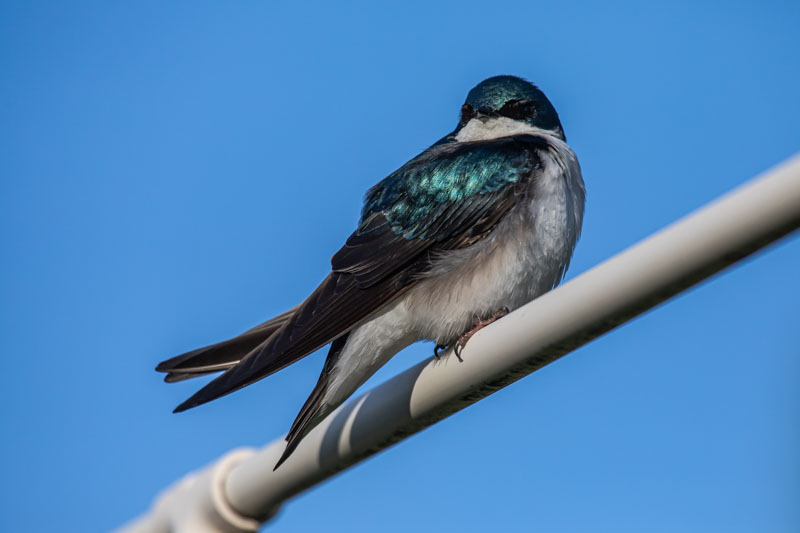
Blue-Green Gloss
Metallic color against open sky.
Camera: Canon EOS 5D Mark IV
Lens: EF100-400mm f/4.5-5.6L IS II USM
Settings: ISO 800 • Aperture f/8.0 • Shutter 1/3200 s
E22A1680 • Size: 5739 x 3826
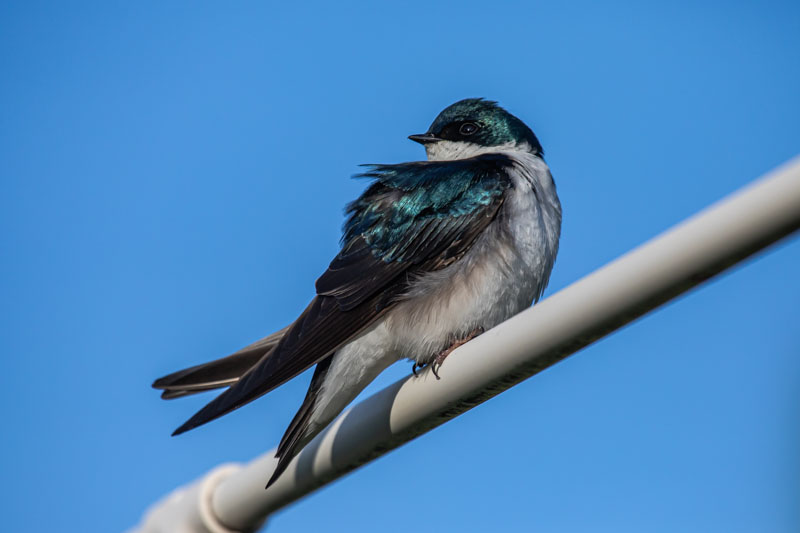
Backward Glance
A turned pose in cool morning light.
Camera: Canon EOS 5D Mark IV
Lens: EF100-400mm f/4.5-5.6L IS II USM
Settings: ISO 800 • Aperture f/8.0 • Shutter 1/3200 s
E22A1679 • Size: 5921 x 3947
Ruffled Feathers
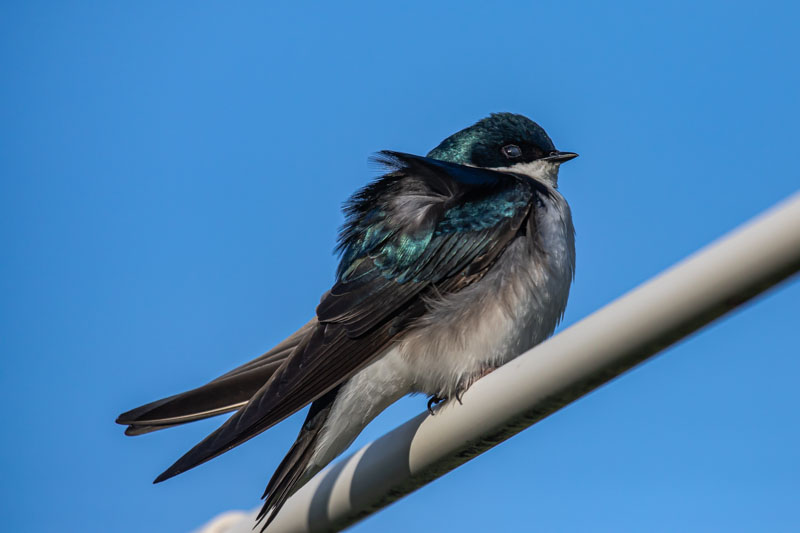
The pipe-perch sequence also revealed a softer side of a bird usually defined by streamlined flight. In the cool morning air, feathers along the shoulder and back lifted away from the body, briefly changing the swallow’s shape.
E22A1664 and E22A1666 are supporting frames rather than primary gallery portraits, but they make the change easy to see. The upperparts lose some of their smooth aerodynamic surface and become layered and textured.
That contrast matters because the bird can look very different when settled on a perch than when it is cutting through open air.
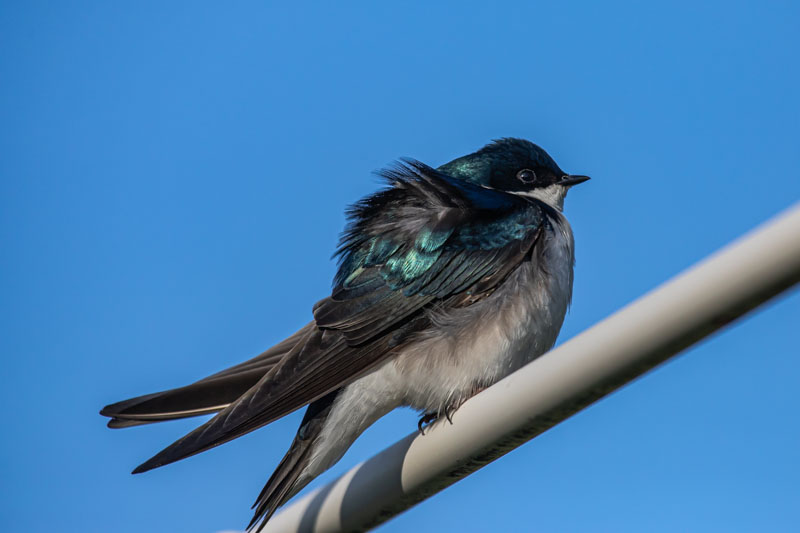
Ruffled Feathers
A cool start to the day.
Camera: Canon EOS 5D Mark IV
Lens: EF100-400mm f/4.5-5.6L IS II USM
Settings: ISO 800 • Aperture f/8.0 • Shutter 1/3200 s
E22A1664 • Size: 5417 x 3611
Feathers Lifted
Morning air caught in the plumage.
Camera: Canon EOS 5D Mark IV
Lens: EF100-400mm f/4.5-5.6L IS II USM
Settings: ISO 800 • Aperture f/8.0 • Shutter 1/3200 s
E22A1666 • Size: 5417 x 3611
Paired on the Pipe
Tree Swallows are often encountered as more than isolated birds around nesting areas. E22A1761 changes the story from a single portrait to a shared perch.
Both birds are in good focus, and the front-facing posture reveals the fine texture of the white breast plumage. The composition is quieter than the later nest-box interaction, but the pair gives the morning a social context that the single-bird portraits cannot.
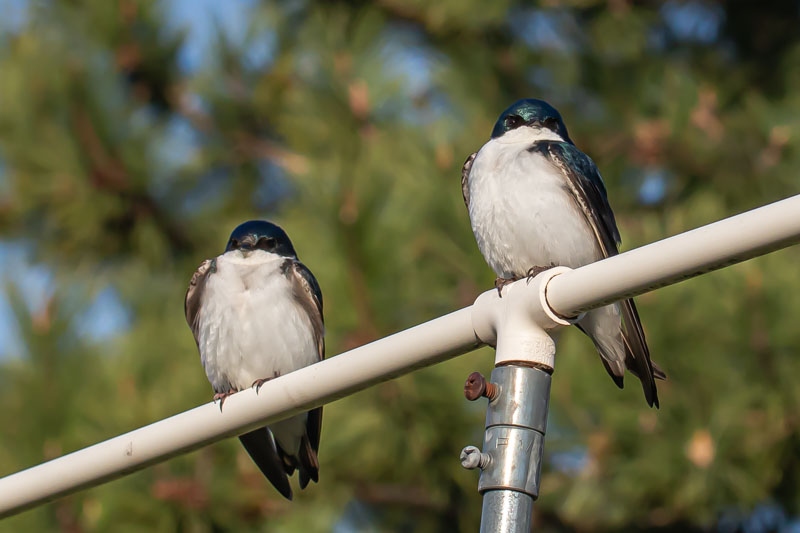
Paired on the Pipe
Two birds in the morning light.
Camera: Canon EOS 5D Mark IV
Lens: EF100-400mm f/4.5-5.6L IS II USM
Settings: ISO 400 • Aperture f/11.0 • Shutter 1/640 s
E22A1761 • Size: 2043 x 1362
Lift Before Flight
The wing sequence captures the boundary between a perched bird and an aerial one.
E22A1657 is the strongest action frame. One wing rises almost fully open while the bird remains anchored to the pipe, exposing the length and structure that are mostly hidden in a resting portrait.
E22A1658 follows with the wing lowered but still extended. The body remains poised forward, retaining the sense that motion has not fully ended.
E22A1654 returns to a quieter posture. Used with the other two frames, it completes a small progression from stillness into motion and back toward composure.
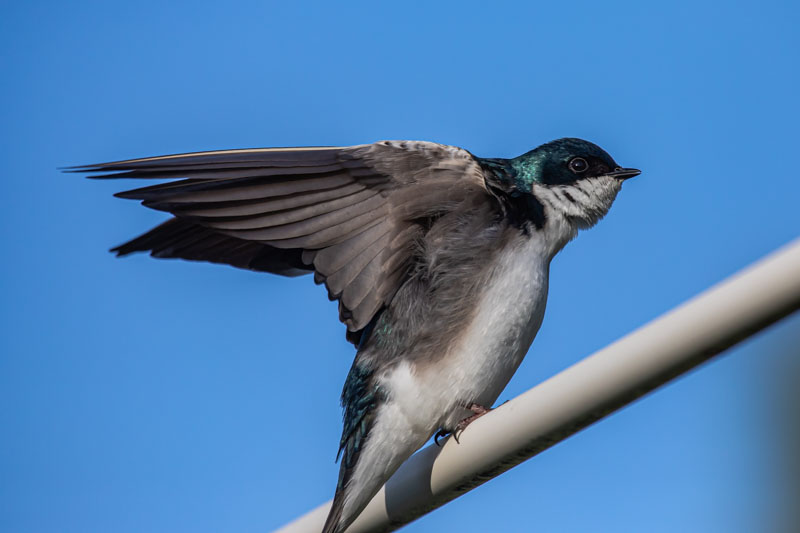
Wing Lift
Stillness breaking into motion.
Camera: Canon EOS 5D Mark IV
Lens: EF100-400mm f/4.5-5.6L IS II USM
Settings: ISO 800 • Aperture f/8.0 • Shutter 1/3200 s
E22A1657 • Size: 5571 x 3714
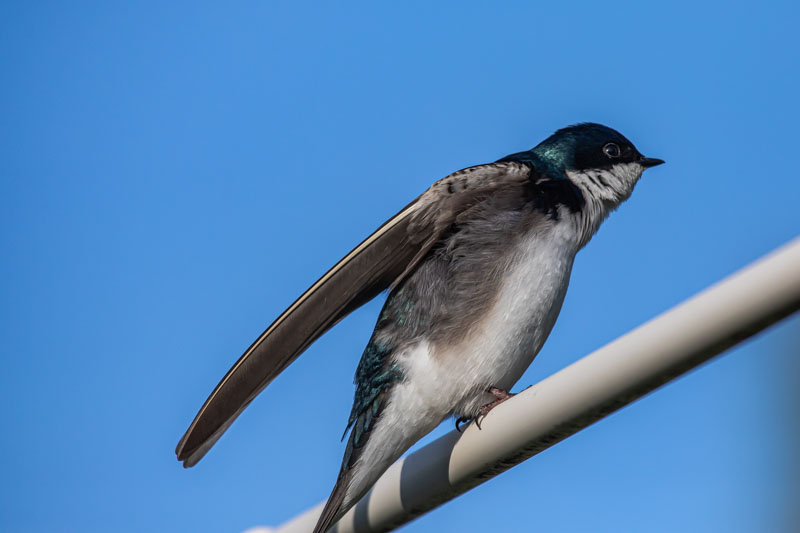
Half Open Wing
A poised transition.
Camera: Canon EOS 5D Mark IV
Lens: EF100-400mm f/4.5-5.6L IS II USM
Settings: ISO 800 • Aperture f/8.0 • Shutter 1/3200 s
E22A1658 • Size: 5417 x 3611
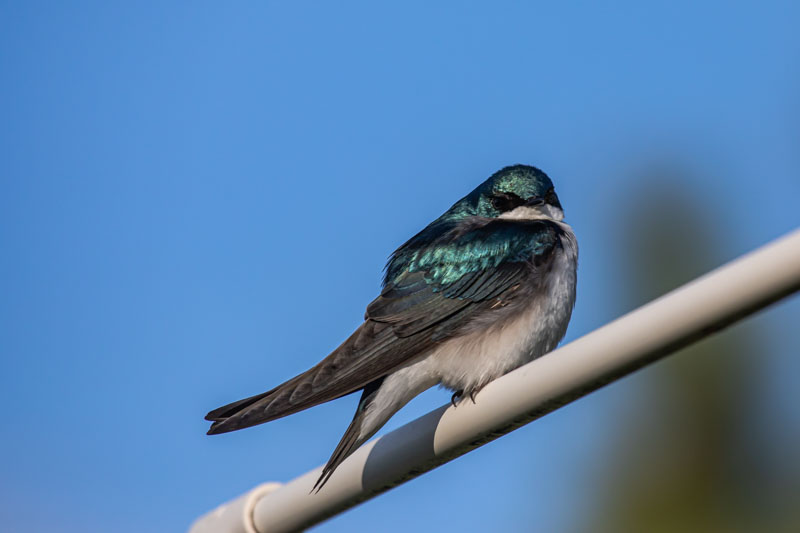
Quiet Return
Composed again on the rail.
Camera: Canon EOS 5D Mark IV
Lens: EF100-400mm f/4.5-5.6L IS II USM
Settings: ISO 800 • Aperture f/8.0 • Shutter 1/3200 s
E22A1654 • Size: 5417 x 3611
Nest Box and Pair Behavior
Around the nest box, the swallows seem less like birds passing through open air and more like residents of a particular place. The roofline becomes a perch, lookout, meeting point, and stage for small social gestures.
E22A1870 catches one bird with a wing lowered and the body feathers loosened. The movement feels less like a launch than a readjustment, giving the frame its title, Ruffling at the Nest Box.
E22A1860 turns the interaction outward. Both birds have their bills open across the roofline, making the frame feel animated rather than simply paired. Nearby frames suggest that the more strongly iridescent bird is likely the male and the more animated bird likely the female, although the photographs alone do not make the sex distinction absolute.
E22A1888 closes the nest-box sequence with a single bird standing above the entrance. The blue-green plumage is especially strong against the muted background, while the seasoned box and small patches of lichen keep the photograph tied to the nesting site.
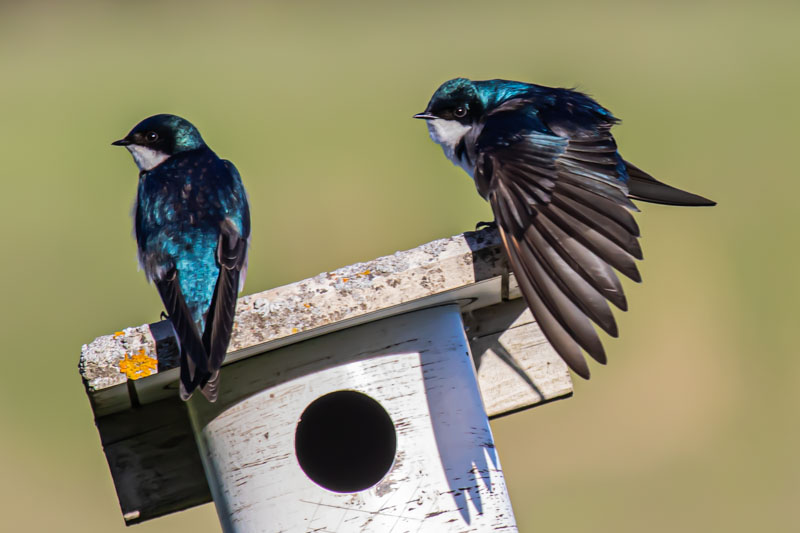
Ruffling at the Nest Box
A brief adjustment beside the box.
Camera: Canon EOS 5D Mark IV
Lens: EF100-400mm f/4.5-5.6L IS II USM
Settings: ISO 800 • Aperture f/8.0 • Shutter 1/1000 s
E22A1870 • Size: 2285 x 1523
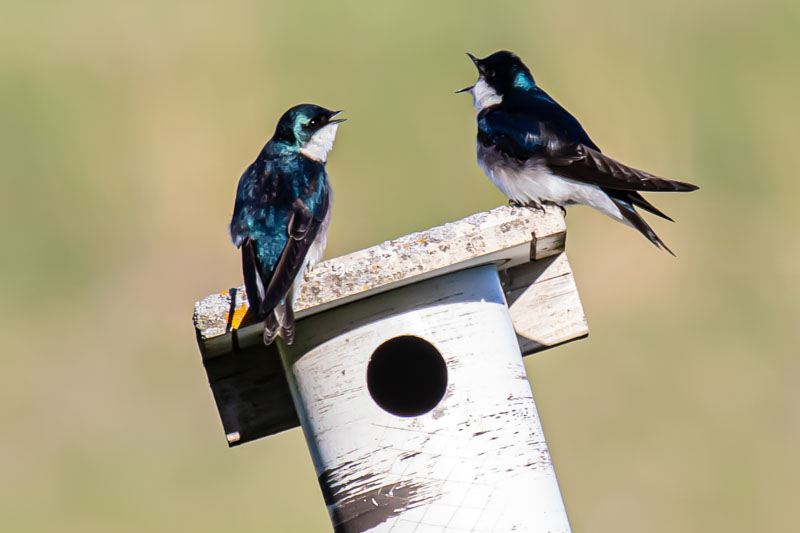
Vocal Interaction
A brief exchange above the nest box.
Camera: Canon EOS 5D Mark IV
Lens: EF100-400mm f/4.5-5.6L IS II USM
Settings: ISO 800 • Aperture f/8.0 • Shutter 1/1000 s
E22A1860 • Size: 1643 x 1095
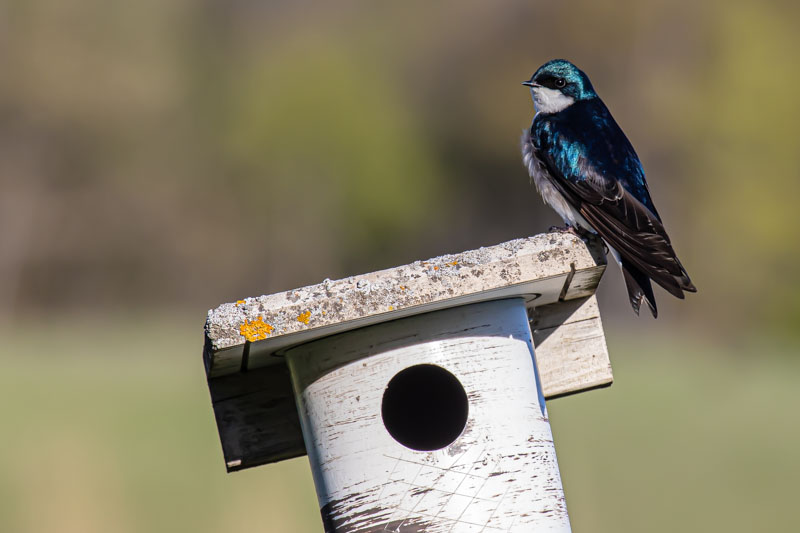
Blue-Green Sentinel
Iridescent plumage above a seasoned box.
Camera: Canon EOS 5D Mark IV
Lens: EF100-400mm f/4.5-5.6L IS II USM
Settings: ISO 800 • Aperture f/11.0 • Shutter 1/640 s
E22A1888 • Size: 3810 x 2540
Photographer’s Perspective
The photographs on this page were not made in a single easy approach. The pipe perch stood about twenty feet from the trail, and the Tree Swallows proved wary from the beginning. I moved slowly along the trail edge rather than walking toward them directly, but even so they flushed when I had closed only part of the distance. Each time, I returned to the tripod, reviewed the images, adjusted the camera, and waited for the birds to settle back onto the pipe.
The process repeated several times through the morning. As the light strengthened, the ISO came down in stages, and with each new attempt the distance closed a little more. What began as a cautious long approach gradually became a closer and more intimate study, until some frames were made at much shorter focal lengths than I would have expected at the start. By the time E22A1761 was taken at 100mm, the effort had become part of the photograph itself: patience, retreat, return, and the small reward of being accepted just a little closer.
That slower approach shaped the photographs as much as the light did. The sequence became more complete not only because the color grew richer and the detail cleaner, but because the birds revealed more with each return: feather texture, shared perches, wing movement, and the social energy around the nest box.
The result is less a ranked collection of individual photographs than a progression:
light and color → feather texture → pair presence → movement → nest-box behavior
That progression is also why the photographs do not need to appear in order of rating. A gallery can tell a stronger story when each image contributes something different.