Song Sparrow — Photographic Sequence
Melospiza melodia
The Song Sparrow photographs collected here span several encounters and show the species in very different settings: exposed seed stalks, a thorny branch, weathered wood, and a wide green field-edge perch. For identification, habitat, and natural-history details, see the Melospiza melodia species page.
Taken separately, many of the photographs are familiar sparrow portraits. Together, they show how much the character of a Song Sparrow image can change when the bird’s posture, breast pattern, and surrounding perch are allowed to remain part of the story.
Standing Watch
The seed-stalk sequence gives the page its clearest introduction. E22A3682 shows the Song Sparrow in side profile with the bird fully visible from bill to tail. The pale eyebrow, dark eye line, malar stripe, streaked breast, central spot, and long tail all remain readable in a single frame.
The dried stalk also gives the portrait a strong sense of place. It is an exposed perch, but not an artificial one: the bird appears to have paused in the brush while keeping watch over the surrounding edge habitat.
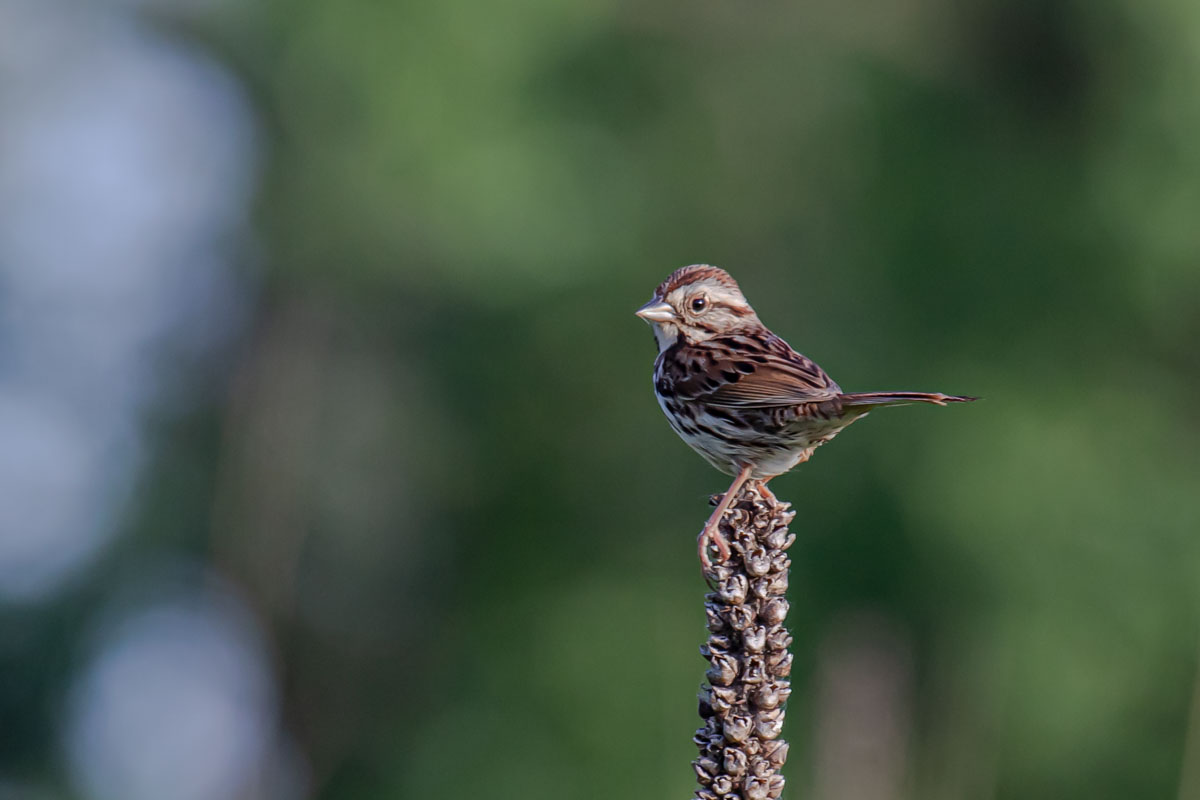
Standing Watch
Layered feathers, long legs, and an attentive posture.
Camera: Canon EOS 5D Mark IV
Lens: EF100-400mm f/4.5-5.6L IS II USM
Settings: ISO 400 • Aperture f/8.0 • Shutter 1/400 s
E22A3682 • Size: 2250 x 1500
A Moment of Stillness
The quieter E22A7361 portrait captures a different side of the species. The Song Sparrow settles on a thorny branch, pausing between moments of activity rather than presenting the field marks as directly as the seed-stalk images.
During this encounter, the Song Sparrow rarely remained still for long. A brief pause like this can be easy to overlook in the field, but the stillness gives the photograph its value. The branches and soft surroundings make the bird feel embedded in the edge habitat instead of simply placed against a background.
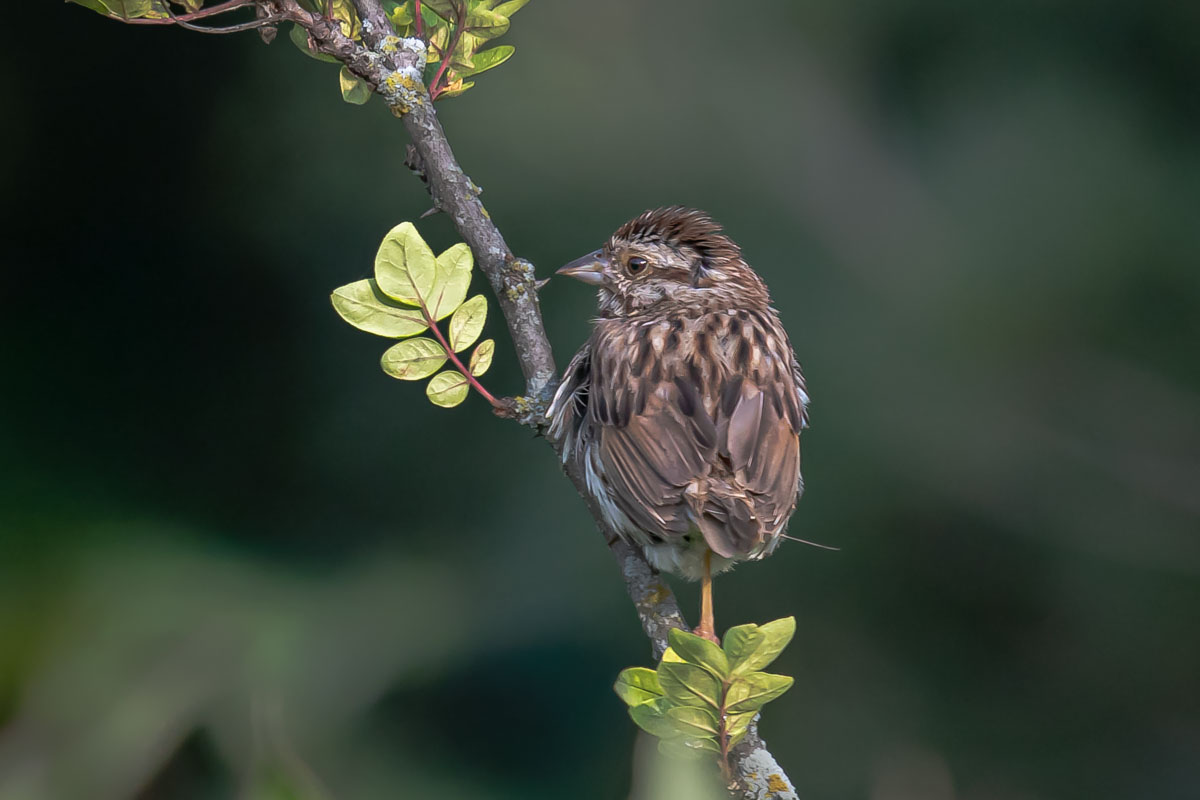
Moment of Stillness
Only for a moment, the busy morning comes to rest.
Camera: Canon EOS 5D Mark IV
Lens: EF100-400mm f/4.5-5.6L IS II USM
Settings: ISO 1000 • Aperture f/8.0 • Shutter 1/640 s
E22A7361 • Size: 2100 x 1400
The seed-stalk and thorny-branch images work together because they describe two kinds of attention: one alert and exposed, the other quiet and briefly settled.
Seed-Stalk Portraits
The tighter portraits keep the facial and breast patterns prominent, while changes in head angle shift the emphasis from plumage detail to expression and behavior.
The three photographs were made from the same visual setting, but the changes in head angle keep the sequence from feeling repetitive. The Song Sparrow moves from a side view, to a direct stare, to a downward glance toward the brush below.
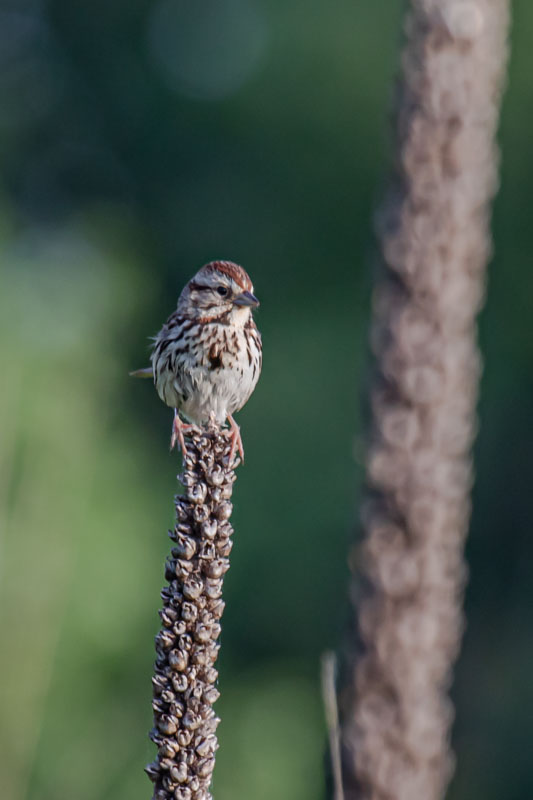
Holding the Perch
A closer look at the intricate breast pattern flowing from the throat to the shoulders.
Camera: Canon EOS 5D Mark IV
Lens: EF100-400mm f/4.5-5.6L IS II USM
Settings: ISO 400 • Aperture f/8.0 • Shutter 1/400 s
E22A3679 • Size: 1333 x 2000
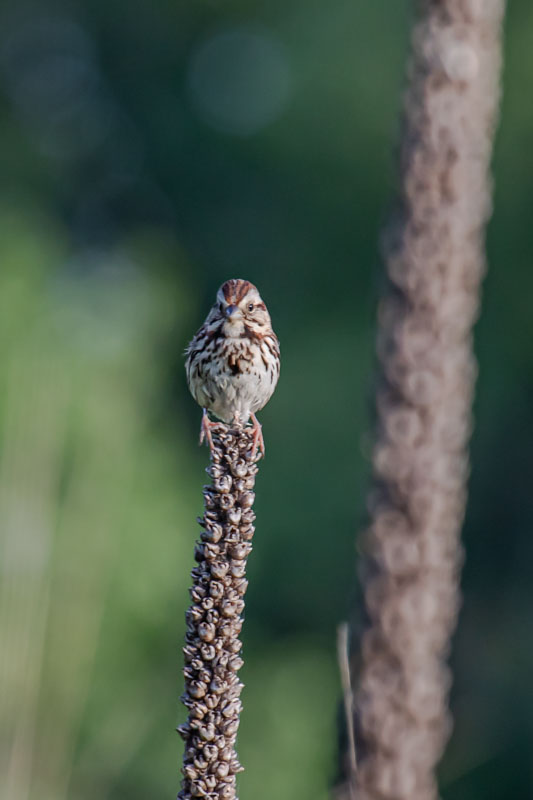
Front and Center
A small bird with a strong presence.
Camera: Canon EOS 5D Mark IV
Lens: EF100-400mm f/4.5-5.6L IS II USM
Settings: ISO 400 • Aperture f/8.0 • Shutter 1/400 s
E22A3680 • Size: 1333 x 2000
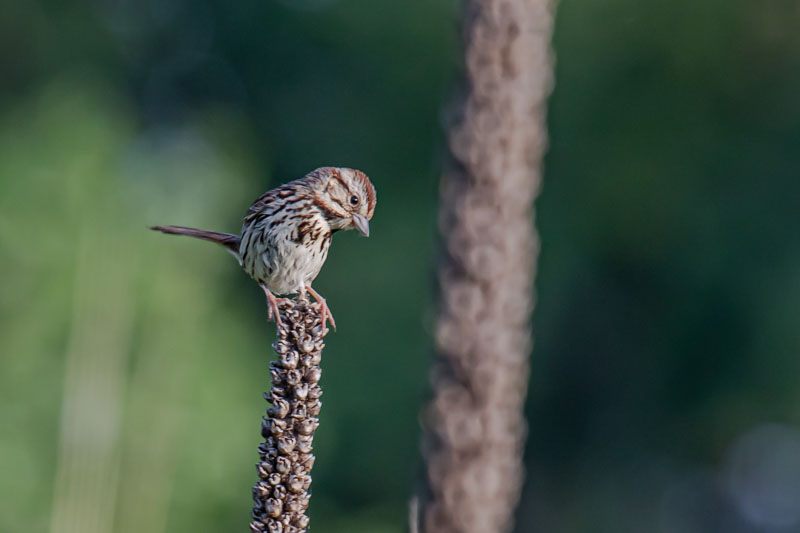
Something Below
A sudden focus on the brush below has its attention.
Camera: Canon EOS 5D Mark IV
Lens: EF100-400mm f/4.5-5.6L IS II USM
Settings: ISO 400 • Aperture f/8.0 • Shutter 1/400 s
E22A3681 • Size: 2250 x 1500
The strongest value of the group is its continuity. The perch and light remain consistent while the bird changes posture, allowing the images to read as a short portrait study rather than a set of unrelated views.
Pointing Sparrow
E21A1917 belongs with the page as an earlier, more atmospheric view. The bird is still perched on a dried seed stalk, but the tail is in motion and the attention seems directed toward something ahead.
It has less of the precise field-mark clarity of the newer sequence, yet that difference gives it a useful role. The image suggests movement and intent, closing the tighter portraits with a little more uncertainty and energy.
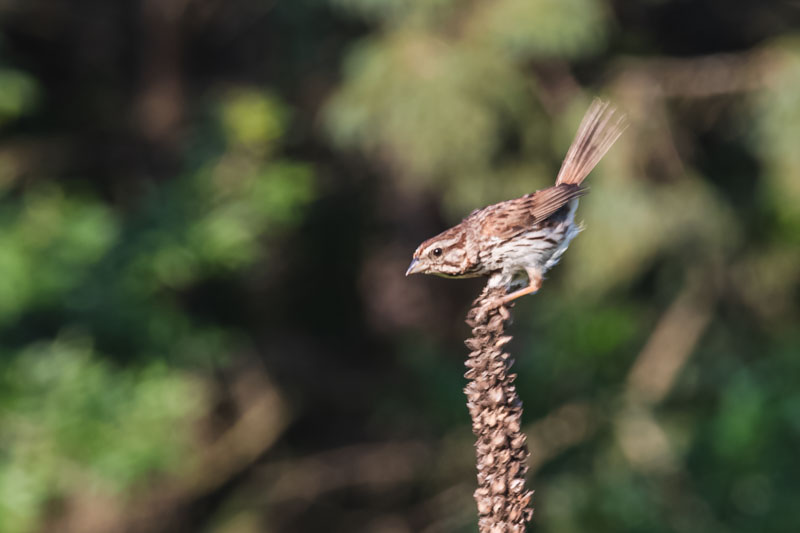
Pointing Sparrow
Tail in motion while the bird seems intent on something ahead.
Camera: Canon EOS 5D Mark IV
Lens: EF100-400mm f/4.5-5.6L IS II USM
Settings: ISO 400 • Aperture f/8.0 • Shutter 1/400 s
E21A1917 • Size: 1799 x 1199
Other Perches
The weathered board and field-post photographs broaden the collection beyond the seed-stalk setting. Both are quieter environmental portraits, with the perch becoming as important to the composition as the bird itself.
E21A1931 places the Song Sparrow against rough, weathered wood. The streaked plumage and irregular surface share a similar visual texture, making the frame feel grounded and tactile.
E21A1794 moves in the opposite direction. The bird becomes a smaller figure on a slanted fence post within a green field, giving the page a wider sense of habitat and scale.
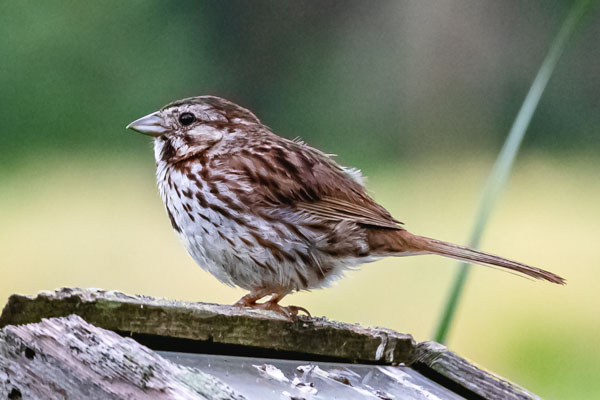
Weathered Board
Streaked plumage against rough wood.
Camera: Canon EOS 5D Mark IV
Lens: EF70-200mm f/2.8L IS II USM + EF2x teleconverter
Settings: ISO 1250 • Aperture f/13.0 • Shutter 1/200 s
E21A1931 • Size: 2109 x 1406
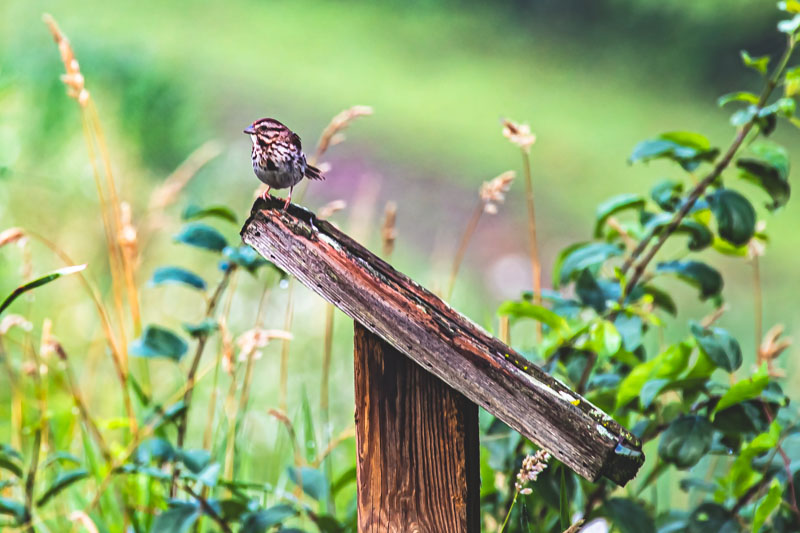
Field Perch
A small figure in a wide green setting.
Camera: Canon EOS 5D Mark IV
Lens: EF70-200mm f/2.8L IS II USM + EF2x teleconverter
Settings: ISO 200 • Aperture f/8.0 • Shutter 1/80 s
E21A1794 • Size: 1799 x 1199
Photographer’s Perspective
The Song Sparrow page changed as the photographs accumulated.
The earliest images emphasized atmosphere and habitat: a bird on weathered wood, a small figure in a green field, and a tail caught in motion. The newer seed-stalk sequence added a cleaner introduction to the species and made the face pattern and breast streaking easier to study.
E22A3682 now works as the strongest gallery lead because it balances identification and composition. The seed-stalk portraits are strongest as a framed set, especially when paired as side view, centered portrait, and downward glance. E22A7361 adds a quieter pause, while E21A1794 keeps the wider field setting in view.
The result is less a ranked collection of individual photographs than a progression:
field marks → posture → expression → movement → perch and habitat
That progression is also why the photographs do not need to appear in order of rating. A gallery can tell a stronger story when each image contributes something different.