Golden-eye Lichen — Photographic Sequence
Teloschistes chrysophthalmus
The Golden-eye Lichen photographs collected here span several observations of Teloschistes chrysophthalmus. Rather than following a single encounter, the sequence compares the same species under different photographic conditions: warm natural sunlight, direct flash, a mixed lichen community, and a wet high-magnification focus stack. For identification, habitat, and natural-history details, see the Teloschistes chrysophthalmus species page.
Rather than following a single encounter, the sequence compares the same species under different photographic conditions: warm natural sunlight, direct flash, a mixed lichen community, and high magnification during a humid, foggy morning.
Natural Light Across the Branch
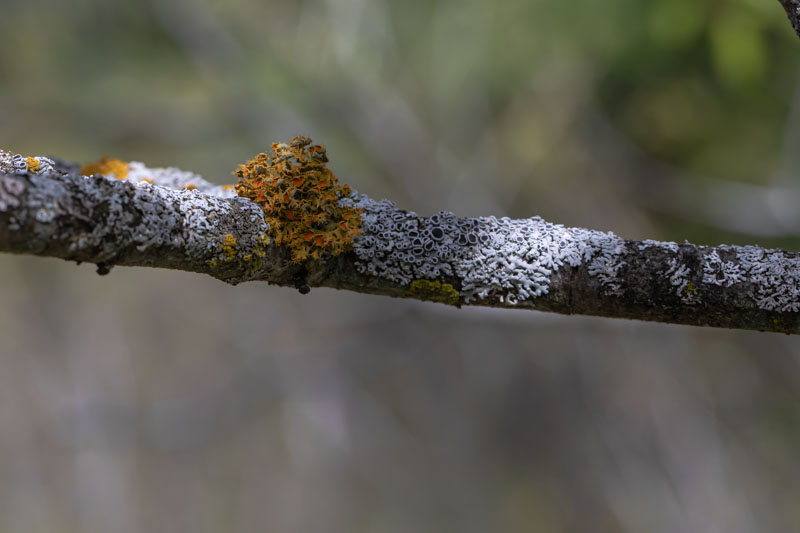
E22A2623 establishes the colony within a lichen-covered branch as sunlight begins to reach the subject. The wider frame shows the Golden-eye as only one element in a crowded bark community, surrounded by gray foliose lichens and smaller yellow growths. The soft background and unlit portions of the branch preserve the sense of waiting for a moving patch of sunlight.
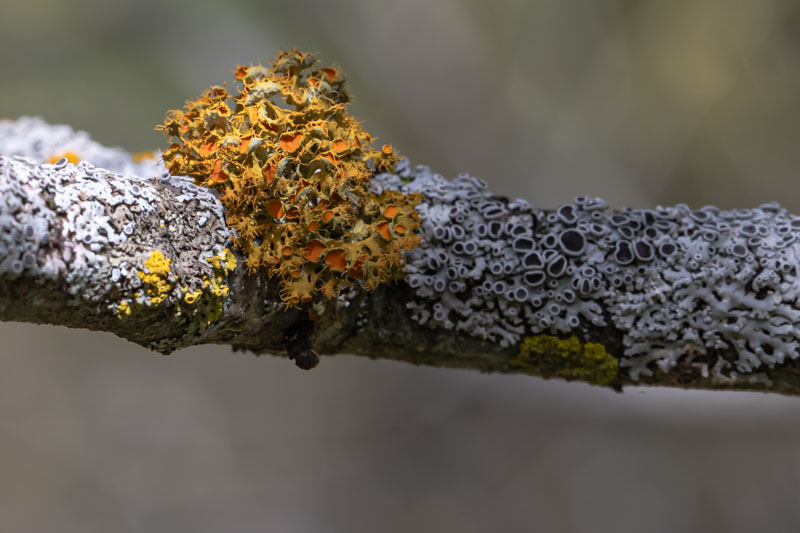
E22A2624 moves closer after the light reaches the colony. The orange apothecia brighten first, while curled lobes and cilia fall into softer shadow. The more directional illumination gives the tuft greater depth than the flash-lit views and separates its amber-orange tones from the cooler gray lichens around it.
Waiting for the Light
A wider natural-light view showing the colony in place on a mixed lichen-covered branch.
Camera: Canon EOS 5D Mark IV
Lens: EF100mm f/2.8L Macro IS USM
Settings: ISO 400 • Aperture f/13 • Shutter 1/100 s
E22A2623 • Size: 5375 x 3583
Golden-eye Lichen in Natural Sunlight
Low sunlight brings out the amber-orange tones and layered structure of the tuft.
Camera: Canon EOS 5D Mark IV
Lens: EF100mm f/2.8L Macro IS USM
Settings: ISO 400 • Aperture f/13 • Shutter 1/100 s
E22A2624 • Size: 2638 x 1759
Golden-eye with Spring Leaves
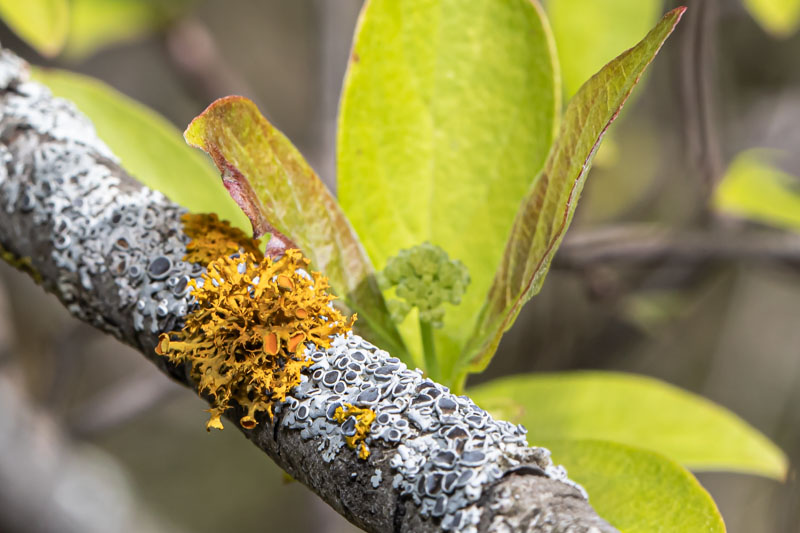
Fresh green leaves brighten the background while the golden tuft rises from a lichen-covered branch.
Camera: Canon EOS 5D Mark IV
Lens: EF100mm f/2.8L Macro IS USM
Settings: ISO 400 • Aperture f/13 • Shutter 1/100 s
E22A2631 • Size: 800 x 533
Flash and Structure
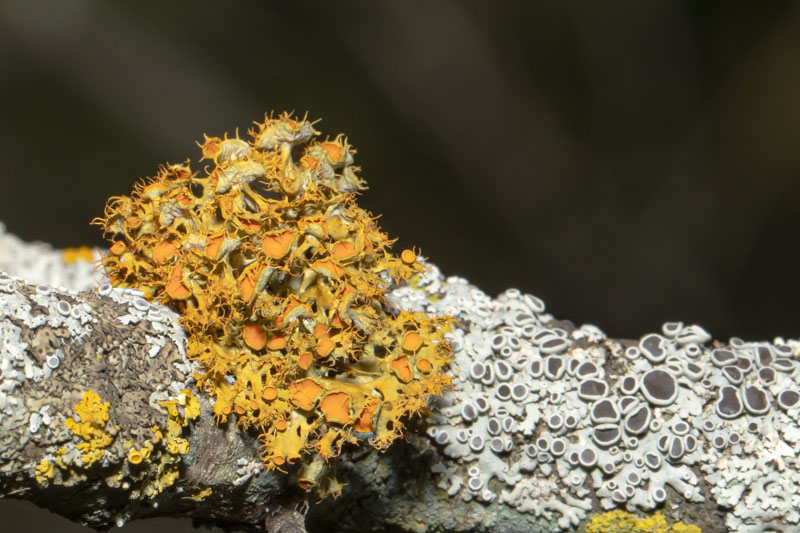
The flash-lit photographs trade some of the warmth and dimensionality of natural light for a more explicit view of structure. E22A2614 resolves the dense marginal cilia, curled lobes, and numerous orange apothecia across the top of the colony. The even illumination also makes the surrounding gray lichens easier to compare within the same plane.
E22A2611 steps back enough to show the Golden-eye as a compact tuft rising from the bark. From this angle the fruticose growth form is especially clear: the colony is not an appressed rosette but a tangled, shrubby mass projecting above neighboring foliose lichens.
Flash-lit Detail
Flash reveals the dense cilia, orange apothecia, and tangled branching structure.
Camera: Canon EOS 5D Mark IV
Lens: EF100mm f/2.8L Macro IS USM
Settings: ISO 100 • Aperture f/18 • Shutter 1/200 s
E22A2614 • Size: 5448 x 3632
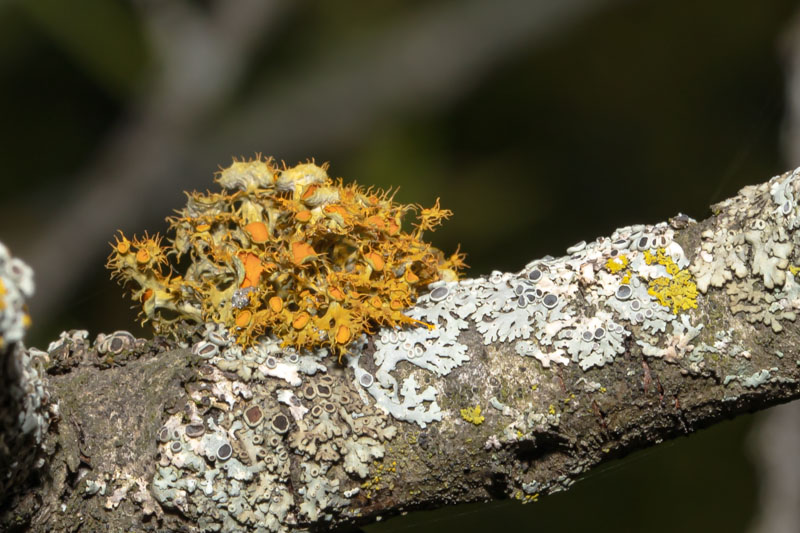
Tufted Form
The colony rises from the bark as a compact, shrubby cluster among gray Physcia-like rosettes.
Camera: Canon EOS 5D Mark IV
Lens: EF100mm f/2.8L Macro IS USM
Settings: ISO 100 • Aperture f/18 • Shutter 1/200 s
E22A2611 • Size: 1991 x 1327
Earlier Studies and Community Context
E22A0106 isolates a compact colony on a slender birch twig. Warm light concentrates attention on the crowded orange apothecia while the subdued bark and background keep the tuft visually separate from its surroundings. The angle also shows how irregular lobes lift away from the branch and create a miniature, layered landscape.
E22A0184_85_88 expands the context. The Golden-eye shares the twig with gray Physcia-like rosettes and small yellow crusts, making the photograph as much a record of a lichen community as a portrait of one species. The bright orange tuft remains the visual center, but its scale becomes clearer when compared with the surrounding growths.
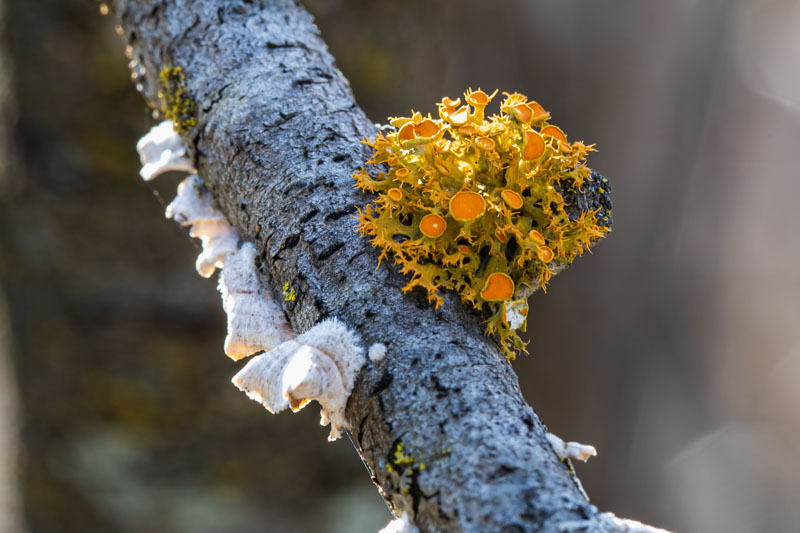
Golden-eye Sunburst on Birch Twig
A dense cluster of vivid orange apothecia rises from a slender birch twig, catching warm light against a backdrop of quiet decay.
Camera: Canon EOS 5D Mark IV
Lens: EF100mm f/2.8L Macro IS USM
Settings: ISO 100 • Aperture f/13 • Shutter 0.5 s
E22A0106 • Size: 3198 x 2132
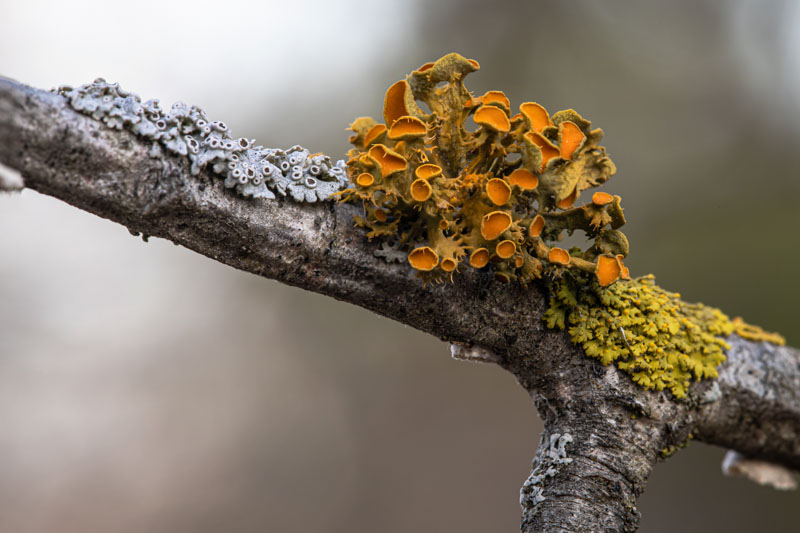
Golden-eye on Twig with Mixed Lichens
A dense cluster of orange apothecia surrounded by gray Physcia-like rosettes and yellow crusts.
Camera: Canon EOS 5D Mark IV
Lens: EF100mm f/2.8L Macro IS USM
Settings: ISO 100 • Aperture f/13 • Shutter 1.0 s
E22A0184_85_88 • Size: 5448 x 3632
Humid Morning at Higher Magnification
A later observation, E22A9460, moves much closer to the Golden-eye colony. The moisture-laden thallus shifts toward olive green while the rounded orange apothecia become glossy and intensely saturated.
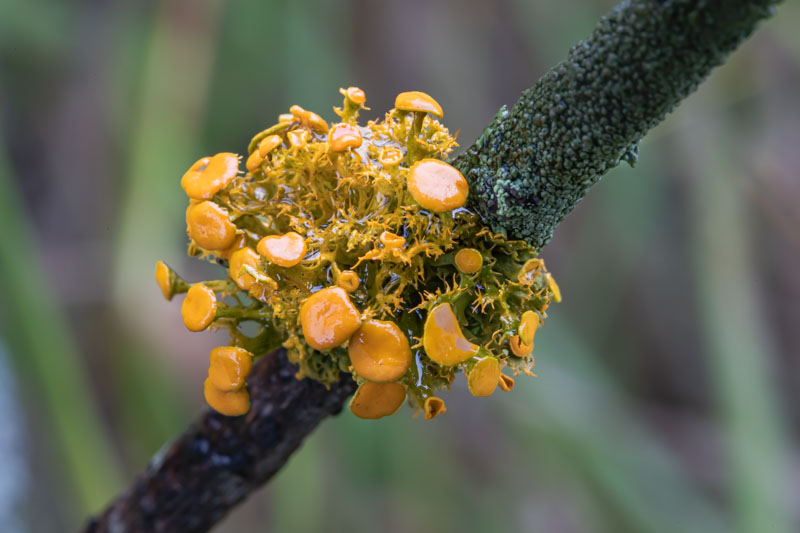
Saturated Golden-eye
High magnification reveals the crowded branching and glossy orange apothecia of a saturated Golden-eye colony.
Camera: Canon EOS 5D Mark IV
Lens: EF100mm f/2.8L Macro IS USM + 2X extension tube
Settings: ISO 100 • Aperture f/22 • Shutter 4.0 s
E22A9460 • Size: 6720 x 4480
Field Characters Across the Sequence
The photographs record complementary visual characters of Teloschistes chrysophthalmus:
- E22A2624 shows the warm orange apothecia, curled lobes, and ciliate margins under low natural sunlight.
- E22A2614 gives the clearest flash-lit view of the dense cilia and tangled branching structure.
- E22A2611 emphasizes the compact, shrubby growth form rising above the bark.
- E22A0184_85_88 places the species among neighboring foliose and crustose lichens and helps establish its scale.
- E22A9460 shows the marked change in color and surface character when wet and at higher magnification.
These images are photographic observations rather than a complete diagnostic series. For identification characters, comparison with similar lichens, and notes on the species, see the Teloschistes chrysophthalmus species page.
Perspective
Natural sunlight gives the dry colony its strongest dimensionality; flash clarifies cilia and branching; wider views place the tuft among neighboring lichens; and the high-magnification view from a humid, foggy morning pushes close enough to make individual apothecia dominate the frame.
mixed branch in moving light → warm natural-light portrait → flash-lit structure → twig community → humid morning at high magnification
Across those changes, the orange apothecia remain the most persistent visual feature. The photographs also show why a lichen can look markedly different from one observation to the next: moisture, angle, illumination, and magnification alter color and texture without changing the underlying organism.