Common Yellowthroat
Geothlypis trichas
Common Yellowthroats are small warblers of wet thickets, brushy field edges, marsh margins, and low woodland growth. The adult male is immediately recognizable by his broad black mask, pale border above the mask, olive-brown upperparts, and bright yellow throat. Although the species often remains low in dense cover, these photographs show a male using a series of exposed branches while carrying freshly caught insects.
For identification details and comparison with similar species, see Geothlypis trichas in the Field Notes section.
The opening portrait catches the bird in full side profile with an insect held clearly in his bill. The black mask, white upper border, yellow throat, olive back, and long tail can all be read at once, while the softly blended background places the bird within the green edge habitat where Common Yellowthroats are most often heard and only briefly seen.
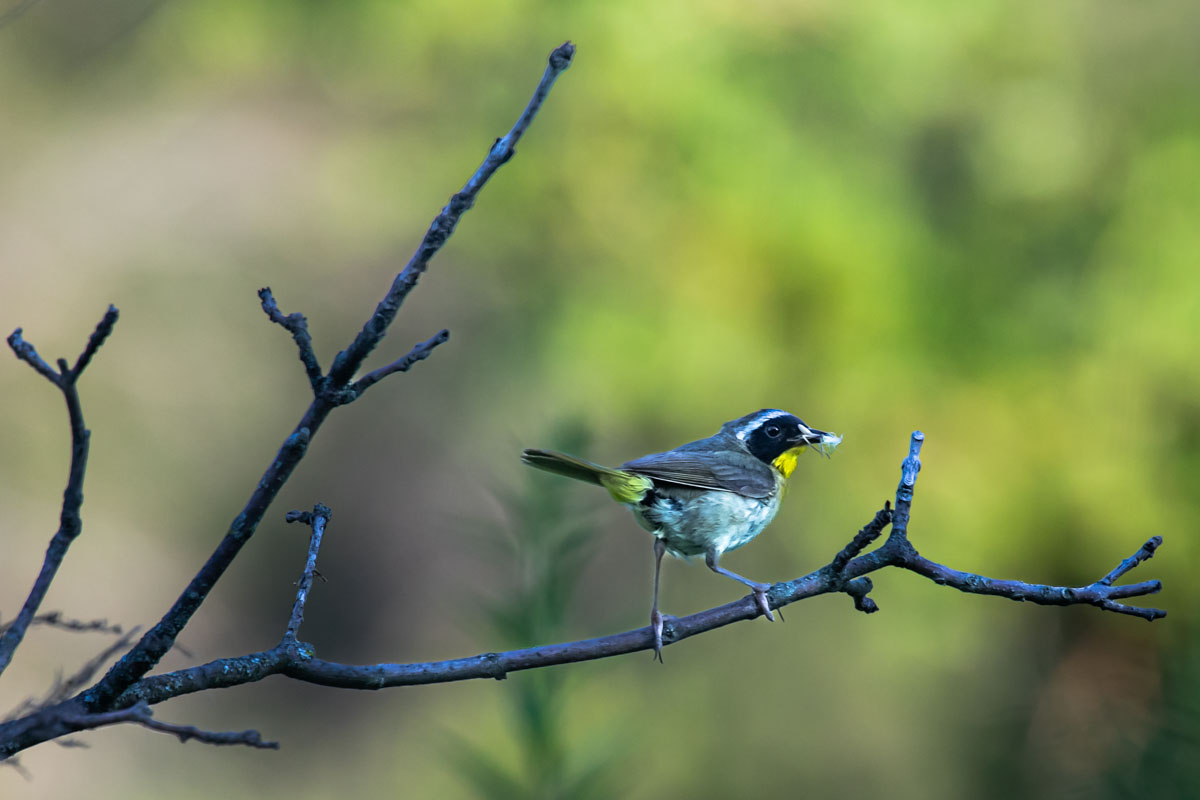
Prey in the Morning Light
A masked warbler pauses with an insect in his bill.
Camera: Canon EOS 5D Mark IV
Lens: EF100-400mm f/4.5-5.6L IS USM
Settings: ISO 6400 • Aperture f/6.3 • Shutter 1/160 s
E22A6799 • Size:
Overview
Most of the photographs on this page were made during one morning encounter as the bird moved between open deadwood, low foliage, and the edge of a wooded opening. Several frames show prey in the bill, suggesting repeated foraging trips through nearby vegetation. The sequence moves from the strongest side profile to wider environmental portraits, then to the cleaner sky-backed views and an earlier photograph made among pine branches.
Framed by Summer Color
In the warmest frame of the series, the bird stands within a loose crown of bare twigs above green leaves. The distant meadow has dissolved into gold and olive, allowing the yellow throat to blend naturally with the setting while the dark mask and branches hold the composition together.
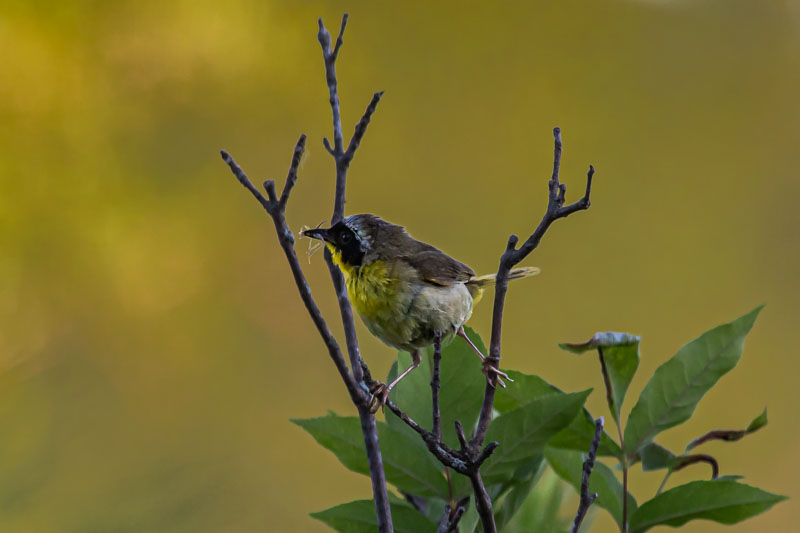
Framed in Gold
Bare twigs rise around the bird against a softly lit meadow.
Camera: Canon EOS 5D Mark IV
Lens: EF100-400mm f/4.5-5.6L IS USM
Settings: ISO 800 • Aperture f/8.0 • Shutter 1/500 s
E22A6836
The upright branches create a natural frame without hiding the bird. His slightly turned head keeps the eye and mask visible, while the insect in the bill adds a small but important sign of activity. Among the photographs in this group, this frame carries the strongest sense of summer atmosphere.
Open Perch Against the Sky
On an exposed branch against clear blue sky, the bird turns just far enough to show the eye, mask, bill, and insect. The cleaned background gives the small details room to read, while the remaining forked branches preserve the structure of the natural perch.
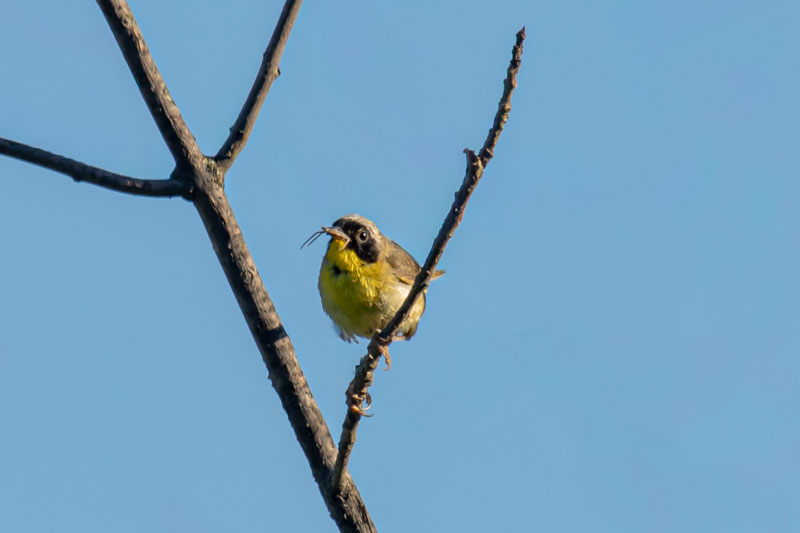
Insect at the Fork
A three-quarter view from an exposed perch.
Camera: Canon EOS 5D Mark IV
Lens: EF100-400mm f/4.5-5.6L IS USM
Settings: ISO 800 • Aperture f/8.0 • Shutter 1/800 s
E22A6808
The three-quarter angle is less descriptive than the full side profile in the opening photograph, but it gives the portrait a more direct sense of contact. The insect remains visible as a set of fine lines extending from the bill, and the plain sky emphasizes the bird's compact shape.
Across the Woodland Edge
A wider environmental portrait places the bird along a long horizontal branch. The perch leads through the frame toward the bird, and the softly mottled green background suggests the layered shrubs and trees beyond the opening.
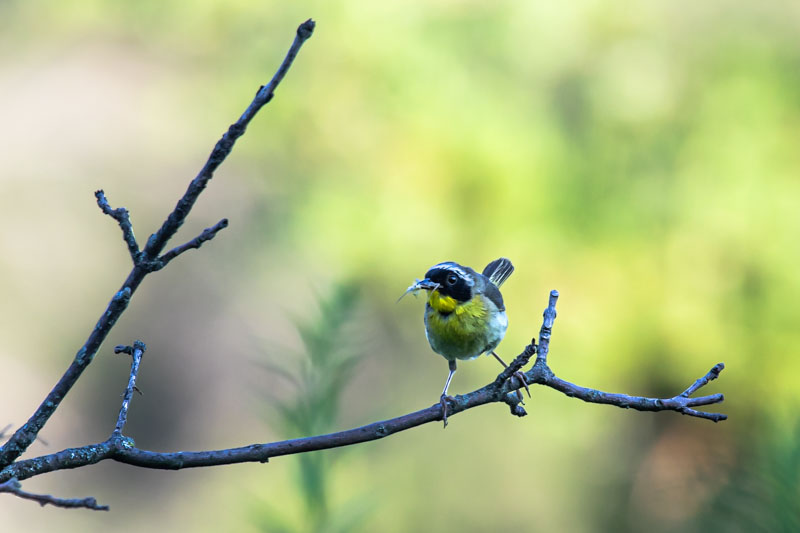
Across the Open Branch
A small hunter poised above the woodland edge.
Camera: Canon EOS 5D Mark IV
Lens: EF100-400mm f/4.5-5.6L IS USM
Settings: ISO 800 • Aperture f/8.0 • Shutter 1/500 s
E22A6803
The bird is smaller in the frame than in the closer portraits, but the long perch and open space give the image a calm, balanced character. It reads less as a field-mark study and more as a view of the bird moving through its surroundings.
Facing the Morning
A second sky-backed portrait catches the bird nearly head-on. The pose creates a strong, compact shape between the upright branches, and the yellow throat becomes the center of the frame.
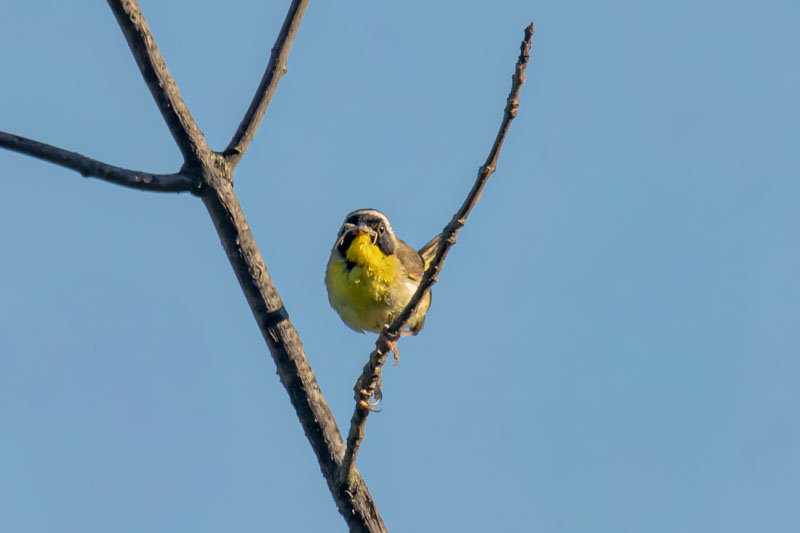
Facing the Morning
A frontal pause high in the branches.
Camera: Canon EOS 5D Mark IV
Lens: EF100-400mm f/4.5-5.6L IS USM
Settings: ISO 800 • Aperture f/8.0 • Shutter 1/500 s
E22A6807
The frontal view is graphic and well isolated, although the angle compresses the mask and makes the insect less obvious than in the side and three-quarter portraits. It works best late in the sequence, after the stronger identification views have already established the bird's field marks.
Among the Pines
An earlier photograph shows another feeding encounter in a more enclosed setting. Pine needles, crossing branches, and filtered highlights surround the bird, creating a busier frame but also showing how easily a Common Yellowthroat can disappear into vegetation even when the yellow throat is brightly lit.
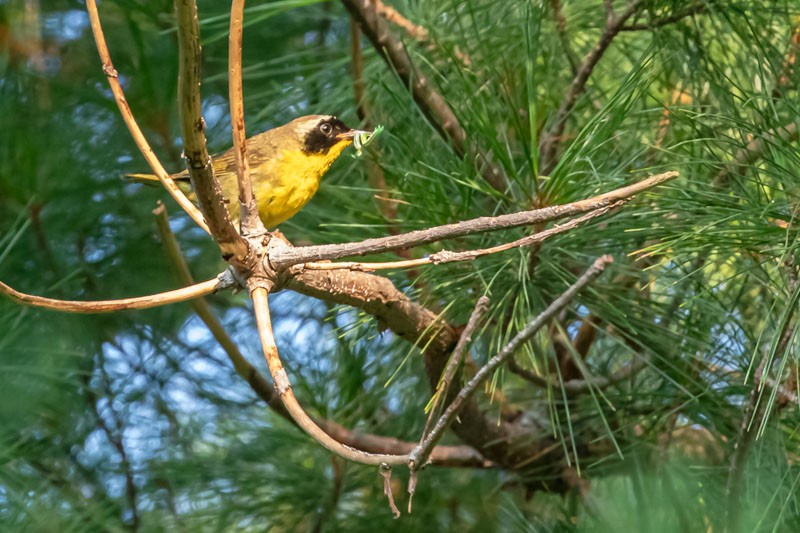
Among the Pines
An earlier feeding encounter in filtered summer light.
Camera: Canon EOS 5D Mark IV
Lens: EF70-200mm f/2.8L IS II USM +2x
Settings: ISO 2500 • Aperture f/13.0 • Shutter 1/100 s
E21A2145
The profile clearly shows the mask and prey, but the surrounding branches compete for attention. Compared with the newer photographs, this frame is most useful as an environmental and behavioral record rather than as the principal portrait of the species.
Photographer’s Perspective
The strongest photographs came when the bird briefly rose above the low cover and paused on open deadwood. Those moments provided clean views of the eye, mask, throat, bill, and prey without losing the brushy character of the habitat. The side profile in E22A6799 offers the clearest combination of identification detail and behavior, while E22A6836 contributes the richest background and strongest sense of place.
The sky-backed photographs required a different balance. Removing distracting background branches from E22A6808 strengthened the image, but retaining the main fork preserved a believable perch. Cropping was kept restrained throughout the series so that the bird would remain sharp enough to support the fine facial markings and the small insects held in the bill.
Common Yellowthroats are often located first by voice from dense vegetation. A clear, open view may last only a few seconds before the bird drops back into cover, making these exposed feeding pauses especially valuable for both identification and photography.