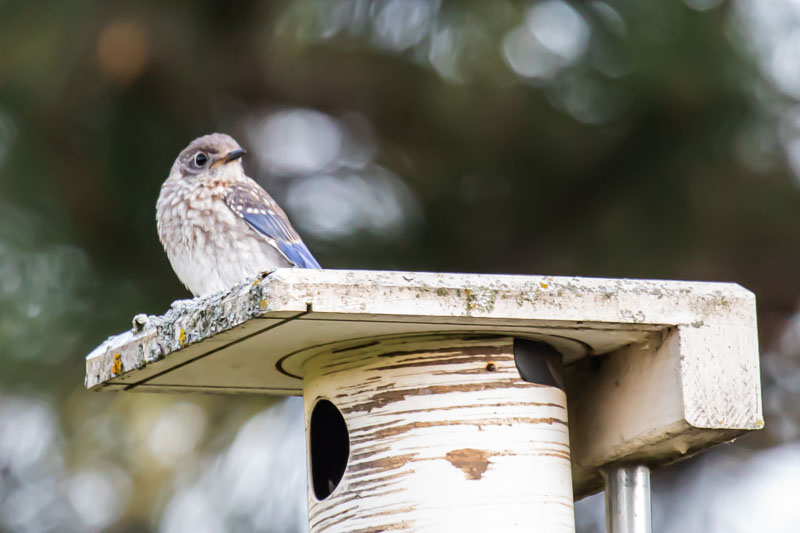
Eastern Bluebird
Sialia sialis
Eastern Bluebirds are small thrushes of open country, often seen perched along woodland edges, field margins, orchards, nest-box trails, and scattered trees. The male’s vivid blue back and rusty-orange breast make him stand out in spring light, while the female carries the same pattern in softer gray-blue and muted warm tones.
For identification details and comparison with similar species, see the Sialia sialis in the Field Notes section.
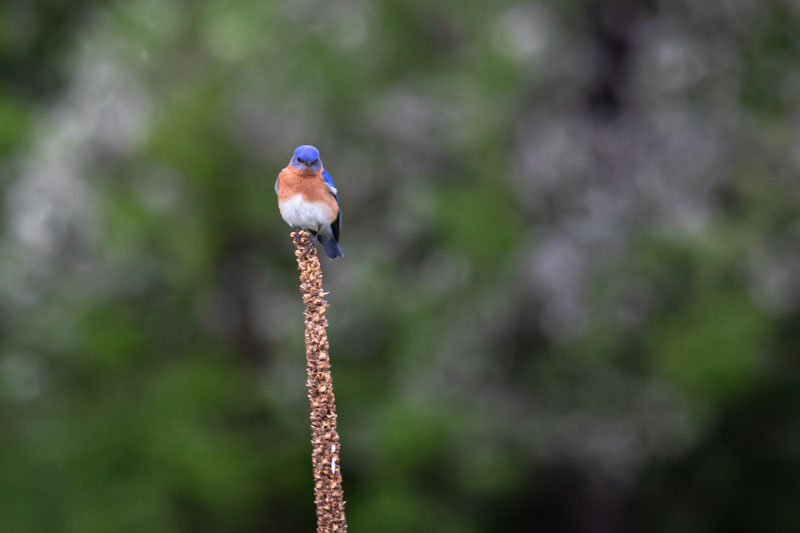
A male Eastern Bluebird perches on a dried mullein stalk near the nest box. The tall, isolated perch gives him a clear vantage point over the surrounding habitat and sets the stage for the nest-box activity that follows.
Male Eastern Bluebird on Mullein Stalk
A lookout above the nesting area.
Camera: Canon EOS 5D Mark IV
Lens: EF100-400mm f/4.5-5.6L IS II USM
Settings: ISO 800 • Aperture f/5.6 • Shutter 1/640 s
E22A2330 • Size: 2834x1889
Overview
This page combines two views of Eastern Bluebirds in spring. The first is a nest-box sequence, where a pair moves between perches, the entrance hole, and the box roof while the female brings nesting material. The second is a quieter set of portraits among fresh leaves, showing the contrast between the brighter male and the more subdued female.
Nest Box Activity
Around the nest box, the pair’s behavior becomes more specific and purposeful. The female repeatedly appears with nesting material, while the male remains close to the entrance, perches on the box, and moves in and out of the cavity. These frames show the box as the center of the birds’ attention rather than just a convenient perch.
Female Eastern Bluebird at Nest Box
Material gathered for the cavity.
Camera: Canon EOS 5D Mark IV
Lens: EF100-400mm f/4.5-5.6L IS II USM
Settings: ISO 800 • Aperture f/7.1 • Shutter 1/640 s
E22A2340 • Size: 5067x3378
The female pauses on the nest box roof with material in her bill. Her head is turned slightly toward the camera,
giving the frame a clearer portrait quality while still showing the behavior of nest construction.
The softer plumage of the female contrasts with the bright white box and dark woodland edge behind her. Even with nesting material visible, she retains the quiet, watchful posture typical of bluebirds at an active site.
Material Arriving
Female above, male at the entrance.
Camera: Canon EOS 5D Mark IV
Lens: EF100-400mm f/4.5-5.6L IS II USM
Settings: ISO 800 • Aperture f/11.0 • Shutter 1/250 s
E22A2459 • Size: 4674x3116
Pair at the Entrance
A shared moment at the nest box.
Camera: Canon EOS 5D Mark IV
Lens: EF100-400mm f/4.5-5.6L IS II USM
Settings: ISO 800 • Aperture f/11.0 • Shutter 1/1250 s
E22A2460 • Size: 4674x3116
Long Stem
Building material balanced above the box.
Camera: Canon EOS 5D Mark IV
Lens: EF100-400mm f/4.5-5.6L IS II USM
Settings: ISO 500 • Aperture f/11.0 • Shutter 1/1250 s
E22A2461 • Size: 4674x3116
Carrying the Stem
Nesting material stretched across the frame.
Camera: Canon EOS 5D Mark IV
Lens: EF100-400mm f/4.5-5.6L IS II USM
Settings: ISO 500 • Aperture f/11.0 • Shutter 1/1250 s
E22A2462 • Size: 4674x3116
Together, these images read as a compact behavioral sequence: material arrives, the male attends the entrance, and the female works from the roofline of the box. The open setting makes the activity easy to follow without losing the sense of distance and caution around the nest site.
Flight from the Box
The strongest action frame in the sequence catches the male just after leaving the nest box. The image shifts the page from stillness into movement, showing the bird’s compact shape opening into flight while the box remains as the fixed point of reference.
Male Eastern Bluebird in Flight
Leaving the nest box.
Camera: Canon EOS 5D Mark IV
Lens: EF100-400mm f/4.5-5.6L IS II USM
Settings: ISO 800 • Aperture f/11.0 • Shutter 1/12500 s
E22A2458 • Size: 4674x3116
The male lifts away from the box, wings spread and tail trailing behind. Against the soft blue-gray background, the flight pose gives a brief view of the bird’s structure and the speed of movement around the nesting site.
Male Attending the Nest Box
The male’s role in the sequence is often watchful: perched near the entrance, facing outward, or returning to the box after a short movement. His color makes him immediately visible against the white box and darker woodland background.
Male Eastern Bluebird on Nest Box
A bright pause at the nest site.
Camera: Canon EOS 5D Mark IV
Lens: EF100-400mm f/4.5-5.6L IS II USM
Settings: ISO 800 • Aperture f/6.3 • Shutter 1/6400 s
E22A2415
This quiet pause helps balance the flight frame. The same bird that appears quick and compact in motion becomes upright and composed on the roof of the box, watching the area around the cavity.
Female at the Box
The female’s plumage is quieter but still distinctly bluebird. Her blue wings and tail remain visible, while the gray-brown head, pale belly, and muted orange breast soften into the wooded background behind the nest box.
Female on the Roofline
A quiet pause above the entrance.
Camera: Canon EOS 5D Mark IV
Lens: EF100-400mm f/4.5-5.6L IS II USM
Settings: ISO 800 • Aperture f/8.0 • Shutter 1/6400 s
E22A2313 • Size: 3220x1247
Female Facing Forward
Soft color against the darker woods.
Camera: Canon EOS 5D Mark IV
Lens: EF100-400mm f/4.5-5.6L IS II USM
Settings: ISO 800 • Aperture f/9.0 • Shutter 1/1250 s
E22A2314 • Size: 3220x1247
These closer nest-box portraits make the female’s field marks easier to study: muted orange through the breast, a pale lower belly, and blue strongest along the wings and tail.
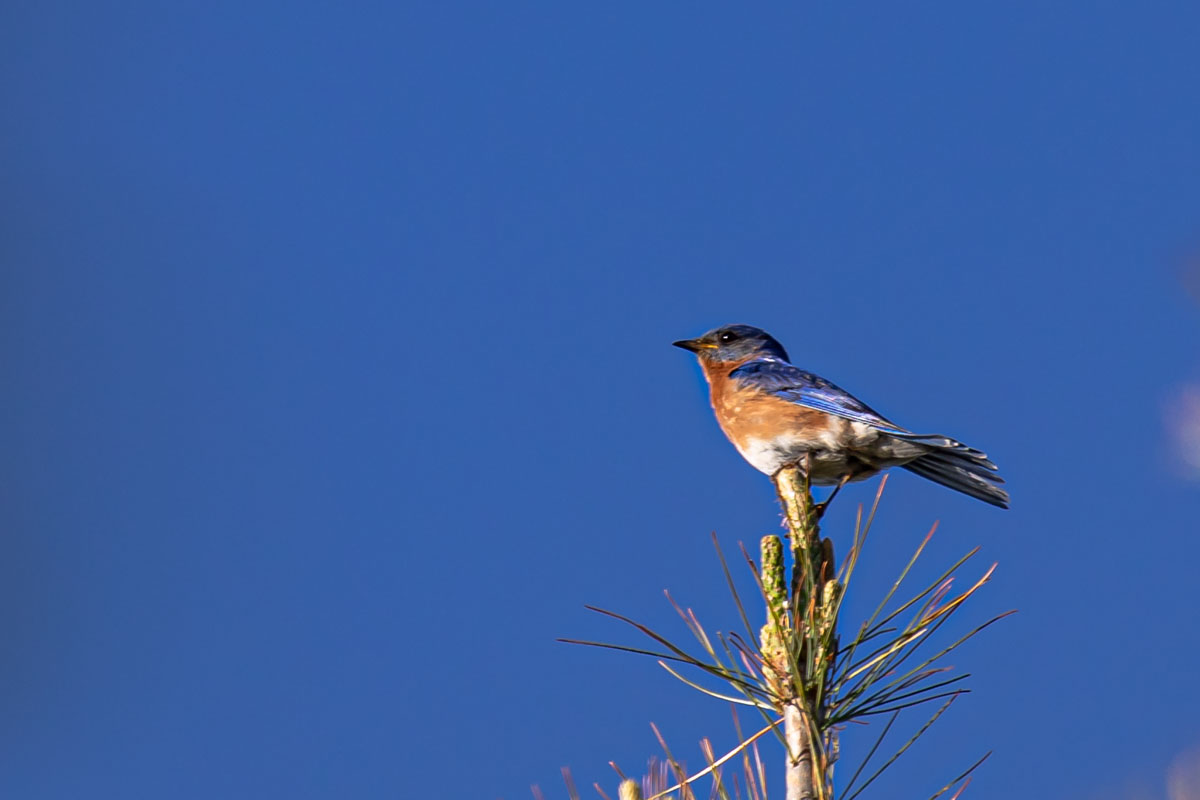
Pine-Top Lookout
Pine-Top Lookout
A high perch against a clear morning sky.
A male Eastern Bluebird pauses at the top of a pine, using the exposed tip as a watch post above the surrounding habitat. The clean blue background emphasizes the bird’s rusty breast and blue upperparts while the pine needles frame the perch.
Camera: Canon EOS 5D Mark IV
Lens: EF100-400mm f/4.5-5.6L IS II USM
Settings: ISO 200 • Aperture f/6.3 • Shutter 1/800 s
E22A2765 • Size: 2974x1983
Spring Leaves
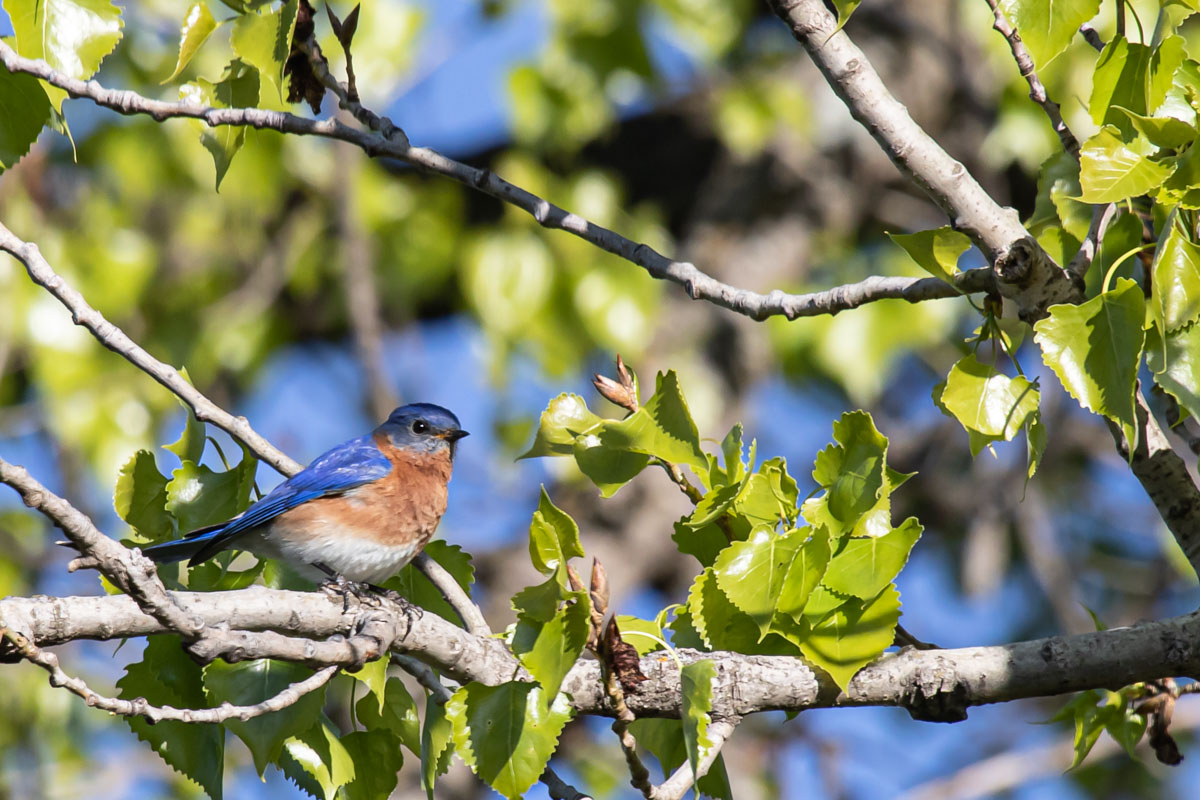
The earlier leafy-branch portraits show the species in a different spring setting. Instead of an active nest box, the scene is defined by new foliage, crossed branches, and patches of bright light.
Male Eastern Bluebird in Spring Leaves
Bright blue against new foliage.
Camera: Canon EOS 5D Mark IV
Lens: EF100-400mm f/4.5-5.6L IS II USM
Settings: ISO 400 • Aperture f/9.0 • Shutter 1/640 s
E22A2126 • Size: 2362x1575
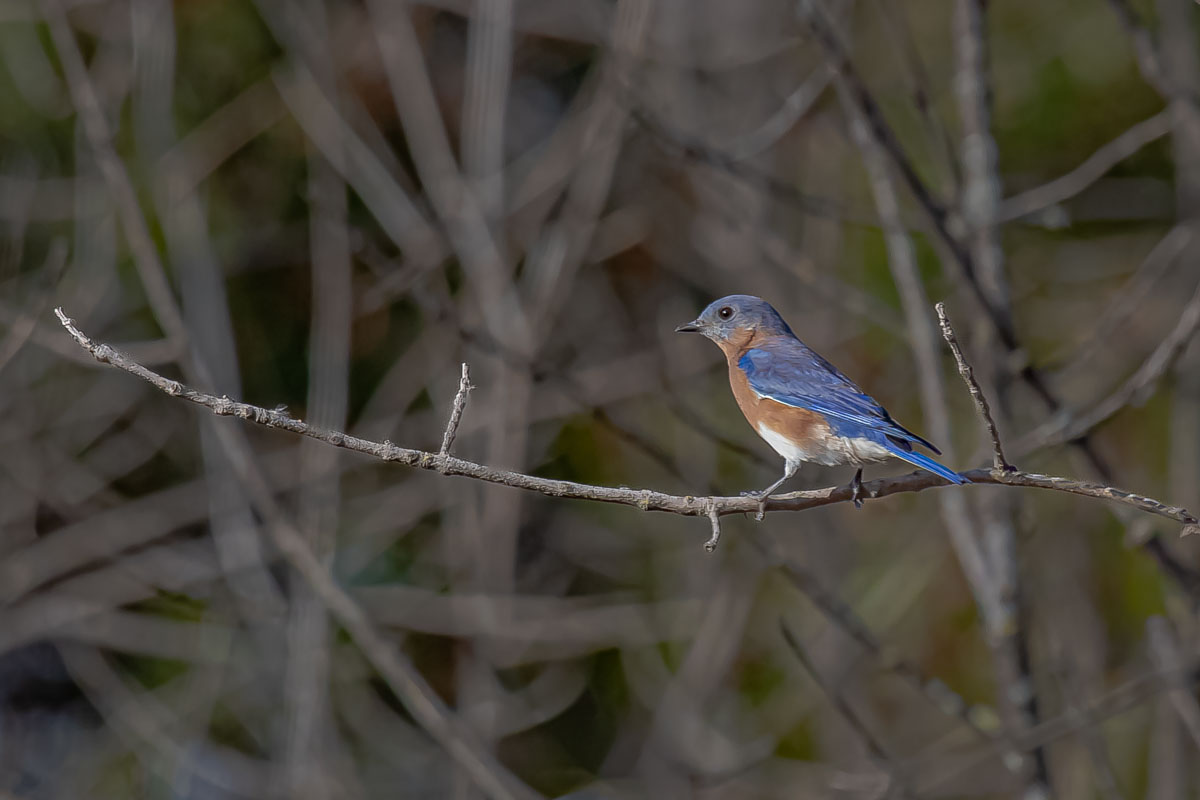
A male Eastern Bluebird pauses on an open branch beneath fresh spring leaves. His blue upperparts and rusty breast catch the sun clearly, making the bird stand out even in a busy pattern of twigs and foliage.
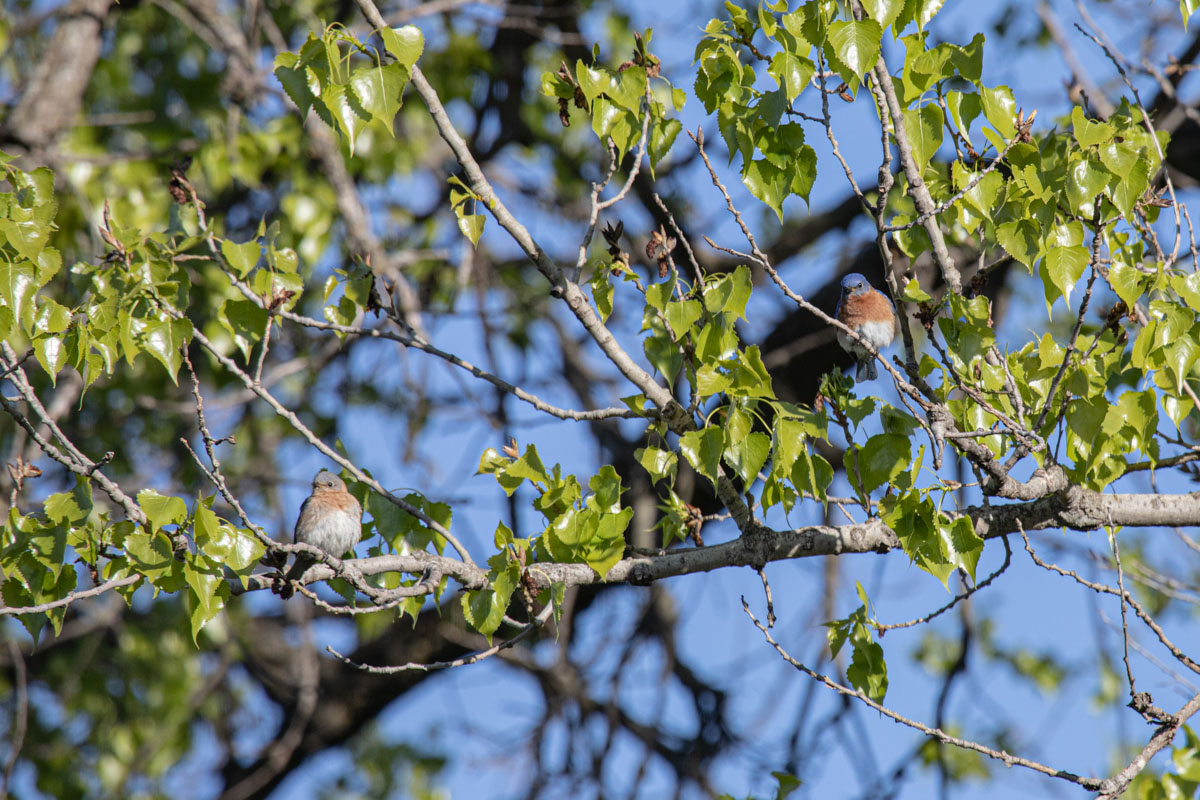
Eastern Bluebird Pair in Spring Tree
A quiet pair among opening leaves.
Camera: Canon EOS 5D Mark IV
Lens: EF100-400mm f/4.5-5.6L IS II USM
Settings: ISO 400 • Aperture f/9.0 • Shutter 1/640 s
E22A2096 • Size: 4093x3129
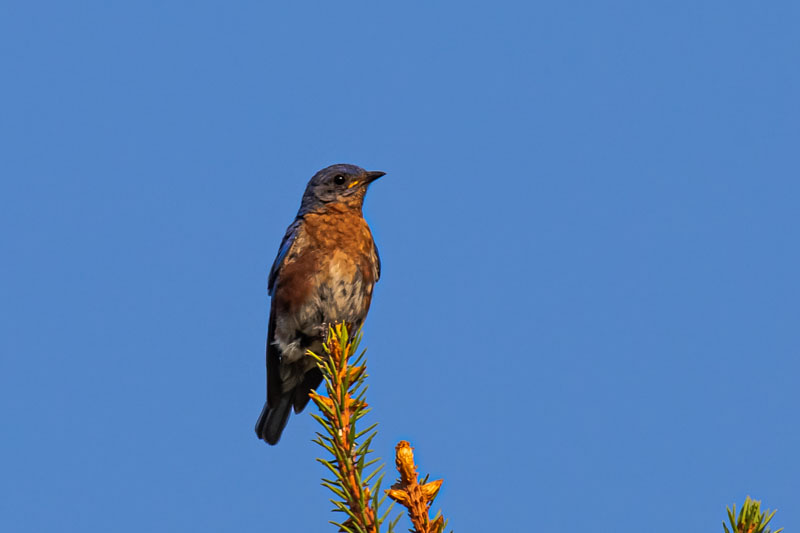
Seen together, the difference between the birds is clear. The male shows stronger blue and richer orange, while the female is more subdued, with gray-brown tones across the head and back and softer color through the breast.
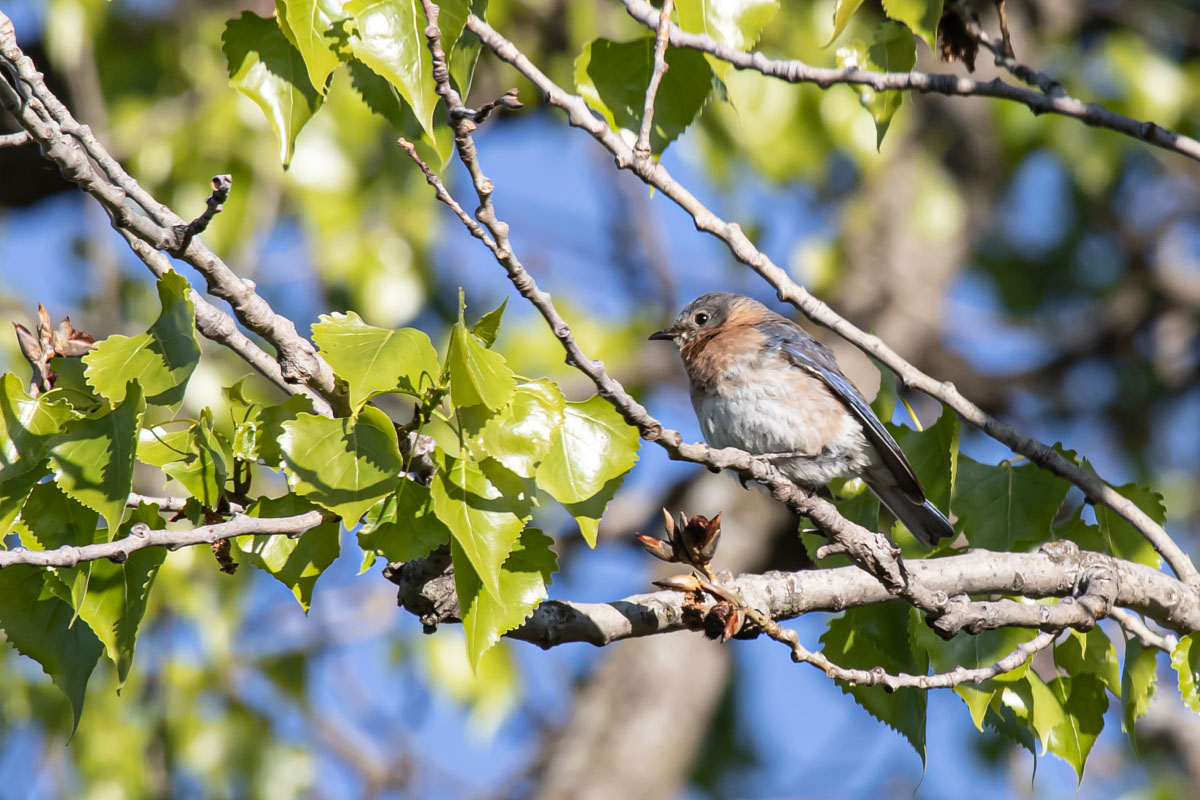
Female Eastern Bluebird on Branch
Softer color in the same spring light.
Camera: Canon EOS 5D Mark IV
Lens: EF100-400mm f/4.5-5.6L IS II USM
Settings: ISO 400 • Aperture f/9.0 • Shutter 1/640 s
E22A2102 • Size: 2362x1575
Her posture matches the quiet alertness of the male, but the overall impression is more understated. In the bright foliage, the blue in the wings and tail becomes the strongest field mark, especially when viewed from the side.
Photographer’s Perspective
The nest-box sequence adds behavior to the earlier portraits. The leafy images show color, sex differences, and spring setting; the box images show purpose. The male’s bright presence, the female’s repeated trips with nesting material, and the single flight frame all point to a pair actively tied to one small site.
The mullein perch is especially useful as an opening image because it gives the male a clean, readable position above the nesting area. From there, the page can move naturally into closer nest-box behavior, then return to the spring portraits as a quieter study of plumage and habitat.
Eastern Bluebirds are closely associated with nest-box conservation efforts in Minnesota. Local programs such as the Bluebird Program of Minnesota have helped promote nest boxes, monitoring, and habitat awareness for bluebirds and other native cavity nesters.