Indigo Bunting
Passerina cyanea
Indigo Buntings are small songbirds of brushy field edges, woodland openings, and regenerating growth. In breeding plumage, the adult male may appear deep cobalt, indigo, or vivid turquoise as the angle and intensity of the light change. The compact body, short conical bill, dark face, and nearly unbroken blue plumage distinguish the male from other birds moving through the meadow edge.
For identification details and comparison with similar species, see the Passerina cyanea page in the Field Notes section.
Rain the previous day had left the meadow grass thoroughly soaked. I followed the male through the low vegetation, but each approach caused him to increase the distance before settling again among thorny stems near the edge of the trees.
The bird finally paused long enough for a short sequence. Sunlight crossing the uneven plumage produced a wide range of blue, from the dark crown and face to bright turquoise across the shoulder, back, and flanks. The thorny perch and softly blurred grasses place the bird within the transition between open meadow and wooded edge where it had been moving.
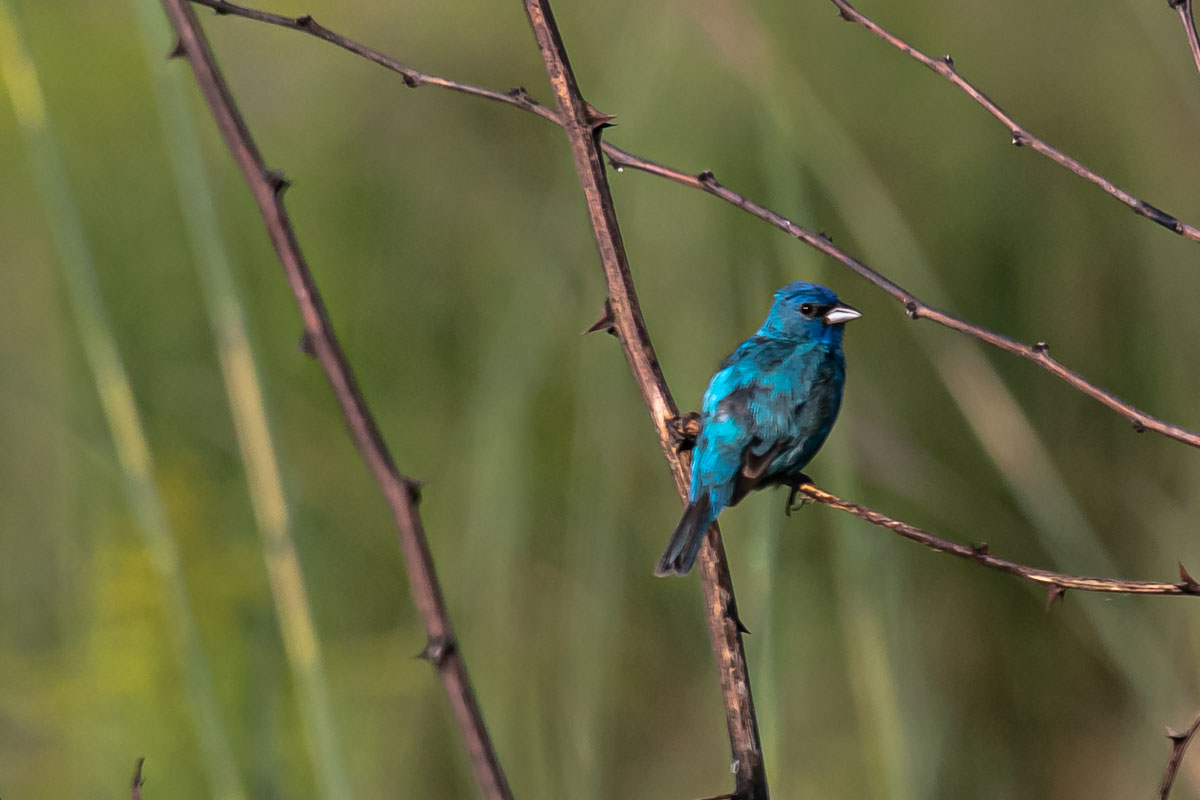
Indigo at the Meadow Edge
Cobalt and turquoise emerge as the morning light crosses the plumage.
Camera: Canon EOS 5D Mark IV
Lens: EF100-400mm f/4.5-5.6L IS USM
Settings: ISO 800 • Aperture f/8.0 • Shutter 1/2000 s
E22A7743 • Size: 1600 x 1067
Overview
E22A7743 provides the strongest conventional portrait in the sequence. The head is held in a clean profile, the bill is separated from the background, and the sun reveals both the darker indigo of the face and the brighter blue-green tones across the body. The open space in front of the bird also gives the frame a quiet sense of direction.
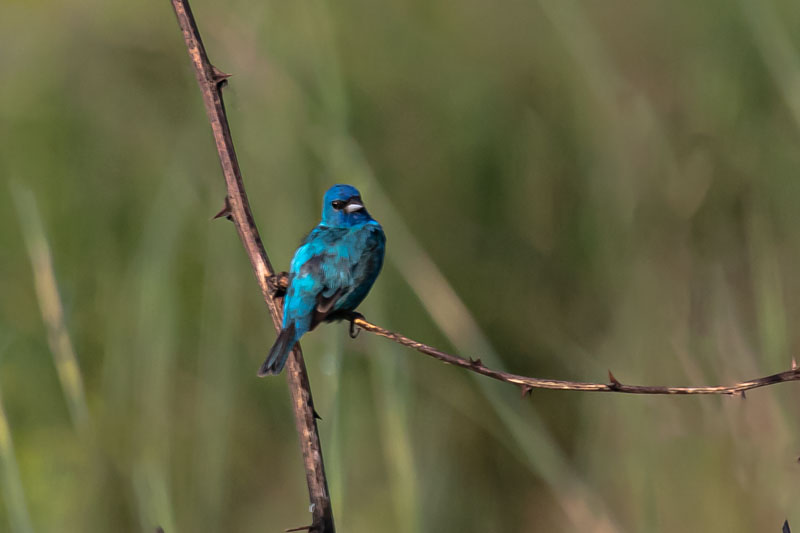
A Glance Through the Thorns
A brief turn brings the dark face and pale bill directly into view.
Camera: Canon EOS 5D Mark IV
Lens: EF100-400mm f/4.5-5.6L IS USM
Settings: ISO 800 • Aperture f/8.0 • Shutter 1/2000 s
E22A7744 • Size: 1600 x 1067
The near-frontal glance adds expression to the sequence. Although the dark eye falls within an equally dark facial area, the light catches the upper bill and the blue feathers along the crown and chest. This frame also shows how readily the apparent color changes across adjacent feathers.
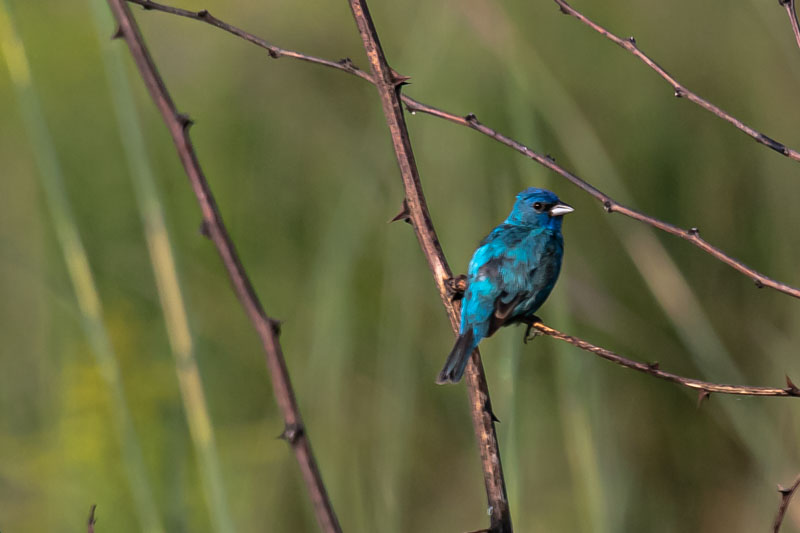
Along the Thorny Edge
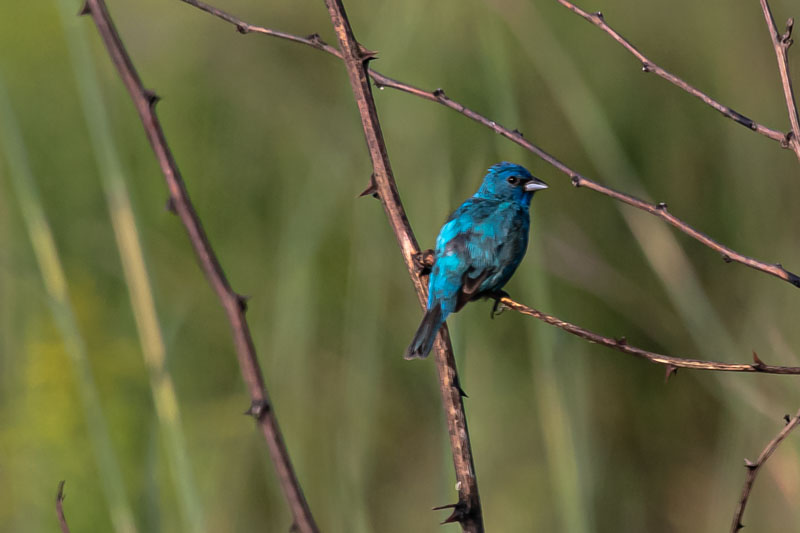
The two side views broaden the setting. E22A7741 is the cleaner identification frame, with the bird isolated against soft vertical grasses. E22A7742 retains more of the crossing branches and gives a stronger impression of the dense, thorny margin through which the male was traveling.
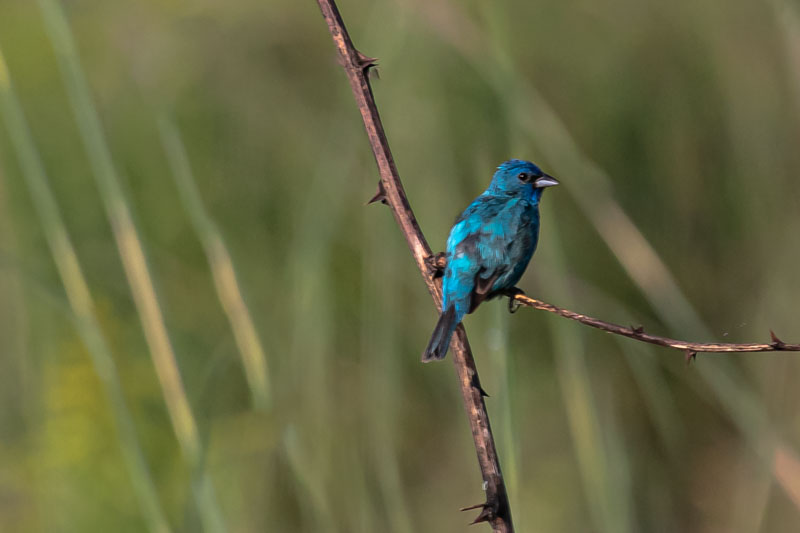
Blue Against the Meadow
A simple profile separates the bird from the vertical sweep of the grass.
Camera: Canon EOS 5D Mark IV
Lens: EF100-400mm f/4.5-5.6L IS USM
Settings: ISO 800 • Aperture f/8.0 • Shutter 1/2000 s
E22A7741 • Size: 1600 x 1067
Between the Briars
Crossing stems reveal the dense margin through which the bird was moving.
Camera: Canon EOS 5D Mark IV
Lens: EF100-400mm f/4.5-5.6L IS USM
Settings: ISO 800 • Aperture f/8.0 • Shutter 1/2000 s
E22A7742 • Size: 1600 x 1067
Watching the Underbrush
The final frame turns away from portraiture and toward behavior. The male lowers his head and looks into the grass beneath the perch, the same low cover to which he repeatedly returned after brief movements toward the trees.
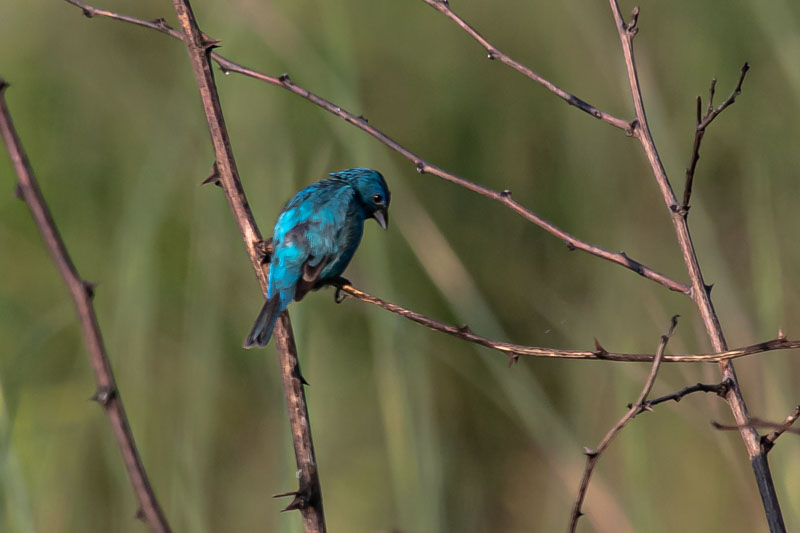
Watching the Grass Below
The portrait sequence closes with attention returning to the cover below.
Camera: Canon EOS 5D Mark IV
Lens: EF100-400mm f/4.5-5.6L IS USM
Settings: ISO 800 • Aperture f/8.0 • Shutter 1/2000 s
E22A7740 • Size: 1600 x 1067
Photographer’s Perspective
A second bird, apparently a female, remained higher in a nearby tree while the blue male stayed much lower in the brush. At intervals he flew toward the higher bird and then returned to the undergrowth. Indigo Buntings were also heard at another nearby location, suggesting that more than one portion of the meadow edge may be part of their regular movement through the area.
After watching the route from the grass meadow toward the trees, I now have a better sense of the branches and openings the male may use again. Waiting near one of those repeated stopping points should offer a better chance of reducing the working distance than continuing to follow him through the wet grass.
These photographs are cropped about as closely as the files will tolerate. They remain softer than intended, but the bird is substantially larger and more clearly recorded than in my earlier Indigo Bunting photographs. Autofocus also had difficulty separating the dark eye and blue plumage from the stronger edges of the surrounding stems, so several of the latest frames were made with manual focus.
E22A7743 is the strongest portrait, followed by the direct glance in E22A7744 and the cleaner habitat profile in E22A7741. E22A7742 expands the thorny setting, while E22A7740 completes the sequence with the male looking back toward the low cover where he spent most of the observation.