Great Egret
Ardea alba
The Great Egret is a large white heron of wetlands, ponds, lakeshores, and marsh edges. Its long S-curved neck, dagger-like bill, black legs, and tall upright posture give it a very different shape from smaller white egrets.
This collection shows the species in several wetland settings, from open marsh reeds to branches above green water. The closer views also show breeding-season color changes, including green facial skin, reddish eye tones, ornamental plumes, and a bill that can appear much darker than the usual yellow-orange.
For identification details and comparison with similar species, see Ardea alba in the Field Notes section.
A Great Egret stands among marsh reeds, its white plumage set against muted water, old stems, and soft reflections. The orange-yellow bill and black legs make this a clean, readable field view.
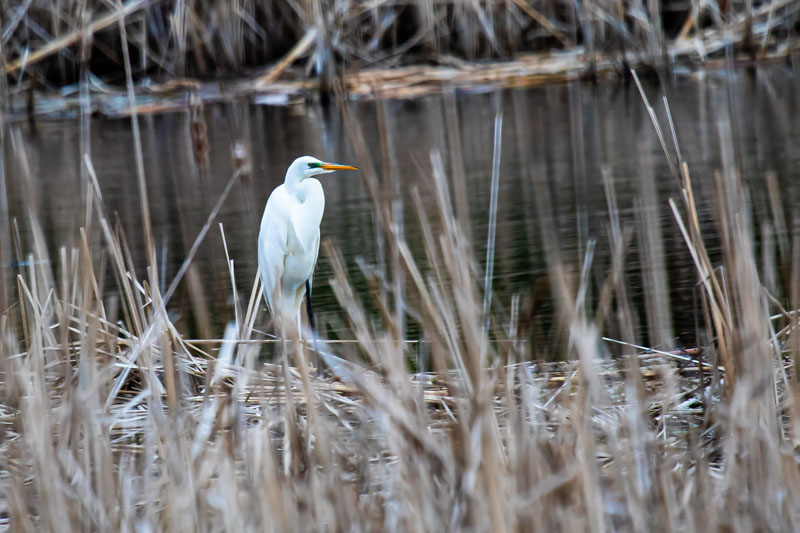
Marsh Sentinel
A tall white form among reeds and reflected water.
Camera: Canon EOS 5D Mark IV
Lens: EF100-400mm f/4.5-5.6L IS USM
Settings: ISO 1250 • Aperture f/5.6 • Shutter 1/640 s
E22A2272 • Size: 2493x1662
Overview
Great Egrets are often seen standing motionless at the water’s edge, walking slowly through shallow marshes, or using exposed branches as hunting perches. Even when partly hidden by vegetation, their size and structure usually stand out: long neck, long bill, broad white body, and long black legs.
These photos emphasize both habitat and seasonal condition. Some frames show the familiar yellow-orange bill, while the closer breeding-condition view shows a much darker bill, bright green lores, a reddish eye, and long ornamental plumes.
Perched Above the Water
In this frame, the bird balances on a weathered branch extending over green water. The long black legs, white body, and folded S-curve of the neck show the classic Great Egret shape.
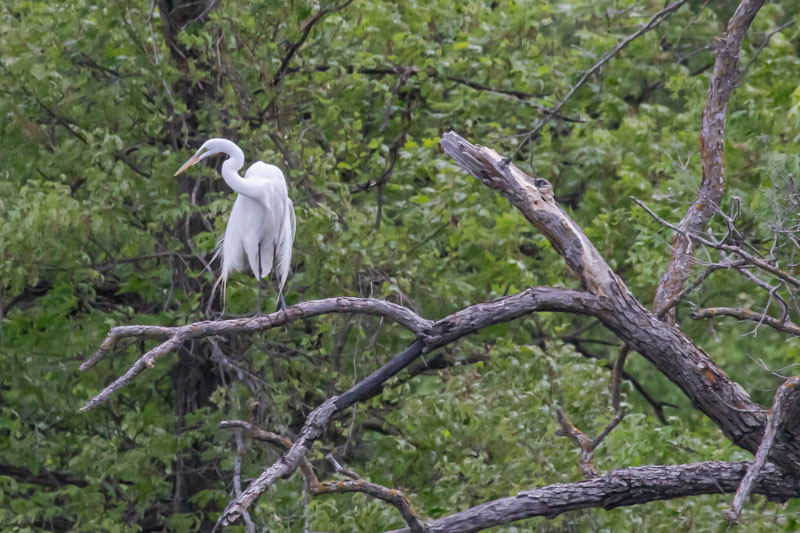
Nearby Mate
A second bird perched close by inside the wetland edge.
Camera: Canon EOS 5D Mark IV
Lens: EF100-400mm f/4.5-5.6L IS USM
Settings: ISO 1600 • Aperture f/8.0 • Shutter 1/5000 s
E22A3062 • Size: 2853x1902
The bird appears alert but still, watching the water below from a raised perch. This posture gives the page a strong habitat image: not just a bird in water, but a wetland hunter using the deadwood structure around the pond.
Breeding Pair Behavior
The closest frame shows the strongest seasonal details. The facial skin is bright green, and long plumes trail from the body. The nearby birds also show variation in bill and eye color, consistent with breeding condition rather than simple lighting variation.
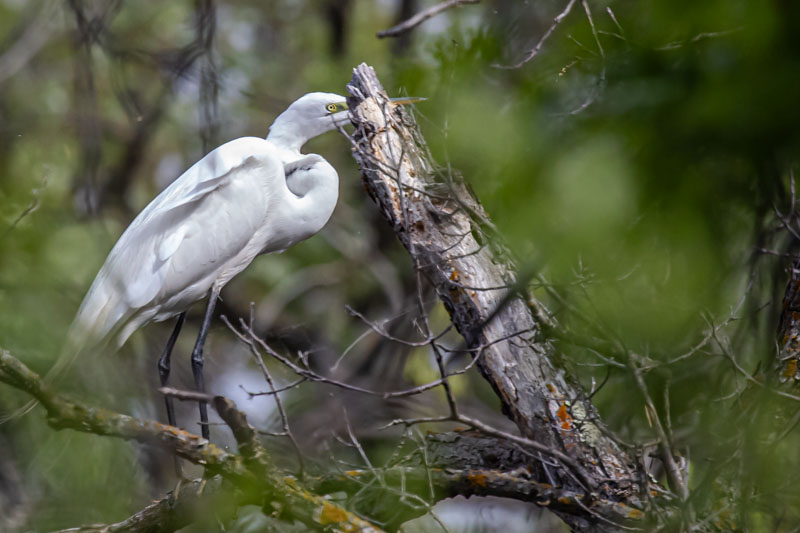
Breeding Colors — Probable Pair Member
Green lores and flowing plumes.
Camera: Canon EOS 5D Mark IV
Lens: EF100-400mm f/4.5-5.6L IS USM
Settings: ISO 1600 • Aperture f/8.0 • Shutter 1/2000 s
E22A3071 • Size: 2853x1902
This bird was close to the egret shown in E22A3083. When flushed, it flew nearer to that second bird rather than away from it, suggesting the two birds were associated and may have been a breeding pair.
Nearby Mate
A second egret perched nearby on deadwood inside the wetland edge. This bird retained a more orange-yellow bill, while the other showed darker breeding-season bill color. Because Great Egrets are similar in appearance between sexes, the photos do not confirm male and female by plumage alone, but the close spacing and movement after flushing support treating the two as a probable pair.
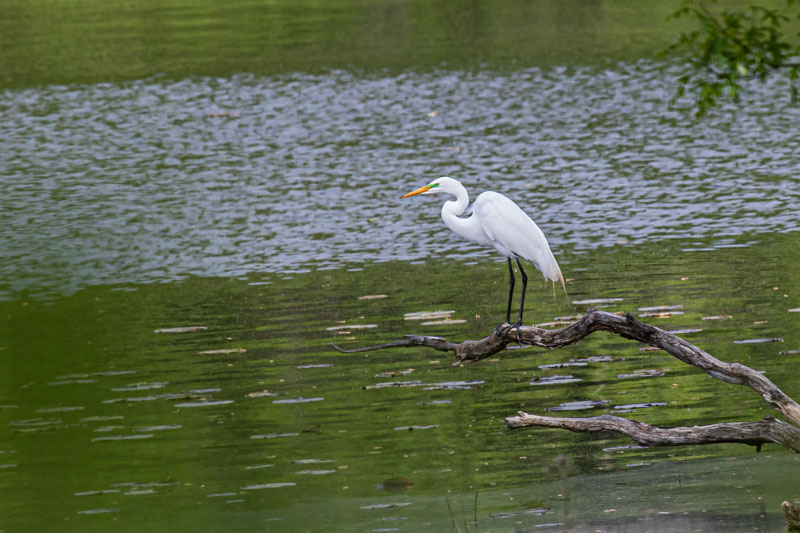
Over Green Water
Balanced above the pond on a weathered branch.
Camera: Canon EOS 5D Mark IV
Lens: EF100-400mm f/4.5-5.6L IS USM
Settings: ISO 640 • Aperture f/8.0 • Shutter 1/800 s
E22A3083 • Size: 2942x1961
Identification
The combination of size, long neck, long bill, white plumage, and black legs supports Great Egret. A Snowy Egret would be smaller and slimmer, usually with a black bill, yellow lores, and yellow feet. These birds have the larger, longer-bodied structure expected for Great Egret.
The variation in bill and eye color is especially useful here. The orange-yellow bill in some frames and the darkened bill with reddish eye tones in another frame show how the same species can look different in breeding condition. The green lores and long plumes in E22A3071 make that seasonal interpretation especially strong.
Photographer’s Perspective
E22A3071 is the strongest field-note image because it captures the temporary breeding colors and plumes at close range. E22A2272 works well as the opening habitat portrait, while E22A3062 and E22A3083 show how the bird uses exposed branches around wetland edges.
Together, the set gives the page both identification value and seasonal context: the familiar tall white egret of marshes and ponds, plus the more dramatic breeding details that change the face, bill, and overall impression of the bird.