Dame’s Rocket
Hesperis matronalis
Dame’s Rocket brings soft white and lavender flowers to shaded trails, moist woodland edges, roadsides, and streambanks in late spring and early summer. Introduced from Europe, this graceful wildflower has naturalized widely across Minnesota, where its clustered blooms often glow in the filtered light at the edge of woods and meadows.
For identification, look for four rounded petals, slightly toothed lance-shaped leaves arranged alternately along a hairy stem, and the slender seedpods typical of the mustard family. Dame’s Rocket is often mistaken for native phlox, but phlox flowers have five petals instead of four.
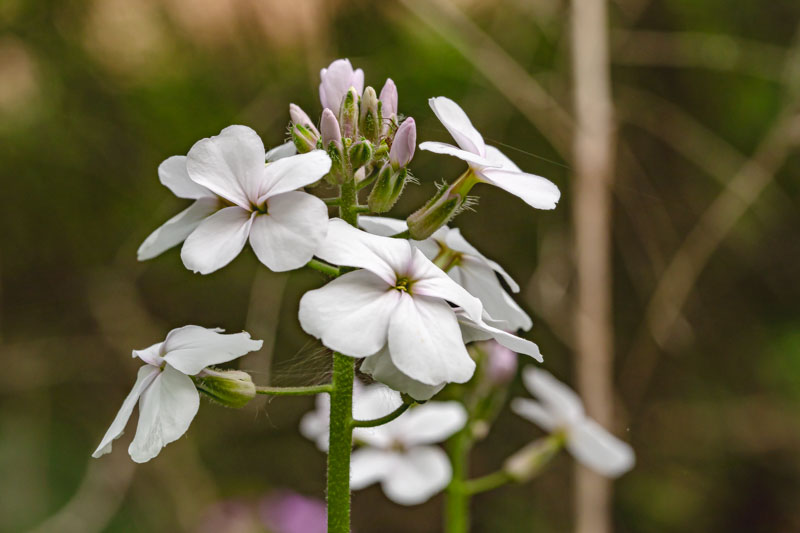
Dame’s Rocket — Woodland Edge Bloom
Pale petals open toward filtered light along a shaded trail.
Four-petaled blossoms of white and lavender rise on slender stems, marking the return of early summer.
E21A1563
Family: Mustard (Brassicaceae)
Bloom time: May–July
Height: 1–3 ft (30–90 cm)
Petals: Four, rounded, white to lavender
Habitat: Moist woodland edges, roadsides, and streambanks; naturalized from Europe
Native range: Eurasia (introduced to North America)
This biennial or short-lived perennial readily naturalizes in disturbed areas, sometimes forming dense colonies. Though introduced, it can provide early nectar for bees, butterflies, and moths, and the flower clusters may also create small hunting grounds for spiders waiting among the blossoms.
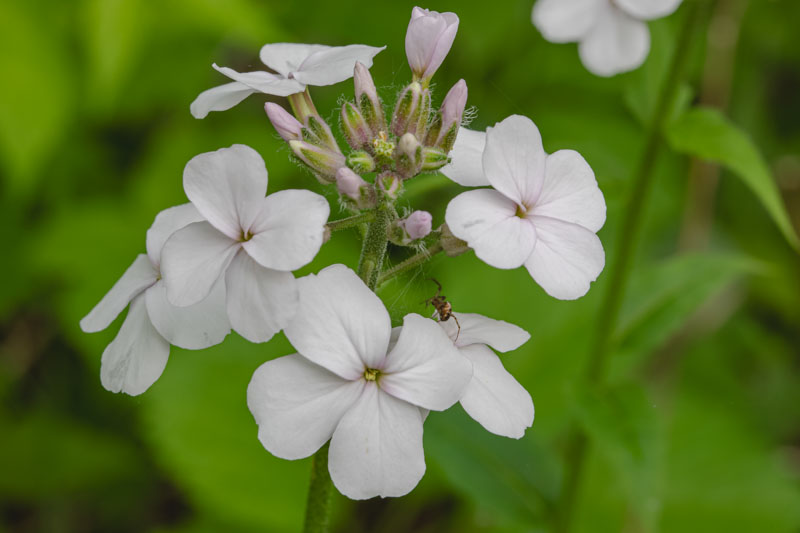
Dame’s Rocket and a Young Garden Spider
Clusters of pale blossoms attract pollinators—and small hunters alike.
Four-petaled flowers in white and lavender rise above early-summer foliage, drawing bees and butterflies.
Hidden among the blooms, a juvenile Black-and-Yellow Garden Spider
waits for its chance among the nectar seekers.
E21A1566
In these photographs, the plant stands where sun meets shade and the soil stays moist. The blooms are especially luminous toward evening, when Dame’s Rocket can release the faint fragrance that helped give the plant its name.
© Ray Fraley — field observations and photography, Minnesota woodland edge.