Black and Yellow Garden Spider
Argiope aurantia
The Black and Yellow Garden Spider is a large, showy orb-weaver of meadows, gardens, prairie edges, and tall herbaceous growth. This gallery emphasizes the spider’s web architecture, hunting behavior, web repair, and the contrast between the large, boldly marked female and the smaller, more secretive male.
For identification details and comparison with similar species, see Argiope aurantia in the Field Notes section.
Morning Geometry
A perfect orb-weaver web glistens with the mist among tall grasses and goldenrod, each strand outlined by the soft morning light. The delicate structure captures the geometry of patience — every thread rebuilt and renewed with precision after a calm night in the prairie.
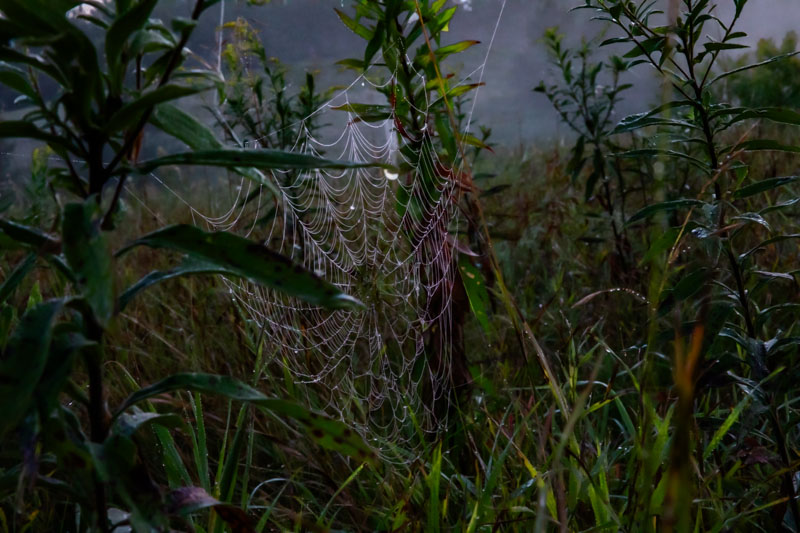
Orb-weaver web in morning dew
A dew-lit orb-weaver web suspended among prairie grasses and goldenrod.
Camera: Canon EOS 5D Mark IV
Lens: EF24-70mm f/2.8L II USM
Settings: ISO 25600 • Aperture f/22.0 • Shutter 1/30 s
E21A3965 • Size: 6720 x 4480
A spider’s web catches the first light, tension and balance woven through grass.
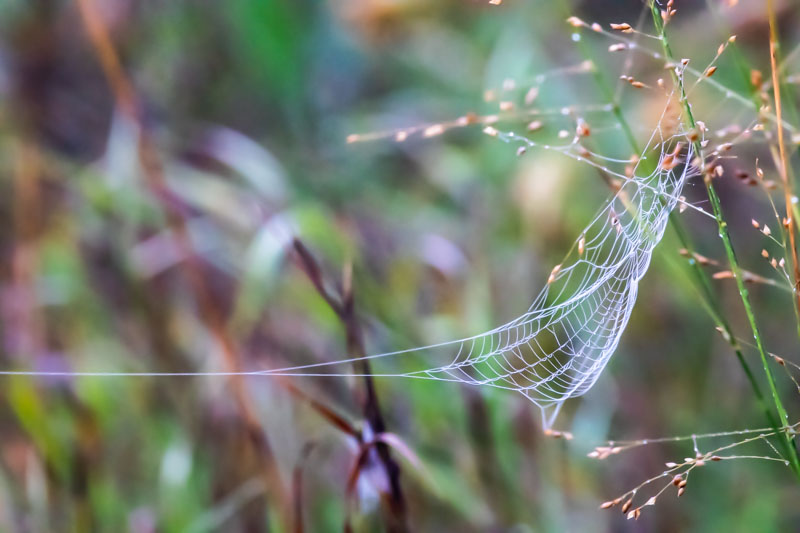
Orb weaver web catches the first light
Tension and balance woven through grass.
Camera: Canon EOS 5D Mark IV
Lens: EF100-400mm f/4.5-5.6L IS II USM
Settings: ISO 16000 • Aperture f/13.0 • Shutter 1/400 s
E21A4635 • Size: 6720 x 4480
Suspended between slender stems, the orb-weaver’s web glows against the warm light of early autumn.
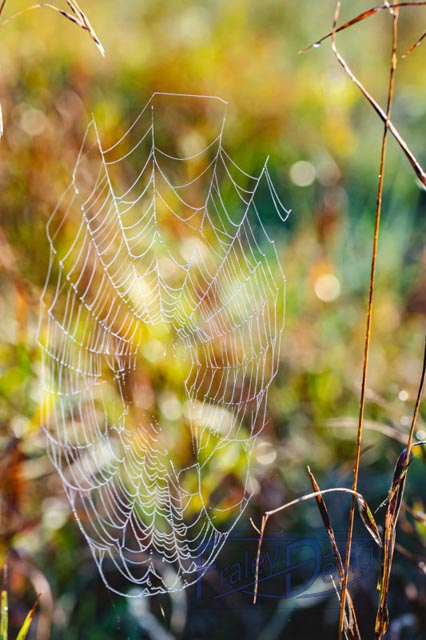
Autumn Silhouette
An orb-weaver web suspended between slender stems in warm autumn light.
Camera: Canon EOS 5D Mark IV
Lens: EF100mm f/2.8L Macro IS USM
Settings: ISO 1600 • Aperture f/8.0 • Shutter 1/1600 s
E21A4297B • Size: 2987 x 4480
The Hunter’s Reward
In the angled morning light, the garden spider wraps her catch with practiced precision. Each turn of silk immobilizes the struggling grasshopper, sealing the energy that will sustain her through another day. The scene, both intricate and brutal, is a quiet glimpse of nature’s efficiency at work.
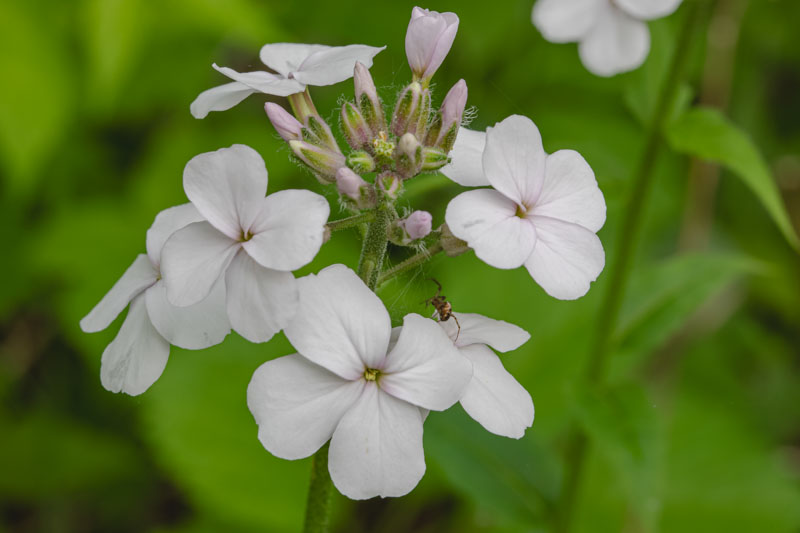
Dame’s Rocket and a Young Garden Spider
Clusters of pale blossoms attract pollinators — and small hunters alike.
Four-petaled flowers in white and lavender rise above early-summer foliage, drawing bees and butterflies. Hidden among the blooms, a juvenile waits for its chance among the nectar seekers.
E21A1566 • Size: 5737 x 3825
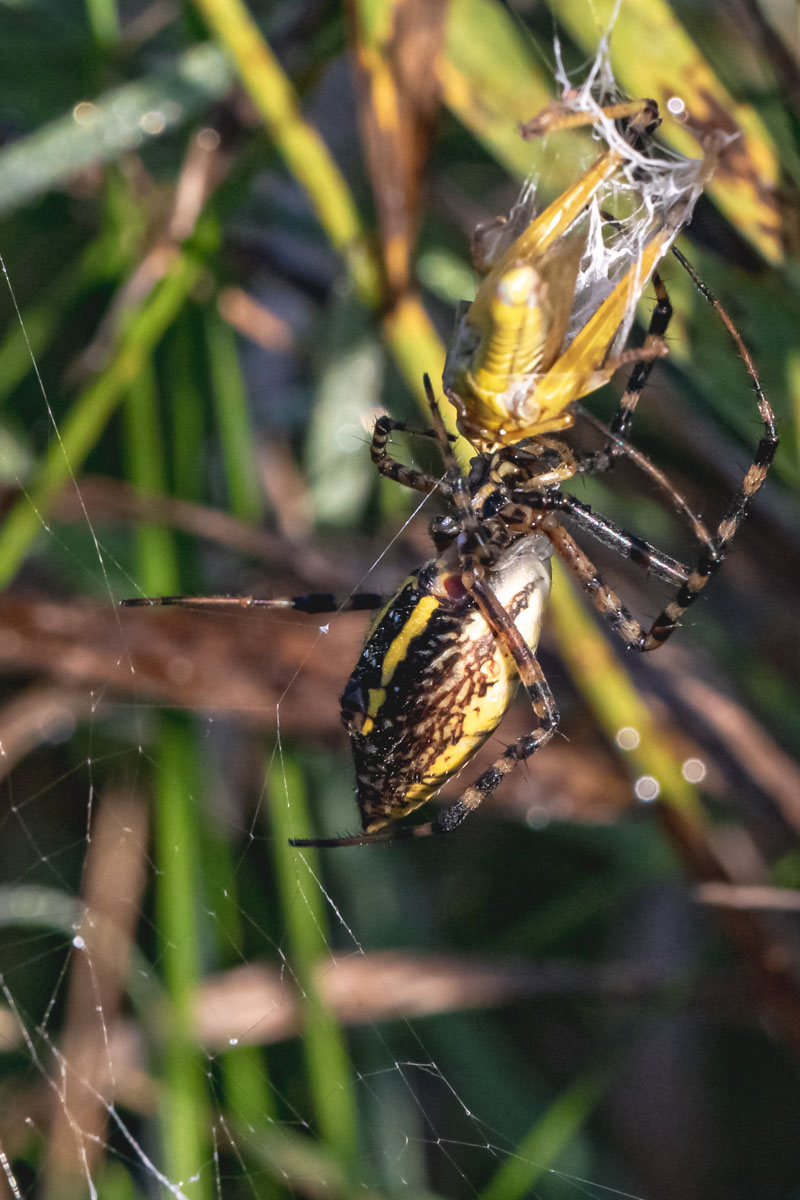
Female Argiope aurantia subduing a grasshopper
A grasshopper is wrapped in silk at the center of the web.
Camera: Canon EOS 5D Mark IV
Lens: EF100mm f/2.8L Macro IS USM
Settings: ISO 800 • Aperture f/13.0 • Shutter 1/500 s
E21A4310B • Size: 2345 x 3518
Thread by Thread
Suspended among prairie grasses, the garden spider reinforces its silk architecture, laying fresh threads across the heart of the web. The zig-zag stabilimentum glows at the center — both signal and structure — as the patient builder prepares for another day of hunting.
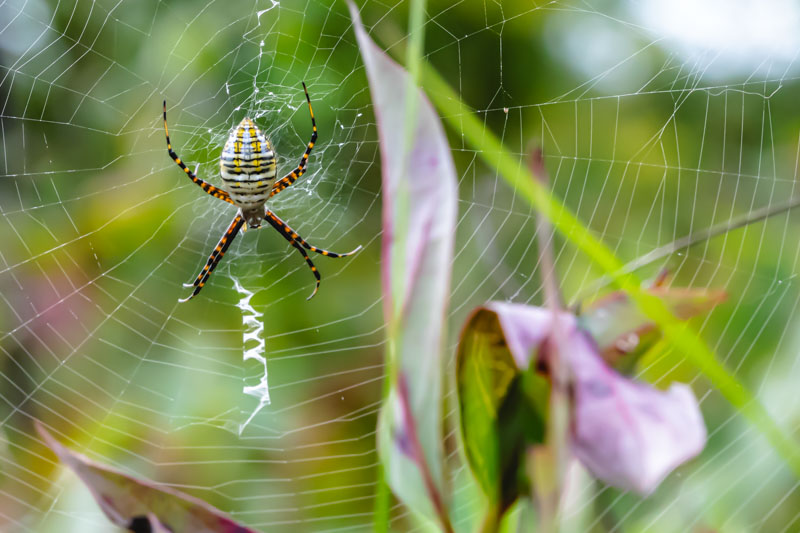
Female Argiope aurantia repairing web
Fresh silk is laid across the heart of the orb web.
Camera: Canon EOS 5D Mark IV
Lens: EF100mm f/2.8L Macro IS USM
Settings: ISO 8000 • Aperture f/13.0 • Shutter 1/640 s
E21A4882 • Size: 4814 x 3209
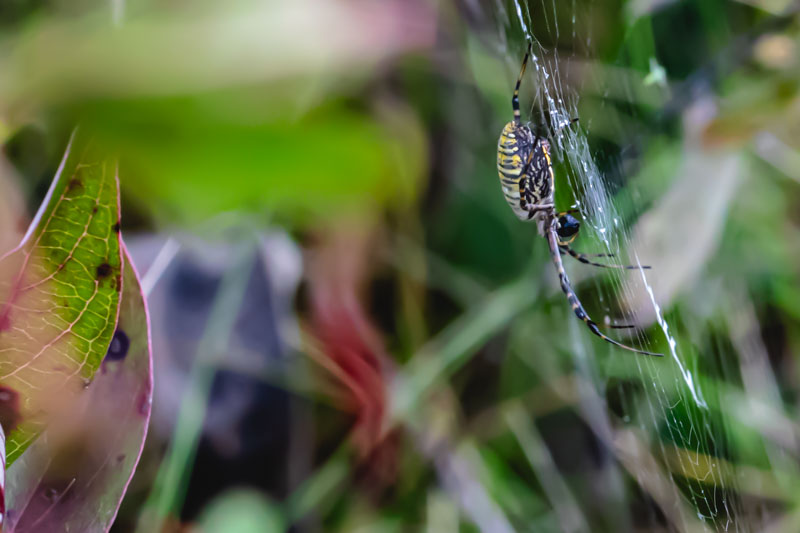
Female Argiope aurantia repairing web
A close view of web maintenance and silk placement.
Camera: Canon EOS 5D Mark IV
Lens: EF100mm f/2.8L Macro IS USM
Settings: ISO 1000 • Aperture f/13.0 • Shutter 1/640 s
E21A4898 • Size: 3424 x 2283
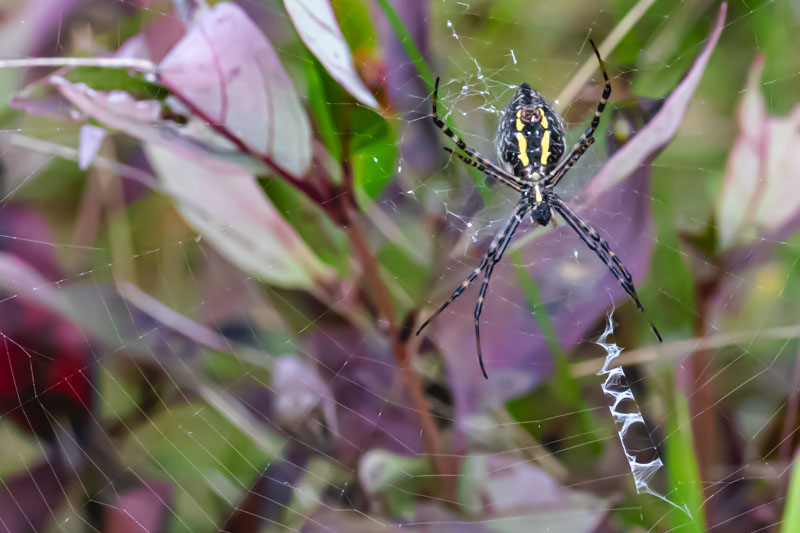
Female Argiope aurantia repairing web
Web repair behavior documented at the center of the orb.
E21A4902 • Size: 3329 x 2153
Field Reference — Web Repair Behavior
| Key | Details |
|---|---|
| Species | Argiope aurantia — Black-and-Yellow Garden Spider |
| Typical Repair Time | Begins near dawn after dewfall or light damage; occasionally midday following prey disturbance. Full rebuilds often occur overnight in late summer. |
| Repair Behavior | Detects slack or breaks via web tension; removes damaged strands; replaces them while maintaining hub geometry. The stabilimentum is typically rewoven last. |
| Posture During Repair | Body angled outward; forelegs test web tension; spinnerets visibly active. May recycle old silk before spinning anew. |
| Environmental Triggers | Light breezes, heavy dew, or prey impacts. Repairs most frequent after calm, humid nights. |
| Key Clues | Clean, bright new spiral sections among dull older silk; partial or freshly spun stabilimentum. |
| Seasonality (MN) | July–September; peak web repair activity after stormy or dewy mornings. |
| Similar Behavior | Neoscona (Barn Spiders): rebuild entire web nightly, consume old silk. Araneus trifolium (Shamrock Orb-Weaver): night repairs, oval webs, no stabilimentum. |
| Photo Notes | Backlight highlights tension lines; capture spider mid-spin or near hub for best behavioral context. |
Hidden Engineer
The smaller male lurks beneath a curled milkweed leaf at the edge of the meadow, near the larger female’s web. He keeps hidden from birds and cautious of the female’s territory, emerging briefly to inspect her silk for pheromone cues or attempt a careful approach. His slender legs and reduced patterning distinguish him from his vivid counterpart.
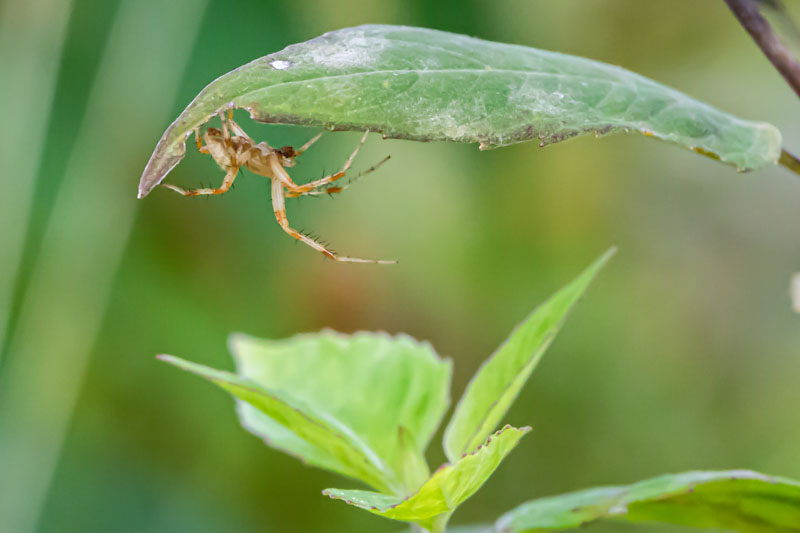
Male Argiope aurantia beneath leaf
A smaller male shelters near the female’s web.
Camera: Canon EOS 5D Mark IV
Lens: EF100mm f/2.8L Macro IS USM
Settings: ISO 16000 • Aperture f/13.0 • Shutter 1/640 s
E21A4911 • Size: 3166 x 2111
Field Reference — Male Argiope aurantia
| Key | Details |
|---|---|
| Size | ~5–9 mm body length — a fraction of the female’s size. |
| Color & Markings | Pale yellow-brown with faint black bands; less vibrant than females. |
| Behavior | Usually found near a female’s web, often under adjacent leaves or grass blades. Uses fine draglines to explore her web perimeter. |
| Habitat Use | Prefers tall meadow or garden plants that provide cover and access to female webs. |
| Seasonality (MN) | Mid to late summer; males become visible as females reach maturity (July–September). |
| Key Clues | Slender body, long legs, reduced coloration; position near but not in web. |
| Photo Notes | Show context — leaf shelter, angle relative to web, and scale difference if both sexes are visible. |