American Goldfinch — Photographer’s Perspective
American Goldfinch — Perspective
Spinus tristis
The American Goldfinch photographs collected here span several encounters and show the species in very different settings: exposed perches, dense summer foliage, feeding among seed clusters, and a late-summer patch of flowering thistles.
Taken separately, many of the photographs are simple moments. Together, they show how much the character of a bird photograph can change when the surrounding habitat becomes part of the story.
For identification, habitat, and natural-history details, see the Spinus tristis species page.
A Clean Introduction
E22A2984 remains one of the simplest photographs in the series. A male American Goldfinch pauses on an open branch, facing forward with the black cap, pale bill, and vivid yellow plumage clearly visible.
The uncluttered perch and soft background make the bird immediately readable. It is less about behavior than presence: a straightforward introduction to the breeding male.
These early portraits established the visual identity of the species, but they did not yet explain very much about how the bird was using its surroundings.
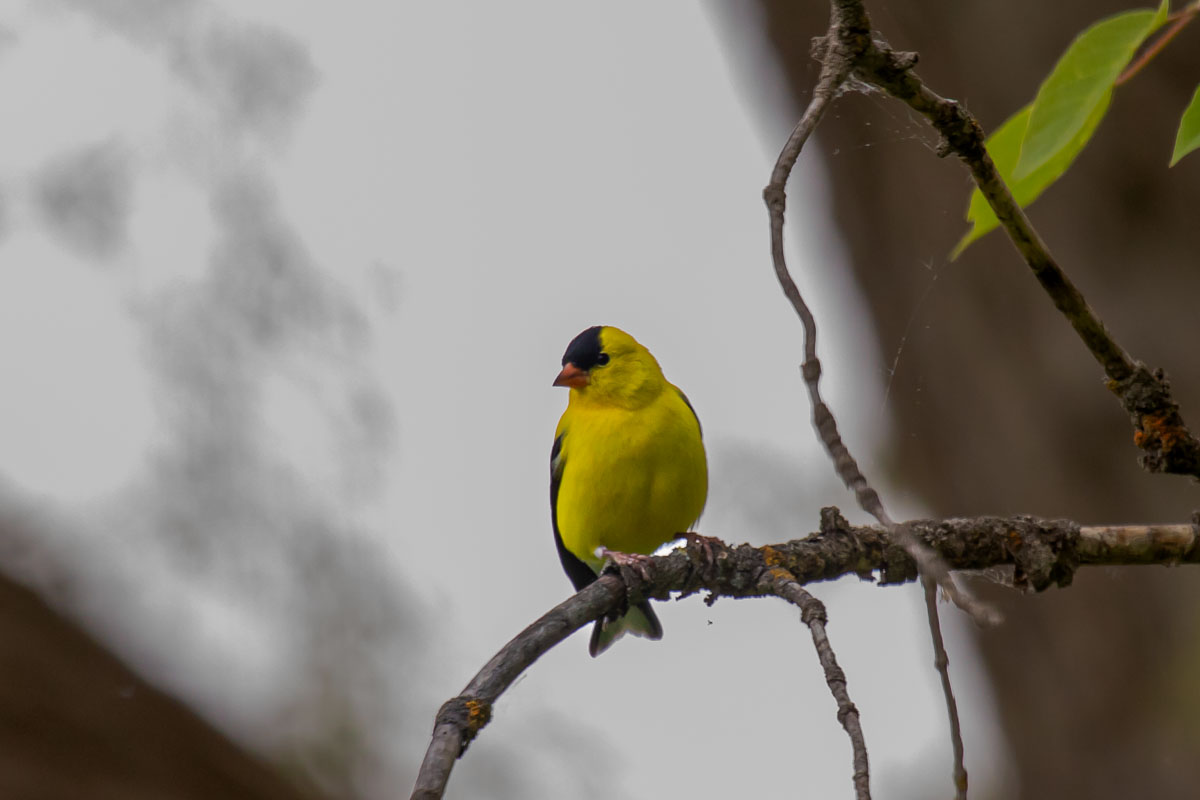
Frontal Portrait
A direct look from a quiet perch.
Camera: Canon EOS 5D Mark IV
Lens: EF100-400mm f/4.5-5.6L IS USM
Settings: ISO 1250 • Aperture f/5.6 • Shutter 1/640 s
E22A2984 • Size: 2493 x 1662
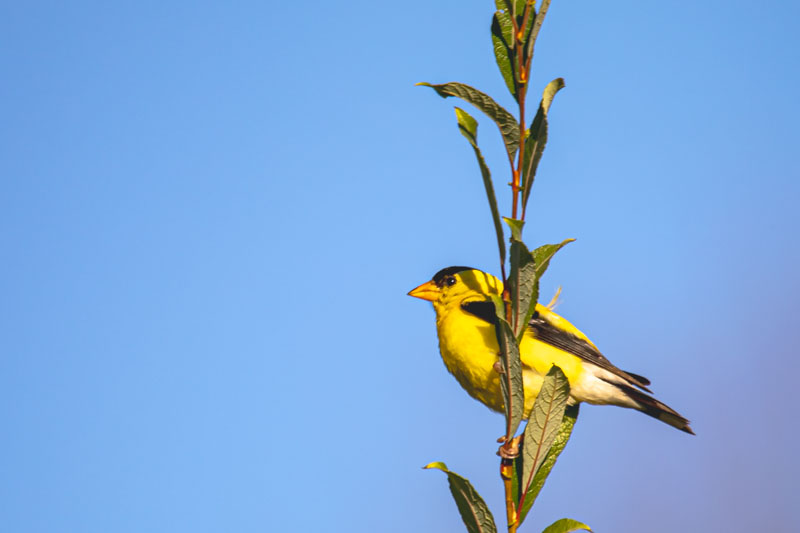
Side Profile
A quiet pause, framed by shifting light.
Camera: Canon EOS 5D Mark IV
Lens: EF100-400mm f/4.5-5.6L IS USM
Settings: ISO 100 • Aperture f/8.0 • Shutter 1/320 s
E21A3395 • Size: 3517 x 2345
At the Dinner Table
E22A2986, E22A2989, and E22A2991 began to change that.
E22A2986 approaches the bird from another direction. The surrounding branches are busier, but the side view exposes more of the folded wing. The dark flight feathers, pale markings, and bright body color make the photograph useful for studying structure as well as plumage.
Instead of simply perching in the tree, the goldfinch is working through leaves and seed clusters. The bird is partly hidden, selecting food from within the surrounding vegetation.
E22A2989 gives the stronger behavioral context. The bright yellow bird remains easy to find, but the leaves, branches, and seed clusters make the frame feel active and lived-in.
E22A2991 moves closer to the feeding moment. The seed is visible at the bill while surrounding leaves partially conceal the bird. Rather than weakening the photograph, that concealment helps describe the way the goldfinch moves through seed-bearing plants—appearing briefly and then disappearing again into the foliage.
These photographs were an important step beyond portraiture. The habitat was beginning to explain the bird.
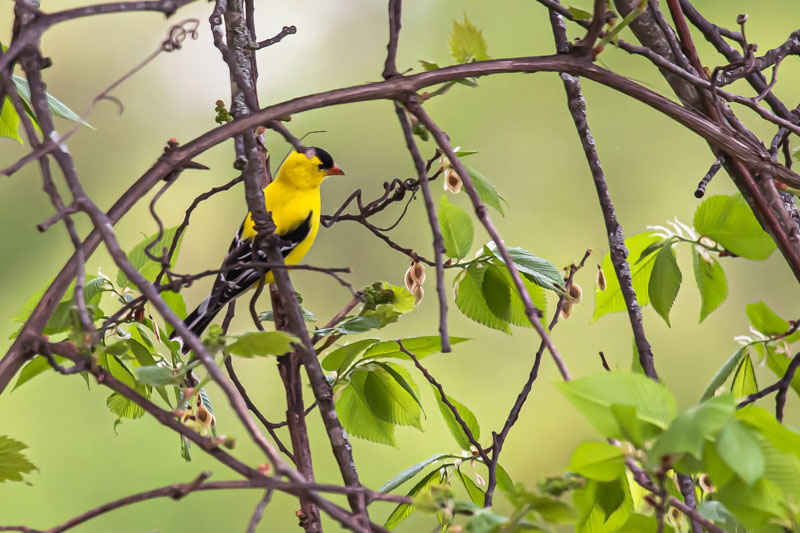
Wing Detail
Black-and-white patterning set against bright yellow plumage.
Camera: Canon EOS 5D Mark IV
Lens: EF100-400mm f/4.5-5.6L IS USM
Settings: ISO 1250 • Aperture f/8.0 • Shutter 1/640 s
E22A2986 • Size: 2358 x 1572
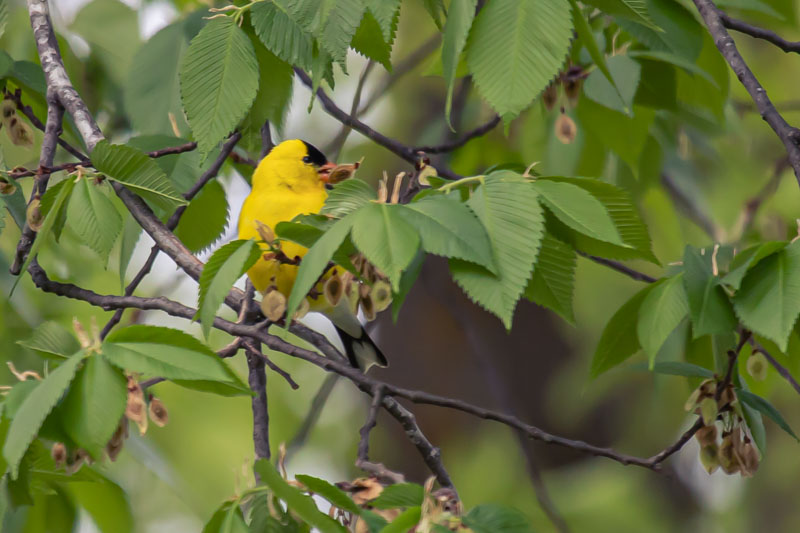
At the Dinner Table
Selecting seeds among fresh leaves.
Camera: Canon EOS 5D Mark IV
Lens: EF100-400mm f/4.5-5.6L IS USM
Settings: ISO 640 • Aperture f/5.6 • Shutter 1/640 s
E22A2989 • Size: 1900 x 1267
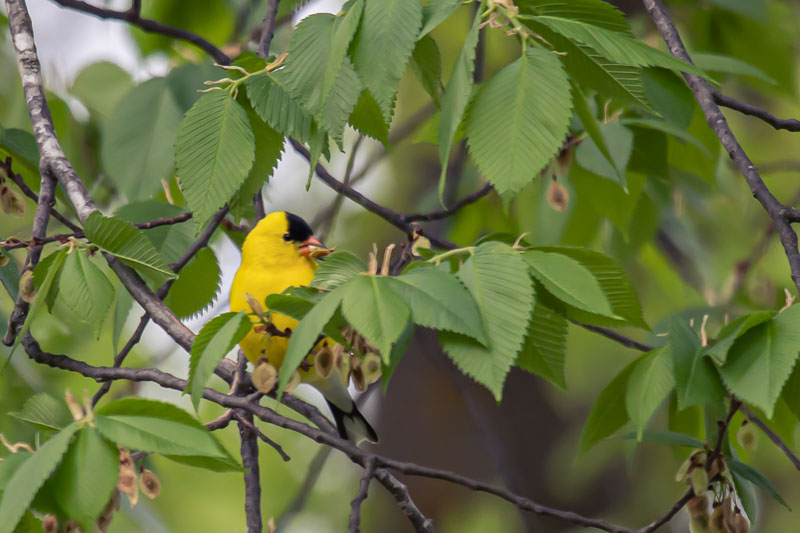
Seed in Beak
A feeding moment partly hidden by foliage.
Camera: Canon EOS 5D Mark IV
Lens: EF100-400mm f/4.5-5.6L IS USM
Settings: ISO 640 • Aperture f/5.6 • Shutter 1/640 s
E22A2991 • Size: 1900 x 1267
Among the Thistles
The late-summer thistle patch brought the different parts of the story together.
Thistles provide both food and structure for American Goldfinches. Flowering heads, drying seed heads, stems, and drifting plant down surround the birds as they move through the patch.
E22A8377 gives a close view of a breeding male while keeping the thistles prominent. A small catchlight brings the eye to life, while the downward posture connects the portrait directly to feeding behavior.
E22A8444 brings the bird even closer to the feeding plant. Perched directly on the thistle, the male shows the black wing, pale wing bars, bright yellow plumage, orange bill, and textured cheek. Loose thistle down surrounds the perch, placing the portrait firmly within the feeding habitat.
The difference from the earlier branch portraits is significant. The perch is no longer incidental. The plant itself has become part of the subject.
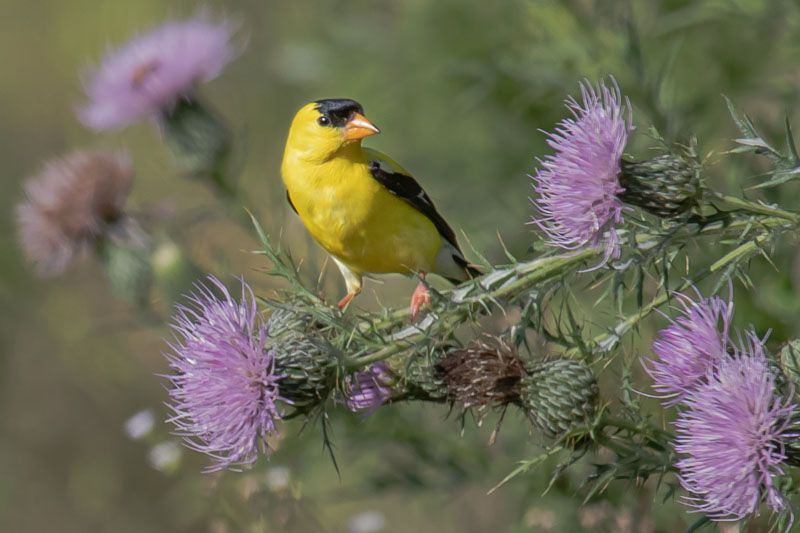
Among Purple Thistles
A quieter portrait framed by late-summer blooms.
Camera: Canon EOS 5D Mark IV
Lens: EF100-400mm f/4.5-5.6L IS USM
Settings: ISO 800 • Aperture f/8.0 • Shutter 1/640 s
E22A8407 • Size: 1400 x 933
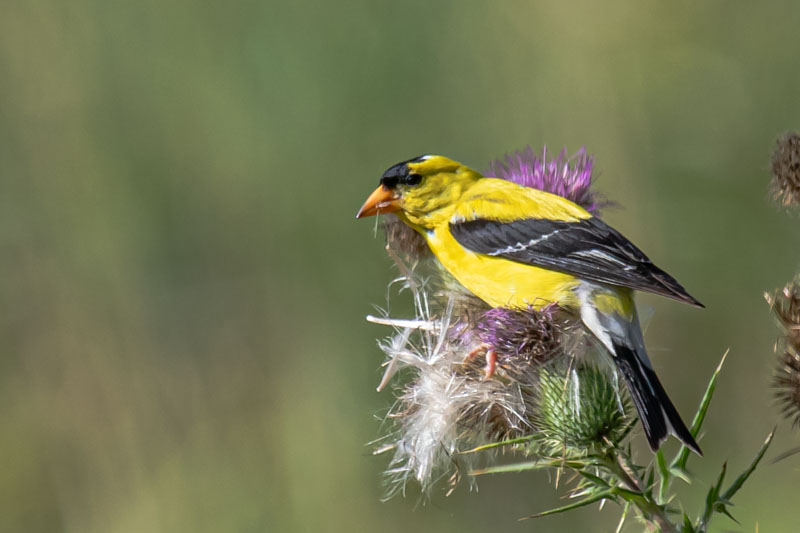
Thistle Feeding
A close view among thistle down and late-summer seed heads.
Camera: Canon EOS 5D Mark IV
Lens: EF100-400mm f/4.5-5.6L IS USM
Settings: ISO 800 • Aperture f/8.0 • Shutter 1/1250 s
E22A8444 • Size: 1400 x 933
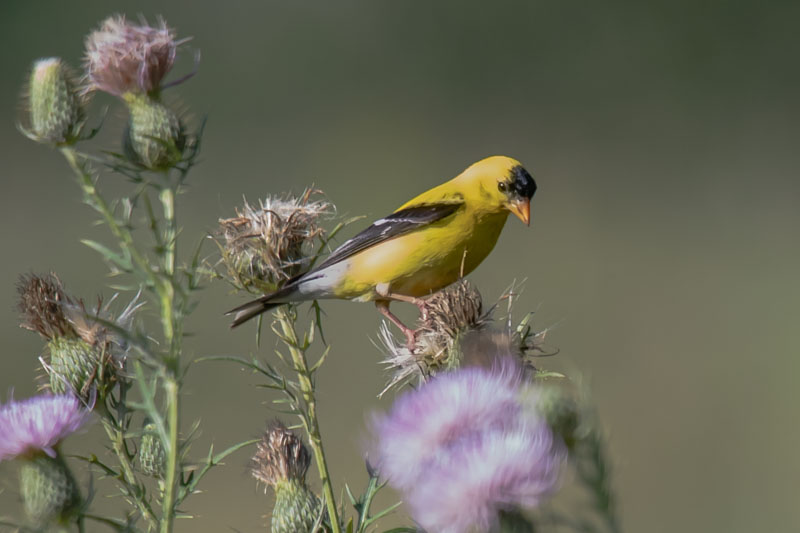
Among the Thistles
A feeding perch among late-summer seed heads.
Camera: Canon EOS 5D Mark IV
Lens: EF100-400mm f/4.5-5.6L IS USM
Settings: ISO 800 • Aperture f/8.0 • Shutter 1/640 s
E22A8377 • Size: 1600 x 1067
Flight Through the Thistles
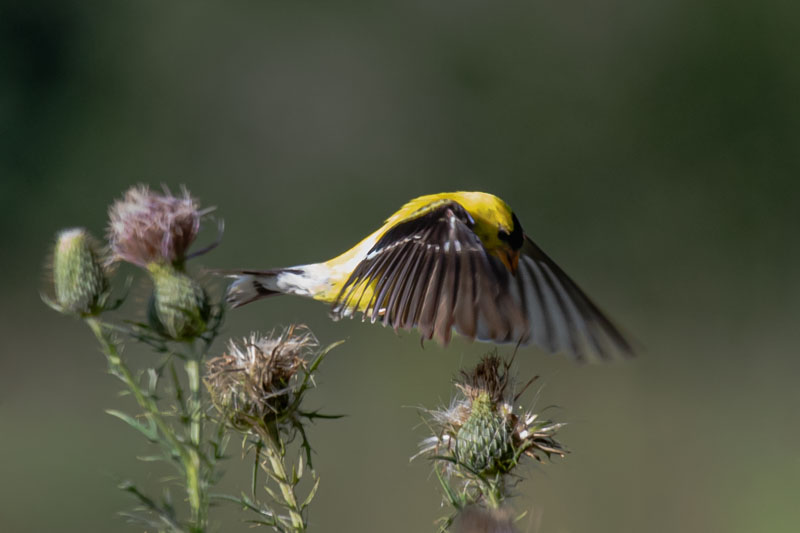
Leaving the Thistles
Wings spread between feeding stems.
Camera: Canon EOS 5D Mark IV
Lens: EF100-400mm f/4.5-5.6L IS USM
Settings: ISO 800 • Aperture f/8.0 • Shutter 1/640 s
E22A8374 • Size: 1600 x 1067
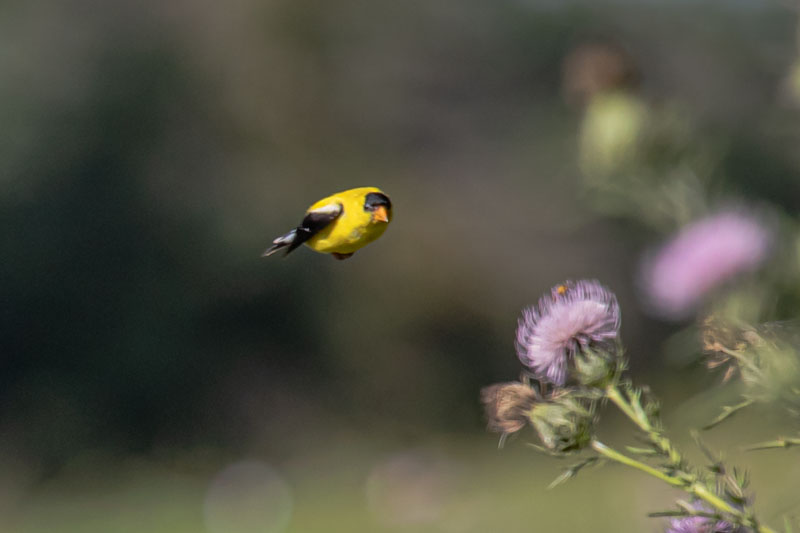
Between the Thistles
A short flight from one feeding stem to another.
Camera: Canon EOS 5D Mark IV
Lens: EF100-400mm f/4.5-5.6L IS USM
Settings: ISO 800 • Aperture f/8.0 • Shutter 1/640 s
E22A8381 • Size: 1600 x 1067
The same thistle patch becomes more dynamic when the bird takes flight.
American Goldfinches rarely seem to move in a straight, deliberate line. Their flight rises and falls, and within the thistle patch the movement becomes even more localized: a short crossing from one feeding stem to another before the bird settles again.
E22A8374 catches the strongest wing display of the sequence. The wings are spread broadly as the bird leaves one cluster of thistles, revealing feather structure that is normally hidden while perched.
E22A8381 captures another stage of that movement. The wings are more compact and the face remains clear, creating a connecting moment between departure and arrival.
E22A8389 places the flight within the broader habitat. The bird is smaller in the frame, surrounded by purple blooms and stems. A slightly wider crop proved important here. Rather than forcing the bird to dominate the photograph, the surrounding thistles give the flight somewhere to happen.
That photograph became less a portrait of a flying Goldfinch and more a photograph of a Goldfinch moving through a thistle patch.
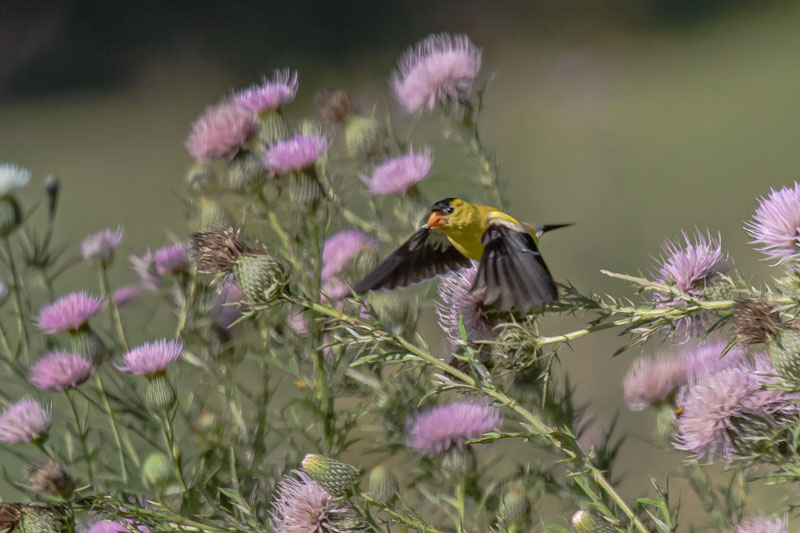
Through the Thistle Patch
Flight woven through a field of purple blooms.
Camera: Canon EOS 5D Mark IV
Lens: EF100-400mm f/4.5-5.6L IS USM
Settings: ISO 800 • Aperture f/8.0 • Shutter 1/640 s
E22A8389 • Size: 1600 x 1067
Among the Leaves
The earlier E21A3395 photograph offers a quieter counterpoint to the thistle sequence.
The bird is smaller in the frame, perched against a clean blue sky with a single vertical stem defining the composition. It lacks the immediacy of the closer portraits, but the negative space gives the photograph a simple, almost graphic quality.
Revisiting older photographs can change how they are understood. Images that once seemed limited by working distance may have strengths that are easier to recognize after the collection has grown.
In this case, the photograph succeeds less through detail than through simplicity.
Side Profile — Filtered Light
A quiet pause, framed by shifting light.
Camera: Canon EOS 5D Mark IV
Lens: EF100-400mm f/4.5-5.6L IS USM
Settings: ISO 800 • Aperture f/8.0 • Shutter 1/640 s
E21A3395 • Size: 1600 x 1067
Female American Goldfinch
E21A3396 records another side of the species.
Where the breeding male announces himself through vivid yellow and black, the female is far easier to lose among leaves and stems. Her quieter olive-yellow plumage blends into the vegetation, and much of the bird is screened by foliage.
The photograph is more documentary than the strongest male portraits, but its value within the collection is different. It broadens the visual record of the species and shows how dramatically visibility can change between the sexes.
Sometimes a photograph belongs on a species page not because it is one of the strongest compositions, but because it completes part of the story.
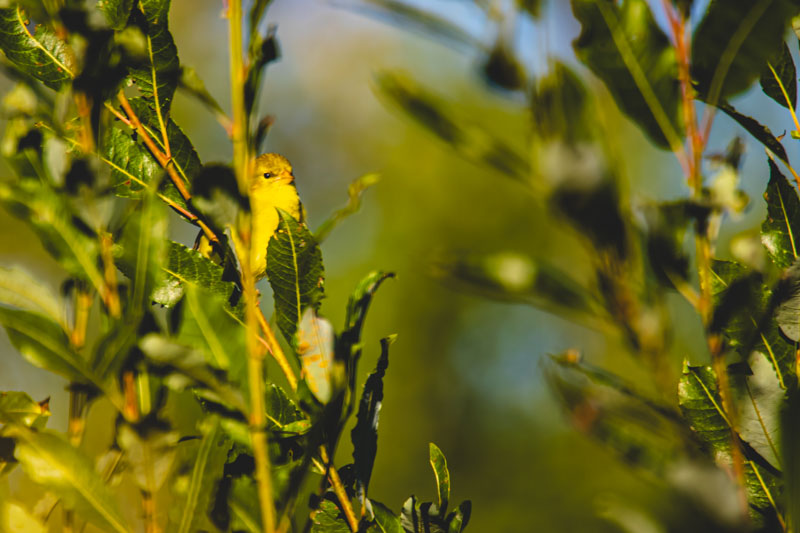
Female — Peeking Through Leaves
A cautious look from within the foliage.
Camera: Canon EOS 5D Mark IV
Lens: EF100-400mm f/4.5-5.6L IS USM
Settings: ISO 100 • Aperture f/8.0 • Shutter 1/320 s
E21A3396 • Size: 1600 x 1067
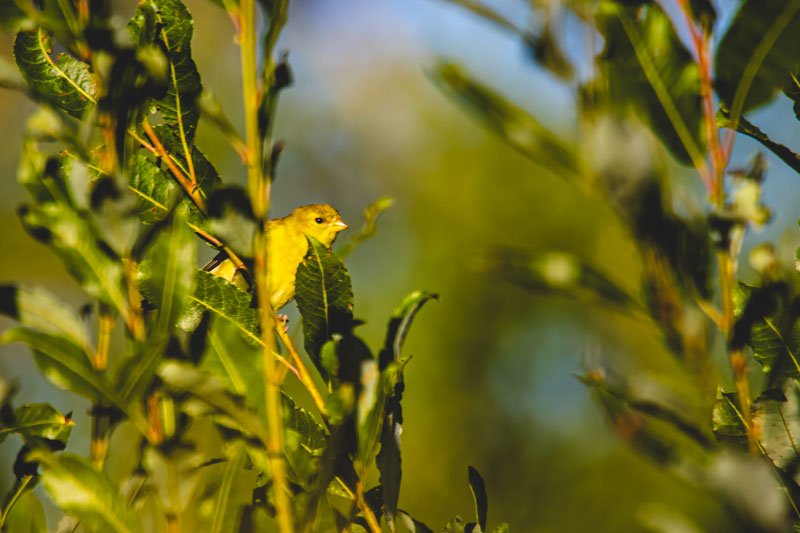
Female — Curious Glance
Head turned toward movement beyond the leaves.
Camera: Canon EOS 5D Mark IV
Lens: EF100-400mm f/4.5-5.6L IS USM
Settings: ISO 100 • Aperture f/8.0 • Shutter 1/320 s
E21A3397 • Size: 1600 x 1067
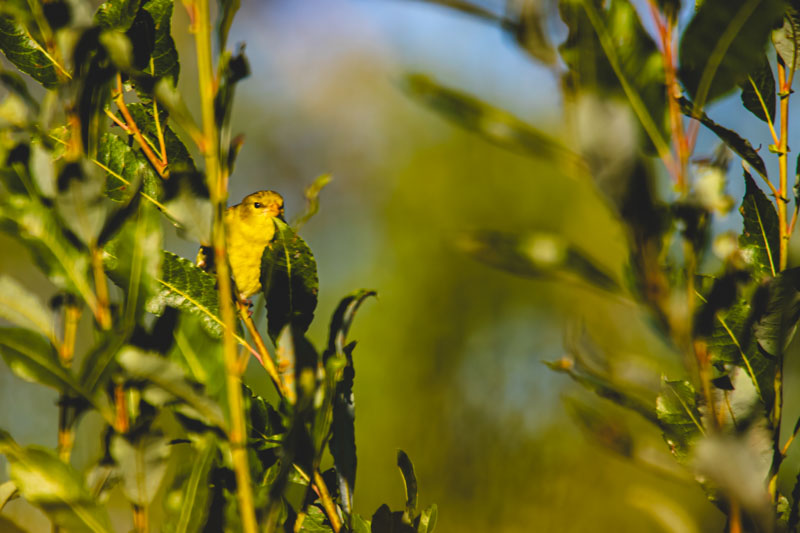
Female — Another Look
A second shift in attention from the same hidden perch.
Camera: Canon EOS 5D Mark IV
Lens: EF100-400mm f/4.5-5.6L IS USM
Settings: ISO 100 • Aperture f/8.0 • Shutter 1/320 s
E21A3398 • Size: 1600 x 1067
Photographer’s Perspective
The American Goldfinch page changed as the photographs accumulated.
The earliest images were primarily portraits and identification photographs. Later feeding frames added behavior. The thistle sequence added something more: a clear relationship between bird, food, movement, and habitat.
E22A2984 still works as a clean introduction to the species. E22A8377 and E22A8444 place the male directly within one of its characteristic late-summer feeding plants. E22A8374 provides the clearest wing display, while E22A8389 expands the scene and allows the thistle patch itself to become part of the photograph.
The result is less a ranked collection of individual photographs than a progression:
portrait → structure → feeding → habitat → movement
That progression is also why the photographs do not need to appear in order of rating. A gallery can tell a stronger story when each image contributes something different.