Sedge Wren
Cistothorus stellaris
Sedge Wrens are compact birds of wet meadows, sedge fields, and shallow marsh margins. Their short bill, finely streaked crown and back, barred wings and tail, and warm buff tones distinguish them from the plainer Northern House Wren. They usually remain low in dense vegetation, making a clear, open view especially rewarding.
For identification details and comparison with similar species, see the Cistothorus stellaris page in the Field Notes section.
Rain the previous day had left the grass thoroughly soaked. Several Sedge Wrens moved through the dense vegetation, repeatedly disappearing below the grass before rising briefly onto exposed stems. Their streaked upperparts, barred tails, and warm buff coloring blended readily into the wetland growth.
The bird in this sequence had just emerged from the thick grass onto a cluster of thorny branches. Its breast feathers were wet and separated, and it paused in the morning light to preen, rearrange its plumage, and dry above the vegetation.
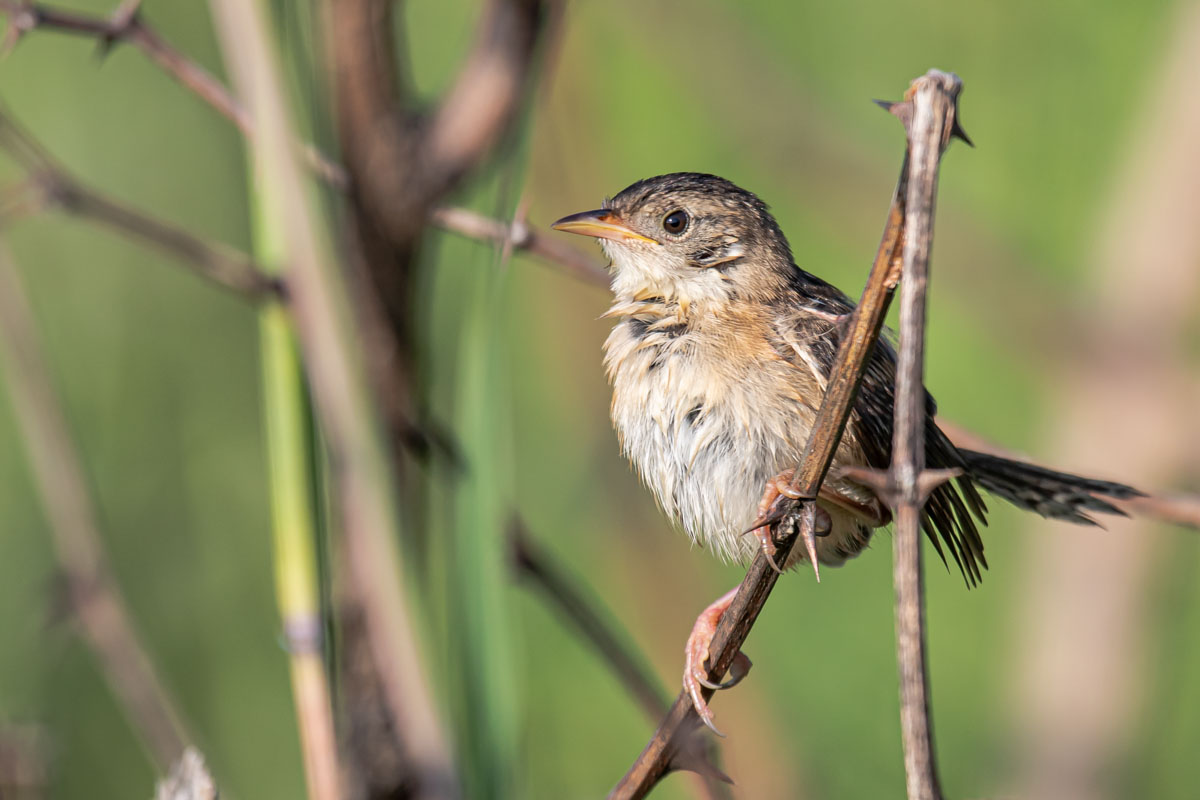
Morning Light in the Eye
Wet feathers, a clear amber eye, and a careful grip among the thorns.
Camera: Canon EOS 5D Mark IV
Lens: EF100-400mm f/4.5-5.6L IS USM
Settings: ISO 400 • Aperture f/8.0 • Shutter 1/640 s
E22A7833 • Size: 3600 x 2400
Overview
The bird first suggested a House Wren because the wet feathers softened its usual pattern and changed its outline. In the clearer side views, the finely streaked crown and back, barred tail, short bill, and warm flanks become easier to read. The low, dense wetland cover also fits Sedge Wren well.
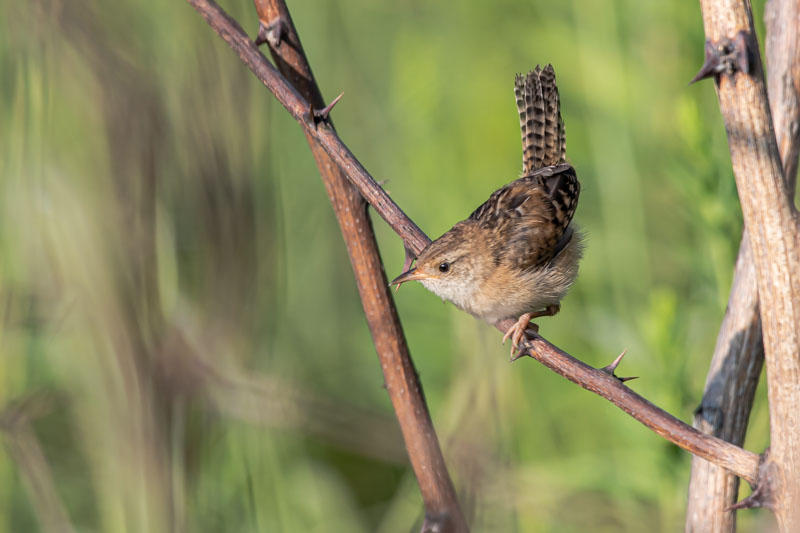
Poised Through the Thorns
A compact body leans forward while the barred tail rises behind.
Camera: Canon EOS 5D Mark IV
Lens: EF100-400mm f/4.5-5.6L IS USM
Settings: ISO 400 • Aperture f/8.0 • Shutter 1/640 s
E22A7838 • Size: 4300 x 2867
The sequence appears to show the bird grooming or drying its plumage in the morning sun. The breast and throat feathers remain clumped and uneven from frame to frame, while the posture shifts from a quiet pause to more active feather rearrangement.
Morning Grooming
The tighter portraits emphasize behavior and expression. One frame catches the throat feathers lifted and separated; another shows the bird nearly head-on, with the wet plumage giving it an unusually round and disheveled appearance.
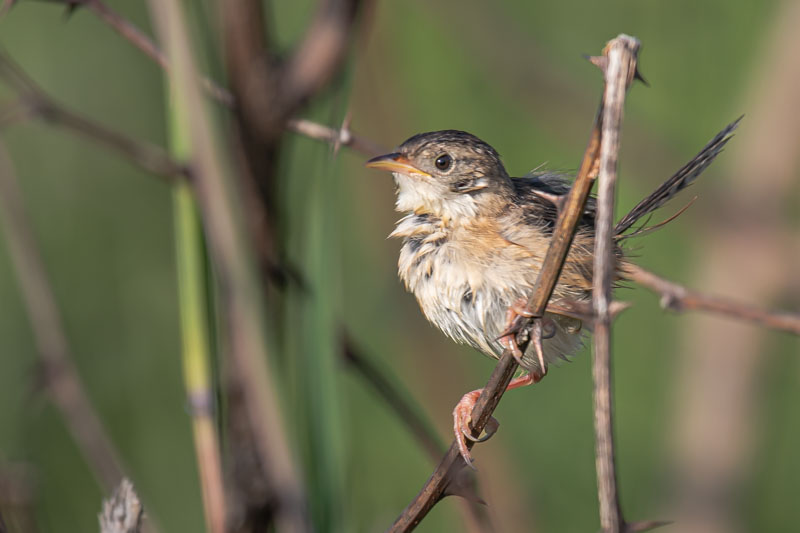
Drying in the Morning Light
Damp throat feathers lift as the bird pauses between movements.
Camera: Canon EOS 5D Mark IV
Lens: EF100-400mm f/4.5-5.6L IS USM
Settings: ISO 400 • Aperture f/8.0 • Shutter 1/640 s
E22A7832 • Size: 3600 x 2400
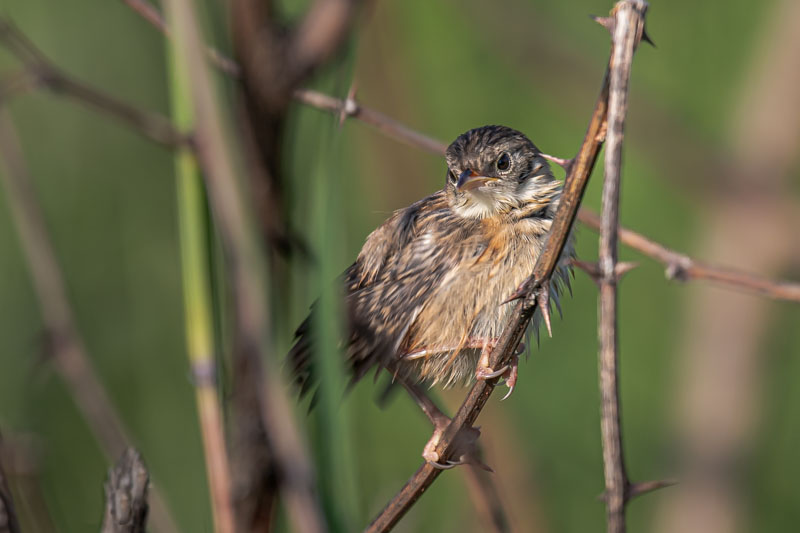
Morning Disarray
A front-facing pause reveals the full, rumpled texture of wet plumage.
Camera: Canon EOS 5D Mark IV
Lens: EF100-400mm f/4.5-5.6L IS USM
Settings: ISO 400 • Aperture f/8.0 • Shutter 1/640 s
E22A7831 • Size: 3600 x 2400
Pointing Wren
The downward-angled frame gives the sequence its strongest sense of direction. Head, back, and raised tail align toward the cover below, while the elevated viewpoint exposes the streaked crown, patterned back, barred wing, and narrow tail more clearly than the frontal portraits.
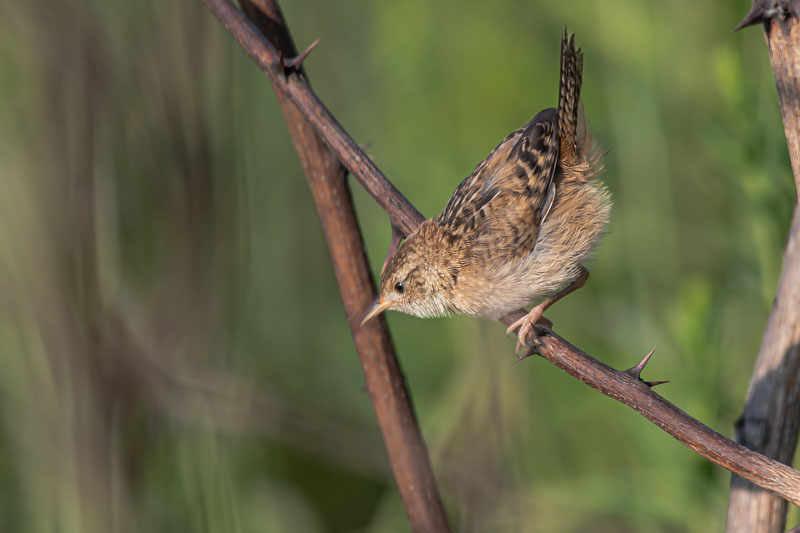
Pointing Wren
The whole body seems aimed toward the sheltering tangle below.
Camera: Canon EOS 5D Mark IV
Lens: EF100-400mm f/4.5-5.6L IS USM
Settings: ISO 400 • Aperture f/8.0 • Shutter 1/640 s
E22A7840 • Size: 3600 x 2400
Settling the Feathers
The remaining portraits complete the behavioral study. The plumage still looks damp, but the bird appears quieter and more composed as it watches the surrounding stems and prepares to move back into cover.
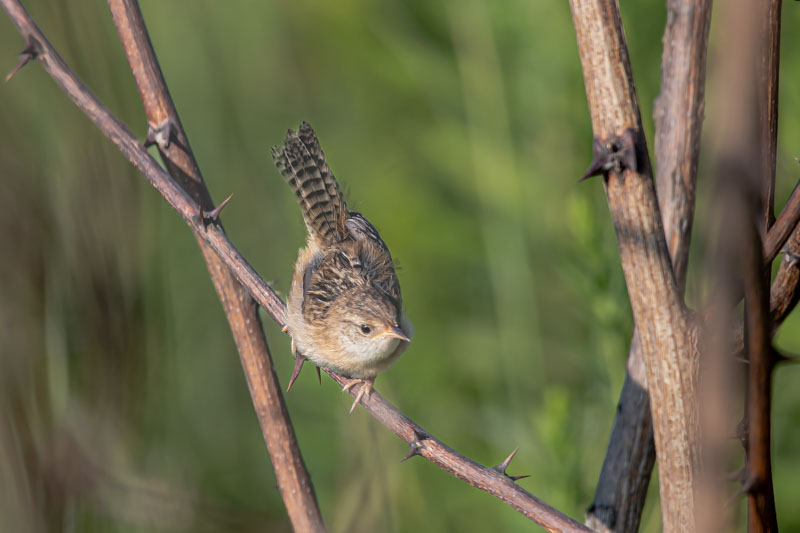
A Look Below
Head lowered and tail raised, the wren prepares to move through the stems.
Camera: Canon EOS 5D Mark IV
Lens: EF100-400mm f/4.5-5.6L IS USM
Settings: ISO 400 • Aperture f/8.0 • Shutter 1/640 s
E22A7836 • Size: 4300 x 2867
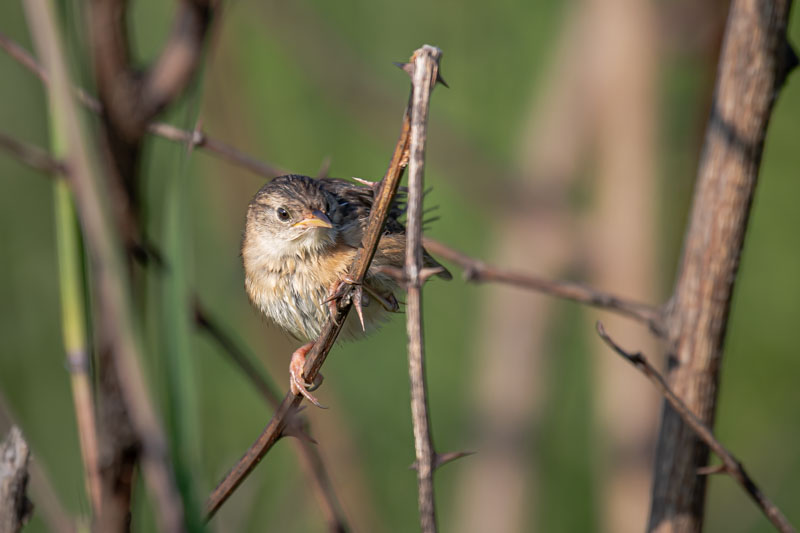
Between the Thorns
The breast remains damp, but the posture has begun to settle.
Camera: Canon EOS 5D Mark IV
Lens: EF100-400mm f/4.5-5.6L IS USM
Settings: ISO 400 • Aperture f/8.0 • Shutter 1/640 s
E22A7835 • Size: 4300 x 2867
Photographer’s Perspective
I had been following an Indigo Bunting that kept increasing the distance each time I drew nearer. After only a few minutes, my pants were soaked from moving through grass still wet from the previous day’s rain.
Several Sedge Wrens were active nearby, but they repeatedly submerged themselves in the dense grass and disappeared from view. This bird finally flew up to the thorny branches, its plumage visibly wet from moving through the vegetation. It remained exposed long enough to produce a short sequence of grooming, drying, and alert postures in the morning light.
E22A7833 is the strongest detailed portrait, especially through the eye, bill, feet, and separated breast feathers. E22A7838 and E22A7840 provide the most animated poses, with the raised tail and forward-leaning posture recalling the earlier photograph titled "Pointing Sparrow".
Together, the seven frames work as a short natural-history sequence: a wet Sedge Wren pauses among thorny stems, rearranges and dries its feathers, then leans back toward the dense cover where the species usually remains hidden.