Celastrus scandens
American Bittersweet is a hardy, native climbing vine known for its striking late-season fruit. For identification, habitat, and natural-history details, see the Celastrus scandens species page.
The tangled stems are both the challenge and the character of this subject. Earlier photographs concentrated on the brilliant opened fruit and twisting woody vines of late autumn. A newly discovered group of vigorous vines now provides an opportunity to follow American Bittersweet through a broader seasonal cycle. E22A9338, E22A9341, and E22A9337 begin that study in late summer, when the capsules have turned orange and the first leaves are yellowing while the surrounding landscape remains predominantly green. Later photographs follow the capsules as they open to expose scarlet arils and, eventually, persist among bare and frost-covered stems.
In autumn, its orange capsules open to reveal scarlet arils surrounding the seeds. The colorful fruit can persist well into winter, providing important color — and wildlife forage — when the landscape becomes subdued. It climbs by twining around nearby stems and branches, sometimes forming dense, sculptural tangles. Unlike the invasive Oriental Bittersweet (Celastrus orbiculatus), the American species typically bears fruit at the tips of the vines rather than along the entire stem.
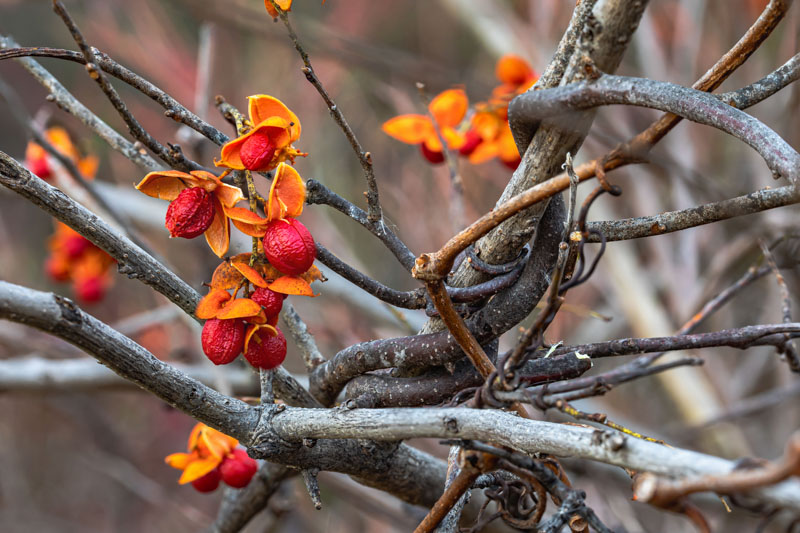
Autumn Capsules & Twisting Vines
Bright scarlet arils emerge from split golden capsules while the vine spirals tightly around its host.
The fruits hang in clusters beside the pond’s edge, a site also shared with Virginia Creeper.
Camera: Canon EOS 5D Mark IV
Lens: EF100mm f/2.8L Macro IS USM
Settings: ISO 200 • Aperture f/13.0 • Shutter 0.5 s
E21A7415-7418 • Size: 5857 x 3903
The vine is already showing the change of seasons while much of the surrounding vegetation remains green. Yellow leaves frame a compact cluster of orange fruit, the capsules still closed before opening to reveal the scarlet arils within. This late-summer stage offers a brief transition between the leafy growth of summer and the brilliant fruit display that will persist after the foliage has fallen.
The Bittersweet of Late-Summer
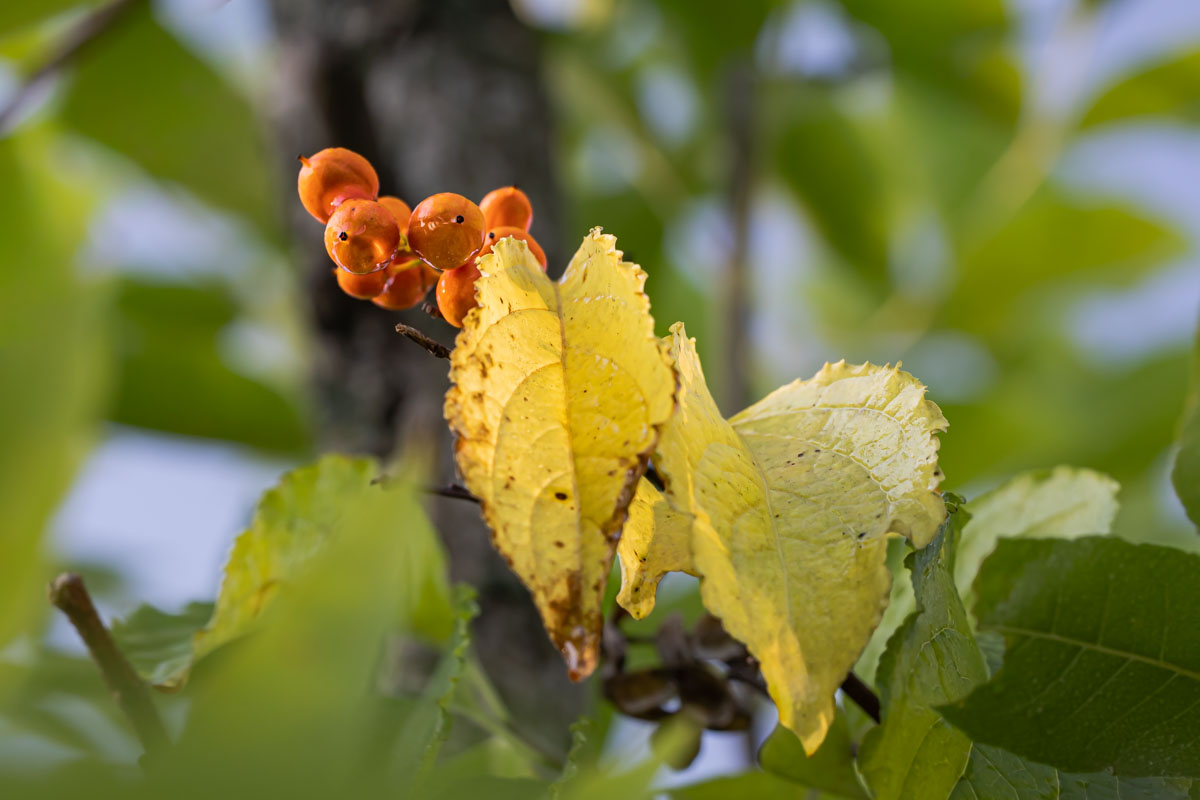 Orange fruit and yellow foliage bring the vine into one of its most distinctive seasonal stages.
Camera: Canon EOS 5D Mark IV
Orange fruit and yellow foliage bring the vine into one of its most distinctive seasonal stages.
Camera: Canon EOS 5D Mark IV
Lens: EF100mm f/2.8L Macro IS USM
Settings: ISO 640 • Aperture f/7.1 • Shutter 1/60 s
E22A9338 • Size: 5400 x 3600
First Signs of Autumn
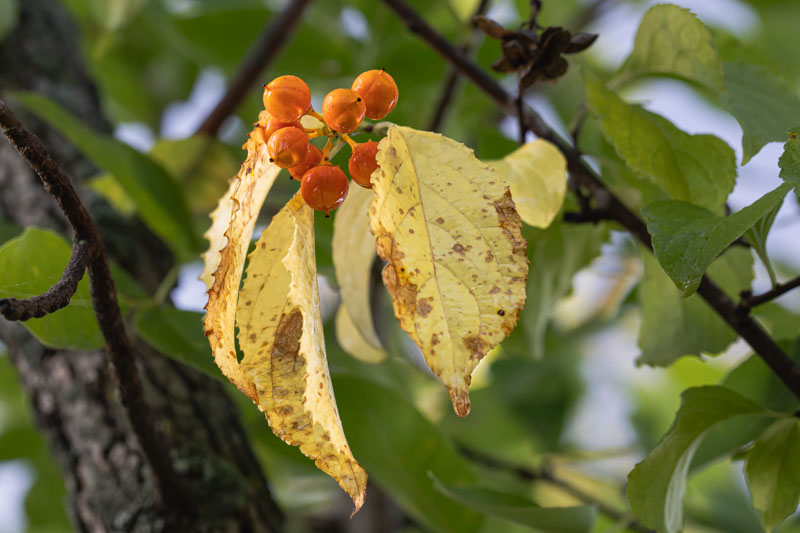 Orange capsules and pendant yellow leaves announce the coming season while summer green still surrounds the vine.
Camera: Canon EOS 5D Mark IV
Orange capsules and pendant yellow leaves announce the coming season while summer green still surrounds the vine.
Camera: Canon EOS 5D Mark IV
Lens: EF100mm f/2.8L Macro IS USM
Settings: ISO 640 • Aperture f/7.1 • Shutter 1/60 s
E22A9341 • Size: 5800 x 3867
The bittersweet is already turning toward autumn while the vegetation around it remains largely green. A compact cluster of orange capsules hangs among pendant yellow leaves, making the vine increasingly conspicuous within the surrounding tangle of stems and foliage. The contrast captures an early seasonal change, when autumn has begun to show itself without yet overtaking the landscape.
At Summer’s Edge
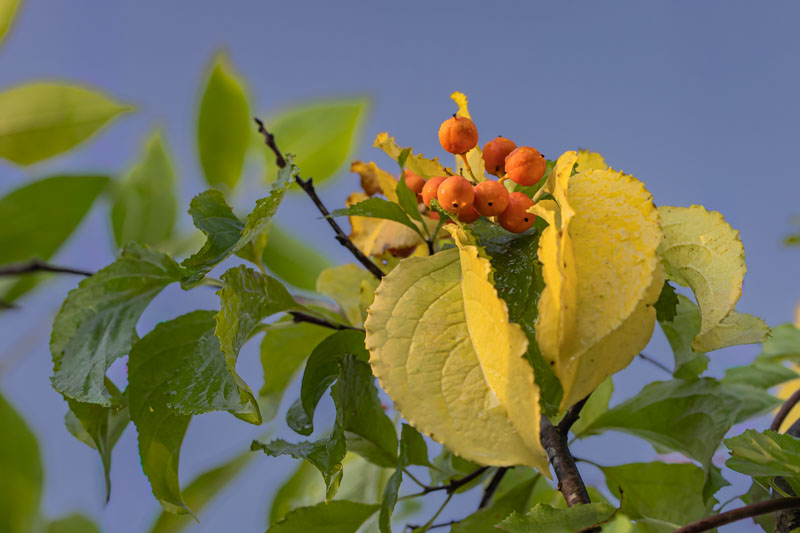 High above the trail, ripening bittersweet reaches toward open sky as the first yellow leaves interrupt the summer canopy.
Camera: Canon EOS 5D Mark IV
Lens: EF100mm f/2.8L Macro IS USM
Settings: ISO 640 • Aperture f/7.1 • Shutter 1/60 s
E22A9337 • Size: 5300 x 3533
Seen from below, the bittersweet climbs high above the trail, carrying clusters of ripening orange capsules into the surrounding canopy. Yellow leaves have begun to stand apart from the summer green, while an opening of blue sky emphasizes the vine’s height and vigorous growth. At the edge of meadow and woods, the scene captures a landscape still dominated by summer with the first signs of autumn already overhead.
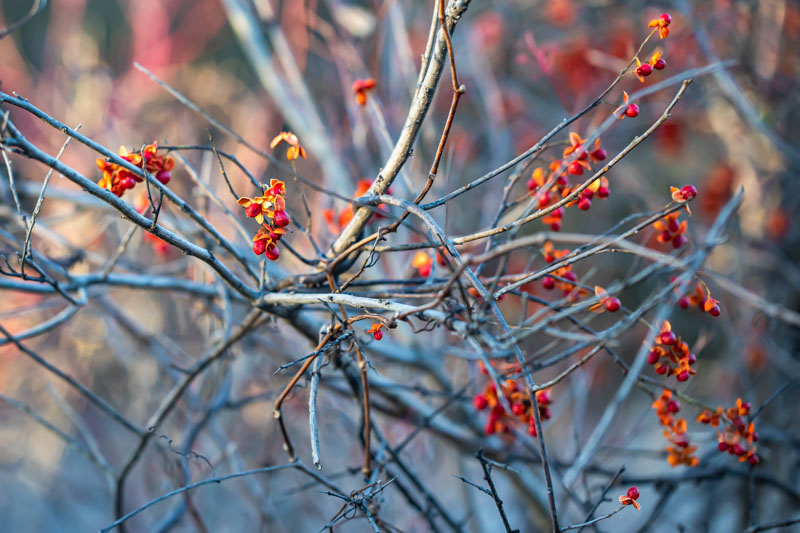
American Bittersweet in November Light
Orange husks split to reveal bright red arils glowing against bare gray vines.
Clusters of fruit hang along twisting stems as the surrounding thicket fades toward winter.
Camera: Canon EOS 5D Mark IV
Lens: EF100mm f/2.8L Macro IS USM
Settings: ISO 10000 • Aperture f/6.3 • Shutter 1/160 s
E21A7383 • Size: 5077 x 3385
Habitat: Woodland edges, thickets, fence lines, and upland shrub communities across the Upper Midwest
Leaves: Oval, finely toothed, turning yellow before dropping in fall
Stems: Woody, twining vine that climbs by wrapping — not by tendrils
Fruit: Orange capsules that split into three sections, exposing glossy red arils in late autumn
Color: Yellow foliage, orange husks, and red fruit — most vibrant after leaf drop
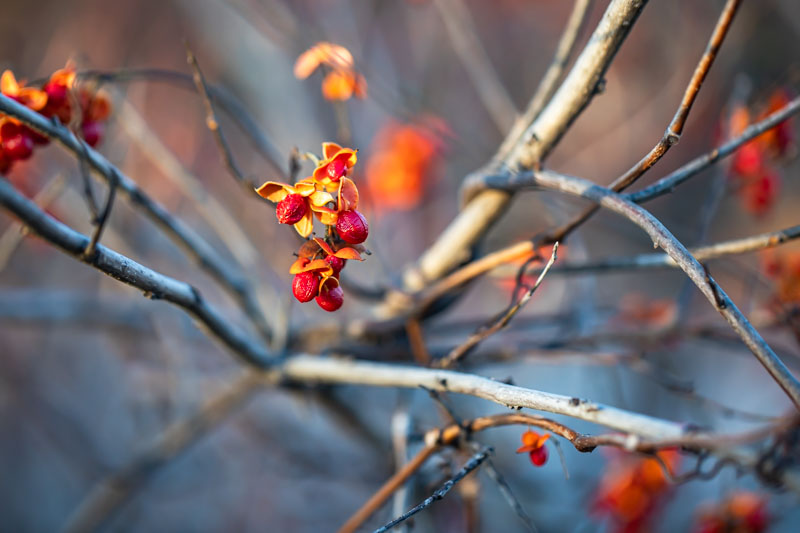
Lanterns in the Tangle
The leathery orange shells curl back to reveal textured red arils.
These late-autumn clusters catch soft morning light, emphasizing their contrast against winter-gray branches.
Camera: Canon EOS 5D Mark IV
Lens: EF100mm f/2.8L Macro IS USM
Settings: ISO 10000 • Aperture f/6.3 • Shutter 1/640 s
E21A7386 • Size: 5277 x 3518
A final burst of color as the woods go quiet — the vine’s lanterns glowing through the first cold mornings.
References
- Minnesota Wildflowers — Celastrus scandens
- USDA Field Guide to Native Vines
- Personal field notes, Lakeville, MN (2025)
Related Pages: