American Bittersweet
Celastrus scandens

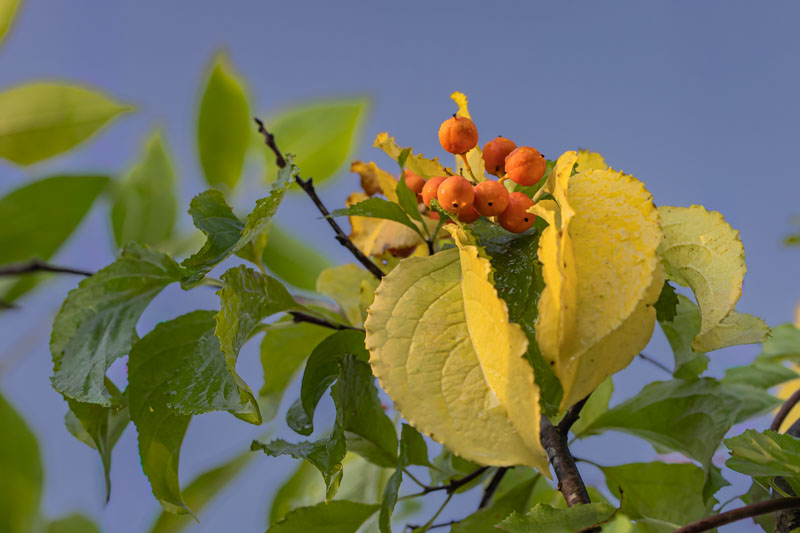
American Bittersweet becomes most conspicuous after leaf fall, when its hunter-orange capsules split open to expose glossy scarlet arils. Against the subdued gray and brown framework of a late-autumn thicket, the fruit appears almost lantern-like.

For identification details and comparison with similar bittersweet, see Celastrus scandens in the Field Notes section.

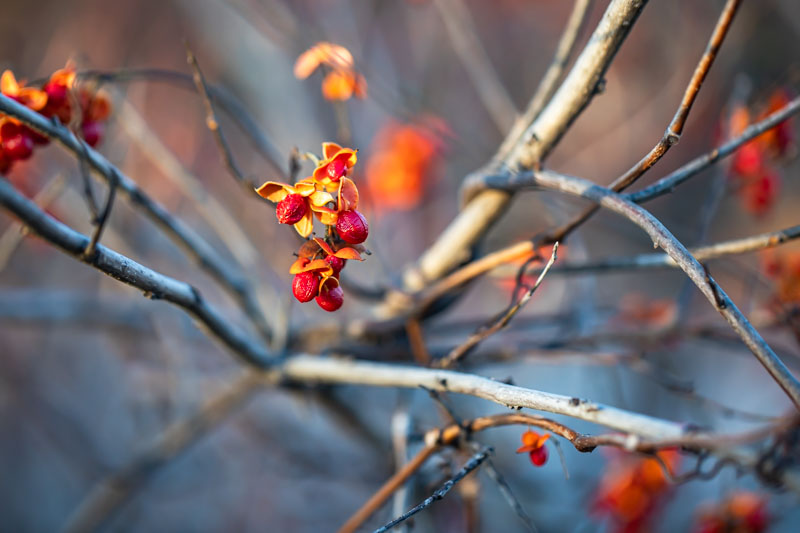
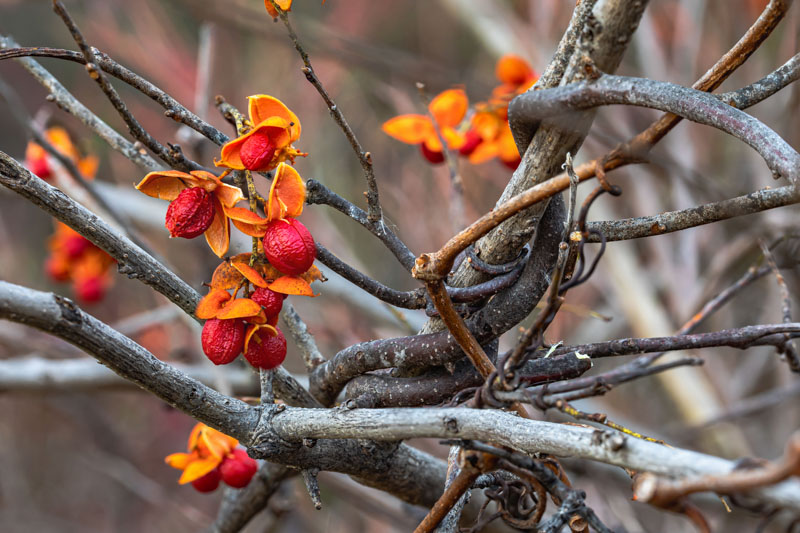
Cluster of American Bittersweet fruit with orange capsules curled around red arils against a softly blurred tangle of vines.

Bittersweet Capsules Opening
Leathery orange shells curl back from a concentrated cluster of scarlet arils, isolated against the soft colors of the surrounding thicket.
Camera: Canon EOS 5D Mark IV
Lens: EF100mm f/2.8L Macro IS USM
Settings: ISO 10000 • Aperture f/6.3 • Shutter 1/640 s
E21A7377 • Size: 5277 x 3518

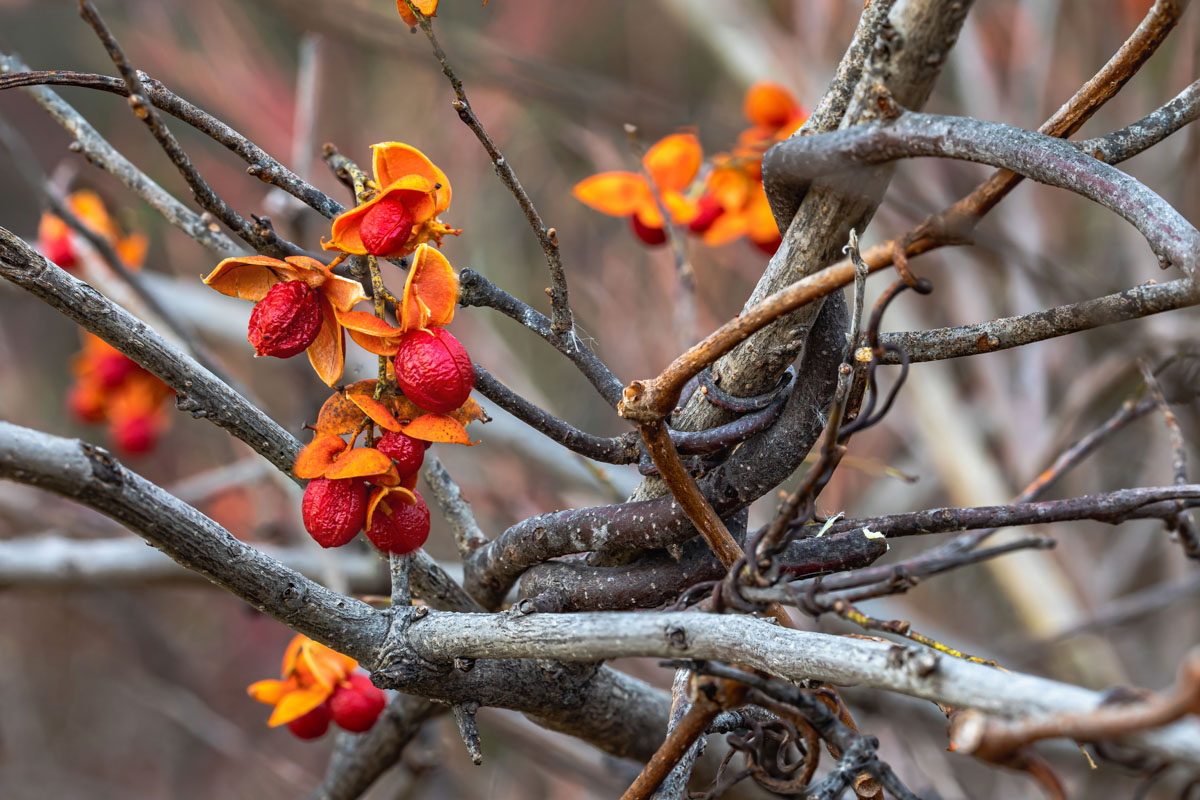
Focus-stacked American Bittersweet fruit beside thick twisting vines and interwoven gray branches.

Autumn Capsules & Twisting Vines
Bright scarlet arils emerge from split golden-orange capsules while the vine spirals tightly through its host branches.
Focus stack: E21A7415-E21A7418
Camera: Canon EOS 5D Mark IV
Lens: EF100mm f/2.8L Macro IS USM
Settings: ISO 200 • Aperture f/13.0 • Shutter 0.5 s
E21A7415-7418 • Size: 5857 x 3903


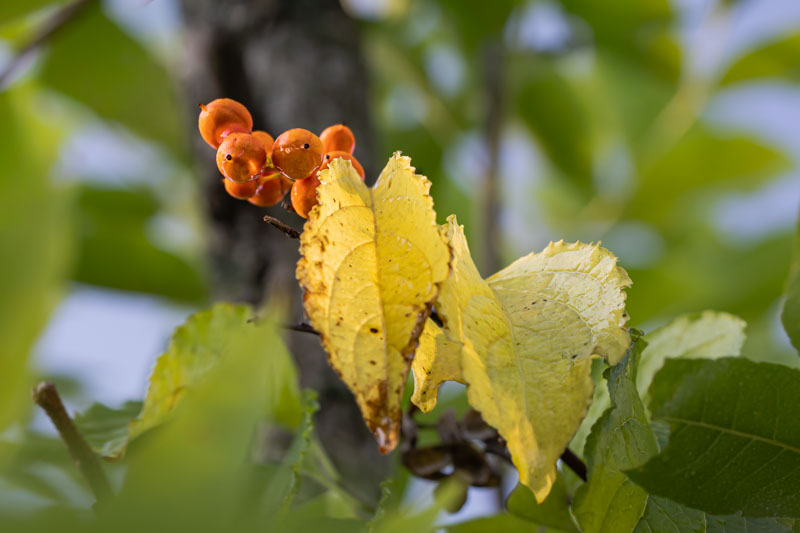
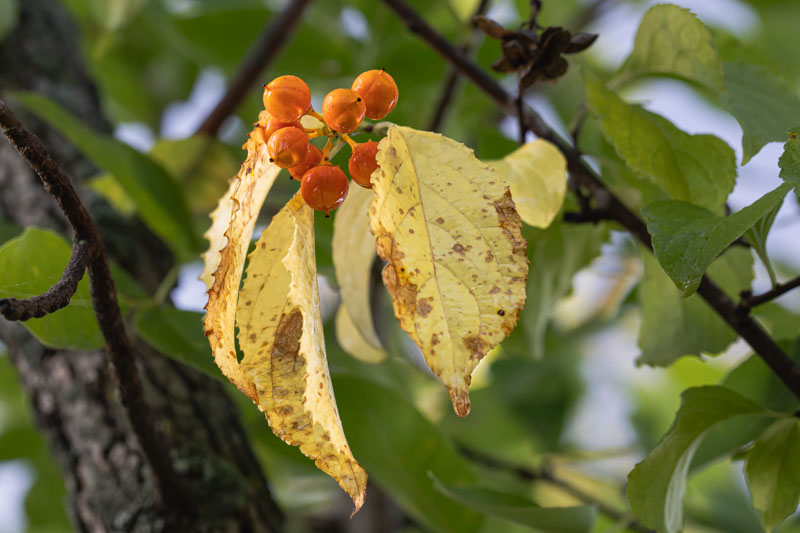
American Bittersweet is a native woody vine that climbs by twining around nearby stems and branches, rather than by producing tendrils. Its finely toothed oval leaves turn yellow before falling. The fruit consists of three-part orange capsules that open in late autumn to reveal red arils surrounding the seeds.

Fruit placement is also an important identification clue. American Bittersweet usually concentrates its fruit in terminal clusters near the ends of the stems. The invasive Round Leaf Bittersweet (Celastrus orbiculatus), also called Oriental Bittersweet, more often bears smaller fruit clusters at the leaf axils along the vine.


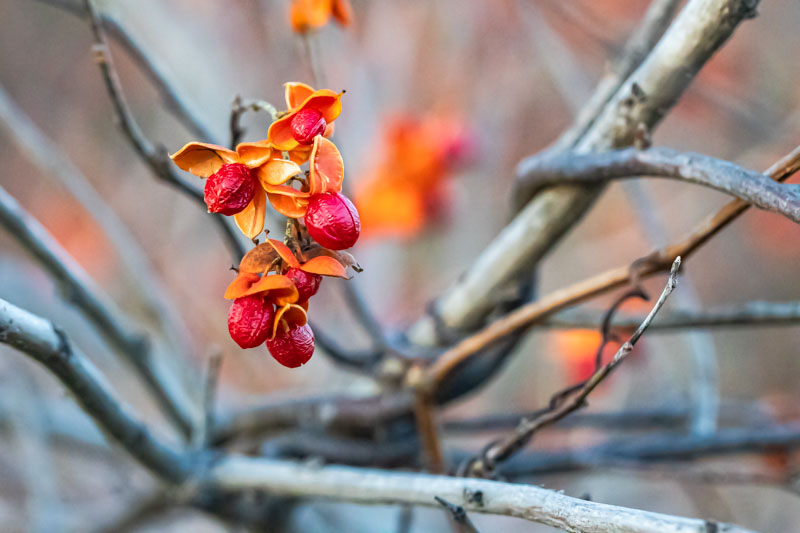
A small fruit cluster glows within looping stems, while distant orange capsules repeat softly through the background.


Small cluster of American Bittersweet fruit framed by looping gray vines in soft November light.

Lanterns in the Tangle
Camera: Canon EOS 5D Mark IV
Lens: EF100mm f/2.8L Macro IS USM
Settings: ISO 500 • Aperture f/3.2 • Shutter 1/200 s
E21A7386 • Size: 6720 x 4480

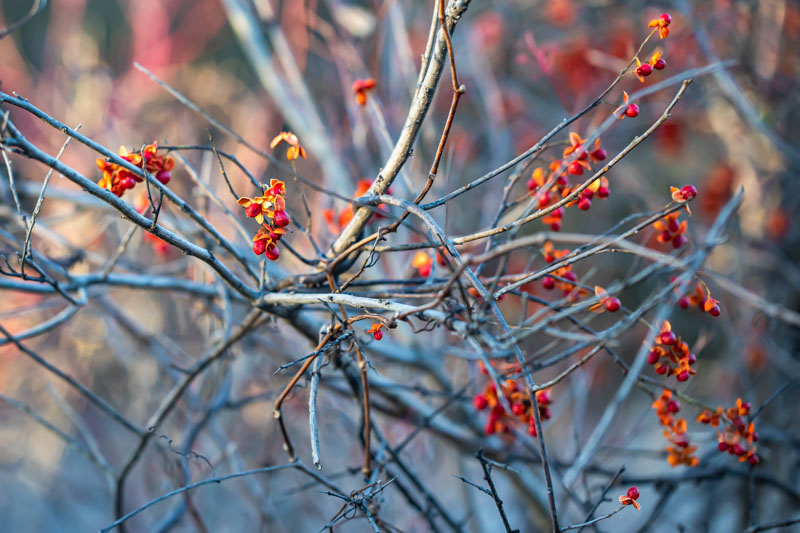
Scattered clusters carry the bittersweet color across the bare vine network as the surrounding vegetation settles toward winter.


Wide view of American Bittersweet fruit scattered through a dense tangle of bare vines and branches.

November Thicket
Camera: Canon EOS 5D Mark IV
Lens: EF100mm f/2.8L Macro IS USM
Settings: ISO 500 • Aperture f/3.2 • Shutter 1/200 s
E21A7383 • Size: 5077 x 3385

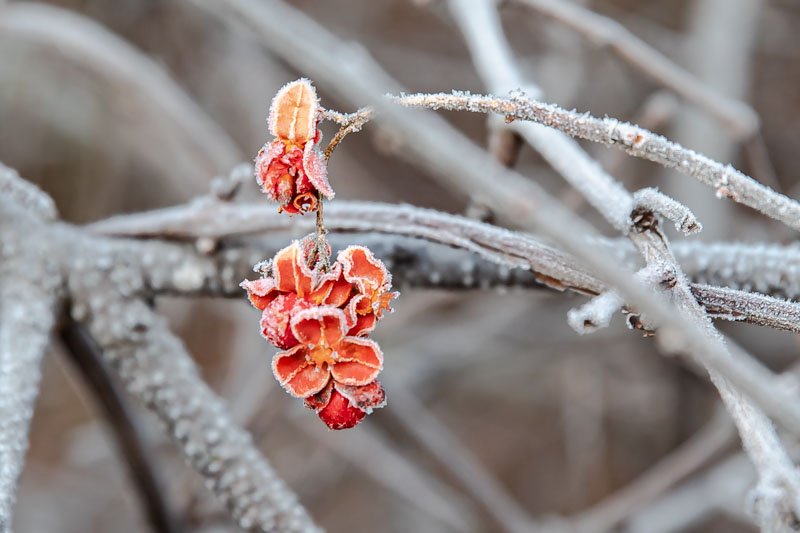
Frost-coated empty American Bittersweet capsules hanging among pale, ice-edged branches.

After the Arils Are Gone
December frost traces the empty capsules after their bright red arils and seeds have disappeared.
Camera: Canon EOS 5D Mark IV
Lens: EF24-70mm f/2.8L II USM
Settings: ISO 200 • Aperture f/4.0 • Shutter 1/13 s
D79A3117 • Size: 2700 x 1800


Photographer's Perspective

The tangled stems are both the challenge and the character of this subject. The hunter-orange capsules were what first drew me to the vine. E21A7377 provides the cleanest portrait, separating one vivid cluster from the background. E21A7415-7418 turns the complexity into a close structural study, where the fruit, coiling vine, and host branches all remain visible. E21A7386 steps back into a quieter environmental portrait, while E21A7383 broadens the view to show how the orange and red fruit is distributed through the larger thicket. D79A3117 closes the sequence in frost, after the arils and seeds have disappeared and only the curled capsules remain.

A final burst of color as the woods go quiet—the vine's lanterns glowing through the first cold mornings.


References

Related: Vines